My father's voice was still coming through the phone when the sheriff's cruiser rolled farther up the gravel drive. I watched it on the security feed from my bedroom, one hand gripping the edge of the laptop, the other still holding the phone to my ear.
“Open the door, Claire,” Dad repeated. His anger had changed shape. A minute earlier it had filled every word. Now there was something tighter underneath it.
Fear.
I had heard that tone before, usually when Dad realized a situation was no longer responding to volume. When I was twelve, it had been the tone he used after breaking a neighbor's fence with his truck. When Kyle wrecked his first car, Dad had used it at the insurance office. It was the voice of a man accustomed to discovering that consequences were negotiable if he spoke firmly enough.
This time, there was nowhere for him to negotiate.
“Dad,” I said, “the deputy is there. Tell everyone to leave.”
“You called the sheriff on your own parents?”
“I told you no before anyone came.”
“You're making this criminal.”
“No. You arrived after I told you not to.”
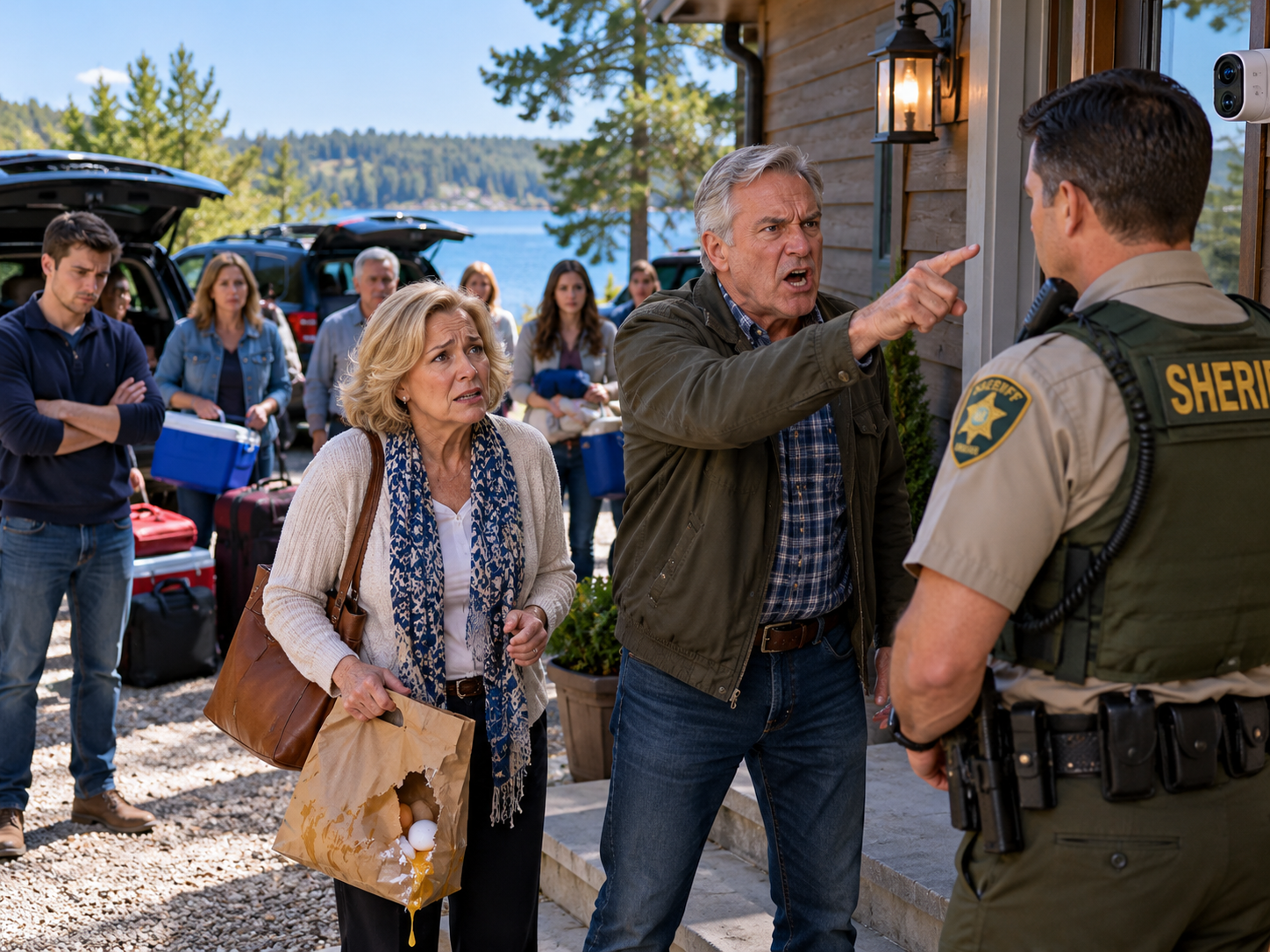
On the screen, Deputy Miles stepped out of the cruiser and closed his door. He did not hurry. He looked at the vehicles first, then the twenty people clustered around my porch, then the bags of groceries and coolers scattered across the wooden steps.
My father walked toward him.
I switched the audio to the exterior microphone.
“Morning,” the deputy said. “Can I ask what's happening here?”
Dad pointed toward the house.
“This is my daughter's property. She's locked us out.”
Deputy Miles glanced at the camera mounted above the front door.
“Does she live here?”
“No. She lives in Portland.”
“Who owns the property?”
Dad hesitated.
“My daughter.”
The deputy looked at him for a moment.
“And did she invite you?”
“She is family.”
“That wasn't my question.”
Dad's jaw tightened.
Behind him, one of my aunts shifted uncomfortably. Kyle stood beside a rented SUV with his arms folded, suddenly fascinated by the gravel beneath his shoes.
Mom stepped forward.
“She is upset. She's exhausted from work. Claire has always been dramatic when she's tired.”
I pressed the intercom.
“Deputy Miles, this is Claire Bennett. I'm the owner. I have written records showing that no one has permission to enter the property this weekend.”
The deputy looked toward the camera.
“Understood.”
Mom's face changed.
“Claire, enough.”
“No.”
“Everyone drove here.”
“I know.”
“We bought food.”
“I know.”
“Your aunt took the day off.”
“I know.”
She stared at the camera as though she could somehow see me through it.
“You would really make twenty people turn around?”
“Yes.”
The answer was so simple that even I felt the weight of it.
For years, I had been trained to soften every refusal until it became an invitation to negotiate.
Not this time.
Deputy Miles asked everyone to gather their belongings and return to their vehicles. He explained that without the owner's permission, they had no right to remain on the property.
My father argued.
The deputy listened.
Dad insisted that this was a family matter.
The deputy told him family relationships did not transfer property rights.
Mom said I was humiliating them.
The deputy did not answer that.
One by one, the guests began collecting their things.
A cooler disappeared into the back of an SUV.
Someone picked up the bags of groceries.
A folding chair scraped against the porch boards.
The entire weekend they had planned was collapsing into an awkward procession of people carrying potato chips, towels, sleeping bags, and cases of bottled water back to their vehicles.
I watched silently.
There was no satisfaction in it.
Mostly, I felt tired.
My father remained on the porch.
He looked up toward the camera.
“Claire.”
I answered.
“Are you really doing this?”
“I already did.”
“You're choosing a building over your family.”
“No,” I said. “I'm choosing a boundary.”
He stared at the camera.
For a moment, neither of us spoke.
Then he turned and walked away.
Mom was the last to leave.
She stood beside her car, one grocery bag still hanging from her hand. A carton of eggs had broken inside it. I could see the yellow spreading through the paper.
She looked toward the house.
Then toward the camera.
Her expression was no longer angry.
It was wounded.
I knew that look.
It had worked on me since childhood.
I almost opened the door.
Almost.
Then I remembered the message she had sent the night before.
You really think you can stop us?
So I stayed inside.
Mrs. Harper crossed the road after the last SUV disappeared.
She knocked on the front door.
I opened it.
“You all right?”
“I think so.”
She glanced down the driveway.
“Twenty people is a lot of people to discover a locked door.”
“I didn't lock them out to punish them.”
“I know.”
She looked at me carefully.
“You locked the door because you meant no.”
I nodded.
She smiled.
“Good.”
I closed the door behind her.
For the first time since the phone started buzzing the night before, the house was quiet.
I walked through every room.
The kitchen was untouched.
The beds were made.
The refrigerator contained exactly what I had left there.
The lake outside the windows was calm, reflecting a pale strip of morning sky.
My parents had spent years treating this place as if my ownership were temporary and their access permanent.
But the deed was in my name.
The mortgage was in my name.
The taxes were in my name.
The repairs were in my name.
The exhaustion that had paid for it had been mine too.
I made coffee.
Then I opened my laptop.
There were already forty-three new messages.
The family group chat had become a battlefield.
Aunt Linda wrote that she had never been treated so badly.
Uncle Ray asked whether the house had always been mine.
Kyle said everyone was overreacting.
Mom wrote that she was devastated by the way I had treated my own family.
Dad said nothing.
That silence worried me more than his shouting.
I scrolled through the messages.
No one asked why I had said no.
No one asked whether they should have come.
They were discussing my refusal as if it were an unfortunate weather event.
I typed a response.
Then deleted it.
Typed another.
Deleted that too.
Finally, I wrote only the truth.
I told everyone yesterday that the lake house was not available. I was not asked before plans were made. I did not consent to twenty people staying there. I changed the locks because I had already experienced unauthorized use of the property. I will not discuss this further in the group chat.
I sent it.
Then I muted the conversation.
My phone rang.
Dad.
I let it ring.
It stopped.
Then started again.
I ignored it.
A third time.
Still nothing.
Then a voicemail arrived.
I played it.
His voice was quieter.
“Claire, call me when you stop being stubborn.”
I almost laughed.
Even after the sheriff had removed them, he still thought the problem was my attitude.
I deleted the voicemail.
An hour later, the locksmith called.
“The new deadbolt is installed,” he said. “The garage access has been reset too.”
“Thank you.”
“You might want to change the emergency contact list.”
“I already did.”
“Good.”
After the call ended, I sat at the kitchen table.
I realized my hands were shaking.
Not because I was afraid of my parents.
Because saying no had cost more than I expected.
It had cost me the comforting illusion that if I explained myself carefully enough, they would eventually understand.
Maybe they never would.
That afternoon, I drove back toward Portland.
I stopped at a gas station halfway there.
My phone showed seven missed calls.
One from Dad.
Two from Mom.
One from Kyle.
Three from numbers I didn't recognize.
I put the phone facedown.
Then I noticed an email notification.
It was from the sheriff's office.
Subject: Incident Documentation — Lake Property.
I opened it.
The report confirmed what had happened.
No one had entered the house.
No damage had been reported.
The responding deputy had advised the group to leave after confirming that I had denied permission.
I read it twice.
Then I saved the file.
I did not know yet how important that document would become.
But I knew one thing.
The weekend had not ended with the sheriff.
It had only exposed what my family had been willing to do when they believed my no would never matter.
Click here to continue reading: PART 2: After the Sheriff Sent Everyone Home, My Family Stopped Pretending the Lake House Was the Real Problem and Started Demanding the Price They Thought I Owed Them
Twenty People Arrived Expecting a Welcome, but My Locked Door and One Quiet Phone Call Forced My Parents to Face a Problem They Had Never Expected
Part 1 of 20