The summer passed without another invasion.
That surprised me.
I had expected more arguments.
More relatives.
More accusations.
Instead, the family became quieter.
Some people stopped contacting me.
Others sent cautious messages.
Aunt Linda eventually apologized for repeating Mom's version without asking me what happened.
Uncle Ray never apologized, but he stopped mentioning the lake house.
Kyle called once.
He did not ask for money.
He asked whether we could talk.
I said yes.
We met at a coffee shop in Portland.
He looked uncomfortable.
“I didn't know you really said no.”
“I know.”
“Mom told us you agreed.”
“I know.”
“I should have asked you.”
“Yes.”
He looked down at his coffee.
“I was embarrassed.”
“I understand.”
“I thought you were just being difficult.”
“I know.”
He looked up.
“I was wrong.”
I nodded.
“I appreciate you saying that.”
He rubbed his thumb along the edge of the cup.
“Are you still mad at me?”
“Yes.”
He winced.
“But not forever.”
That made him smile.
“Fair.”
We did not hug.
We did not suddenly become best friends.
But when we left the coffee shop, the distance between us felt honest instead of forced.
That was enough.
My mother was slower.
She wanted to repair everything immediately.
I didn't let her.
We began with phone calls.
Then coffee.
Short meetings.
No discussion of the lake house unless I brought it up.
No requests for money.
No surprise visits.
She struggled with that.
Once, she said, “I don't know how to be your mother if I can't help.”
I told her, “You can listen.”
She looked at me for a long moment.
“I can do that.”
And she tried.
My father was different.
He did not apologize quickly.
He sent messages instead.
Sometimes they were ordinary.
How is work?
Did you get enough sleep?
How is the lake?
I answered some.
Ignored others.
Eventually, he sent a birthday card.
Inside was one sentence.
I am learning that being your father does not mean deciding for you.
I kept that card.
Not because it erased what happened.
It didn't.
But because it showed that the lesson had finally reached him.
By autumn, my relationship with Mom had become something I could actually recognize.
She came to the lake house once.
She asked before coming.
She arrived alone.
I met her at the gate.
She looked at the house.
“You changed the locks.”
“Yes.”
“Still?”
“Yes.”
She nodded.
“Good.”
I looked at her.
She smiled faintly.
“I mean it.”
That was the first time she had ever said something like that without adding a condition.
I let her inside.
She walked slowly through the rooms.
She did not open drawers.
She did not inspect closets.
She did not start planning meals.
She simply looked.
In the kitchen, she stopped.
“You bought these chairs?”
“Yes.”
“They're nice.”
“Thank you.”
She touched the back of one.
“I never realized how much work this place must have been.”
I did not answer.
She looked at me.
“I didn't.”
That was as close to an apology as she could manage that day.
I accepted it for what it was.
Not enough to erase everything.
Enough to acknowledge something real.
We sat on the porch.
The lake was calm.
After several minutes, Mom said, “I thought you were rejecting us.”
“I was rejecting what you were doing.”
She nodded.
“I understand the difference now.”
I looked at her.
“Do you?”
“Yes.”
She took a breath.
“I thought because we were your parents, you would always choose us.”
“I still choose you.”
She looked surprised.
“I just don't choose you instead of myself anymore.”
Her eyes filled.
“I wish I'd taught you that.”
“So do I.”
She smiled sadly.
“Maybe you can teach me now.”
I didn't promise.
But I stayed on the porch with her until sunset.
That was enough for that day.
Winter came.
Then spring.
My life became ordinary again.
I still worked at St. Mercy Medical Center.
The night shifts still left my feet aching.
I still drank too much coffee.
I still drove the same car.
I still escaped to the lake house whenever the hospital became too loud in my head.
The difference was that I no longer checked my phone every few minutes to see whether my family had decided what I should do next.
The lake house became quiet in the way I had always wanted.
Not lonely.
Quiet.
Mrs. Harper still watched the road.
She still called if an unfamiliar vehicle stopped too long.
Once, she called to tell me that my father had driven past.
“Did he stop?”
“No.”
“Okay.”
“He waved.”
I smiled.
“Did you wave back?”
“Of course.”
“That sounds like progress.”
“Don't get sentimental.”
She laughed.
The following summer, I sat on the dock at sunrise.
Juniper, the rescue dog I had adopted after everything happened, lay beside me with her head on my leg.
The lake was almost perfectly still.
My phone buzzed.
I looked at it.
A message from Mom.
Coffee next Saturday?
I replied.
Yes. Noon.
A second message appeared.
Thank you.
I put the phone away.
The word thank you did not feel like a trap.
That was new.
A week later, I met her at the diner halfway between Portland and the lake.
We talked for forty minutes.
She told me about a neighbor.
I told her about a patient who had finally gone home after a long hospitalization.
She asked about the house.
I said it was fine.
She did not ask whether the family could use it.
She did not ask about holidays.
She did not ask about Kyle's business.
When we left, she hugged me.
I hugged her back.
Then we went our separate ways.
That was our relationship now.
Not perfect.
Not repaired into something it had never been.
But real.
My father remained more distant.
He sent birthday cards.
One Christmas, he sent a small package with a new coffee mug.
There was no note.
I used it anyway.
Kyle eventually stabilized his business.
He stopped asking me for loans.
He paid back part of what he owed.
Then more.
The final payment arrived two years after the lake-house weekend.
He texted me afterward.
Debt cleared.
I replied:
Thank you.
He sent a thumbs-up.
That tiny exchange meant more than some family speeches I had heard in my childhood.
Because this time, a promise had been followed by an action.
I kept the sheriff's report.
I kept the attorney's letter.
I kept the messages proving that I had refused before they arrived.
But I no longer needed to read them.
They were records.
Not weapons.
The deed remained in the desk drawer.
My name remained on it.
The locks remained changed.
The alarm remained active.
The house remained mine.
But eventually I understood something else.
The real thing I had taken back was not the property.
It was my ability to make a decision without waiting for permission.
For most of my life, I had believed being a good daughter meant being available.
Available for money.
Available for emergencies.
Available for criticism.
Available for family vacations.
Available for whatever someone else decided I should provide.
The lake house forced me to confront that belief because there was nowhere left to hide behind politeness.
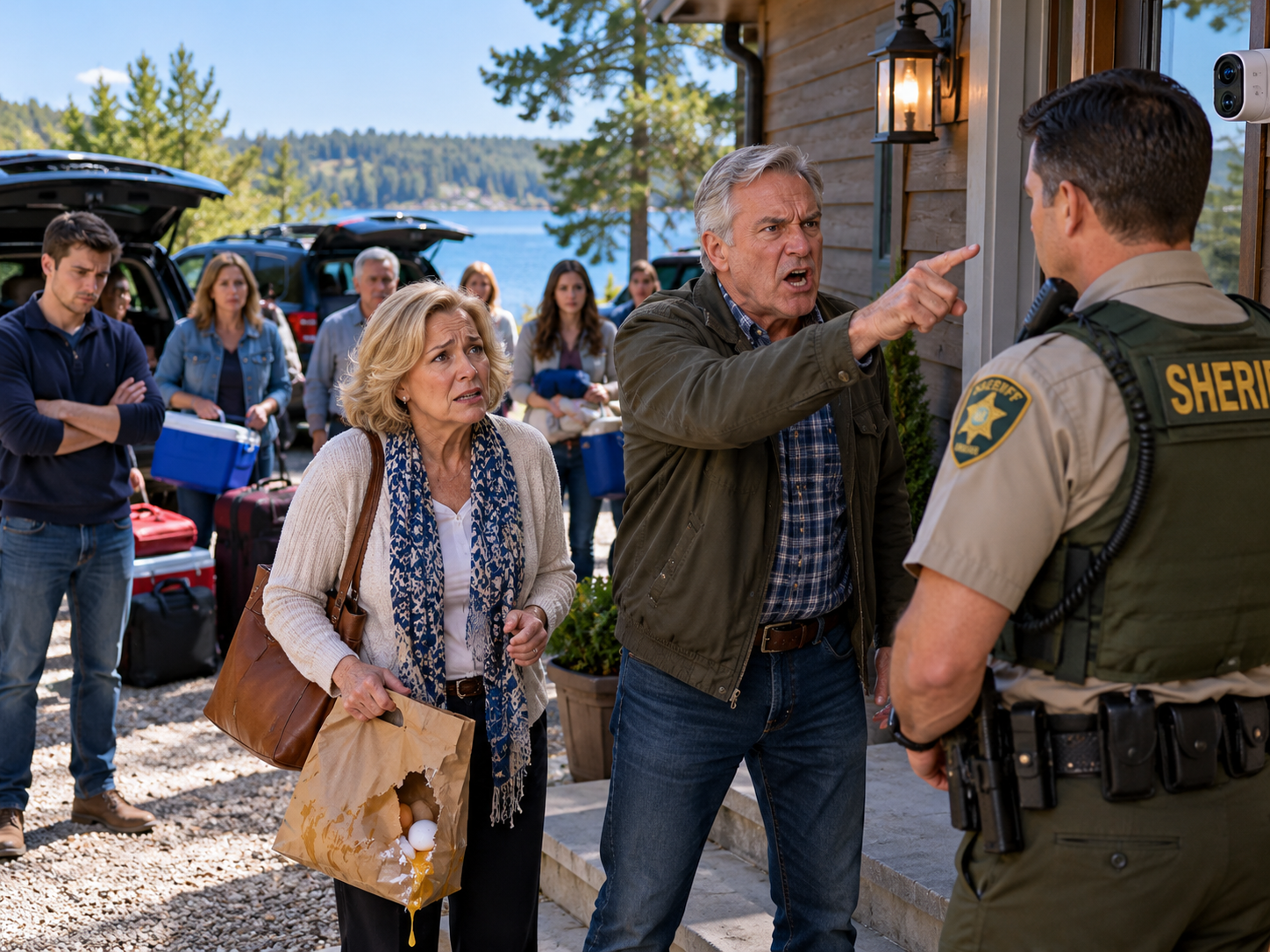
They had announced twenty guests.
They had ordered me to stock the refrigerator.
I had said no.
They came anyway.
I locked the doors.
The sheriff arrived.
The weekend ended.
And then came the harder part.
I had to keep saying no after everyone went home.
I had to say no to guilt.
No to pressure.
No to the belief that love required access.
And eventually, I learned that a boundary was not an angry wall.
It was a door with a handle on my side.
I could open it.
I could close it.
I could invite someone in.
I could decide when I needed quiet.
One evening, I sat on the porch with a piece of chocolate cake from the bakery in town.
Juniper slept under the table.
A heron stood motionless at the edge of the water.
The sun was dropping behind the trees.
My phone was silent.
I looked toward the desk inside, where the deed and the old letters were stored.
Two kinds of evidence.
One proved the property belonged to me.
The other reminded me why I had needed it.
I smiled.
The house was mine.
But more importantly, the choice was mine.
And for the first time, I understood that saying no had never been about keeping my family out.
It had been about making sure that when I finally said yes, it meant something.
Click here to continue reading: PART 5: The First Christmas After the Lake House Incident Forced Me to Discover Whether My Family Had Actually Learned the Difference Between Permission and Obligation
Twenty People Arrived Expecting a Welcome, but My Locked Door and One Quiet Phone Call Forced My Parents to Face a Problem They Had Never Expected
Part 4 of 20