
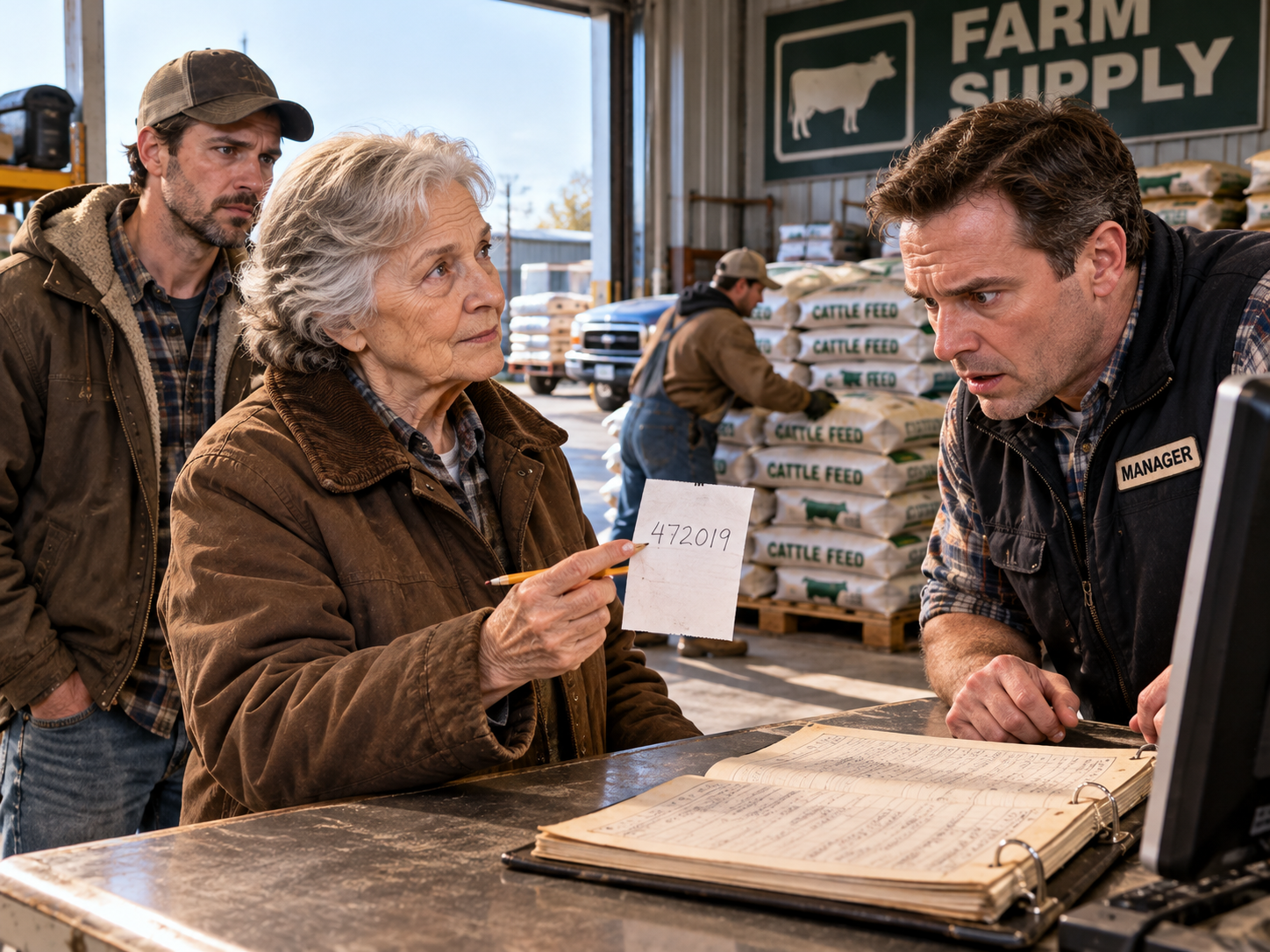
The manager had already ordered the employee to unload my mother's cattle feed when she asked for a pencil. I remember that detail because everything else about the morning seemed designed to make us feel small: the cold coming through the loading-bay doors, the diesel smell clinging to our coats, and the twenty bags of feed being carried away from the cart my seventy-four-year-old mother had waited patiently beside.
We had arrived first. We had selected the feed, confirmed the price, and watched an employee begin loading it. Then a customer with a larger operation had offered more money, and the manager decided our purchase no longer mattered. My mother had not raised her voice once. She had simply asked to see an old ledger, written six numbers on a receipt, and waited while the manager disappeared into his office.
When he returned with a dusty binder, his expression had changed so completely that I wondered whether I had misunderstood what I was seeing. He turned pages with a hurried thumb, stopped at an entry, and looked from the faded handwriting to the numbers my mother had written. His lips parted, but for several seconds no sound came out.
Mom leaned toward the open book. Her face remained composed.
"That's what I came to find out," she said.
I was still trying to understand what she meant when the manager closed the office door behind him and lowered his voice.
"Mrs. Carter, where exactly did you get that receipt?"
She glanced at the pencil resting beside his hand. "From you. You printed it before you canceled our sale."
"No. I mean the numbers."
"You know where I got them."
He looked down at the ledger again. "I need to speak to you privately."
I nearly laughed at the absurdity of it. Ten minutes earlier, he had been perfectly comfortable humiliating my mother in front of his employee. Now, after seeing six numbers on a scrap of paper, he wanted privacy.
Mom did not move.
"Whatever you need to ask me, you can ask me here."
The manager looked toward me, then back at her. For the first time that morning, he seemed unsure who held the advantage.
My name is Daniel Carter. My younger brother and I run most of the day-to-day work on our family's cattle farm outside Redfield, Iowa. The farm has been in our family for three generations, and by November, every decision about feed becomes important. The grass has thinned, the mornings are hard with frost, and the cattle depend increasingly on what we haul out to the feeding areas.
Our mother, Ruth Carter, was seventy-four that year. Dad had died eight years earlier, and people who knew our family sometimes assumed Mom had stepped back from the farm after his death. She had not. She no longer operated the heavy machinery unless she absolutely had to, but she still checked the cattle, kept the accounts, and made the final decisions about purchases.
She had a way of studying a problem before saying anything about it. Dad used to joke that she could look at a fence post long enough to make it confess who had broken it. She never considered silence a sign of weakness. She simply disliked wasting words before she understood what they needed to accomplish.
That morning, she had asked me to drive her into town because our feed supply was running low. We needed twenty bags to carry us through the week until our next delivery. It was not an emergency in the dramatic sense, but cattle do not understand postponed orders. They eat every day, regardless of the weather or a supplier's promises.
The local farm supply store was our usual stop. It carried the feed brand we had used for years, along with seed, fencing supplies, livestock medicine, and the smaller items that somehow became essential at the worst possible moment. Dad had bought supplies there before I was born. Mom had continued shopping there after he died.
The store's current manager, Travis Miller, had grown up a few farms from us. His father, Walter, had run the business for decades and had known my dad well. Walter had died several years before the events I am describing, leaving Travis responsible for the store.
I knew Travis well enough to recognize his ordinary moods. He was brisk when the shop was busy, impatient when deliveries ran late, and usually polite to customers he knew. He was not the sort of person who enjoyed being challenged in front of employees. Until that morning, I had never seen him look genuinely frightened.
We arrived shortly after the doors opened. A pale sky hung over town, and the frost on our windshield had melted into thin streams by the time we reached the store. Mom wore her brown winter coat, a knitted scarf, and the old leather gloves Dad had bought her years before. She carried her purse and a folded shopping list.
The final twenty bags of our usual cattle feed sat on a pallet near the loading door. Mom checked the label herself, bending slightly to read the product information. She compared it with the brand name on her list, then nodded to the young employee who had come to help us.
"We'll take all twenty," she told him.
He confirmed the price and started loading the bags onto a flat cart. Mom watched to make sure the correct mix had been selected. She had never liked making a purchase without checking the details, especially when a substitute product could upset the cattle's feeding routine.
The employee had loaded several bags when Travis emerged from his office.
"Hold on," he said.
The young man stopped with a bag balanced against his hip.
Travis walked toward us, glancing at the pallet as if he had just remembered something. He told Mom that the remaining stock had been committed to another customer. She asked when that had happened, since the employee had already begun filling our order.
"Just now," Travis replied.
The explanation made no sense. The bags had been sitting there when we arrived, and nobody had mentioned a reservation. Mom looked toward the loading door, where the twenty bags were stacked in plain sight.
"Who are they committed to?"
"A commercial operation. They're taking the lot."
"Then why was your employee loading them for me?"
Travis shifted his weight. He explained that the other farm had called with an offer above the listed price. It was a substantial order, and the store had to consider its business interests. The customer was prepared to pay more, so Travis had decided to redirect the remaining inventory.
I could feel my jaw tightening. The next supplier was almost forty miles away, and freezing rain was expected later that day. We had planned our morning around getting the feed home before the roads became difficult. Mom had been buying from this store for longer than Travis had been alive.
"We were here first," I said.
Travis looked at me as if I had introduced an irrelevant detail.
"I understand that, Daniel. But business is business."
"What does that mean? That you can take back a purchase whenever someone offers you a little more?"
"We hadn't completed the transaction."
The employee lowered the bag he was holding. He looked uncomfortable, but he did not challenge his manager. Travis told him to put the bags back on the pallet, and the young man began unloading our cart.
Mom watched without interrupting. I wanted to argue about the posted price, the inconvenience, and the fact that a regular customer had been treated as though her word meant nothing. But I also knew my mother well enough to recognize the slight tightening around her eyes. She was thinking, and she did not want me speaking for her.
When the employee finished, Travis turned to Mom and offered a strained smile.
"I hope you understand. We have to look after the business."
Mom removed one glove and tucked it into her coat pocket.
"I suppose you do have to make a living," she said.
Travis seemed relieved. He thanked her for understanding and turned toward his office, apparently satisfied that the problem had ended without a scene.
That was when Mom asked for a pencil.
She took the canceled receipt from the counter and turned it over. For a few seconds, she studied the blank back as though she were deciding where to begin. Then she wrote six numbers in a neat row, pressing firmly enough that the pencil marks showed through the thin paper.
She slid it across the counter.
"Would you check those against your old ledger?"
Travis barely glanced at the numbers. He seemed ready to push the receipt aside. Then he picked it up again and read them more carefully.
His expression changed.
"Where did you get these?"
"Your father gave them to me."
He stared at her. "My father gave you those numbers?"
"Thirty-two years ago."
Travis looked toward the office, then back at the receipt. He asked whether she still had the original paper on which Walter had written them. Mom said she did not need the paper. She had memorized the numbers, and Walter had told her to keep them somewhere she would not forget.
"What were they for?" I asked.
Mom did not answer me. She watched Travis instead.
"Check the ledger," she said.
He disappeared into his office. We could hear drawers opening, a cabinet door closing, and the muffled scrape of something heavy being moved. Five minutes passed. Then ten. The employee who had loaded our cart pretended to straighten merchandise near the counter, although I could tell he was listening.
Mom stood quietly with both hands resting on the counter. I asked again what the numbers meant, but she only said that Dad had known the answer and that Walter had made her promise not to use them unless there was no other choice.
That was the first time I understood the numbers were not merely a memory. They were connected to something Mom had carried for thirty-two years without telling her children.
Finally, Travis came out carrying a thick binder coated in dust. He laid it on the counter and began turning pages, checking the handwritten numbers on the receipt against entries recorded long before I had started working on the farm.
His finger stopped on a page.
He leaned closer, read the entry again, and went pale.
Then he looked at my mother.
"What is this?" he whispered.
Mom leaned slightly toward the page.
"That's exactly what I came here to find out."
Click here to continue reading: PART 2: The Dusty Ledger Held a Record From Thirty-Two Years Earlier, and the Manager Realized My Mother Knew Something His Family Had Never Explained
The Store Manager Took Back My Mother’s Last Twenty Bags of Cattle Feed, Until Six Numbers on a Receipt Changed His Expression
Part 1 of 20

