
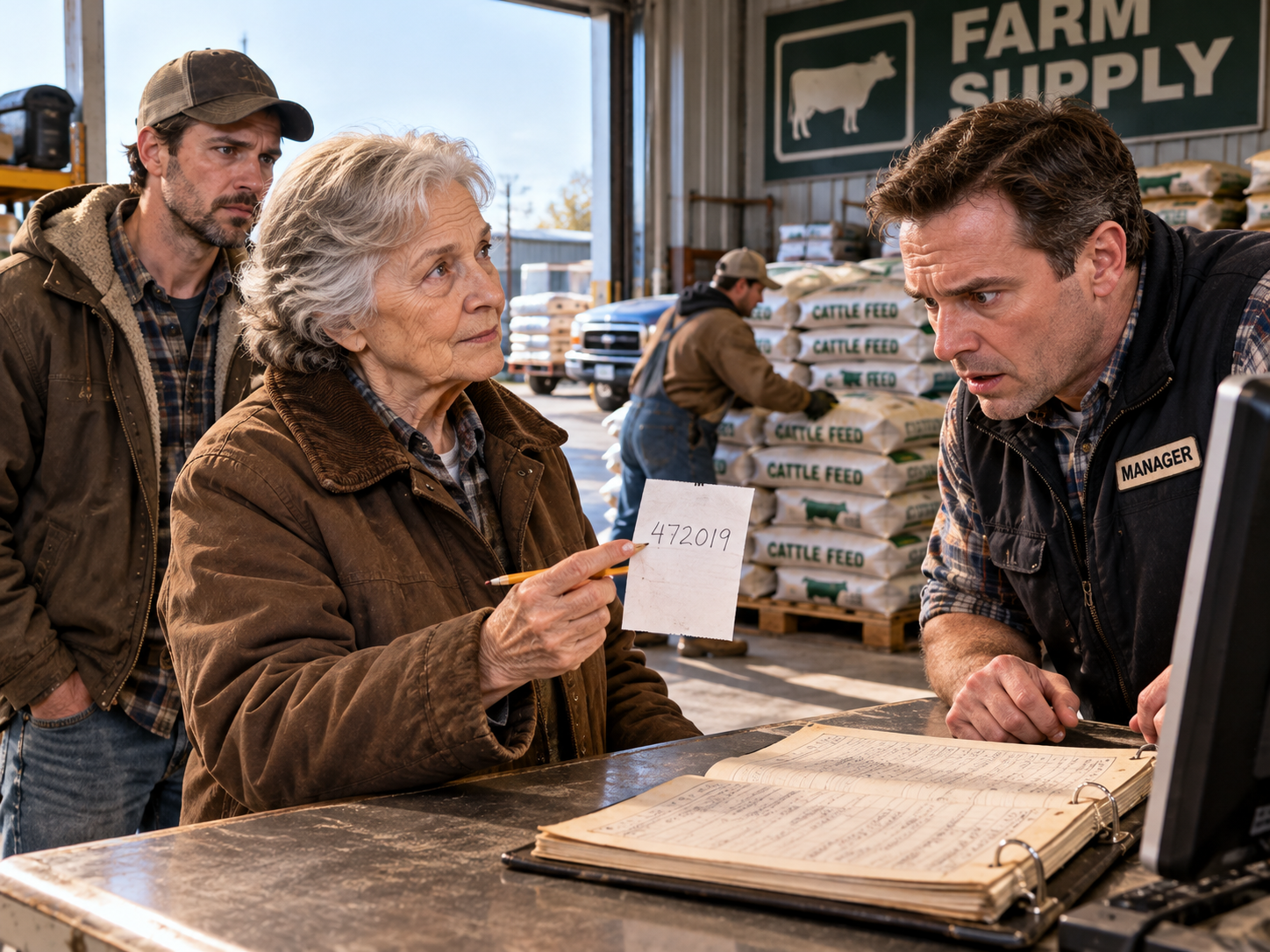
Martin called on a Tuesday morning to say that the accountant's archive had yielded a partial copy of the reserve account's closing schedule. The original supporting file was still being located, but the partial copy contained enough information to establish the date of closure and several final transactions.
Mom asked him to send the document to her before arranging another meeting. She wanted to read it without anyone standing over her shoulder or telling her what it meant.
When the copy arrived, she spread it across the kitchen table and studied the columns. The handwriting was not Walter's, and the figures were typed rather than written by hand. The page listed transfers, outstanding balances, and a final adjustment. Beside the six-digit reference was a notation that the account had been closed following a review of the store's financial obligations.
One line referred to a settlement involving the original agreement. Another indicated that supporting records had been retained in a separate file. The copy did not show that the store owed our family money, but it did not explain precisely how every obligation had been handled, either.
Mom read the page twice. Then she called Martin.
He explained that the closing schedule appeared to show the reserve account had been reconciled when Walter's estate was settled. The final adjustment might have represented the transfer of unused funds back into the store's operating account, but he did not want to assume that without the supporting schedule. The surviving copy was incomplete, and the wording of the adjustment was too abbreviated to establish its full meaning.
"Then let's not guess," Mom said.
Martin agreed. He had already asked the accounting firm to search for the original file and any correspondence explaining the final adjustment. He also planned to compare the closing schedule with the store's own ledger, which contained a matching date but did not describe the transaction in detail.
Travis called later that day. He sounded more anxious than he had during the earlier meetings. He had seen the preliminary schedule and worried that people might interpret the missing details as evidence of misconduct by his father or the store.
Mom told him that nobody had made such an accusation.
"But the records look incomplete," he said.
"They are incomplete. That's why we're looking for the rest."
He asked whether she would agree to keep the matter private while the review continued. Mom said she had no intention of spreading speculation about Walter. But she would not agree to conceal the findings if the records showed that the agreement had been mishandled.
"I won't accuse your father without evidence," she told him. "I also won't tell you everything is settled before we know what happened."
Travis accepted the answer, though I could hear his frustration. He wanted certainty, and he wanted it to protect the reputation of the man who had built the business. Mom wanted certainty too, but she was unwilling to decide in advance what the answer should be.
The next afternoon, Martin arranged a meeting at the store. He brought the partial closing schedule, the original agreement, Walter's letter, and the ledger entries. Travis attended with a notebook in which he had written down questions about the dates and amounts. I accompanied Mom, partly to help with the papers and partly because I wanted to understand what had happened to an agreement that had shaped our family's relationship with the store for decades.
Martin began by confirming what the records established. Walter had created the reserve in connection with the original assistance from my parents. The account had been used to support inventory purchases and preserve supplies for established local farms during shortages. When the account was closed, the store's accountant had prepared a reconciliation, but the surviving copy did not include the detailed explanation for every adjustment.
The original agreement remained intact. No later document had been found that expressly canceled it. The store had continued to refer to the six-digit code in its records after Walter's death, although the reference had eventually disappeared from the modern inventory system.
Travis asked whether the closing schedule suggested that the store had failed to honor the agreement. Martin said it did not establish that. The account could have been properly reconciled while the continuing business commitment remained in effect. The reserve itself and the agreement were related, but they were not necessarily the same thing. Closing the account did not automatically mean the store had canceled the commitment concerning essential supplies.
That distinction mattered. I had begun to wonder whether the store had quietly ended the arrangement after Walter died, leaving the numbers as a forgotten relic. The documents did not support that conclusion. They showed that the financial reserve had been closed, but the agreement itself had not been clearly revoked in the records we had reviewed.
Mom asked what the final adjustment represented.
Martin pointed to the abbreviated notation and explained that it might reflect the transfer of unused funds, a final payment, or another accounting treatment. The surviving copy was insufficient to determine which. He would not recommend that anyone infer a debt or wrongdoing from the line without the supporting documentation.
Travis looked relieved for a moment, then troubled again.
"If the account was closed properly, why did the agreement remain in the ledger?"
"Because the agreement may have continued to have significance independent of the reserve," Martin answered. "The records suggest that Walter wanted the commitment preserved even after the financial arrangement had been settled."
Mom nodded. "That was what he told us. The money was to help the store through a difficult period. The promise about essential supplies was supposed to outlast that period."
Travis asked why the promise had never been formally transferred into the new inventory system. Martin said he could not answer that without understanding the decisions made during the store's restructuring. It might have been an administrative oversight rather than a deliberate decision. The important thing was that the original document remained available and could now be accurately reflected in the store's procedures.
The meeting might have ended there, but Travis had one more question. He asked whether Walter's closing records contained any indication that he had believed the agreement no longer applied after the reserve was closed.
Martin reviewed the partial schedule again. There was no clear statement to that effect. In fact, a note on the final page referred to preserving the related agreement with the historical customer records. It suggested that the financial account and the business commitment had been treated as separate matters, though the missing supporting file was needed to confirm the details.
Travis sat back and looked at the papers. His father's reputation was not being destroyed by the review. If anything, the records suggested Walter had been careful to preserve the agreement even after the reserve was closed. The failure had occurred later, when the reference disappeared from the modern system and Travis made a decision without consulting the archive.
He admitted that he had wanted the review to end quickly because he feared it would expose something embarrassing about his father. Now he could see that the more immediate embarrassment belonged to him. He had acted as though a larger offer automatically outweighed a prior commitment, and he had not checked the records that could have prevented the mistake.
Mom did not take advantage of his admission. She told him that every manager made mistakes, but a good manager had to be willing to correct them. She reminded him that Walter had not expected his son to know every detail of the store's history by heart. He had expected him to preserve the records and look at them when a decision depended on them.
Travis said he understood. He promised to keep the agreement attached to the inventory procedure and to make sure the next person who managed the store received a clear explanation of its scope. Martin recommended that the store also retain the supporting correspondence and the closing schedule together, so that future reviewers would not confuse the reserve account with the continuing commitment.
Before we left, Martin received a message from the accounting firm. The original supporting file had been located in off-site storage, but it would take several days to retrieve and examine it. He told us that the remaining questions might be answered once the file arrived.
Mom thanked him and said she was willing to wait.
On the drive home, I asked whether she was disappointed that the review had taken so long.
"No," she said. "It took thirty-two years for the question to come back to us. A few more days won't hurt."
I asked whether she was worried that the original file might reveal something different from what she remembered.
"Of course it might," she said. "That's why we need it."
I realized that she was not protecting an idealized memory of Walter or Dad. She was protecting the integrity of the agreement. If the records showed that a detail had been misunderstood, she was prepared to accept that. What she would not accept was a decision based on convenience when the evidence had not been examined.
The next week, Travis sent Mom a written apology for the way he had handled the feed order. He acknowledged that he had changed the sale without checking the store's records and had treated the larger offer as more important than the existing commitment. He also described the steps he had taken to update the inventory system and preserve the agreement.
Mom read the letter and filed it with the documents. She did not respond with a long message or demand another meeting. She said his actions would matter more than his words, and that the store now had a chance to prove it had learned from the incident.
Then, on Friday afternoon, Martin called again.
The original closing file had arrived.
He had found a signed statement from Walter and the accountant, along with a detailed schedule that explained the final adjustment. He asked Mom to come in the following morning to review the documents.
Before ending the call, he added that the schedule clarified a point nobody had been able to answer from the partial copy.
Mom grew very still.
"What point?" she asked.
Martin paused before answering.
"It explains exactly what Walter intended to preserve when the reserve account was closed."
Click here to continue reading: PART 8: Walter’s Final Statement Explained Why the Agreement Survived the Reserve, but Its Last Instruction Put the Responsibility Back on Travis
The Store Manager Took Back My Mother’s Last Twenty Bags of Cattle Feed, Until Six Numbers on a Receipt Changed His Expression
Part 7 of 20

