
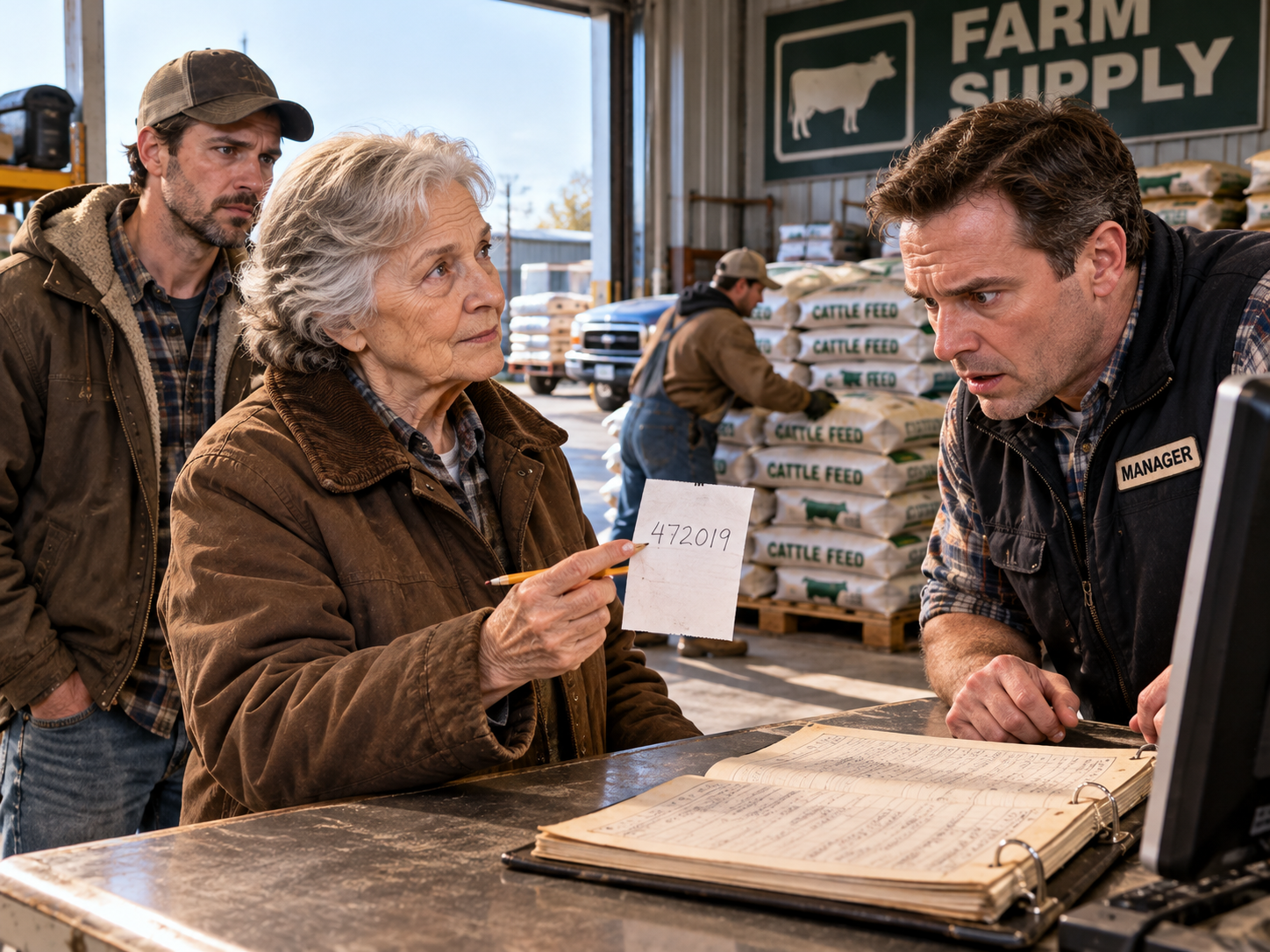
The first serious cold spell of the season arrived with a forecast that kept changing. One morning, the weather report predicted snow; by afternoon, freezing rain had become the greater concern. We adjusted the farm’s schedule as best we could, moving outdoor work forward where possible and making sure essential supplies were available before the roads became dangerous. The cattle did not care what the forecast said. They needed feed on time, and our equipment needed attention whether the weather cooperated or not.
I found myself checking our storage more often than usual. The memory of the November shortage had made me cautious, and I wanted to avoid being forced into a last-minute trip during bad weather. Mom noticed my habit and reminded me not to let one difficult experience turn into unnecessary worry. We should plan carefully, she said, but we could not buy every possible supply in advance or assume every business would fail us. The lesson was to prepare sensibly and keep our records straight, not to live as though the next dispute were already waiting around the corner.
Her advice was harder to follow than I expected. Once you have seen how quickly a normal transaction can become a problem, it is tempting to search for warning signs everywhere. I began to think about every purchase as a question of trust: whether the order would arrive, whether the price would change, whether someone had made a commitment that another person might overlook. Mom reminded me that most transactions worked as they should. The fact that a promise could be forgotten did not mean every person was careless or every business was dishonest.
That distinction mattered when a routine delivery was delayed. I called the supplier, explained what we needed, and asked for an updated arrival estimate. The person on the phone checked the order and gave me a new time. I was irritated, but there was no reason to accuse anyone of breaking a promise deliberately. The delay had a practical explanation, and we could adjust our work. I thanked the employee and made a note of the revised delivery. The conversation ended without drama, which was how most business conversations should end.
Later that evening, I told Mom I had been careful not to overreact. She said she was glad, then asked whether I had recorded the new delivery time. I had. She nodded. “Good. If something changes again, you will know what was agreed and when.” It sounded like a small lesson, but it was the same principle that had mattered at the store. Clear records could not prevent every problem, but they helped distinguish a misunderstanding from a broken commitment and gave people something concrete to review.
At the farm supply store, Travis was learning to apply that principle in his own way. During a visit in early January, I heard him ask an employee to confirm whether a delivery had already been promised to another customer before reallocating it. The employee checked the order records and confirmed the status. Travis then explained the available options to the customer at the counter. He was not invoking our agreement, and the product was not part of the old commitment. He was simply making sure that a decision about limited stock took existing obligations into account.
I realized then that the store’s response had become broader in one important sense without expanding the agreement itself. The specific commitment still applied only within its written scope. But the process of checking records before making a consequential decision was useful in ordinary situations, too. It did not create new rights for our family or anyone else. It made the business more careful about promises it had already made, whatever form those promises took.
When I mentioned that observation to Mom, she said that good habits often began with a particular mistake and eventually became part of ordinary work. But she warned me not to confuse a general improvement with the original agreement. The store could adopt a better procedure for all its customers without changing the terms of Walter’s commitment. That distinction protected both sides. It allowed the business to learn from the incident while keeping the actual legal and practical meaning of the agreement clear.
A week later, Martin called Mom to confirm that the records had been indexed and that the store had retained the written acknowledgment. He did not report a new discovery or suggest that the agreement had changed. He simply wanted to make sure the file was complete and that the store understood how to consult it. Mom thanked him for his work. Before ending the call, she asked whether he believed the documents now provided a reasonable basis for future managers to understand the arrangement. Martin said the procedure would help, while reminding her that any future dispute would still depend on the facts and the actual terms of the agreement.
Mom appreciated his caution. She had never expected a piece of paper to solve every future problem automatically. She wanted the records preserved so that a future decision would be made with the relevant information available. If circumstances changed, the agreement might need to be interpreted in light of those circumstances. If a valid amendment were ever made, it would need to be documented. If someone questioned its scope, the store would need to review the evidence. None of that could be replaced by simply remembering that the agreement existed.
I began to understand the cost of forgetting in a more practical way. The immediate cost in November had been the risk of leaving our farm without the feed we needed. The larger cost was the possibility that a long-standing commitment could be treated as irrelevant because the person making a decision had never heard of it. The store might have continued operating for years without anyone discovering the problem. Our family might never have known that the agreement had been overlooked. The old papers would still have existed, but their purpose would have been lost in practice.
That was what made the discovery important. The agreement did not guarantee that every future farmer would get every essential product during a shortage. It did not establish a universal rule about which customer should receive stock first. It addressed a defined situation and required the store to consider a commitment it had made. Once the commitment was brought to light, the store could no longer treat the higher offer as the only relevant fact. There was another fact, older but still meaningful, that had to be considered.
My brother saw the point from a different angle. He said that the store could have avoided the entire dispute if the original agreement had been indexed correctly years earlier. I agreed, though I also knew that record systems change and people inherit responsibilities they do not fully understand. The failure had not required deliberate dishonesty. It had grown from an ordinary gap between a document that existed and a manager who did not know what it meant. That was why the remedy had to be practical rather than theatrical.
Mom remained consistent in her view of Travis. She did not excuse his decision, but she did not keep treating him as though he would repeat it forever. When we needed supplies, she continued to buy them at the store. She checked invoices, paid the stated price, and asked ordinary questions when something was unclear. She did not demand that Travis reassure her about the agreement every time she entered. The documents and procedure were supposed to do that work, allowing the relationship to return to normal business.
One afternoon, Travis stopped by the farm to deliver a document Martin had asked him to pass along. It was an updated copy of the store’s record index, not a new agreement or a change in the original terms. He explained that the store had added a note reminding staff to consult the full file before making a decision involving a possible shortage of essential supplies. Mom thanked him and reviewed the note. She asked one question about the wording, and Travis agreed that it should be precise. He took the paper back to correct the phrase before returning a final copy.
The exchange was brief, but it showed how much the situation had changed. In November, Mom had been forced to prove that an old commitment existed. Now Travis was voluntarily bringing her a record intended to prevent the same misunderstanding. He was not asking for praise, and she did not give him any special ceremony. She simply expected the wording to be accurate, just as he had come to expect that the records should be checked.
When he left, I asked whether she thought the store would keep the procedure in place for years. She said she could not know. Managers changed, businesses changed, and records sometimes became disorganized again. But the index, acknowledgment, and original documents gave the store a better starting point than it had before. “We cannot guarantee what people will do,” she said. “We can make it easier for them to do the right thing.”
That answer seemed to contain the whole story. The agreement had been written because Walter and my parents understood that circumstances could change. The reserve had been temporary because its financial purpose had ended. The supply commitment had remained separate because its purpose was different. The closing file had confirmed that no money was owed to our family, while the continuing agreement still mattered within its scope. Each fact had a place, and keeping them distinct prevented the truth from being distorted.
As the weather grew colder, our farm continued to operate without another dispute. We kept enough supplies on hand when possible, checked deliveries, and adjusted plans when conditions required it. I stopped treating every delay as a warning and began treating it as a problem to document and solve. That was not a small change in my own thinking. I had learned that trust did not require ignoring facts, and careful recordkeeping did not require assuming the worst about people.
The store’s responsibility was similar. Travis could continue serving the largest customer who came through the door, but he had to consider existing commitments before redirecting essential stock in a qualifying shortage. He could make decisions about ordinary inventory, but he could not simply assume an old agreement had disappeared because the related reserve account was closed. He could rely on his staff, but he had to ensure that the relevant records were accessible. These were not extraordinary burdens. They were part of running a business that wanted to honor its own arrangements.
Mom never described the experience as a victory over Travis. She described it as a correction. The store had made a decision without considering a commitment, then reviewed the records and changed its approach. Our family had obtained the feed we needed, and the written arrangement had been restored to practical use. There was no need to humiliate anyone or keep demanding apologies. The most meaningful outcome was that the next decision could be made with better information.
By the end of January, I could walk into the store without thinking first about the canceled sale. I still remembered the morning clearly, but it no longer shaped every visit. The employees greeted us as they always had, and we continued buying what we needed. The agreement remained in the archive, ready to be consulted if the relevant circumstances arose. The story had become less about a confrontation and more about the quiet work that followed it.
The cost of forgetting had been real, but it had not become permanent. The documents were found, the reserve was reconciled, the commitment was clarified, and the procedure was improved. That did not make future mistakes impossible. It made the store better prepared to avoid repeating this one. For Mom, that was enough. She had never asked for a guarantee that the future would be perfect. She had asked for the promise already made to be treated as something worth remembering.
Click here to continue reading: PART 15: WHAT WE COULD AND COULD NOT CLAIM
The Store Manager Took Back My Mother’s Last Twenty Bags of Cattle Feed, Until Six Numbers on a Receipt Changed His Expression
Part 14 of 20

