
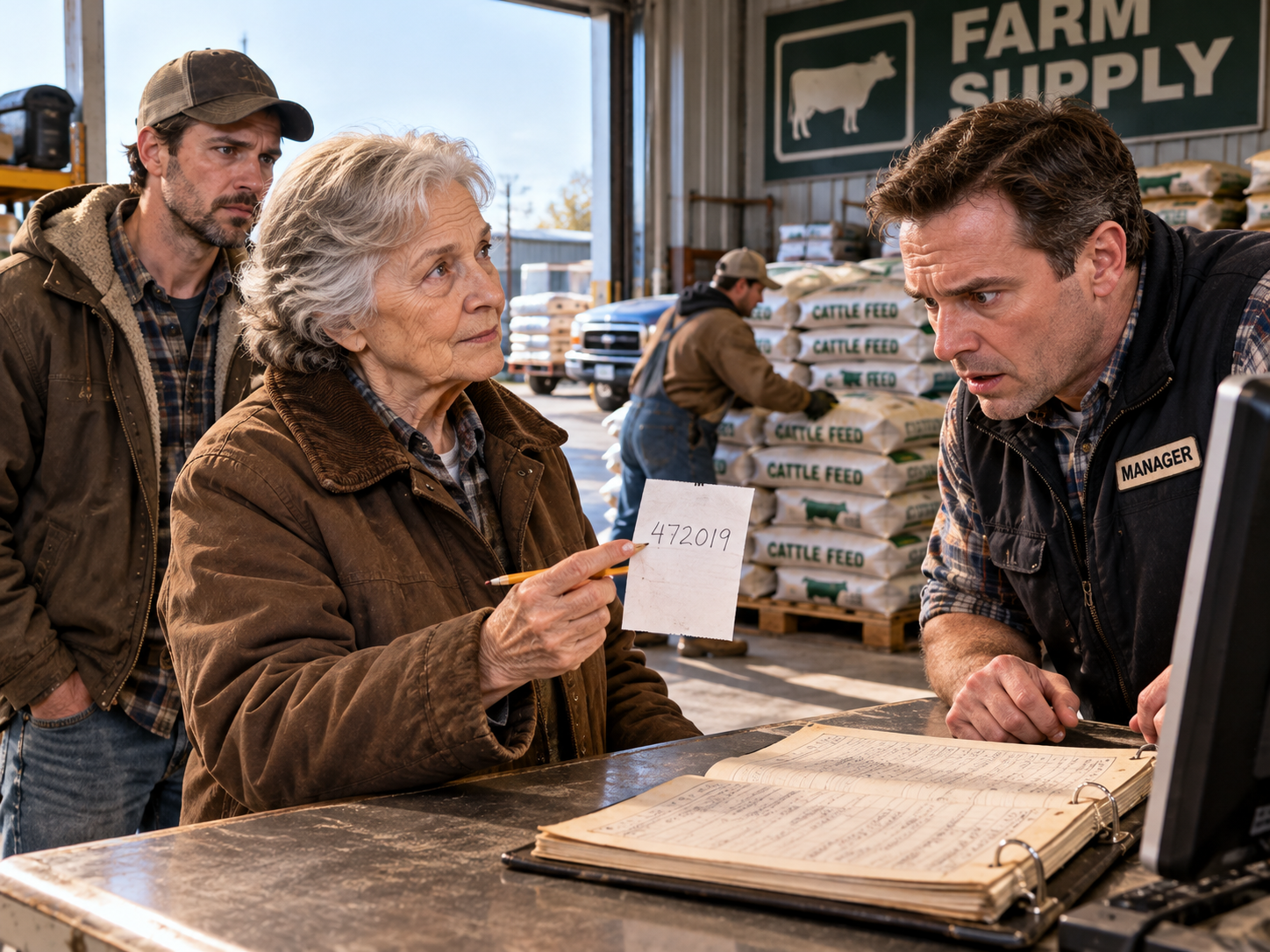
Winter settled more firmly over the fields as November gave way to December. The ground hardened, the mornings arrived dark and cold, and every trip between the house and the barn required another layer of clothing. On the farm, there was little time to dwell on the store dispute. The cattle needed feeding whether the sky was clear or gray, and equipment still broke at the least convenient moment. The agreement remained in its folder, but our days were shaped by the work in front of us.
Still, I found myself thinking about the six numbers whenever I saw a receipt. Before the incident, I would have treated them as a reference code, useful only to whoever maintained a ledger. Now I understood that a number could preserve a relationship long after the people involved stopped speaking about it. It did not explain itself. It did not guarantee that anyone would respect the arrangement it pointed to. But if someone knew where to look, it could lead to the evidence needed to understand a decision that otherwise seemed inexplicable.
Mom never described the six numbers as a secret. She had not kept them hidden to gain leverage over Travis or the store. She had remembered them because Walter had given them to her when the agreement was made. She had also remembered the condition attached to them: she should not bring them up unless there was no other choice. For decades, she had never needed to. The store had continued operating, the old arrangement had remained in the background, and no shortage had forced her to invoke it.
I asked her once why she had waited until Travis canceled the sale before writing the numbers on the receipt. She answered that she had first wanted to give him the opportunity to reconsider. When he refused to sell the feed because a larger customer had offered more money, she understood that asking again would not solve the problem. The numbers were not a threat. They were a way to direct him toward the records he needed to review. She had used them only after the ordinary conversation failed.
That answer made me think differently about the moment in the store. I had remembered the silence after she wrote the numbers, the way Travis’s expression changed, and the sudden seriousness that followed. I had imagined that Mom possessed some powerful piece of information that would force the manager to reverse his decision. In reality, she had no guarantee of what he would find. She had trusted that the records would speak for themselves, and she had been prepared to accept what a careful review showed. Her confidence came from knowing the history, not from believing she could control the outcome.
Martin had been equally careful throughout the review. He had not declared that the agreement gave our family an unlimited right to supplies. He had not claimed that the closed reserve contained money we could demand. He had separated the financial record from the continuing commitment and looked for evidence that the latter had been canceled. The result was narrower than some people might have hoped, but it was strong enough to resolve the actual dispute. The reserve had been settled. No outstanding amount was owed to our family. The supply commitment remained relevant within its original scope, and the store had not located a signed amendment or cancellation.
The distinction between those findings mattered because it kept the truth from being exaggerated. If we had told the town that Dad had secretly owned part of the store, we would have been lying. If we had said the store owed Mom a fortune, we would have been lying. If we had insisted that every future shortage must be resolved in our favor, we would have been stretching the agreement beyond what it said. None of those claims was necessary. The real facts were enough: Dad and Mom had helped Walter during a difficult period, Walter had made a written commitment about essential supplies, and that commitment had nearly been overlooked years later.
I began to understand why Mom had never seemed tempted by the idea of a hidden financial benefit. She had known the difference between helping a business survive and buying control over it. The reserve had been a practical mechanism during a difficult season, not a permanent account that belonged to our family. When the reserve was closed and reconciled, the remaining balance returned to the store’s operating funds. The separate promise about essential supplies was not erased simply because the temporary financial arrangement had ended. Each record had to be read according to what it actually said.
One afternoon, I drove into town to collect a part we had ordered. Travis was busy with a delivery, so I waited near the counter while an employee checked the invoice. On a shelf behind the desk, I noticed a plain folder with a small label indicating that archived customer commitments were kept there. I could not see its contents, and I did not ask to inspect it. I was not interested in monitoring the store. But seeing the label reassured me that the revised procedure was more than a promise made during an uncomfortable meeting.
When Travis came over, he asked whether the cattle were doing well. I told him they were, and we exchanged a few words about the weather. He did not bring up the dispute, and neither did I. There was no need to revisit the apology every time we met. The most useful proof of a changed attitude was not repeated regret; it was the absence of the same careless decision when another one had to be made.
Before I left, Travis said, “I have been thinking about what your mother told me—that I cannot know every conversation my father had, but I can keep the records he left.” He looked toward the back office. “I used to think old files were mostly history. Now I realize some of them are instructions I have not read yet.” I told him that sounded like a reasonable lesson. He smiled briefly, then turned to help the next customer. I left without feeling that we had become friends in some dramatic new way. We had simply reached a better understanding of the responsibility he carried.
At home, I told Mom about the folder and Travis’s comment. She listened while putting away the day’s receipts. “Good,” she said. “Then perhaps the next person will not have to write six numbers on a canceled receipt.” She said it lightly, but I knew she meant it. She wanted the procedure to work without another crisis. If the agreement was checked when it mattered, there would be no reason for her to use the reference again.
I wondered whether we should ask the store to send us an annual confirmation that the agreement remained on file. Mom said we could, but she did not think it was necessary unless the records changed or the store raised a question. She preferred a simple written acknowledgment and properly maintained documents over a ritual that might become meaningless. “You can ask people to remember something every year,” she said. “That does not mean they will understand it. Better to make sure they know where the paper is and what they need to do with it.”
It was a practical answer, and it reflected the way she had managed the farm all her life. She trusted people, but she did not confuse trust with leaving everything to chance. She kept receipts, recorded payments, checked deliveries, and wrote down decisions that might matter later. When an agreement carried consequences beyond a single day, she wanted it documented. The point was not that people were always dishonest. The point was that even decent people could forget what had been promised, especially when time and circumstances changed.
As December progressed, the store continued its usual work. The larger commercial farm remained a customer, and our family remained a customer. The arrangement did not create a permanent division between large operations and small ones. It required the store to consider a prior commitment when the specified circumstances arose. That might occasionally complicate a decision, but it did not prevent the business from serving other customers. Travis had accepted that honoring a written agreement was part of running the store, not a personal favor to Mom.
The first time I fully understood that, I was standing in line behind a farmer buying fencing supplies. He complained that businesses should be free to sell to whoever paid the most. Travis listened and said that price mattered, but so did any existing obligation. A person who had already promised something could not simply pretend the promise did not exist because a better offer appeared. The farmer did not agree entirely, but he accepted the explanation and completed his purchase. Nobody mentioned our family. The conversation was about ordinary business, which was where the lesson belonged.
Mom heard about the exchange from someone else, not from me. When she told me, she did not smile or claim victory. She asked whether Travis had handled the situation correctly. I said that, from what I had heard, he had checked the records and explained the decision. “Then that is good,” she replied. “He does not have to agree with us about everything. He just has to be careful about what he has promised.”
I began to see that her goal had never been to make Travis think of her family whenever he made a business decision. It was to make him think of his responsibilities before he made one. That was a different kind of influence, quieter and more lasting. It did not depend on fear of a confrontation or embarrassment in front of customers. It depended on a process that could guide a manager who had never met Walter or my father and who might not know our family at all.
On a cold evening near the middle of the month, Mom took the folder containing our copies from the cabinet and checked that the pages were still in order. She returned the folder to its place without ceremony. I asked whether she was worried that the store might someday forget again. She said it was possible. Nothing written could prevent every mistake, and nobody could promise that every future manager would be attentive. But the store now had a written acknowledgment, a clear file reference, and a procedure requiring the agreement to be reviewed during relevant shortages. Those safeguards made a repeat less likely.
“That's all we can do?” I asked.
“That's what we can do now,” she said. “If something changes later, we deal with it then.” She did not need the future to be guaranteed before she could be satisfied with the present. She had made the request, seen the records reviewed, and obtained a clear answer. Continuing to worry about every possibility would not make the agreement stronger.
I returned to my own work with a better appreciation of how easily important things could be lost without being destroyed. The original agreement had never disappeared. It had remained among the store’s records, waiting for someone to understand why it mattered. Walter’s letter, the ledger, and the closing file had preserved the distinction between a temporary reserve and a continuing commitment. The six numbers had connected those pieces. The missing element had not been paper. It had been attention.
Years from now, someone might open that folder and wonder why an old agreement about essential supplies deserved consideration. They might never know the cold morning when Travis canceled our sale or the way Mom had written the numbers on the receipt. They might never meet our family. But if they read the documents carefully, they would understand the practical reason for the commitment. It had been made so that, in a shortage, the store would not forget an established obligation merely because a more profitable choice appeared in front of it.
I no longer thought the six numbers were powerful because they could force a manager to change his mind. They were powerful because they led to evidence, and the evidence made a decision answerable to something beyond convenience. The numbers did not replace judgment. They made informed judgment possible. Mom had never needed them to be magic. She needed them to be accurate.
Click here to continue reading: PART 12: THE WORD THAT REMAINED
The Store Manager Took Back My Mother’s Last Twenty Bags of Cattle Feed, Until Six Numbers on a Receipt Changed His Expression
Part 11 of 20

