
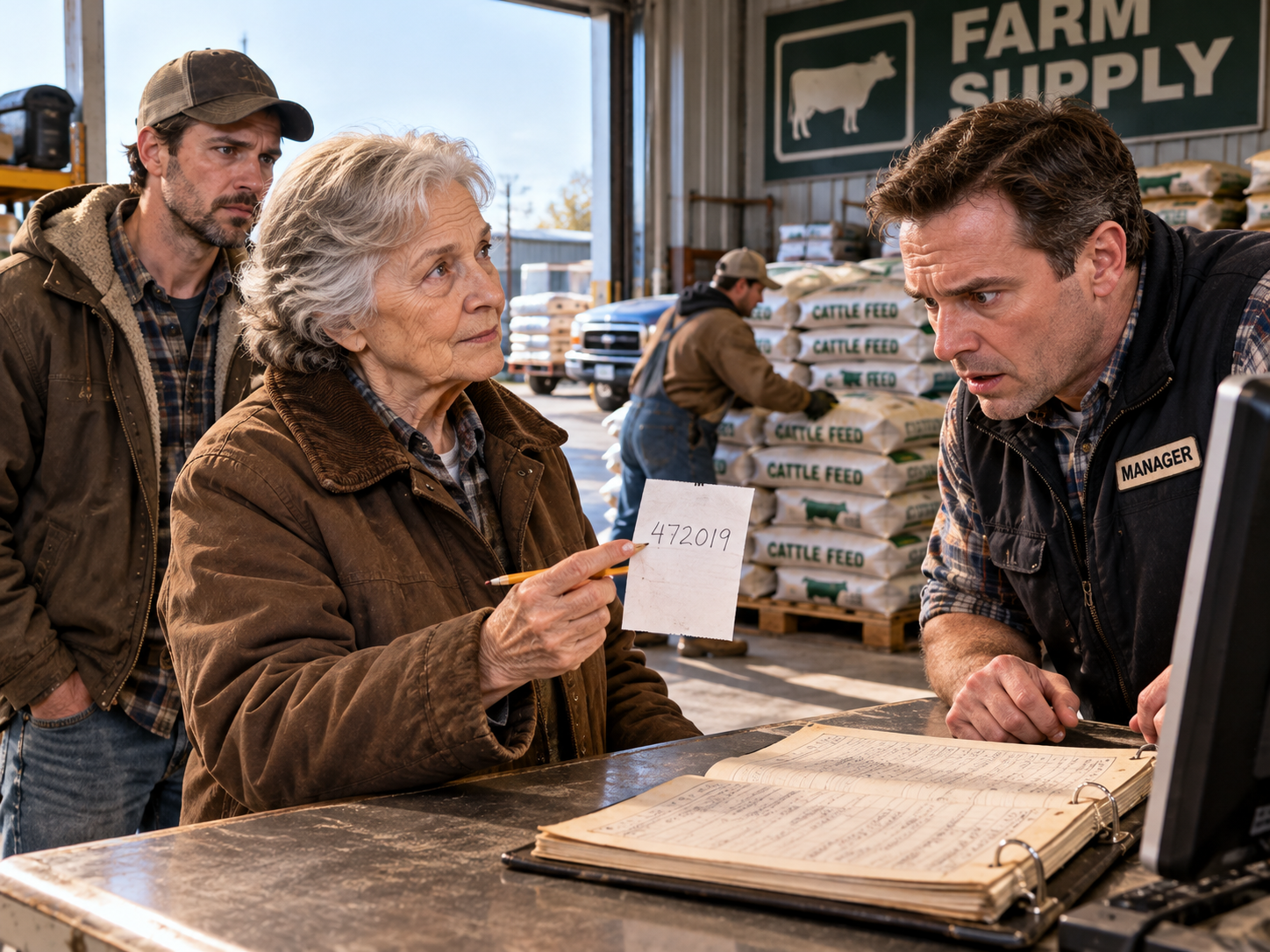
Mom did not sleep especially well that night. She did not say so, but I heard her moving around the kitchen before dawn, checking the account folder and making sure the original agreement was still inside. When I came downstairs, she had already prepared coffee and placed the six-number receipt beside the papers Martin had sent us.
"Ready?" I asked.
"As ready as I can be."
The roads were dry, and the morning air had that sharp November bite that made every breath feel clean and cold. We reached the store shortly after opening. Travis was waiting near the office with Martin Hale, who had brought a larger file than before. The original closing statement was inside, along with the detailed schedule and Walter's signed note.
Martin explained that the accountant's records were complete enough to answer the main question. The reserve account had been closed because the original financial assistance had been reconciled according to the agreed terms. The remaining balance had been transferred back into the store's operating funds. There was no indication that the store owed my parents an outstanding amount from that reserve.
Mom listened without visible disappointment. She had never claimed that the store owed her money, and the records confirmed that the financial portion of the old arrangement had been settled. But Martin was not finished.
The supporting file showed that Walter had deliberately kept the commitment concerning essential supplies separate from the financial reserve. The reserve had been temporary, intended to stabilize the business during a difficult period. The commitment had been intended to continue as a business practice for as long as the store operated under the arrangement established with my parents, subject to its stated scope and any proper later amendment.
In other words, closing the account had not canceled the promise. Walter had taken care to record that distinction because he did not want a future manager to assume the end of the financial arrangement meant the end of the business commitment.
Travis looked down at the statement. He had spent days worrying that the missing records might reveal a financial problem or a hidden debt. Instead, they showed that his father had separated the two matters deliberately and had tried to preserve the agreement for the future.
Martin passed the signed statement across the table. Walter had written that the reserve should be reconciled when its original purpose had been fulfilled, but that the associated commitment should remain attached to the store's customer records. The note explained that the six-digit code was not a claim against the business. It was a reference to the agreement governing how essential supplies should be handled when stock was scarce and a larger buyer offered more money.
Mom read the paragraph slowly. When she finished, she placed the page beside the original agreement and let out a long breath.
"That sounds like Walter," she said.
Martin agreed. The records showed no verified amendment or cancellation of the commitment. The store's attorney could not guarantee that no separate document existed elsewhere, but the archive review had found no evidence that the agreement had been revoked. The most reasonable course was to preserve the commitment in the store's current procedures and obtain legal advice before making any future decision that might conflict with it.
Travis rubbed his hands together. "I should have known."
Mom shook her head. "You should have checked. Knowing every old agreement is impossible. Checking the records when something unusual happens is part of the job."
He accepted the distinction. His failure had not been that he lacked his father's memory. It was that he had treated the absence of a reference in the modern system as proof that no obligation existed. He had trusted the convenience of the new system without verifying whether it contained everything important from the old one.
Martin explained that the store would retain the original agreement, Walter's letter, the closing statement, and the related ledger entries in a dedicated file. The inventory system would include a clear notice referring managers to the agreement whenever essential stock became scarce. The procedure would not require the store to supply products it did not have or disregard legitimate operational needs, but it would require managers to check the commitment before diverting the final available stock to a larger buyer.
Mom asked whether the new procedure would be available to the employees who handled inventory decisions.
Travis said it would. He planned to review it with the staff and include the relevant information in the store's management records. He also intended to audit other archived customer arrangements so that no other commitment had been lost during the transition to the newer system.
"Good," Mom said. "Then this won't depend on somebody remembering the numbers."
Travis looked at the receipt on the table. "I suppose those numbers are what brought us here."
"They brought us to the record," Mom replied. "The record is what matters."
I watched Travis consider that. He had initially treated the six digits as something suspicious, perhaps a secret code my mother had no right to know. Now he understood that the numbers were simply a bridge between a promise and the documents that proved it. They had not given Mom new power over the store. They had made it possible to locate a responsibility the store had allowed itself to forget.
Martin then asked Mom whether she wanted a written copy of the completed review. She said yes. She wanted the findings to state clearly that the reserve account had been settled and that the commitment concerning essential supplies had been recorded separately and had not been shown to have been canceled. She also wanted the limitations of the agreement included, so nobody would later claim she had demanded more than Walter promised.
Martin agreed to prepare the final report. He emphasized that the report would document what the records supported, not make broad claims about every future circumstance. Mom said that was exactly what she wanted.
The meeting could have ended there, but Travis asked if he might speak with Mom privately for a moment. She agreed, and Martin stepped into the adjoining office. I stayed at the table, close enough to hear their conversation but not close enough to interrupt.
Travis told her he was embarrassed by the way he had behaved during the original sale. He had seen an opportunity to earn more money and had assumed that the larger order mattered more than the customer already standing in front of him. He had not considered whether the store had made a commitment that limited his options. When Mom had asked for the pencil, he had expected her to make a complaint or threaten to take her business elsewhere. He had not expected to find his father's handwriting in a ledger he thought he understood.
Mom let him finish.
"Your father and mine knew each other a long time," she said. "They didn't agree on everything. But when they made a promise, they tried to be careful about what it meant. That's why they wrote it down."
Travis said he wished Walter had explained the arrangement more clearly before his death.
"He may have thought the records were clear enough," Mom replied. "Or he may have thought you would ask if you needed to know. We can't change that now. What you can do is make sure the next person doesn't face the same problem."
He nodded. Then he apologized once more, this time without adding that he had been under pressure from the commercial buyer. Mom accepted the apology, but she did not tell him the matter no longer mattered. She said she appreciated that he had corrected the sale and was now correcting the records. That was enough for the moment.
When Martin returned, he gave Mom a written acknowledgment confirming that the store would preserve the agreement and follow the updated procedure while the legal review remained available for any future questions. It was not a grand public declaration, and it did not turn the old agreement into a guarantee that our farm would always receive every item we requested. It was a practical record that could be used by the people responsible for making decisions.
Before leaving, Mom asked Travis one final question.
"If another farmer comes in needing the last of something essential, and a bigger customer offers more money, what will you do?"
Travis looked at the papers before answering. "I'll check the records before I make the decision. And if the agreement applies, I'll honor it."
Mom nodded. "That's all I wanted."
We drove home with no feed in the truck this time, only the folder containing the completed review and copies of the records. The immediate shortage had been resolved days earlier, but the larger question had finally been answered. Walter's agreement had survived because he had documented it carefully, and it had been restored to the store's procedures because Mom had remembered how to find it.
Over the following weeks, Travis made good on his commitments. He added the reference to the inventory system, briefed his staff, and reviewed the older customer files. He did not advertise the agreement or use it to make the store look generous. He treated it as a responsibility that had always belonged to the business, whether or not anyone outside the office knew about it.
The store also kept serving the large commercial farm. The agreement was not designed to punish bigger customers or prevent the business from making a profit. It was meant to prevent a particular kind of unfairness when supplies were scarce and an established local farm depended on the store for essential goods. Travis could still negotiate bulk orders, manage inventory, and run a profitable business. He simply had to do those things with the relevant commitments in view.
Mom continued shopping there. She never brought up the old agreement unless a practical question required it. She bought fencing supplies, livestock medicine, feed, and seed at the listed prices. When Travis treated her respectfully, she responded respectfully. She did not use the incident to demand favors or special discounts, and she did not tell other customers that the store had been forced to honor an old promise.
One afternoon, I asked whether she thought Walter would have been satisfied with the outcome.
She paused before answering.
"I think he'd have wanted the records kept properly. He'd have wanted Travis to understand the agreement. And he'd have wanted the store to stay open and useful to the farms around here."
"Do you think Dad would have been surprised that you remembered the numbers?"
That made her smile.
"Your father knew I remembered things."
She returned to her accounts, and I let the question rest. I had come to understand that the numbers were never the remarkable part. What mattered was that Mom had remembered the promise, waited until it was genuinely needed, and used the record to ask for what had already been agreed upon.
The next time we needed feed, the order went through without difficulty. The employee checked the inventory, confirmed the quantity, and loaded the bags onto our cart. Travis happened to be near the loading door, and he asked Mom whether the cattle were doing well. She told him they were and thanked him for asking.
There was no mention of the ledger, the reserve, or the six numbers. There was no need.
Months later, when the weather warmed and the store began preparing for spring planting, Travis sent Mom a copy of the final record index. It listed the agreement, Walter's letter, the reserve account's closing statement, and the supporting ledger entries. He had placed the six-digit reference where any future manager could find it, with a note explaining the document's purpose and limitations.
Mom filed the index beside our copy of the original agreement. Then she returned to planning the spring work, just as she had done every year since Dad died.
I sometimes think about that morning in November, when the last twenty bags of cattle feed were taken away from us because another customer had offered more money. At the time, I thought the story was about a manager who had forgotten the value of a loyal customer. It was that, but it was also about the danger of assuming that what is missing from a new system has no place in the old one.
Travis had inherited his father's business, but he had not inherited every memory that shaped it. Mom had carried one of those memories for thirty-two years, not because she wanted leverage over the store, but because Walter had asked her to preserve a way of finding the truth if the promise was ever forgotten.
When the day came, she did not shout, threaten, or demand a special favor. She wrote six numbers on a receipt and waited for the records to answer.
The final answer was not that our family owned part of the store, that money remained hidden in an account, or that the business owed us a fortune. The reserve had been settled, the agreement had remained relevant, and the store had a responsibility to honor it within its proper scope. Walter had made that distinction clear, and the surviving documents confirmed it.
The real outcome was simpler: twenty bags of feed had reached the farm when we needed them, and a promise that might have disappeared with the people who made it had been restored to the place where it belonged.
Mom never asked the store to remember her family as heroes. She only asked it to remember its own word.
Click here to continue reading: PART 9: THE PROMISE THAT OUTLIVED THE LEDGER
The Store Manager Took Back My Mother’s Last Twenty Bags of Cattle Feed, Until Six Numbers on a Receipt Changed His Expression
Part 8 of 20

