
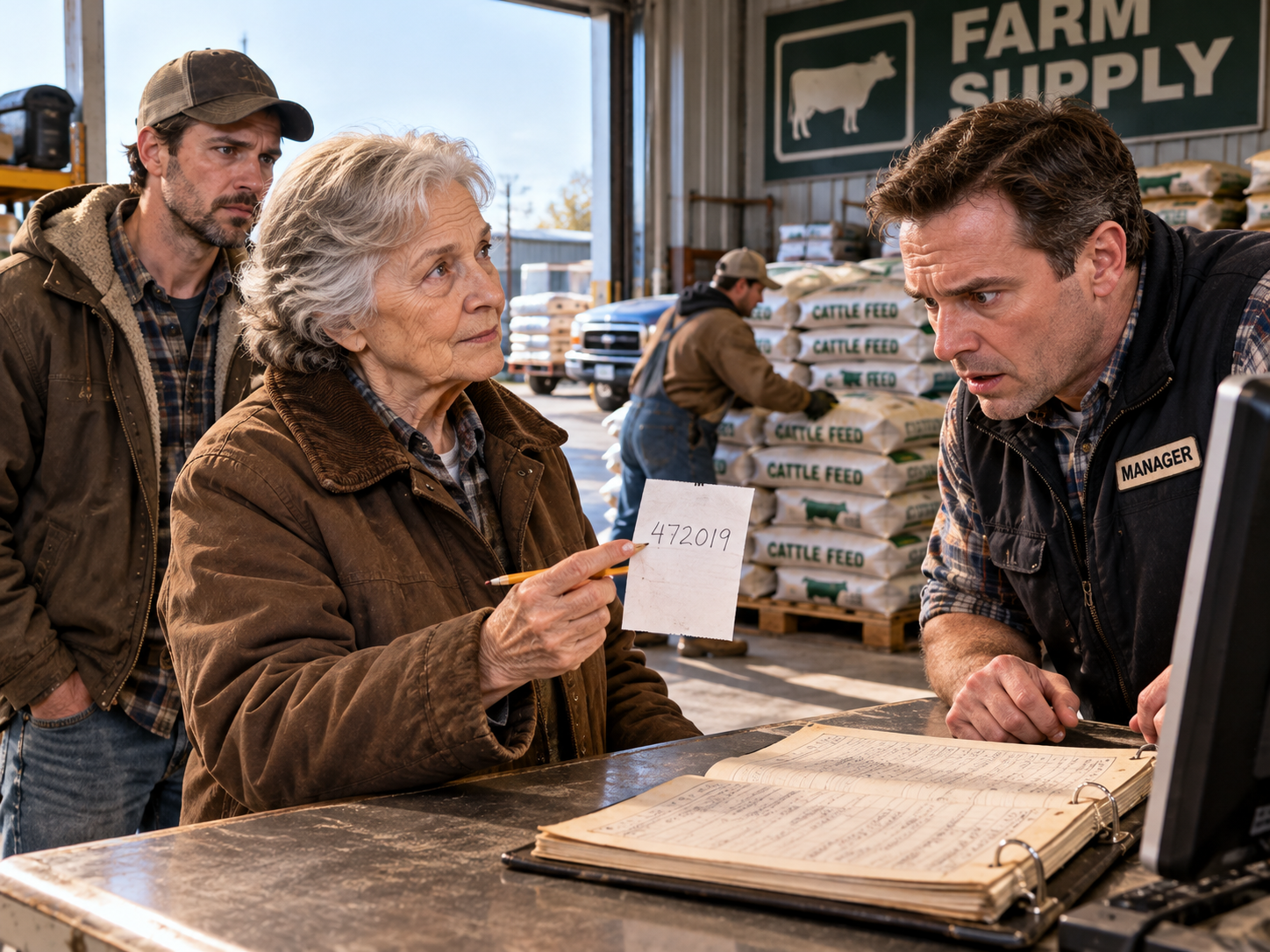
The story did not spread through Redfield the way I expected. There was no announcement over the local radio, no dramatic confrontation at the store, and no crowd waiting to hear what had happened. People learned about it in pieces, mostly through ordinary conversations. Someone heard that Travis had corrected a mistake. Someone else heard that an old agreement had been found in the store’s records. A farmer who had known my father asked Mom about it while buying fencing supplies. The details changed slightly from one telling to another, but the central fact remained: the store had discovered an old commitment and agreed to honor it within its terms.
Mom refused to embellish the story when people asked. If someone suggested that she had uncovered a hidden fortune, she corrected them. If someone said the store had been forced to give our family special treatment, she explained that we had paid the posted price for the feed. If anyone asked whether we now had a permanent right to the store’s supplies, she told them the agreement did not say that. She was patient with questions, but she would not allow a useful lesson to become a false story about our family.
I found her approach frustrating at first. Part of me wanted people to understand how close we had come to being left without feed because a larger buyer offered more money. I wanted them to know that Mom had remembered a promise no one else could find. I wanted the store’s mistake to be acknowledged clearly, without the edges softened by politeness. But Mom reminded me that correcting the record was not the same as punishing everyone who had misunderstood it. Travis had accepted responsibility, Martin had reviewed the documents, and the procedure had changed. She saw no reason to turn a resolved dispute into a lasting feud.
The first sign that the changes mattered came the following week, when I stopped at the store to pick up a replacement part for a piece of equipment. Two customers were discussing a shipment of basic supplies that had arrived smaller than expected. Travis was checking the inventory list, and an employee stood beside him with a clipboard. Before deciding how to divide the remaining stock, Travis asked the employee whether any customer commitments applied. The employee said he had checked the records and found none relevant to that particular shipment. Travis reviewed the list himself, confirmed the result, and then made the allocation.
It was an ordinary transaction, not a test arranged for our benefit. Nobody mentioned Ruth Carter or the six numbers. Nobody applauded Travis for following a procedure. He simply checked the facts before making a decision. That was the kind of change Mom had wanted, although she never saw this particular moment. I did not tell her about it that evening because I was not sure she would consider it worth mentioning. She might have said it was exactly what the store should have been doing all along.
A few days later, a farmer named George Benton asked me whether the old agreement meant that small farms had some kind of priority over large operations. George had known our family for years, and he was not trying to start an argument. He was worried about supply shortages and wanted to know whether the store had changed its rules in a way that might affect him. I told him what I understood: the agreement applied to a defined situation involving essential supplies, shortages, and established local customers. It was not a general rule that small farms always came first. If he had a question about his own arrangements, he needed to ask the store directly.
George considered that for a moment. “So it isn't about being small,” he said. “It's about whether they already promised something.” I told him that was closer to it. He thanked me and went on with his day. I was relieved. I had no wish to become the unofficial interpreter of an agreement I had not written and was not qualified to expand. The documents had already been reviewed by the person responsible for that work. Our role was to explain what we knew without pretending to know more.
At home, Mom continued the routines she had followed for years. She checked the feed, recorded purchases, and kept an eye on the weather. She did not bring the agreement to the kitchen table every night or speak about Walter Miller as though he had left behind a treasure map. If anything, she talked about him less than I expected. When his name came up, she remembered a practical man who had faced difficult decisions and understood that a local business could not survive by treating every relationship as a fresh negotiation.
My father had understood the same thing. During the hard season thirty-two years earlier, he and Mom had helped Walter when the store was struggling. They had not done it because they expected to control the business forever. They had done it because the store mattered to the farms around it, and because Walter had been willing to put his commitment in writing. The agreement had grown from a relationship of mutual need, not from a desire to place one family above another. Remembering that history helped me understand why Mom was so careful not to claim more than it promised.
One afternoon, I found her reviewing the copies Martin had prepared. The pages were in a plain folder, protected from the dust and moisture that found their way into almost everything on a farm. She had marked no dramatic passages, drawn no angry circles around the manager’s mistake, and written no demands in the margins. Instead, she had placed a small note on the front identifying the six-number reference and the related documents. It was simple enough that someone unfamiliar with the story could understand where to begin.
“Do you think this will be enough?” I asked.
“Enough for what?” she replied.
“For someone who finds it years from now.”
She adjusted the folder on the table. “It will help them find the other papers. Then they will have to read them.” She said it without sarcasm. She knew that no note could make another person responsible, honest, or attentive. It could only make the information easier to locate. The rest depended on whoever came next.
I had always thought of my mother’s memory as the strongest part of her. She remembered dates, prices, old agreements, and conversations that other people had long forgotten. But after watching her handle the store dispute, I realized memory was only one part of it. She also knew when to insist, when to wait, and when to stop. She had waited while Martin examined the records. She had insisted when the store’s decision threatened an existing commitment. And once the feed had been sold to us and the agreement documented, she stopped asking for more.
The larger commercial farm that had offered the higher price did not disappear from the store’s business. Its people continued buying supplies, and Travis continued serving them. The store did not punish them for making an offer, because the problem had not been that they wanted the feed. The problem had been the manager’s decision to redirect the last available stock without first checking whether a prior commitment applied. That distinction prevented the dispute from turning into a contest between families or farms. It kept the responsibility where it belonged: with the person who had made the decision.
I saw the value of that distinction when another customer mentioned the incident at the counter. He called the larger buyer greedy, and Travis gently corrected him. The buyer had made a commercial offer, Travis explained, and there was nothing inherently wrong with that. Travis had been responsible for checking the store’s obligations before accepting it. The customer seemed surprised by the answer, then shrugged and returned to his shopping. I admired Travis for saying it. He could have protected himself by blaming the other farm, but he did not.
The correction did not erase what had happened to us. Mom had still faced the possibility of going home without the feed she needed, and the store had still nearly disregarded an agreement that had survived for more than three decades. But accepting responsibility did not require inventing a second wrong to balance the first. Travis had made a mistake, acknowledged it, and changed his process. That was not the same as pretending nothing had happened. It was what made the apology worth something.
By the end of the month, the incident had become less interesting to the town. People had other concerns: machinery failures, changing prices, sick animals, delayed deliveries, and the weather that seemed to change its mind every few hours. I was glad. A dispute did not have to remain a public spectacle to matter. The result that mattered most was invisible to anyone who had not been involved. The store now had a clearer way to identify and review old commitments before making certain inventory decisions.
One evening, while we were checking the cattle, my brother asked whether Dad would have been surprised that the agreement had been forgotten. Mom thought about it before answering. “He would have been disappointed,” she said. “But he would also have known that people forget things. That is why he wanted the agreement written down.” She looked toward the barn, where we had stored the feed purchased that difficult week. “Writing it down was his way of helping people remember when he could no longer be there to explain it.”
I carried that thought with me long after the conversation ended. My father had not been able to guarantee what the future would bring. He could not have predicted who would manage the store decades later, what systems they would use, or which old records would be misplaced. He could only do what was possible at the time: make the arrangement clear, put it in writing, and trust that the people who came after him would take the trouble to understand it.
The six numbers had not changed in thirty-two years. The paper had yellowed, the ledger had gathered dust, and the people who remembered the original agreement had grown older or passed away. Yet the numbers still connected the records, and the records still explained a commitment that mattered. The discovery had not made the past perfect. It had simply made the past available to the present.
Mom never asked the town to praise her. When people thanked her for reminding the store of its agreement, she said that Walter had kept good records and that Martin had done the work of reviewing them. She shared credit easily, but she did not surrender the point. The store had a responsibility to honor the commitment once it was understood. Our family had a responsibility to tell the truth about what it did and did not mean. Neither responsibility required applause.
By the time the next month began, the story had become part of the ordinary history of our farm. We remembered the freezing rain, the canceled receipt, and the six numbers that had made Travis look twice. We also remembered that the twenty bags were purchased at the posted price, carried home, and used to keep the cattle fed. The practical problem had been solved, and the old agreement had a place in the store’s records again. Nothing about that was spectacular. That was precisely why it mattered.
Click here to continue reading: PART 11: THE MEANING OF SIX NUMBERS
The Store Manager Took Back My Mother’s Last Twenty Bags of Cattle Feed, Until Six Numbers on a Receipt Changed His Expression
Part 10 of 20

