
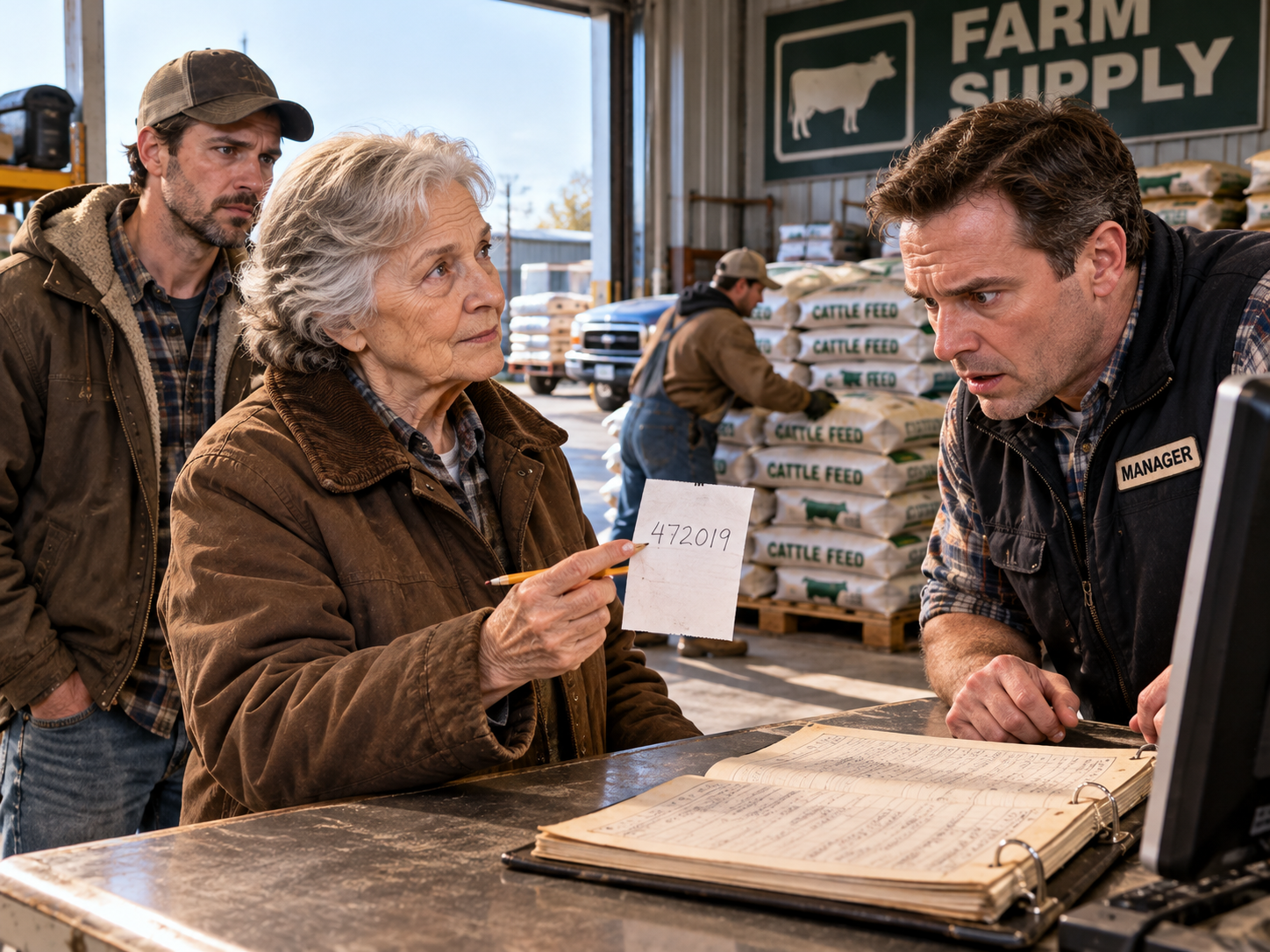
By the time the farm’s busiest spring preparations began, the November incident had become part of the past in the ordinary sense. We remembered it, but we no longer organized our days around it. The cattle were fed, equipment was being prepared, and orders were placed according to the work ahead. When I went into town, I thought about the supplies I needed rather than the old agreement. The store had preserved the records, and I had no reason to assume the next transaction would become another test.
I was surprised by how much relief came from that ordinary feeling. For months, I had replayed the original scene in my mind: the twenty bags on the cart, Travis canceling the sale, Mom asking for a pencil, and the six numbers appearing on the back of the receipt. I had been angry about how quickly a larger offer had displaced our need. I had also worried that the agreement might be too old, too complicated, or too poorly documented to make any difference. The resolution had answered those concerns, and the continuing improvements had made it easier to let them go.
Mom had let go much earlier than I had. She did not pretend the first decision had been acceptable, but once the store had corrected it and preserved the agreement, she stopped carrying the argument into every conversation. She could remember the mistake without needing to remain angry at the person who made it. I had mistaken that restraint for indifference at first. Now I saw that she was simply unwilling to let a resolved problem consume attention that belonged elsewhere.
One afternoon, a neighbor asked me whether the store had ever apologized publicly for what happened. I told him that Travis had apologized directly and in writing, and that the store had updated its procedure. The neighbor seemed to think there should have been more. I asked what more would have accomplished. He said it would have shown that the store understood the seriousness of its decision. I explained that the written acknowledgment and procedure were concrete signs that the problem had been taken seriously. A public statement might have satisfied curiosity, but it was not necessary to preserve the agreement.
He considered that answer and changed the subject. I did not mind. Not every conversation needed to end with agreement, and I did not need everyone in town to share Mom’s view. What mattered was that the store had recognized its responsibility and made a practical correction. The outcome did not depend on whether outsiders thought the apology had been dramatic enough.
I had learned that there was a difference between recognition and spectacle. Recognition meant acknowledging the actual mistake, reviewing the evidence, and taking steps to avoid repeating it. Spectacle meant making sure everyone saw the acknowledgment. Sometimes public attention could be necessary, especially when a problem affected many people or remained unresolved. But in our case, the agreement was specific, the feed had been sold, and the procedure had been updated. The useful work had already been done.
The next time I visited the store, Travis was helping a customer compare two types of equipment. He explained the differences, checked availability, and gave the customer time to decide. Nothing about the exchange involved our agreement. It was simply a manager helping someone make a purchase. I watched for a moment, then went to the aisle where my own supplies were kept. I no longer felt the need to measure every action he took against the mistake he had made in November.
That did not mean I trusted every decision automatically. Trust was not a switch that could be turned on because someone apologized. It grew through repeated ordinary interactions, and it could be weakened again by careless behavior. But I was willing to let Travis demonstrate that he had learned from the incident. The updated procedure gave me a reason to believe the correction was more than a temporary response to an uncomfortable conversation.
Mom continued to visit the store when she needed supplies. She greeted the employees, checked her purchases, and asked questions when something was unclear. She did not mention the agreement unless a relevant issue arose. Her behavior sent a message that the purpose of the dispute had never been to establish permanent control over the relationship. The store had responsibilities, and our family had responsibilities. Once the old commitment was acknowledged, both sides could return to doing business without treating every transaction as a continuation of the conflict.
I asked Mom whether she thought the story would still matter to anyone in ten years. She said that depended on what people learned from it. If they remembered only that an older woman had written six numbers on a receipt and surprised a manager, the story would lose most of its value. If they remembered that old commitments needed to be preserved, understood, and checked before decisions were made, then it could remain useful. The names and details might fade, but the practical lesson could survive.
I thought about that whenever I looked at the folder in our cabinet. The agreement itself was not a grand document. It did not contain sweeping declarations or promises that the store would never face another shortage. It addressed a particular relationship and a particular type of obligation. Its importance came from the fact that it had been honored when the relevant circumstances arose. A modest commitment, properly understood, could matter more than a dramatic promise that no one knew how to apply.
The financial reserve was an especially important part of the story because it could easily have led to confusion. A person looking only at the closed account might have assumed that every arrangement associated with it had ended. The closing statement, Walter’s letter, and the original agreement showed otherwise. The reserve had been temporary, its balance had been reconciled, and no debt remained. The supply commitment had been distinct. The store’s obligation was not financial repayment to our family; it was to consider the existing agreement within the circumstances it covered.
Martin’s careful review had prevented the dispute from becoming something it was not. He had not told Mom that she could demand money from the store or claim ownership. He had not promised that the agreement would guarantee every future supply. He had established the strongest conclusion the records supported: the commitment remained relevant, no signed cancellation or amendment had been located in the materials reviewed, and the store had a sound basis to honor it in the situation that had arisen. That conclusion had been enough to resolve the practical question.
I came to respect how much discipline it took to stop at the right conclusion. When a person has been treated unfairly, the temptation is to push the evidence as far as possible in the hope of securing a stronger result. Mom had resisted that temptation. She had accepted the fact that the reserve was closed and that no money was owed. She had accepted the limits of the supply agreement. She had not asked for an additional benefit because the store had made a mistake. Her request was narrow, and the result was correspondingly clear.
The store’s response had also been stronger because it remained narrow. Travis did not promise that our family would always receive scarce stock first. He agreed to check whether the old commitment applied and to honor it when it did. The store did not ban the larger commercial farm from purchasing supplies. It continued to serve all customers while preserving a specific obligation. The solution corrected the actual problem without creating a new one.
In early spring, I helped Mom sort older farm papers that had accumulated in a drawer. We found receipts for repairs, invoices from suppliers, and notes about purchases we had made years earlier. Some papers could be discarded after their information had been recorded. Others needed to stay with the documents they explained. We worked slowly, labeling folders and moving important records into safer storage. The task was not exciting, but it made the farm’s own history easier to follow.
When we finished, Mom looked at the neatly arranged files and said that paperwork was useful only when it helped someone make a decision. I asked whether she thought we had become too cautious. She said no. We were simply paying attention to what needed to be remembered. She had not kept the six numbers because she expected to use them someday. She had kept them because Walter had told her they mattered. When the circumstances finally arose, she was glad she had not dismissed them as an old detail with no practical purpose.
I understood that point more deeply now. People often keep memories because they are attached to the people involved. But records can also preserve instructions, obligations, and reasons that might otherwise disappear. The six numbers were connected to Walter, my father, and the agreement they had made. Their emotional value came from that history, but their practical value came from the way they led to the documents. Mom’s memory had preserved both meanings until the right moment arrived.
The story had become history not because everyone forgot it, but because it no longer needed to be a current dispute. We could tell it accurately without reliving the anger. We could remember the mistake without defining Travis entirely by it. We could appreciate Mom’s persistence without claiming that she had uncovered a fortune or won control over the store. We could recognize the importance of the agreement while respecting its limits.
I found that this was a more satisfying ending than the dramatic version I had once imagined. A hidden fortune would have changed our family’s financial position. A public confrontation might have made the store look bad. But neither would have addressed the real weakness that had allowed the problem to occur. The useful ending was that the agreement had been restored to the store’s working records and the next manager would have a clearer path to finding it.
The twenty bags of feed had been consumed, but their purpose had been fulfilled. They had carried the cattle through the difficult week, and they had exposed a forgotten commitment that deserved attention. The store had corrected the sale, clarified the record, and changed its procedure. Our family had continued farming. The story did not need another crisis to justify the work that had been done.
When people asked what happened in the end, I told them that Mom had remembered an old agreement and that the store had honored it after reviewing the records. I explained that the reserve was closed, that no money was owed, and that the agreement did not give us unlimited rights to supplies. I told them the store had updated its procedure so the file could be found more easily. Some people wanted a more surprising conclusion, but I had stopped trying to provide one.
The truth was sufficient. A promise had been made, nearly forgotten, and then brought back into view. It had survived because the people who made it had written it down and because Mom remembered how to find the record. It had a better chance of surviving into the future because the store had accepted responsibility for preserving it. That was the story I wanted to remember, even if it was less dramatic than the versions people might prefer.
Click here to continue reading: PART 20: THE WORD THAT OUTLASTED THE WINTER
The Store Manager Took Back My Mother’s Last Twenty Bags of Cattle Feed, Until Six Numbers on a Receipt Changed His Expression
Part 19 of 20

