
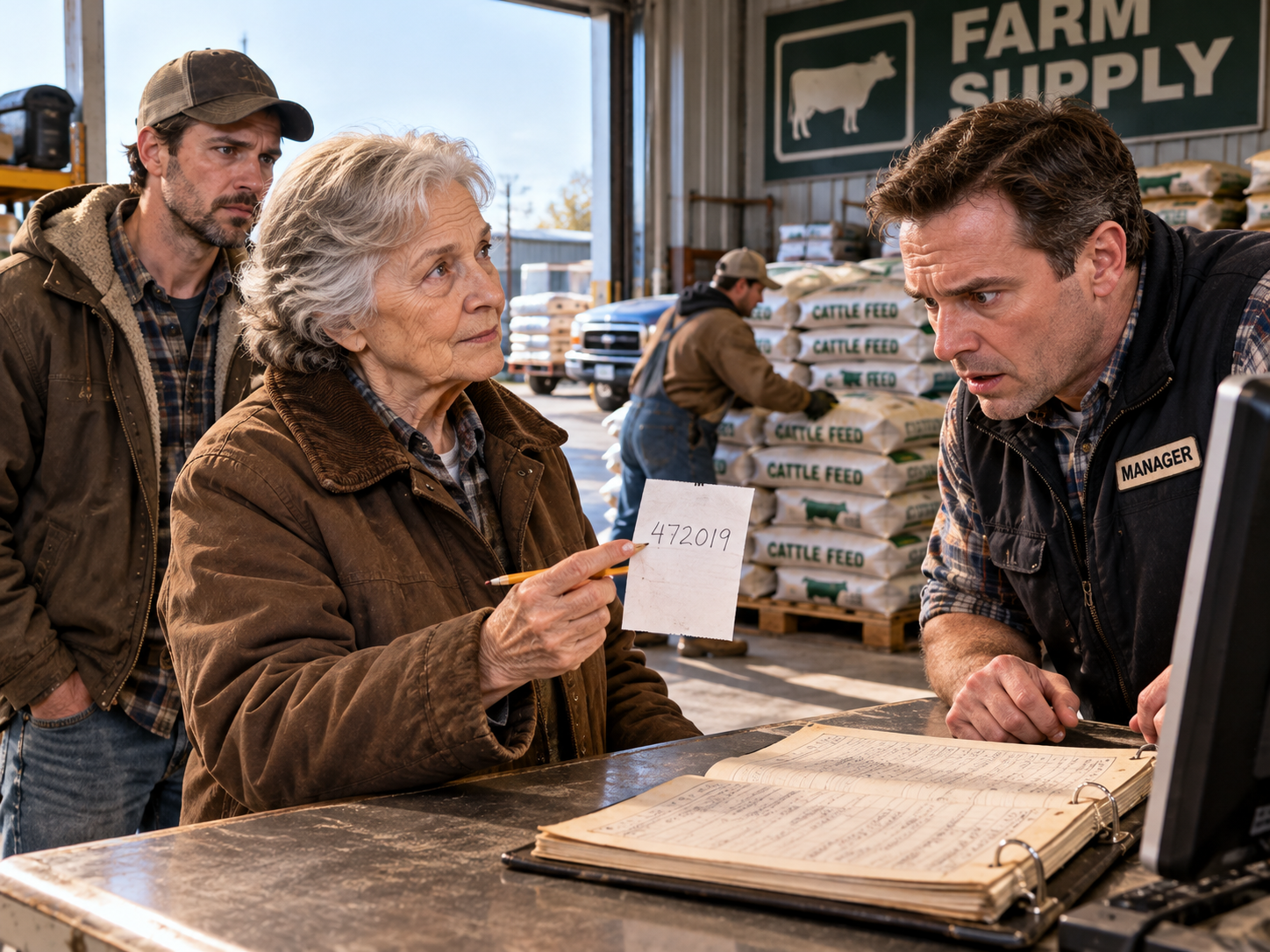
Travis's attorney did not answer on the first call. The manager paced once between the counter and his office, then stopped and tried again. Each time he returned, he looked at the ledger as though the numbers might change while he was away. My mother remained still, but I could see her watching him with the patience of someone who had waited a very long time for an answer.
The employee who had been loading our order stood near the pallet, unsure whether to continue working. Travis finally told him to keep the twenty bags together and not release them to anyone until he gave further instructions. Then he asked Mom if she would sit down.
She declined.
"I'd rather stand until we know whether we're leaving with feed."
Travis accepted that without argument. He returned to the binder and began comparing the agreement with the other entries. His attorney answered at last, and he explained the discovery in a low voice, giving the lawyer the dates and the reference number. He listened for several minutes, asked a question, and then fell silent.
When the call ended, he did not look relieved.
"My attorney says the agreement needs to be examined in full," he told us. "He can't determine its current effect from a few pages over the phone. He wants to see the original, any amendments, and the store's records of what happened afterward."
"That sounds reasonable," Mom said. "We have the original here, don't we?"
Travis looked down at the folder. "This appears to be the original agreement. But I need to confirm that nothing replaced it."
I asked whether that meant he would sell us the feed.
"It means I can't give you a definite answer until I understand what I inherited."
I felt my temper rising again. "You understood enough to take the bags away from us when someone offered more money."
He flinched slightly, but did not respond defensively. Perhaps the ledger had made it impossible for him to pretend that the morning's decision was simply ordinary business. The problem was no longer an argument about who had reached the store first. It was about whether the store had ignored an agreement that its founder had made with our family decades earlier.
Mom rested one hand on the counter.
"Travis, nobody is asking you to decide the whole history of the store before lunch. We need twenty bags. Your father made an agreement with us. If the records show that it still applies, then we should discuss how to honor it. If something changed, let's find out what changed."
He nodded, but his gaze remained fixed on the ledger.
There was another reason for his hesitation. The commercial farm that had offered more money was not a stranger buying a few bags. It was a large operation that purchased supplies from the store in bulk and had recently become one of its most important accounts. Travis had been trying to keep that customer happy, and losing the order could mean losing future business.
He explained that the customer had already arranged transportation and expected the remaining stock. He had accepted the higher offer because he believed it was the best decision for the store. He had not thought the old agreement was relevant to a routine sale.
"Then you should have checked before changing our order," I said.
"You're right about that," he replied.
His admission surprised me enough that I stopped speaking. I had expected him to defend himself or accuse us of using an old document to gain an unfair advantage. Instead, he acknowledged the immediate mistake, even though he was not yet prepared to decide what the agreement required.
Mom asked him to show us the other records connected to the six numbers. Travis hesitated, then opened the smaller notebook he had brought from his office. It contained a series of entries made over several years, some in Walter's handwriting and others added by employees. Several references appeared beside the original code. One recorded a later review of the arrangement. Another indicated that the store had continued providing supplies under special terms to certain local farms during a period of shortage.
The entries did not establish that every detail of the original agreement had remained unchanged. But they suggested that the arrangement had not been forgotten immediately after Walter signed it. Someone had continued recording related transactions for years.
Travis turned another page and found a notation from the time he had taken over management. Beside it was a brief entry in his own handwriting, dated several years earlier. He read it twice, then frowned.
"What is it?" Mom asked.
He rubbed the side of his face. "I remember this account."
He explained that when he had first taken over the store, Walter had given him a list of older arrangements and warned him not to discard records simply because they looked outdated. Travis had been dealing with staffing problems, overdue invoices, and a major inventory system change. He had transferred several old accounts into a separate archive and had assumed that any arrangement requiring special treatment would be flagged in the new system.
The six-number reference had not been transferred into the modern inventory records. It remained in the old ledger, which meant Travis's current system showed the twenty bags as ordinary stock. He had seen the inventory, accepted the commercial offer, and never checked the archived records.
"Why didn't you keep the old reference with the new account?" I asked.
"I should have," he said. "I thought the archive was only for historical records. I didn't realize this one still had practical consequences."
Mom looked at the notebook. "Your father told you to preserve those records."
"He did."
"And did he tell you why?"
Travis shook his head. "Not in detail."
He looked ashamed now, not because my mother had exposed some secret scandal, but because he recognized how carelessly he had treated his father's warning. Walter had left him a business built on years of relationships. Travis had modernized its systems and pursued larger contracts, but he had assumed that anything not visible on a computer screen no longer mattered.
Mom did not lecture him. She asked whether the store's records showed any amendment to the agreement. Travis searched the notebook and then the binder, checking the years after the original date. He found references to a review, but no signed document that clearly canceled the arrangement. One entry noted that Walter had reaffirmed the store's commitment to local farms during another supply shortage. It referred to the same six-number code.
"That helps," Mom said. "But it still doesn't tell us everything."
Travis looked up, surprised that she was not claiming victory.
"I want the whole record," she continued. "Your father gave me those numbers because he wanted the agreement to survive our memories. I won't pretend I know what happened after he died. That's why we are checking."
I began to understand why Mom had not mentioned the arrangement to us during all those years. She had not been saving a secret weapon to use whenever she disliked a business decision. She had kept a promise that was meant to be used only when the ordinary way of doing things failed. The fact that she had remembered the numbers did not mean she had wanted to rely on them.
Travis asked whether she had used the reference before.
"Never."
"Not even when supplies were short?"
"No. Your father and mine understood each other. We did business normally. There was no reason to bring it up."
He studied her face, perhaps trying to decide whether she was exaggerating the history. Mom simply waited. She did not need to convince him that the agreement existed. The signatures were in front of him.
His attorney called back while we were still at the counter. Travis placed the phone on speaker after asking permission, and the lawyer requested the wording of the key paragraph. Travis read it aloud. The attorney asked about the signatures, the dates, and the later references. Then he explained that the agreement appeared to be a serious record of a prior business commitment, but its current enforceability and scope could not be confirmed until he examined the full original and the related records.
He also advised Travis not to release the twenty bags to the larger customer while the question was unresolved. The store needed to avoid creating another problem by completing a transaction that might conflict with an existing obligation. The lawyer said he would come to the store as soon as he could, provided the weather and his schedule allowed it.
Travis thanked him and ended the call.
"So the feed stays here?" I asked.
"For now," he said.
It was not the answer I wanted, but at least the bags were no longer being treated as though the higher offer had settled the matter. I glanced toward the loading door. The sky outside had turned a darker gray, and a few tiny pellets of ice clicked against the metal frame.
Mom looked at her watch. "How long before your attorney arrives?"
"About an hour, if the roads are all right."
"We'll wait."
Travis seemed surprised again. "You don't have to stay here."
"I know. But if we're going to sort this out, I'd rather do it once."
He offered us coffee. Mom accepted, and I took a cup as well. The employee brought the drinks from the break room and placed them on the counter. No one said much while we waited. The store remained open, and customers came and went, unaware that a thirty-two-year-old agreement was being reconsidered a few feet from the feed aisle.
During that hour, Travis asked Mom what Walter had been like when they made the agreement. She described him as a proud man who had been frightened by the possibility of losing the store but unwilling to admit how serious things had become. Dad had recognized the signs because our farm had faced difficult seasons of its own. He knew that when a business supplying essential goods failed, the consequences did not end with the owner.
Walter had asked Dad for help. My parents had discussed the request privately and agreed to provide financial support, along with some agricultural supplies that could help the store maintain stock while payments from other customers came in. In return, Walter wanted to make sure the store would not abandon the smaller farms that had depended on it during difficult times.
"He didn't want a favor that would make him feel indebted forever," Mom explained. "He wanted an agreement that gave everyone something useful. We helped the store get through a bad period. He promised that when supplies were scarce, the store would not let the biggest buyer automatically take everything just because that buyer could pay more."
Travis listened carefully. "Did Dad ever repay you?"
"Some of the money was repaid according to the terms. Some of the arrangement was settled through business transactions and supplies. The agreement was never meant to be an endless debt. It was meant to protect a particular way of doing business."
That distinction mattered. I had initially imagined that the ledger might show the store owed us a large sum, or that my parents had secretly owned part of the business. Neither was true. They had helped Walter stabilize the store, and the agreement had established a commitment about how the store should treat essential local customers during shortages. The six numbers pointed to that commitment.
The attorney arrived shortly before noon. He introduced himself as Martin Hale and examined the original agreement without rushing. He compared the signatures with the supporting records and read the relevant entries in the binder. Then he asked Travis to explain exactly what had happened that morning.
Travis did not leave out the higher offer or the fact that he had instructed the employee to unload our cart. He explained that he had assumed the inventory was available for sale to any customer and had not checked the archived agreement before changing the order.
Martin listened, then asked whether the commercial buyer had already paid. Travis said no. The buyer had offered a higher price over the phone, but the store had not completed a sale or issued an invoice. That meant the immediate situation could still be handled without undoing a completed transaction.
Martin explained that he would need to review the complete file before offering a final opinion about the agreement's legal effect. However, the signed document and the later references provided a credible basis for treating the arrangement seriously. The store should not disregard it merely because the reference had been omitted from the modern inventory system.
He also cautioned Mom that the agreement did not necessarily give her an unlimited right to demand stock or override every ordinary business decision. Its wording concerned essential supplies during shortages and the treatment of established local farms when larger buyers sought to take the remaining inventory. The current circumstances appeared closely related to that purpose, but the full review would determine the precise scope.
Mom accepted the explanation. "I don't need more than the agreement says," she replied. "I need the store to keep its word."
Martin closed the folder and looked at Travis. "Then the first thing to decide is whether the store will honor the commitment while we finish the review."
Travis glanced toward the pallet. He had a decision to make, and this time he could not pretend he lacked the information.
Click here to continue reading: PART 4: The Old Agreement Settled the Feed Dispute, but My Mother’s Final Question Forced the Manager to Decide What Kind of Business His Father Had Left Him
The Store Manager Took Back My Mother’s Last Twenty Bags of Cattle Feed, Until Six Numbers on a Receipt Changed His Expression
Part 3 of 20

