
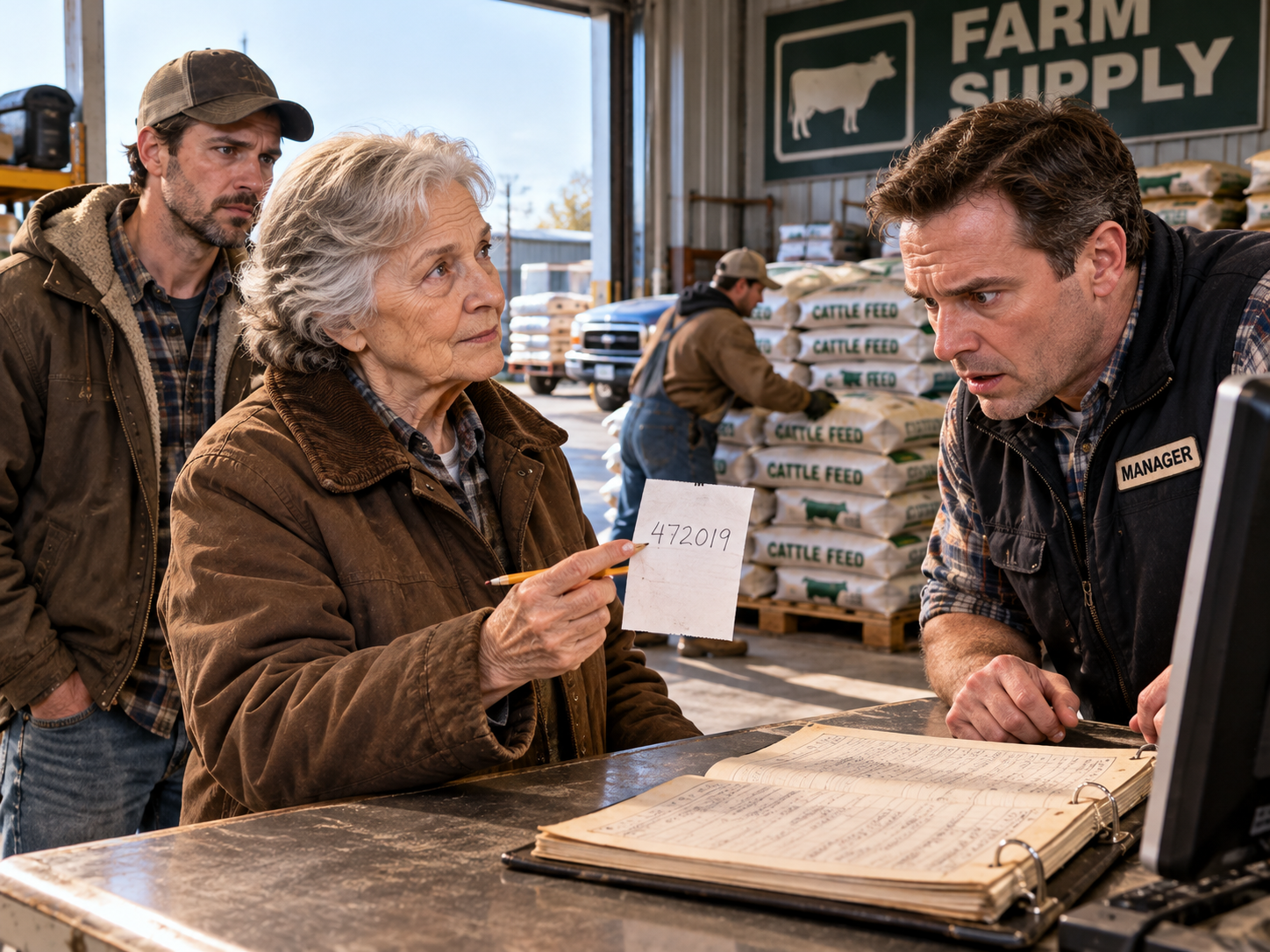
Martin Hale spent another twenty minutes reviewing the original agreement and the supporting entries. He asked Mom a few questions about the arrangement, then checked the dates against the ledger. He was careful not to promise that every clause would necessarily be enforceable in every circumstance, but he concluded that the document was genuine enough to guide the store's immediate decision while a more complete review could be made.
The agreement had been created to protect established local farming customers during shortages of essential supplies. It did not require Walter's store to operate at a loss, give my family ownership of the business, or guarantee us unlimited access to inventory. But it did record a commitment that the store would not divert the final available stock to a larger buyer solely because that buyer offered more money, when doing so would leave a qualifying local farm without essential supplies.
Our situation fit that purpose. We had arrived first, the feed was necessary for the cattle, the store had not completed a sale to the commercial buyer, and the remaining inventory was exactly what we needed to get through the week. Martin told Travis that, based on the documents he had reviewed, the store had strong reasons to honor the agreement rather than proceed with the higher offer.
Travis stared at the papers. "So I have to sell the twenty bags to Mrs. Carter?"
Martin answered carefully. "The agreement gives you a serious obligation to consider. In these circumstances, I recommend that you honor it. We can review the full legal position afterward, but there is no reason to create a dispute by ignoring the original commitment today."
For a moment, nobody moved. Then Travis stood and walked toward the loading door. He told the employee to put the twenty bags back on our cart and prepare the sale at the listed price. The young man looked relieved to have a clear instruction. He began moving the bags, one at a time, while Travis returned to the counter and asked the cashier to restore the canceled transaction.
Mom did not smile triumphantly. She simply put her gloves back on and watched the cart being filled. When the employee had loaded the last bag, she checked the labels once more. She had not come to the store to prove that she could defeat Travis. She had come because our cattle needed feed, and the store had made a commitment that mattered precisely when an ordinary customer could not compete with a larger buyer's offer.
Travis completed the sale and handed Mom the receipt. The price was the one posted on the shelf, not the higher amount the commercial farm had offered. He apologized for changing the order without checking the old records first. His apology was awkward, and it did not undo the humiliation of watching our feed taken away, but he did not add an excuse or blame the employee.
"I'm sorry, Mrs. Carter," he said. "I should have checked the agreement before I made that decision."
Mom folded the receipt and placed it in her purse. "Yes, you should have."
She did not soften the answer to make him feel better. But she also did not turn the moment into a lecture. She had what she needed, and the next step was to get the feed home before the weather worsened.
Before we left, Martin asked Mom whether she would be willing to provide a written account of the original arrangement for the store's records. He explained that the document and ledger should be preserved together, and that the store needed to establish how the agreement had been handled after Walter's death. He wanted a clear record for future managers so that the same confusion would not arise again.
Mom agreed, with one condition.
"I want a copy of everything you put in that file. Not because I'm planning to use it against the store, but because your father and my husband made that agreement for a reason. I don't want it disappearing again."
Martin said that was reasonable. He arranged for copies of the agreement, the relevant ledger entries, and the related notes to be made. He also advised Travis to update the store's records so the reference would be visible to anyone responsible for managing inventory during a shortage.
Travis nodded, though I could see that he was still absorbing the implications. He had inherited a business that looked familiar from the outside, but the ledger had shown him that some of its most important responsibilities were not visible in the modern system he relied on. The agreement did not make him a bad manager for failing to recognize it immediately. What mattered now was whether he would learn from the mistake or try to bury it again.
As the employee loaded our bags into the truck, I finally asked Mom the question I had been holding back all morning.
"Why didn't you ever tell us about this?"
She stood beside the passenger door, watching the last bag being secured. The cold wind had picked up, and the first thin flakes of freezing rain were beginning to strike the pavement.
"Because it wasn't a story I wanted to use to get special treatment," she said. "Your father and Walter made an agreement when both families were in a difficult position. They handled it honestly, and the store continued doing business with us. There was no reason to bring up an old arrangement just to remind someone that we had helped."
"But you remembered the numbers all these years."
"I remembered the promise. The numbers were only a way to find the record."
I asked why she had decided to use them that morning rather than simply drive to another supplier.
Mom looked at me. "Because the next supplier is forty miles away, the weather was turning, and the manager had taken back the last feed we needed after we had already begun the purchase. I wasn't going to use an old agreement over a small inconvenience. But when he decided that a bigger offer mattered more than a commitment his father had made, I knew it was time to check whether the promise was still there."
Her answer made me reconsider the way I had interpreted her calmness. I had thought she was simply refusing to argue with Travis because she did not want a confrontation. In reality, she had been deciding whether the situation had crossed the line that Walter had asked her to remember. She had not used the numbers to threaten him. She had used them to ask whether the store still intended to honor its own history.
We climbed into the truck, and I started the engine. Through the windshield, I watched Travis standing near the loading door, speaking quietly with Martin. He looked toward us once and raised a hand. Mom returned the gesture, then turned to watch the road as I pulled out of the parking lot.
The drive home was slow. The weather had begun to turn, and the pavement looked slick in places. I kept both hands on the wheel while Mom held the receipt in her lap. She seemed tired now that the immediate problem had been settled. Her shoulders had relaxed, and she was looking out at the fields passing beyond the roadside ditches.
After several miles, she said that Walter had once told Dad he was afraid the store would eventually become a place where only the biggest customers mattered. Dad had replied that a business could grow without forgetting the people who had helped it survive. Their agreement had been a practical way to preserve that principle, not a demand that the store remain unchanged forever.
"Your father understood that large orders keep a business going," Mom said. "He wasn't against making money. He just believed that when supplies are limited, a store should remember the people who depend on it for their ordinary needs. Otherwise, the little farms are always the ones left driving farther, paying more, and hoping somebody has a few bags left."
I thought about the commercial buyer. It had offered more money because it could afford to, and Travis had accepted because the offer seemed good for his business. There was nothing inherently wrong with a larger farm negotiating a price. The problem was that the store had already begun serving another customer and had an older commitment specifically intended to prevent this kind of outcome during shortages.
By the time we reached the farm, the freezing rain had become steady enough to coat the truck's mirrors. My brother was waiting near the feed shed, having moved the cattle closer to their winter feeding area. He helped me unload the bags while Mom went inside to check the afternoon schedule. The cattle had their feed before the weather made the roads more dangerous, and that simple fact mattered more than the satisfaction of having won an argument.
That evening, Mom placed the receipt beside the copy of the agreement Martin had arranged to send us. She studied the six numbers once more, then tucked the receipt into the folder. She said she would keep it with the other records, not as a trophy but as a reminder that a promise only remained useful when someone was willing to look for it.
Over the next several days, Martin completed his review of the store's records. The evidence supported the conclusion that Walter had established the agreement with my parents and that later entries showed the arrangement had been carried forward rather than expressly canceled. The legal review confirmed that the store needed to respect the agreement within its stated scope, while also recognizing its limits. It was not an ownership interest in the business or a guarantee of every product under every circumstance. It was a defined commitment concerning essential supplies and the treatment of established local farms during shortages.
Travis met with his staff and updated the inventory procedures. The six-digit reference was entered into the store's records, along with a note directing managers to consult the archived agreement before diverting the last available stock of essential goods during a shortage. He also reviewed other old customer arrangements to make sure there were no similar commitments hidden in files that the modern system did not recognize.
A week later, Mom returned to the store to buy fencing staples and a bottle of livestock medicine. I offered to go with her, but she said she could manage the short trip herself. When she returned, she told me Travis had greeted her at the counter and apologized again for the way he had handled the feed order. He had not tried to make a public display of his regret or asked her to reassure him that everything was forgiven.
He had simply asked whether she had received the copies of the agreement and whether the cattle had enough feed for the week.
"That's a better question," she said.
The larger commercial farm did not become our enemy, and the store did not collapse because it sold us twenty bags at the posted price. The immediate decision cost the store the chance to earn more on that particular sale, but it preserved something more important: the credibility of a commitment made when the business needed help. Travis later explained to the customer that the stock had been subject to a prior arrangement and that he had made a mistake by offering it before checking the records. The customer was unhappy, but the matter did not turn into the disaster he had feared.
As winter settled in, the farm returned to its familiar routine. My brother and I handled the heavier jobs, Mom kept the accounts, and the cattle were fed on schedule. The old agreement stayed in our records, and the store kept its updated reference where future managers could find it. Nobody treated Mom as a person who could demand anything she wanted, and she never used the document to claim more than it promised.
One evening, while we were sorting paperwork at the kitchen table, I asked whether she thought Walter had expected the agreement to be used thirty-two years later.
She smiled faintly. "I think he hoped it wouldn't have to be. But he knew people forget things when the people who made them are gone."
She put the folder away and turned back to the household accounts. There was no dramatic speech, no celebration, and no demand that the store recognize her publicly. She had wanted the feed, an honest answer, and the fulfillment of a promise that had survived longer than the men who made it.
I finally understood why she had written the six numbers without raising her voice. She had not needed to threaten Travis, shame him, or tell him what his father would think of him. She had given him a way to find the truth in his own family's records. What he did with that truth was his responsibility.
The next time we visited the store, the twenty bags of cattle feed were no longer the story anyone needed to tell. The important part was that a manager had discovered his father's promise before making a second mistake, and that my mother had insisted the promise be treated as a real responsibility rather than a convenient memory.
Dad and Walter had made their agreement in a difficult season, believing that a local business could serve its community without abandoning the practical realities of making a living. Thirty-two years later, the ledger gave that belief a place to stand. Mom did not ask for special treatment. She asked the store to remember what it had already agreed to do.
And, in the end, it did.
Click here to continue reading: PART 5: A Week After the Feed Dispute, Another Entry in Walter’s Ledger Raised a Question About Who Had Benefited From the Old Agreement
The Store Manager Took Back My Mother’s Last Twenty Bags of Cattle Feed, Until Six Numbers on a Receipt Changed His Expression
Part 4 of 20

