
The following spring, when the ground finally began to soften and the farm’s schedule shifted toward the next season, I realized that I had stopped thinking of the store incident as something unfinished. It had become a complete chapter in our family’s history. The feed had been purchased, the cattle had been cared for, and the old agreement had been documented and returned to the store’s working records. Nothing remained that required Mom to argue, Travis to apologize again, or Martin to reopen the same review.
That did not mean the agreement had expired. It remained a commitment concerning essential supplies during qualifying shortages, subject to its original scope and any valid amendment. The financial reserve was a separate matter. It had been closed and reconciled, and its remaining balance had returned to the store’s operating funds. Our family had no outstanding claim to that money. The supply commitment continued to matter because the records showed that it had been intended to continue separately from the temporary reserve.
The distinction was easy to explain now, but it had taken careful work to establish it. The six numbers had led Travis to the ledger. The ledger had connected the reference to the agreement. Walter’s letter had explained the relationship between the reserve and the continuing commitment. The closing file had confirmed that the reserve had been settled. Martin had reviewed the evidence and advised the store to honor the agreement within its terms. Each step had answered a different question, and none had required us to claim more than the documents supported.
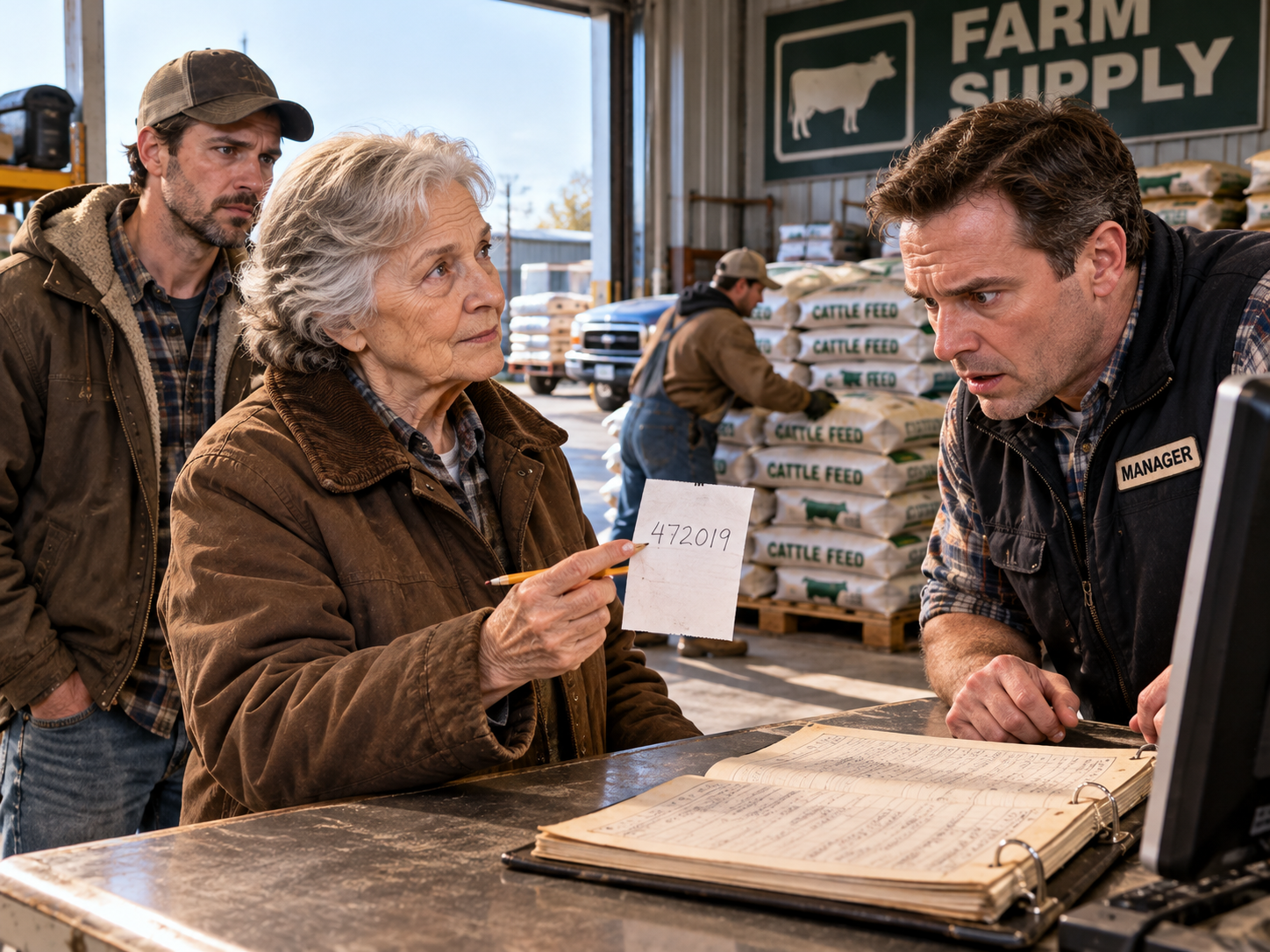
I often returned in my mind to the moment when Mom asked Travis for a pencil. At the time, I had thought she was preparing to write a complaint or record the canceled transaction. Instead, she had written six numbers that seemed meaningless to everyone except her. She had not raised her voice or threatened legal action. She had simply directed the manager toward a record he did not know he needed to find. That quiet action changed the direction of the morning because it made the forgotten agreement impossible to ignore.
The numbers had not been magic. They had not forced the store to do anything, and they had not established ownership or a claim to hidden money. Their importance lay in their connection to the documents. Once the documents were found, the issue could be examined on its merits. The store had a commitment, the commitment applied within a defined scope, and the original decision had been made without checking whether it mattered. The proper response was to review the agreement and correct the decision if its terms applied.
Mom had been right to insist on that review, but she had also been right to stop when the review was complete. She did not demand that the store pay her for the stress of the morning. She did not ask for free supplies or special treatment. She did not claim that the reserve account was still hers. She accepted the findings and the limits of the agreement. Her goal had never been to win as much as possible. It had been to ensure that the promise was honored.
I had learned something from her restraint. At first, I wanted a result that would make the seriousness of the mistake unmistakable to everyone. I wanted a public acknowledgment and a consequence that would show no business could simply put a higher offer above a commitment. But the store’s corrected procedure did more to address the actual problem than public embarrassment would have done. It gave future managers a way to identify the agreement before making a similar decision. The change was quieter, but it was more useful.
Travis had learned something, too. He could not know every conversation his father had held decades earlier, and he could not be expected to remember every arrangement without records. But he was responsible for the business he managed and the obligations it had inherited. Once the agreement came to his attention, he had to examine it carefully, accept the evidence, and make sure the file was easier to find in the future. He had done that work. I did not need to pretend his first decision had been harmless to recognize that his response mattered.
The larger commercial farm remained a customer. The store continued selling supplies to businesses of every size, and the old agreement did not turn every transaction into a competition between small farms and large ones. It required the store to consider a specific prior commitment when the relevant circumstances arose. That was all. The solution did not require the store to ignore price, abandon ordinary business practices, or deny every larger buyer a purchase. It required the manager to account for an obligation already on the books.
Martin’s careful review had kept the story grounded in those facts. He had not promised that the agreement could never be challenged or that no missing document could exist elsewhere. He had explained that no signed amendment or cancellation had been found in the records reviewed and that the evidence supported honoring the commitment in this case. He had made sure the store preserved the relevant papers and understood the limits of what they established. His caution had been part of the solution, not a weakness in it.
I thought about that when I watched Mom review her farm accounts. She was exact about numbers and careful with records, but she never confused a record with a guarantee. A receipt could show what had been purchased. A contract could show what had been promised. Neither could control every future circumstance. What mattered was having the right information available when a decision had to be made. The rest depended on the people responsible for acting on it.
The folder containing our copies remained in the cabinet. The receipt with the six numbers was still there, beside the agreement and the written acknowledgment. We had made a second copy and stored it separately. The store had kept its own file and added the reference to its index. We did not check the folder every week, and we did not ask Travis to confirm its existence whenever we visited. The records were preserved, and the procedure was in place. We could return to our ordinary lives without treating the agreement as a daily concern.
One afternoon, Mom and I sat at the kitchen table after finishing the day’s accounts. I asked whether she ever wished she had used the six numbers earlier, perhaps when the store first began changing its systems or when Walter’s generation passed away. She shook her head. “There was no problem that required them before,” she said. “And I did not know what the store’s records looked like until Travis went searching.” She had not been waiting for a dramatic moment. She had simply remembered a reference that became necessary when the ordinary path failed.
She also reminded me that the agreement had been made for a reason. Walter and my parents had wanted a local store to remain useful to the farms that depended on it. They had helped one another during a difficult season and written down a commitment intended to guide future decisions. The arrangement was practical, not grand. It did not guarantee that the store would never struggle again or that every farm would always receive everything it needed. It reflected a belief that business relationships included responsibilities that could not always be reduced to the highest offer.
That belief had survived the winter because the records were still there. The reserve had served its temporary purpose and been settled. The continuing commitment had remained separate. The six numbers had linked the papers, and Mom had remembered them. Once the store understood the distinction, it could honor the agreement without treating the closed reserve as an unpaid debt or granting our family rights it had never received. The truth was not complicated once all the relevant documents were read together.
As the season advanced, I found myself paying more attention to the promises I made. When I agreed to deliver something by a certain time, I wrote down the arrangement. When I told my brother I would handle a repair, I made sure he knew what I had promised and when I expected to finish. These were small habits, but they helped prevent the sort of confusion that can grow when people remember the same conversation differently. Mom did not need to tell me to do it. The lesson had become part of how I approached my work.
My brother adopted some of the same habits, though he still joked that we were turning the farm into an office. I reminded him that we had always kept accounts; we were simply becoming more deliberate about preserving information that might matter later. He admitted that written delivery details had already helped us avoid a misunderstanding with a supplier. We laughed about it, and the conversation ended there. The lesson did not need a speech. It showed its value in ordinary work.
I came to see that this was the best kind of legacy: not a story that required people to admire the past, but a habit that helped them make better decisions in the present. My father and Walter had left an agreement. Mom had preserved its reference. Travis had put the document back into the store’s procedures. Martin had clarified what the records did and did not prove. The people who came after them had a better chance of understanding the commitment without knowing the original families.
I could not guarantee that the store would never overlook the agreement again. No one could guarantee that. A future manager might change the inventory system or reorganize the archives. The store might face circumstances no one had anticipated. But the records were clearer now, and the process was better. If a question arose, the people responsible would have a starting point. That was more meaningful than an assurance that nothing could ever go wrong.
The story also reminded me that fairness does not always mean giving everyone the same thing. It means making decisions with the relevant obligations and circumstances in view. The larger customer’s offer mattered as a business consideration. Our need for feed mattered because we were an established local farm, and the store had a specific commitment that applied to qualifying shortages. The correct decision was not based on which family was more sympathetic or which customer was more powerful. It was based on the agreement and the facts of the situation.
Mom had never asked the store to favor her because she was seventy-four years old or because she had known Walter. Her age did not create the commitment. Her relationship with Walter helped explain why she remembered it, but the written agreement established what the store had promised. That distinction was important to her. She wanted the store to honor the document, not to make an exception out of pity or personal loyalty. The promise deserved consideration because it existed, not because she could tell a moving story about the people who had made it.
When I look back on that November morning now, I remember how ordinary everything had seemed at first. We needed twenty bags of cattle feed. The store had twenty bags available. An employee began loading them, and we expected to pay the posted price and leave. Then Travis canceled the sale because a larger customer offered more money. The situation became serious only when the ordinary transaction revealed a forgotten obligation. Mom’s six numbers brought the record into view, and the record changed what the store needed to consider.
The outcome was not a hidden fortune or a dramatic victory over a dishonest business. It was a corrected sale, a clarified agreement, and a better procedure. The reserve was closed, and no money was owed to our family. The continuing supply commitment remained relevant within its original scope, and no signed cancellation or amendment had been found in the records reviewed. The store acknowledged the mistake, preserved the documents, and continued serving all its customers. Our family went back to farming.
That is why I no longer think the story needs another twist. The promise did not need to reveal a secret ownership stake or lead to a new confrontation. It had already done what it was meant to do. It had helped our family obtain essential supplies in a difficult week and reminded a business to consider its existing obligations before making a decision based solely on a higher offer. The lasting result was not a reward. It was the restoration of a commitment that had nearly been forgotten.
The years may eventually carry away the details of that morning. People may forget how the receipt looked, how Travis reacted to the numbers, or how long Martin spent reviewing the old records. But the agreement remains in the store’s archive, and our family keeps its copies. If the relevant circumstances ever arise again, the people responsible have a way to find it. If they never do, the promise can remain quiet, as it should.
Mom never asked the store to remember her family as heroes. She only asked it to remember its own word.
The End
Read more original stories on Feel Every Story.
The Store Manager Took Back My Mother’s Last Twenty Bags of Cattle Feed, Until Six Numbers on a Receipt Changed His Expression
Part 20 of 20

