
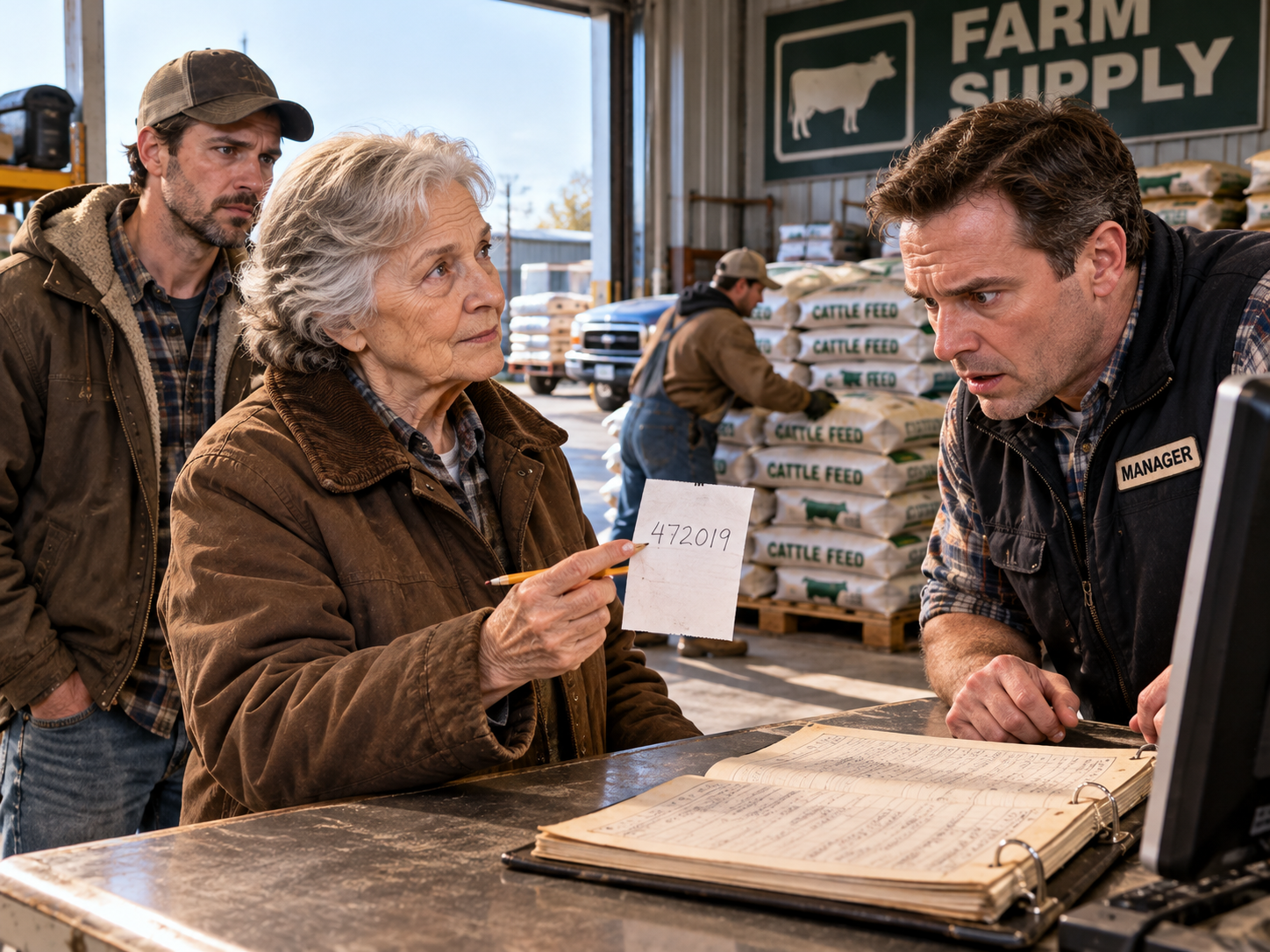
Martin did not read the rest of Walter's letter immediately. He first explained that the reserve account had been closed during a later restructuring of the store's finances. The closure itself was documented, but he had not yet finished tracing every transaction associated with it.
Mom asked whether the letter showed that the reserve had been created with our family's money.
Martin said the records supported a connection to the original assistance, although he wanted to compare the amounts and dates before making a definitive statement about the precise source of every deposit. The store had operated through several difficult seasons, and more than one transaction might have passed through the account.
"That's fair," Mom said. "Let's read what Walter wrote."
Martin continued. Walter's letter explained that the reserve was intended to help the store keep essential supplies available when ordinary inventory became unreliable. The arrangement had been developed after the store nearly ran out of cash during a difficult season. Walter did not want to borrow repeatedly whenever several customers fell behind on payments, nor did he want to abandon local farmers when large orders threatened to empty the shelves.
The letter referred to my parents' assistance as the foundation for the reserve, but it also made clear that the money was to be managed by the store. The purpose was not to create an account that my family could withdraw from at will. It was to support a specific business commitment.
I felt a strange mixture of relief and disappointment. Relief, because the letter confirmed that Mom's understanding had a documented basis. Disappointment, because I had half expected the old records to reveal a hidden fortune or some dramatic financial claim. Instead, they showed something more ordinary and more consequential: people had made an agreement, written it down, and expected later generations to respect it.
Martin turned the page.
The final paragraph referred to the six-digit code as a reminder that the reserve was connected to the store's commitment to established local farms. Walter had instructed the bookkeeper to preserve the related records and to ensure that any later manager understood the conditions under which the reserve had been created.
Travis read that paragraph silently after Martin finished. His face tightened.
"My father left me the account books," he said. "I thought I had reviewed everything important."
Mom answered gently, "You reviewed the records you knew how to look for. You didn't know what you were looking at here."
Travis did not seem comforted. He said he had spent years modernizing the business, replacing old procedures, and trying to make the store more competitive. He had believed that his father's handwritten ledgers were mostly historical records, useful for understanding the past but not for managing the present.
Martin reminded him that the letter had explicitly instructed future managers to preserve the connection. The failure was not necessarily deliberate, but the instruction had not been carried into the modern system. That omission had allowed Travis to make the decision about our feed without knowing the full background.
"I didn't know the agreement applied," Travis said.
"You didn't know because you hadn't checked," I replied.
He looked at me but did not argue. The truth was uncomfortable, but there was no benefit in pretending otherwise.
Mom placed the signed agreement beside Walter's letter. "Your father made sure this could be found. That's why he gave me the numbers. He wanted a way to connect the promise to the records, even if people forgot the story."
Travis asked whether Mom had ever discussed the reserve with Walter after the original agreement was signed. She said they had spoken about the arrangement occasionally, but never as a demand for special treatment. When the store was doing well, the agreement remained in the background. When supplies were available, she bought what she needed at the posted price and paid her bills like any other customer.
"So why didn't you tell me about it when I took over?" Travis asked.
Mom looked at him steadily. "Because Walter never told me he had failed to explain it to you. I had no reason to assume the records were being ignored. You were his son. I thought he had given you what you needed."
Travis lowered his eyes. I could tell that the answer hurt him more than any accusation would have. He had spent years believing he had inherited the store's responsibilities along with its inventory and customer accounts. Now he was discovering that one of those responsibilities had been preserved in a form he had never fully understood.
Martin explained that the next task was to reconstruct the reserve account's closing transactions. The letter did not establish that money remained owed to anyone, and the account had been closed long before the current feed dispute. But its history could show whether the store had fulfilled the original purpose and whether the related obligations had been properly carried forward.
Mom agreed that the review should continue. She did not ask Martin to reopen the account or calculate a payment to our family. She wanted a clear record of what had happened, including whether Walter's promise had been honored after he was gone.
Before leaving, Travis asked Mom if she would be willing to return once the review was complete. He said he wanted to hear her recollection of the old arrangement and make sure the store's records reflected it accurately.
"I'll come," she said. "But don't make my memory the only record. You have the documents. Keep them where the next person can find them."
That evening, Mom and I sat at the kitchen table with the copy of Walter's letter. She told me more about the winter when the store had nearly failed. Dad had come home one night and explained that Walter was struggling to meet his obligations. Several customers had delayed payments, suppliers were demanding cash, and the store had been forced to choose between buying enough inventory and keeping its bills current.
Dad believed the store mattered to the whole area. If it closed, small farms would have to travel farther for everyday supplies, and emergency purchases would become more difficult. Mom had agreed to help because they had the resources at the time and because Walter was willing to make a clear agreement about how the support would be handled.
"They weren't doing charity," she said. "They were helping each other stay in business."
I asked whether she had worried about the risk.
"Of course. Your father and I discussed it carefully. We couldn't afford to lose everything we had, and Walter knew that. That's why we wrote the agreement down. Trust doesn't mean you avoid paperwork. It means you write down what you agree to, then honor it."
Her answer stayed with me. I had always associated trust with knowing someone well enough not to need formal arrangements. Mom saw it differently. A written record was not an insult to a relationship; it was a way to protect the relationship from confusion later.
The following week, Martin sent a preliminary summary of the reserve account's history. It showed that the account had supported inventory purchases during several shortages and that the store had continued recording transactions linked to the six-digit reference. However, the final closure entry contained a cross-reference to another file that had not yet been located.
Travis was the one who called Mom with the update. He said he had spent the morning searching through the older filing cabinets and had found references to a closing statement prepared when Walter's estate was being settled. The statement appeared to have been reviewed by an accountant, but the supporting schedule was missing from the file.
Mom asked him to send the reference to Martin.
He did so immediately.
I was impressed by the change. A week earlier, Travis had treated our request as an obstacle to a more profitable sale. Now he was actively searching for records that might complicate the story further. He was no longer trying to close the matter as quickly as possible. He wanted to know what his father had done and whether the business had fulfilled its obligations.
The accountant who had prepared the closing statement was retired, but Martin managed to contact his former office. The firm still held an index of older files, though the original supporting schedule would need to be located in off-site storage. Martin explained that it could take several days.
Mom was willing to wait. The immediate feed dispute had been resolved, and there was no longer a reason to rush the investigation. She told Travis she appreciated his efforts and hoped the store would preserve the records properly when the review was finished.
He thanked her, then said something I had not expected.
"My father used to tell me that the store's reputation depended on the people who could trust it when they had no other option. I thought he meant keeping the shelves stocked and the prices fair. I didn't understand that he meant remembering the agreements behind those decisions, too."
Mom nodded. "Both matter."
When she returned home, she seemed lighter. The letter had answered one question, even as it raised another. Walter had created the reserve to support the agreement, and the records suggested that it had been used for its intended purpose. The remaining uncertainty concerned how the account had been closed and whether every related obligation had been documented.
I asked Mom whether she thought the next file would change anything important.
"I don't know," she said. "But if we want the truth, we can't stop looking just because the first answer feels comfortable."
Click here to continue reading: PART 7: The Missing Closing Statement Revealed What Happened After Walter’s Death, and Travis Had to Decide Whether to Protect His Reputation or His Father’s Record
The Store Manager Took Back My Mother’s Last Twenty Bags of Cattle Feed, Until Six Numbers on a Receipt Changed His Expression
Part 6 of 20

