
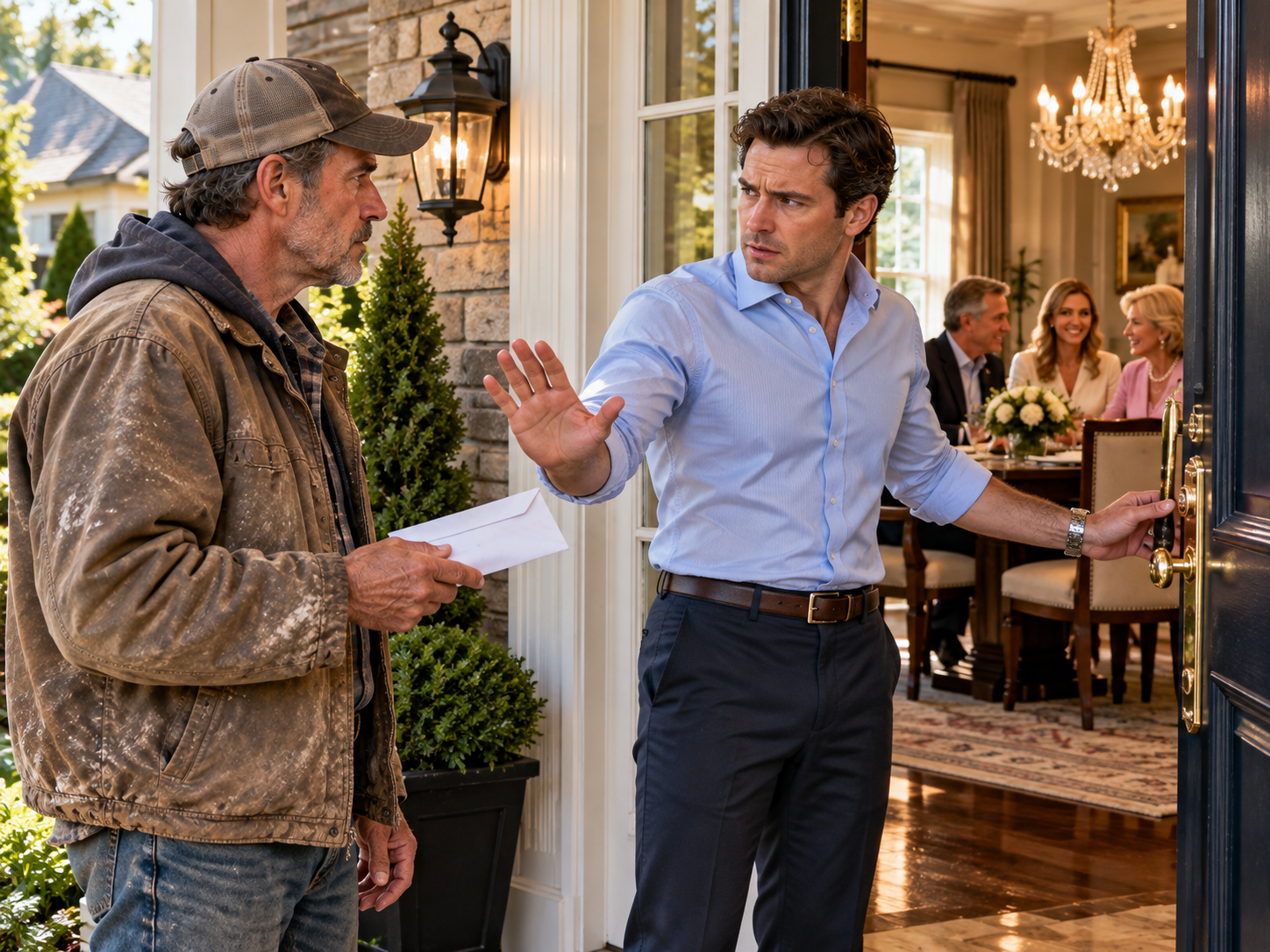
“Dad, please don’t make me ask you twice.”
My son stood between me and the front door, one hand gripping the brass handle as though the entire afternoon depended on keeping it shut. Behind him, through the narrow window beside the entrance, I could see sunlight spilling across a polished hallway. Somewhere inside, a woman laughed. A man answered her, his voice smooth and comfortable, the voice of someone who had never wondered whether he belonged in a room.
I stood on the porch holding a white envelope. I had come straight from a roofing job across town, and the wind had blown fine gray dust across my jacket. My boots carried dried mud along their seams. I knew what I looked like. I had spent thirty years working with my hands, and I had never considered honest work something to apologize for.
My son, Trent, apparently disagreed.
“I’m delivering these property documents,” I told him. “I only need a moment.”
He glanced toward the dining room window, then back at me. His jaw tightened.
“Just hand them over, Dad. I’ll take care of it.”
“I can give them to you inside.”
“No.”
He said it too quickly. Then his expression softened, as if he realized how blunt he sounded.
“Not right now. We have guests.”
I looked past his shoulder at the house. Five years earlier, I had bought the Brentwood property as an investment. It had three bedrooms, a generous kitchen, a finished basement, and a backyard large enough for a small garden. The neighborhood was quiet and well maintained, with stone walkways, trimmed hedges, and driveways that seemed to get washed every Saturday morning.
When Trent and his wife, Madison, had been struggling to save for a home of their own, I had offered them the keys.
“You need a place where you can get ahead,” I had told them. “Stay here while you build your savings. We’ll figure out the next step when you’re ready.”
I hadn't charged them rent. I paid the property expenses and arranged repairs whenever something broke. I wanted my son to have the breathing room I hadn't enjoyed when I was his age. My own father had taught me that helping your children did not have to mean handing them money. Sometimes it meant removing one heavy burden so they could carry the rest themselves.
I had believed Trent understood that.
Now he stood in the doorway of the house I had bought, in a pressed shirt and expensive-looking watch, trying to prevent me from stepping inside.
“Who’s visiting?” I asked, although I already suspected the answer.
“Madison’s parents.”
“Her mother and father?”
“Yes.”
“Then I should say hello.”
His fingers tightened around the handle.
“Dad, please. They’re having lunch, and things are a little formal today.”
I glanced down at my jacket. The canvas was faded around the elbows, and one pocket had been stitched twice. My boots were scratched from years of ladders, gravel, and unfinished jobs. Nothing about them was new, but everything was serviceable.
“What does that have to do with me?”
Trent looked away.
“It's just that they have a certain impression of us.”
“Us?”
He rubbed the side of his face. Through the window, I could see Madison crossing the dining room with a serving dish. She wore a cream-colored blouse and had her hair arranged neatly behind her shoulders. She looked toward the front door but didn't come closer.
Trent lowered his voice.
“They don't need to see you dressed like that.”
For several seconds, I didn't answer. A breeze moved through the ornamental grass beside the porch. Somewhere down the street, a lawn mower started and settled into a steady mechanical hum.
I looked at my son, waiting for him to hear what he had just said.
He didn't take it back.
“I'm coming from work,” I said.
“I know.”
“I've been working since six this morning.”
“I know, Dad. That's the problem.”
He seemed to hear the cruelty in his own words only after they had left his mouth. His eyes flickered toward the window again.
I had spent years climbing roofs in summer heat and bitter cold. I had worked through rain delays, broken tools, aching shoulders, and the kind of fatigue that made a flight of stairs feel twice as long. Those jobs had paid my bills, raised my son, and helped me purchase the property on which he now stood.
Yet I did not tell him any of that.
I simply held the envelope between us.
“Trent, I came here to drop off documents. I wasn't planning to stay for lunch.”
“Then just give them to me.”
“I'll do that after I say hello.”
He stepped farther across the doorway.
“Dad, don't.”
His voice had changed. He was no longer asking for convenience. He was afraid of something.
That was when I heard Madison's father speaking through the dining room window.
“It's a beautiful place,” the man said. “You made a very smart decision buying in this neighborhood.”
A second voice answered, Madison's mother.
“We always hoped Madison would have a stable home. It means a lot to see her settled like this.”
I looked at Trent.
He had stopped moving.
Madison's father continued, apparently admiring the property.
“Real estate around here isn't getting any cheaper. If you bought five years ago, you've probably done very well.”
I watched my son's face. He looked toward the window as if he could somehow reach through the glass and stop the conversation.
His silence told me more than his words had.
“Trent,” I said quietly, “what have you told them about this house?”
He swallowed.
“Can we talk about that later?”
“No. We can talk about it now.”
He shook his head, frustrated, but there was panic beneath the irritation.
“Dad, it isn't a big deal.”
“Then tell me what isn't a big deal.”
He glanced toward the dining room again. I could see Madison standing near the table, listening now. Her face had lost its easy expression.
Trent lowered his voice even further.
“I told them I bought the house.”
I waited for him to explain.
He didn't.
“You told Madison's parents that you bought my property?”
“I was going to tell them eventually.”
“When?”
He looked down at the porch boards.
“I don't know.”
“Five years is a long time to forget to mention something like that.”
His cheeks reddened.
“It wasn't supposed to turn into this.”
I looked at the house again. The front windows were spotless. A decorative wreath hung on the door, and two matching planters stood beside the steps. I remembered paying for the new roof, the replacement water heater, and the repair to the downstairs plumbing. Every expense had been ordinary, necessary, and manageable. I had never complained because I believed I was helping my son build a future.
Now I wondered how many times he had stood in this house and allowed someone to congratulate him for an achievement that wasn't his.
“Does Madison know?” I asked.
He hesitated.
That pause was worse than a denial.
“She knows you helped us,” he said.
“That isn't what I asked.”
Trent exhaled sharply.
“She knows we live here because you let us. But she doesn't know everything about the arrangement.”
“What does that mean?”
“It means I haven't explained it properly.”
I studied him. He looked older than I remembered, but not in the way I had expected. There was no new maturity in his expression, no quiet confidence earned by years of sacrifice. Instead, he looked like a man trying to hold together a story that had become too complicated to maintain.
From inside, Madison called his name.
“Trent? Is everything all right?”
He turned toward the house.
“Everything's fine,” he called back.
Then he faced me again.
“Please, Dad. Just go home. I'll call you tonight.”
I could have argued. I could have reminded him that I owned the property, that he had lived there without paying rent, and that I had come to deliver papers concerning the house. I could have raised my voice enough for everyone inside to hear exactly who was standing on the porch.
But I saw something more troubling than embarrassment in his eyes.
He wasn't merely ashamed of my clothes. He was frightened that my presence might expose a version of his life that he had carefully arranged for other people to admire.
I looked at the envelope in my hand.
“What are these documents for?” he asked, noticing the way I had gone quiet.
“Routine property paperwork.”
“Then leave it with me.”
“I will.”
I slid the envelope under my arm and reached into my jacket pocket.
His attention snapped to my hand.
“What are you doing?”
“Making a phone call.”
“Dad, don't turn this into a scene.”
I took out my phone and scrolled to a contact I had used for years whenever the property needed legal attention.
Calder Webb.
Calder had handled the purchase, reviewed the insurance arrangements, and helped me organize the paperwork whenever something changed. He knew that the Brentwood house was an investment property I had allowed my son and daughter-in-law to occupy without rent. He also knew that the arrangement had never been a transfer of ownership.
I pressed the call button.
Trent stepped closer.
“Who are you calling?”
I didn't answer.
The phone rang twice.
“Kent,” Calder said. “Good afternoon.”
“I'm standing outside the Brentwood property,” I told him. “I need you to review the complete file and prepare the documents necessary to change the current occupancy arrangement.”
Silence followed.
Then Calder asked, “Has something happened?”
I looked directly at my son.
“Yes,” I said. “I think it's time we made sure the paperwork reflects reality.”
Trent's expression changed so quickly that I almost felt sorry for him.
Almost.
Click here to continue reading: PART 2: The Call That Turned My Son’s Carefully Protected Secret Into a Question of Ownership
My Son Closed the Door Before I Could Discover What He Had Told His In-Laws
Part 1 of 20

