
Calder did not rush to fill the silence. He had known me long enough to understand that I wasn't a man who threatened people whenever he became angry. If I called him about a property matter, I generally wanted the facts reviewed before I made a decision.
“Are you asking me to prepare a notice ending the occupancy arrangement,” he said, “or do you want a broader review before we decide what steps are appropriate?”
“A complete review first,” I answered. “I want the title, the original agreement, the expenses, and every document connected to the arrangement examined. Then I want to know what options are available.”
“Understood. I'll pull the file and call you tomorrow morning.”
“Thank you, Calder.”
I ended the call.
Trent was staring at me as though I had just announced that the house was being demolished.
“You're calling a lawyer over this?”
“I'm calling the attorney who handles my property.”
“Dad, come on. You can't be serious.”
“I haven't made a final decision about anything. I've asked him to review the file.”
“You know what I mean.”
I did. He wanted me to promise that nothing would change. He wanted me to accept his explanation, return home, and let him find a way to keep his story intact. He wanted the conversation to remain between us, where he could control what was said and what was left unsaid.
But I had spent five years treating the arrangement as a matter of trust. I had allowed him to live in the house without rent, covered the expenses, and assumed that our understanding was clear. If he had decided to present the property as his own, I needed to know what that meant for the arrangement going forward.
“Why did you tell them you bought it?” I asked.
He looked over his shoulder.
“Not here.”
“You were comfortable telling them when I wasn't standing here.”
“Dad, please.”
“Did you tell them you paid for the house?”
His silence answered before he did.
“I said I bought it,” he admitted. “I didn't give them a detailed history.”
“Did you let them believe you paid for it?”
He rubbed both hands over his face.
“Yes.”
A cold wind moved across the porch, carrying the smell of damp soil from the garden beds. I could hear dishes being moved inside and the muted sound of conversation that had stopped whenever our voices grew louder.
“Why?” I asked.
He gave a short, bitter laugh.
“Because I was tired of feeling like I was behind everyone else.”
The answer was so ordinary that it hurt.
Trent had grown up watching me work. He knew I had never been wealthy in the way some of his friends' parents were wealthy. I had bought reliable vehicles instead of impressive ones, repaired things before replacing them, and worked extra jobs when expenses rose. I had paid for his education as best I could and helped him when he needed it. I thought I had taught him that a person's worth wasn't measured by the appearance of his driveway.
Apparently, he had learned a different lesson from the world around him.
“Madison's parents talk about success all the time,” he continued. “They ask questions about investments, neighborhoods, retirement accounts. They compare everything. I got tired of feeling as though I had nothing to show them.”
“So you showed them my house.”
He winced.
“When you put it like that, it sounds terrible.”
“It sounds like what happened.”
He looked down the driveway toward my truck. I could see him measuring the distance between the porch and the vehicle, perhaps calculating whether he could persuade me to leave before Madison's parents came outside.
“I was going to tell them,” he repeated.
“Five years later?”
“I thought I would have bought my own place by then.”
“You had five years without rent.”
“I know.”
“You had five years to save money that other people spend on housing.”
“I know, Dad.”
“Then where is the money you saved?”
He stared at me.
For the first time, he seemed to realize that the question wasn't simply about the house or the story he had told his in-laws. It was about what he had done with the opportunity I had given him.
“I have savings,” he said defensively. “We have expenses.”
“I never said you didn't.”
“Then why are you interrogating me?”
“Because I am trying to understand why the help I gave you became something you were ashamed to acknowledge.”
His mouth opened, then closed.
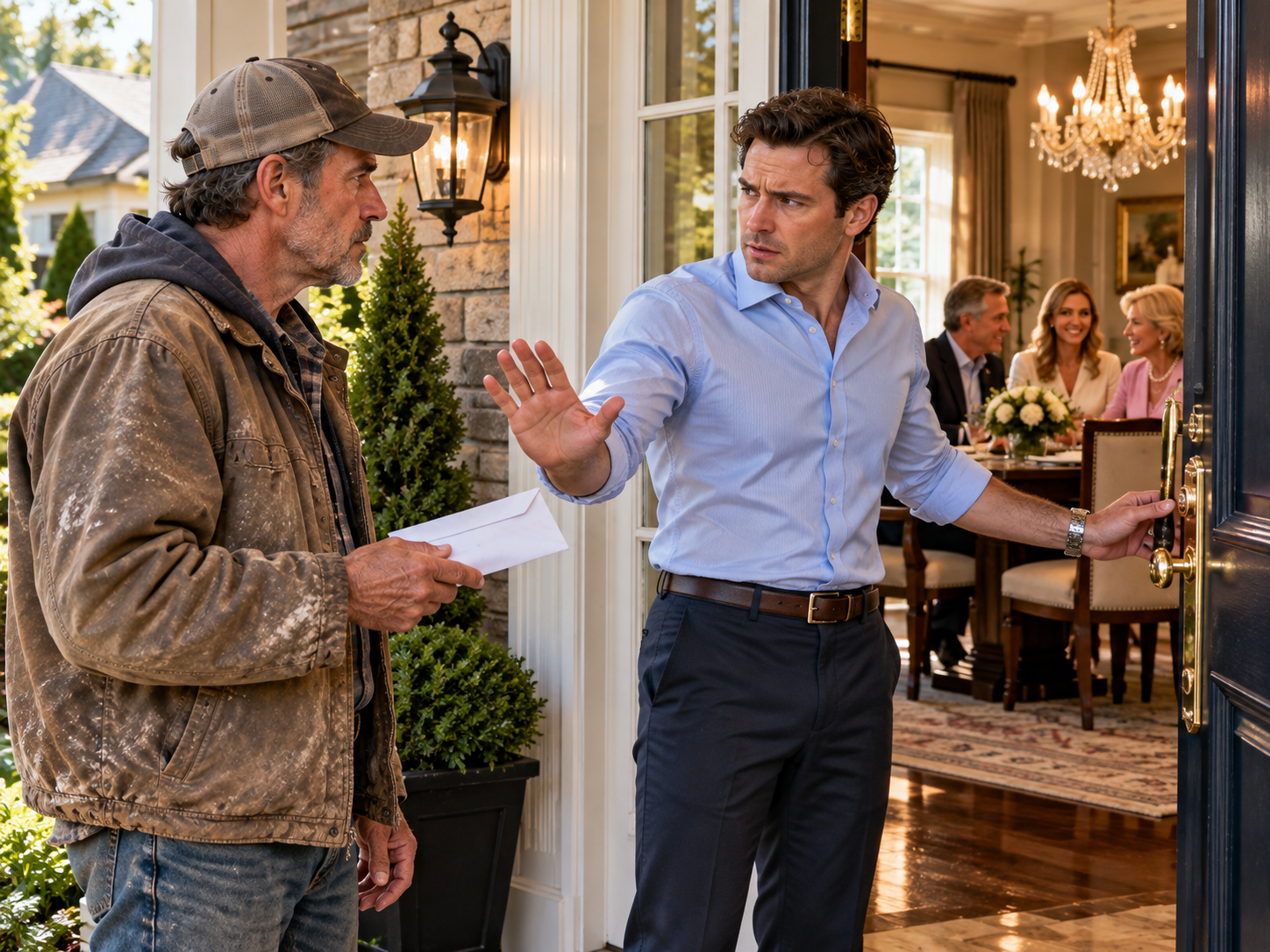
Before he could answer, the front door moved behind him. Madison appeared in the opening, one hand resting on the frame. Her expression shifted between confusion and concern as she looked from her husband to me.
“Kent? What are you doing out here?”
“Delivering some property documents,” I said. “I was hoping to come in and say hello.”
She looked at Trent.
He avoided her eyes.
“Your father-in-law and mother-in-law are inside,” he said quickly. “We were just discussing a family matter.”
Madison frowned.
“What family matter?”
Trent reached for the door.
“Nothing you need to worry about.”
She moved her hand away before he could close it.
“Then why do you look like that?”
He didn't answer.
I could have explained everything on the porch. I could have told Madison that her husband had been presenting my property as his own and had just admitted it. But I had no interest in humiliating her in front of her parents, especially when I did not yet know what she had been told.
“Madison,” I said, “I'd rather speak with everyone when we can do it honestly and without rushing. I came to deliver these papers, and I'll arrange another time if necessary.”
She looked at the envelope.
“What papers?”
“Property documents. Nothing you need to sign right now.”
Trent's shoulders relaxed slightly, and I noticed it. Even then, he was relieved that I hadn't exposed him in front of her parents. He was still more concerned with controlling the immediate embarrassment than with correcting the underlying lie.
Madison studied his face.
“Why didn't you let your father come inside?”
Trent looked at me, silently pleading.
I decided not to rescue him.
“That's a question you should ask your husband,” I said gently.
Her expression changed. She looked at Trent again, waiting.
He said nothing.
From inside, her father called, “Madison, are you coming back? The food's getting cold.”
She turned toward the dining room.
“I'll be there in a minute.”
Then she faced me.
“I'm sorry if something happened. I didn't know you were coming.”
“That's all right.”
I meant it. She had not made the decision to keep me outside, at least not as far as I knew. I wasn't going to blame her for something her husband had chosen.
I handed Trent the envelope.
“Keep these documents safe. Calder will contact me after he's reviewed the file.”
Trent took it reluctantly.
“What does he need to review?”
“The property arrangement.”
His eyes widened.
“Dad, you can't just change everything because I made one mistake.”
“One mistake?”
He flinched at the question.
I didn't raise my voice. I didn't need to. He had admitted that he had let his in-laws believe he owned the house. He had blocked me from entering because he feared they might discover the truth. And he had asked me to leave rather than face the consequences of his own decision.
“I'm not going to argue on the porch,” I told him. “We'll talk when the facts are clear.”
I walked down the steps.
“Dad, wait.”
I kept going.
“Please. Just give me until tonight.”
I reached my truck and opened the door.
“I'll call you,” he said. “We'll work this out.”
I looked at him across the roof of the vehicle.
“Trent, you've had five years to work this out.”
His face tightened.
I got into the truck and drove away.
At home, I set the envelope's duplicate receipt on the kitchen counter and washed the dust from my hands. The house was quiet. I made coffee, sat at the table, and tried to separate my anger from the decisions I might need to make. I had no desire to throw my son out on the street. I also had no intention of pretending that the arrangement could continue exactly as it had when the trust behind it had been damaged.
My phone rang three times during the next hour. The first call was from Trent. The second was from Madison. The third came from a number I didn't recognize, and I let it go to voicemail.
I listened to Trent's message first.
“Dad, please call me. This has gotten out of hand. I can explain everything.”
Madison's message was shorter.
“Kent, I think there's something I don't understand. Please call when you have time.”
I replayed her message once. Her voice sounded shaken, but not angry. She had not accused me of anything. She had asked for an explanation.
That mattered.
I had raised Trent to understand that choices carried consequences. I had also taught him that people deserved a chance to explain themselves before a judgment was made. I intended to follow that principle, even if it was harder when the person who had hurt me was my own son.
I left my phone on the counter and finished my coffee. Outside, the afternoon light faded across the backyard. I thought about the house, the repairs I had paid for, and the rent I had never collected. None of those things had been a burden when I believed the arrangement was helping Trent build a stable future. What troubled me was not the money. It was the way he had treated the truth as something that might lower his standing in another person's eyes.
At 8:17 that evening, my phone rang again.
This time, it was Calder.
“I've located the original purchase documents and the records relating to Trent and Madison's occupancy,” he said. “The initial review raises a question we need to settle before you decide what to do next.”
I sat straighter.
“What kind of question?”
“The title is clear,” he replied. “But there is another document in the file that I want to discuss with you before I recommend any change.”
I looked at the dark kitchen window, where my reflection hovered over the glass.
“What document?”
“A signed agreement from the beginning of the arrangement. It may affect how we should proceed.”
Click here to continue reading: PART 3: The Paper in Calder’s File Revealed a Promise I Had Almost Forgotten Making
My Son Closed the Door Before I Could Discover What He Had Told His In-Laws
Part 2 of 20

