
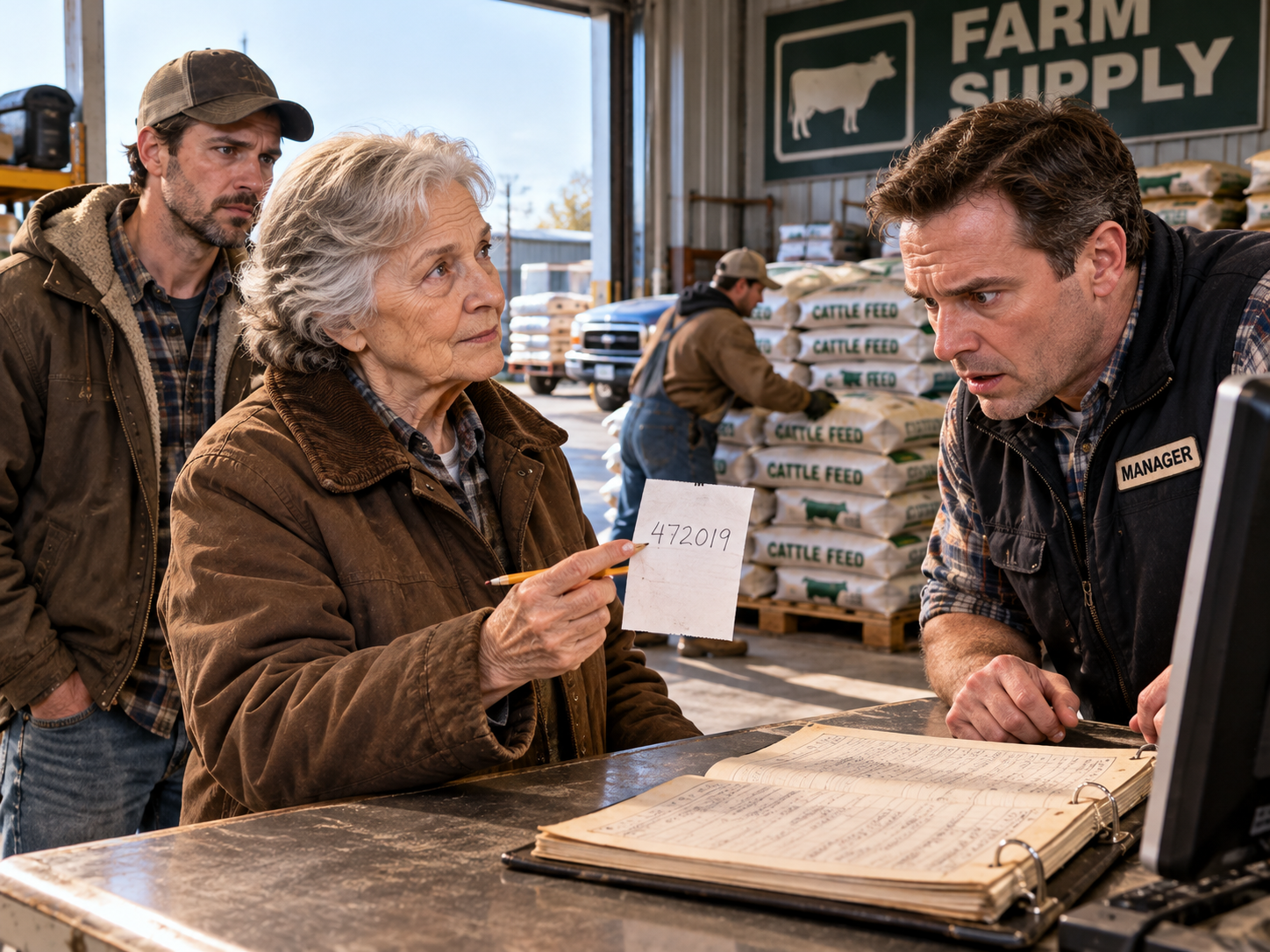
The next time Mom mentioned the six numbers, it was not because we needed feed.
It was a week after Travis had honored the agreement, and our farm had returned to its usual November routine. The cattle were eating on schedule, the fencing repairs were caught up, and the freezing rain had passed without leaving much damage beyond a few slick patches along the north lane. I thought the matter at the store had ended as cleanly as it could.
Then Mom received a telephone call from Martin Hale, the store's attorney.
He explained that while reviewing the old agreement, he had found another reference connected to the six-digit code. It appeared in a separate ledger from the one Travis had first opened. Martin wanted to confirm whether Mom recognized the entry before he drew any conclusions about its meaning.
Mom listened without interrupting. When he finished, she asked him to read the date aloud.
He did.
She looked across the kitchen table at me. For the first time since the dispute, I saw uncertainty cross her face.
"That was the winter after Walter signed the agreement," she said.
Martin asked whether she could come to the store the following afternoon to examine the record. Mom agreed, then ended the call and placed the telephone beside her account book.
"What is it?" I asked.
"I'm not sure yet."
That answer unsettled me more than a confident explanation would have. Mom had spent thirty-two years remembering the numbers and keeping the agreement private. She had never suggested that the arrangement concealed a second transaction. Now a separate ledger had appeared, and even she did not immediately know what it meant.
I asked whether the record could change the agreement we had just established. She said it might clarify how Walter had handled the original arrangement, but we would need to read it before deciding anything.
"Your father always said records were better than memories," she added. "Even when the memory belongs to someone you trust."
The next afternoon, I drove her into Redfield again. The sky was clear, but the temperature had dropped overnight, and the truck's heater rattled as we followed the familiar road toward town. Mom carried the folder containing our copy of Walter's agreement. She had placed the receipt with the six numbers inside a transparent sleeve, carefully preserving the pencil marks.
Travis met us at the store's office rather than the counter. He seemed less defensive than he had during our first visit. The updated inventory procedure had already been introduced, and he had instructed his employees to check the old records before making decisions about scarce essential supplies.
Martin sat at a small conference table with two ledgers and a thin folder. He greeted Mom and explained that he had traced the reference through several years of the store's financial records. The new entry did not replace the agreement, nor did it show that the store had been sold or that my parents had owned part of it. Instead, it documented a transaction connected to the original assistance my parents had provided.
He opened the ledger to a page marked with a paper tab.
The entry recorded a transfer of funds from Walter's business account into a separate reserve. Beside it, someone had written the same six-digit reference, followed by a notation about maintaining essential stock for established local farms during periods of shortage.
I leaned closer. The amount was substantial enough to have mattered to a small business thirty-two years earlier, but it was not the figure that held my attention. It was the date and the wording beside it.
"Why was this kept separately?" I asked.
Martin explained that Walter had maintained a reserve account for transactions that did not fit the store's ordinary inventory bookkeeping. The old agreement appeared to have been associated with that account, though the records did not yet establish whether every later transaction had been handled in the same way.
Travis looked uncomfortable. He said he had known the reserve ledger existed but had not understood its connection to the six-digit reference. When he reorganized the store's accounts, he had focused on active suppliers and outstanding balances. He had assumed the reserve records were historical.
Mom studied the entry for a long moment.
"Your father was careful," she said to Travis. "He didn't like money moving without a reason attached to it."
Travis nodded. "He was always particular about documentation."
"Then he must have had a reason for putting this here."
Martin agreed that the notation suggested a deliberate connection, but he cautioned that the ledger alone did not explain the complete purpose of the transfer. He wanted to compare it with the original agreement and any surviving correspondence. He had already requested access to the remaining archived files.
I asked whether the entry showed that the store still owed our family money.
Martin shook his head. He said the records did not support that conclusion. The original arrangement had included financial assistance, supplies, and a commitment concerning essential stock. Some of the financial portion had been repaid or settled according to the terms described by Mom. The new entry appeared related to how the store had managed the arrangement, not proof of an unpaid balance.
Mom seemed relieved to hear that. She had never suggested that we were owed a fortune, and I realized she did not want the agreement turned into something it had never been.
"What matters is what Walter promised," she said. "If he kept a reserve because he intended to honor that promise, I want to know how it was used. That's all."
Martin explained that he could not answer that yet. He would need to compare the entry with the later records, including any notes about shortages and customer allocations. The six-digit code seemed to function as a cross-reference, linking the agreement to transactions recorded elsewhere.
Travis turned the page and found another notation. It referred to a review of essential inventory during a period when several local farms had struggled to obtain feed. The entry did not identify every customer, but it indicated that the reserve had been used to maintain stock that might otherwise have been committed to larger orders.
I looked at Mom. She was reading slowly, moving her finger beneath each line.
"That sounds like what your father wanted," she said.
"Possibly," Martin replied. "But we should not assume every entry represents the same arrangement until we've checked the supporting documents."
Mom nodded. She was not interested in forcing the evidence to say what she wanted. That was something I admired about her, though I had not always understood it. She could hold a conviction firmly while still leaving room for facts she had not yet seen.
Before we left, Martin asked whether Mom remembered any additional payments or supplies provided after the original agreement. She recalled a delivery of agricultural materials and a later settlement that Walter had discussed with Dad. She could not remember the exact amount, and she did not try to guess. Martin recorded her recollection as background information rather than treating it as proof.
On the drive home, I asked Mom whether she was worried.
"About what?"
"About the ledger showing something different from what you remember."
She watched the fields slide past the window. "A record can complicate a memory without making the memory worthless. If something doesn't match, we find out why."
That evening, I told my brother about the second ledger. He wondered whether the store might have been keeping a separate fund that had never been properly accounted for. I told him Martin had not reached that conclusion, and Mom had not claimed the money belonged to us.
We agreed to wait for the records rather than build a theory around a single entry.
Two days later, Martin called again. He had found a short letter from Walter referring to the reserve and the six-digit code. The letter was addressed to a bookkeeper who had worked at the store during the same period. Martin said the letter might explain why the transaction had been recorded separately, but he wanted Mom to see it before he summarized the contents.
Mom agreed to another meeting.
This time, she asked me to bring the original folder from our home. She wanted the signed agreement and the old receipt available for comparison. Before we left, she checked that every page was present and that the receipt remained in its sleeve.
At the store, Martin laid Walter's letter beside the agreement. The handwriting was unmistakable, and the date matched the period shown in the ledger. He read the opening lines aloud, then stopped at a sentence that referred to the purpose of the reserve.
Mom leaned forward.
"Read that part again," she said.
Martin did.
Her expression changed, and she reached for the edge of the table.
I had seen her remain composed when Travis canceled our sale. I had watched her stand quietly while the first ledger was opened. But now she looked as though a memory she had kept neatly folded for decades had suddenly unfolded into something larger.
"What does it say?" I asked.
Mom did not answer immediately.
Instead, she looked at Martin and asked him whether the original reserve account was still open in the store's records.
He told her that the account had been closed years earlier, but its remaining balance and final transactions were documented in the archive.
Mom looked down at the letter again.
"Then we need to see how it was closed," she said.
Click here to continue reading: PART 6: Walter’s Letter Explained the Hidden Reserve, but Its Final Paragraph Raised a Question Travis Could No Longer Avoid
The Store Manager Took Back My Mother’s Last Twenty Bags of Cattle Feed, Until Six Numbers on a Receipt Changed His Expression
Part 5 of 20

