
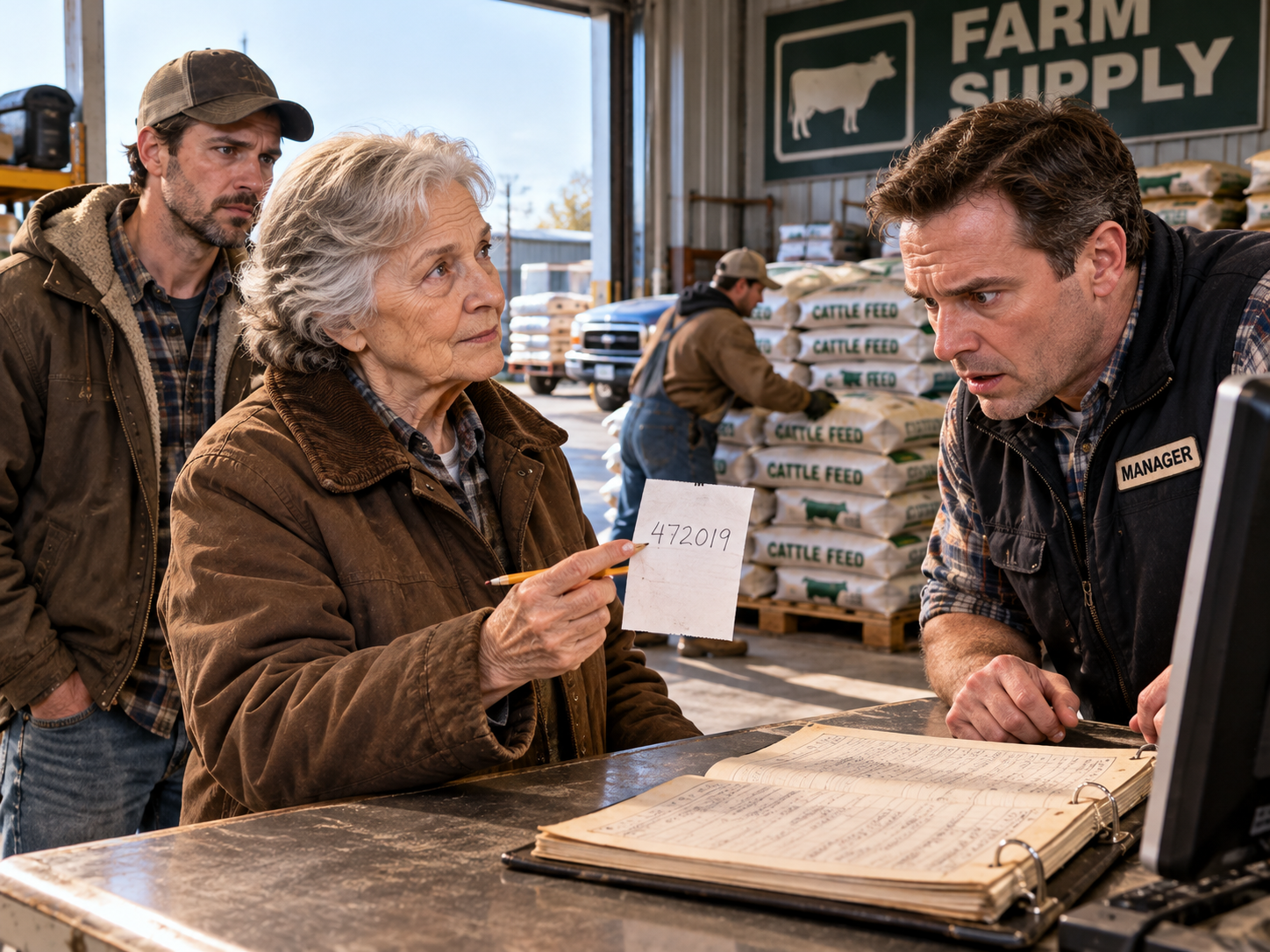
The first thing that changed after the store put everything in writing was not the way Travis Miller greeted Mom when she walked through the door. He had always known how to say hello, and he had learned how to apologize. What changed was what happened after the greeting. Before, Travis would turn toward the shelves, check the computer, and make a decision based on whatever appeared on the screen. Now, whenever an essential supply was running low and more than one customer needed it, he paused long enough to ask whether there was an older commitment he needed to check. It was a small pause, easy to overlook, but I noticed it because I knew exactly how much trouble could begin when nobody took that extra moment.
The twenty bags of cattle feed had carried us through the week when the freezing rain arrived. My younger brother and I had unloaded them into the dry storage area, stacking each bag carefully and keeping the oldest stock accessible. Mom checked the count twice, not because she distrusted us, but because she had kept farm accounts for decades and believed that numbers deserved attention even when everyone involved was honest. The weather turned the roads slick, the cattle stayed restless, and we had enough work without worrying about whether we would have the feed they needed. By the time the rain passed, the immediate crisis had become another difficult week behind us.
I thought that would be the end of the matter. The documents had been reviewed, the old reserve had been accounted for, and the store had acknowledged the agreement. Travis had admitted that he should have checked before canceling our purchase. Martin Hale, the store’s attorney, had prepared the written acknowledgment and advised that the original papers remain together in the records. Nobody owed our family money, and Mom had made it clear that she expected no special prices or privileges. The arrangement was narrow, practical, and understandable. I could not see what more needed to happen.
Mom, however, was not satisfied with the idea that a promise had been restored merely because several people now understood it. She wanted to know whether the next person responsible for the store would understand it, too. One evening, while she sat at the kitchen table sorting receipts, she asked me, “If Travis leaves tomorrow, what happens to those papers?” I told her they would remain in the archive. She tapped the corner of a receipt against the table. “That is where they were before,” she replied. “And look how close we came to losing them without anyone even knowing they existed.”
I understood her point, though I did not immediately agree with the extent of her concern. The documents had been found, the records had been reconciled, and Martin had confirmed that no cancellation had been located. The store had also changed its procedure. Surely that was enough. Mom did not argue with me. She simply placed the receipt in a folder and asked whether I remembered the first thing Travis had said when he saw the six numbers she had written. I remembered it perfectly. He had asked where she got them. Her answer had sent him searching through records his own office had nearly forgotten.
“That is the part I keep thinking about,” she said. “The numbers were still there. The agreement was still there. But nobody knew what they meant.” She did not sound triumphant. If anything, she seemed tired. The discovery had not made her proud of being right; it had reminded her how much depended on the habits of people who might never meet one another. Walter Miller had known my father. Travis had inherited the store and its responsibilities, but not every memory that had once guided them. The years had separated the people who made the promise from the people who needed to understand it.
A few days later, Martin called to ask whether Mom would agree to a brief meeting at the store. He wanted to confirm that the documents had been copied and that the new procedure accurately reflected the agreement's limits. Mom agreed, but she insisted that the meeting remain practical. She did not want a public announcement or a ceremony. She wanted the paperwork correct. I went with her because I had been involved from the beginning, and because the dispute had taught me that a person could believe a matter settled while overlooking the details that made the settlement last.
The meeting took place in the small office behind the counter. Travis had arranged the original agreement, Walter’s letter, the ledger references, and the closing statement in a single folder. Martin had prepared a short record explaining where those materials belonged and when they needed to be consulted. The language did not turn the agreement into an unlimited promise. It specified that the commitment concerned essential supplies during shortages for established local farm customers, within the original scope and subject to any valid amendment. It did not guarantee every product, excuse a customer from ordinary payment, or require the store to ignore genuine limits on stock.
Mom read every page. She stopped twice to ask Martin about individual phrases, and he answered without rushing her. When she reached the section about amendments, she asked whether the store had discovered any signed document canceling the commitment. Martin said it had not. The records they had located supported the distinction between the closed financial reserve and the continuing supply arrangement, but he would not claim that no missing document could possibly exist anywhere. He was careful, and Mom appreciated that. She had not spent her life balancing farm accounts by confusing a strong conclusion with an absolute certainty.
Travis listened while Martin explained how the revised procedure would work. When a shortage arose, the employee handling inventory would identify the available essential stock, check whether an existing commitment applied, and bring any uncertainty to management before reallocating the last supply solely on the basis of a higher offer. If the agreement did not apply, the store could make its decision under ordinary business rules. If it did apply, the store would honor it within its terms. The procedure was not designed to favor our family in every disagreement. It was designed to prevent a forgotten promise from being ignored simply because the person making a decision had never heard of it.
“I can do that,” Travis said. “And I should have done it the first time.”
Mom closed the folder and looked at him. “You cannot know every conversation your father had,” she said. “But you can make sure the records your father kept are part of the business you run.” Travis nodded. For a moment, neither of them spoke. I remembered the way he had looked at the six numbers that first morning, first with irritation, then with confusion, and finally with the uneasy recognition that something important had been sitting in his own store all along. He had not become a different person overnight, but he was learning to be more careful with a responsibility he had inherited.
Martin asked Mom whether she wanted the family to keep an additional certified copy. She said yes, one for our records, but she did not want the store's copy treated as something that could be removed whenever the agreement became inconvenient. Martin added a note identifying the file and explaining that any proposed change should be reviewed against the original documents and properly recorded. That note did not create a new promise. It made the old one harder to overlook.
As we left, Travis walked us to the counter. The store was busy, and a delivery driver was waiting with paperwork. He turned to help the next customer before we reached the door. Watching him return to ordinary business gave me a clearer sense of what Mom had wanted all along. She had not come to claim the store, embarrass its manager, or collect a reward. She had come because twenty bags of feed were needed on a cold week, and because a larger offer had nearly erased a commitment made long before either of us understood its importance.
On the drive home, I asked Mom whether she felt relieved. She watched the fields pass beyond the window before answering. “I am relieved that we found the truth,” she said. “I am not going to assume that finding it once means nobody will need to look again.” That was as close as she came to celebrating. She had secured the feed, clarified the agreement, and obtained a written acknowledgment. Still, she understood that records only helped when people were willing to consult them, and promises only endured when someone took responsibility for remembering them.
That evening, my brother asked whether the old agreement meant we would always get the feed first if the store ran short. Mom answered before I could. “No. It means the store must consider the commitment when the conditions fit. It does not mean we get everything we want.” My brother looked disappointed for a second, then nodded. The distinction mattered. Our family had not been granted ownership of the store or a permanent claim over its inventory. We had a specific agreement, born from a specific period of hardship, and it deserved to be honored precisely as it was written.
I thought about those six numbers on the back of the canceled receipt. They had looked unimportant to Travis because they meant nothing to him at first glance. They had meant something to Mom because she remembered why they existed. Between those two facts lay the whole problem. A promise could survive in a ledger for thirty-two years and still become almost useless if no one knew where to find it or why it mattered. That did not make Travis a villain or Mom a hero. It made the failure ordinary, which was exactly why it needed correcting.
When I went to bed that night, I could hear the wind moving across the fields again. The cattle had feed, the storage room was dry, and the paperwork was where it belonged. For the first time since that morning at the store, I stopped imagining the twenty bags as something we had nearly lost. I began thinking of them as a reminder of what had been recovered: not a fortune, not a secret ownership stake, but a piece of history that still had a practical purpose.
Click here to continue reading: PART 10: WHAT A SMALL TOWN REMEMBERS
The Store Manager Took Back My Mother’s Last Twenty Bags of Cattle Feed, Until Six Numbers on a Receipt Changed His Expression
Part 9 of 20

