
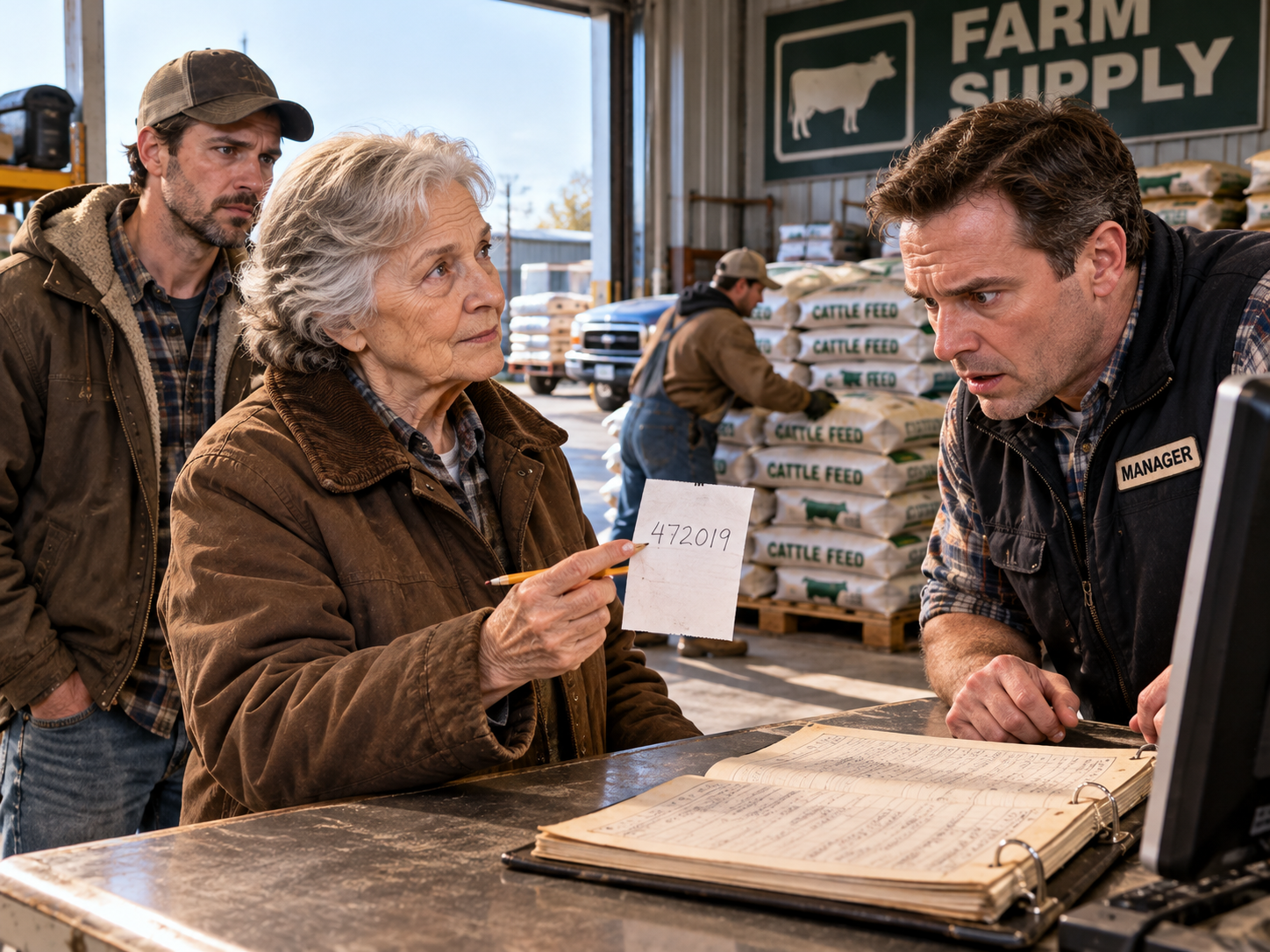
By the time the new year approached, the first-week-of-November incident had become a quiet part of our family history. The twenty bags of feed were long gone, consumed by the cattle as they had been intended to be. The receipt on which Mom had written the six numbers was kept with our household records, not displayed like a trophy. The store had its own copies of the agreement and related papers. Martin’s written acknowledgment remained with them, and the revised procedure directed future managers to consult the file when a relevant shortage arose.
There was no final celebration, no grand public apology, and no moment when everyone in town gathered to declare the matter resolved. Life did not arrange itself around the shape of a story. The cattle still needed feeding before daylight, the machinery still demanded repairs, and the weather still decided when a job could be done. We carried on, as farms do, with the knowledge that some problems are solved not by changing the whole world but by correcting one decision and making the next decision more carefully.
I used to believe the most important part of a family story was the moment when someone discovered the truth. In this case, I thought it was the moment Travis looked at Mom’s numbers and realized they meant something. That was certainly the turning point. Without it, he might have dismissed her concern, and the old agreement might have remained buried. But the longer I thought about what happened, the more I understood that the discovery itself was only the beginning. The documents had to be reviewed. The financial reserve had to be distinguished from the continuing commitment. The store had to acknowledge the result and change its procedure. A truth discovered but never acted upon would not have put feed in our storage room.
Mom understood that from the beginning. She had not written the six numbers to win an argument. She had written them because she knew there was a record that could answer the question Travis had refused to consider. Once the record was found, she let the process take its course. She did not demand that the store admit to more than the evidence showed, and she did not accept claims that the agreement gave her more than it actually promised. She wanted the decision corrected, not transformed into something larger.
I asked her one evening whether she had ever regretted keeping the numbers to herself for so many years. She was sorting the household bills, and she paused with a pen in her hand. “No,” she said. “There was no reason to bring them up before.” She considered the question a little longer. “But perhaps I should have asked Walter whether the store had a way to keep the agreement easy to find.” Then she shook her head. “No, we could not have planned every detail. We did what made sense at the time.”
Her answer reminded me that no agreement could anticipate every future circumstance. Walter had written a commitment, kept the related records, and left instructions about preserving them. My father and Mom had signed the agreement and remembered its purpose. Those were sensible steps. What they could not control was the passage of time, the introduction of new inventory systems, or the way a later manager might interpret an old file. The failure was not proof that the original arrangement had been foolish. It was proof that a good arrangement needed to be carried forward with care.
I also thought about Travis. It would have been easy to reduce him to the manager who chose money over a promise. That was what I had wanted to do when the sale was canceled. I had been angry, and I believed he had put our farm at risk because he saw a larger customer as more important. But the full story was more complicated. Travis had made a bad decision without understanding the agreement. Once the records were brought to his attention, he agreed to review them, accepted Martin’s advice, sold us the feed at the posted price, apologized, and changed the process. None of that erased his first decision, but it mattered when judging what he did afterward.
A mistake can reveal a person’s priorities, but so can the response to that mistake. Travis could have argued endlessly, blamed Walter for leaving unclear records, or insisted that a closed reserve meant every related obligation had ended. Instead, he allowed the evidence to be examined. He accepted the limits of what Martin could conclude and took responsibility for making the agreement easier to find. He did not need to become a perfect manager for the outcome to improve. He needed to be more careful than he had been on that cold morning.
The larger buyer, too, had remained part of the ordinary business of the store. That mattered because the dispute had never truly been about which farm deserved more respect. It had been about whether a specific commitment applied to a specific shortage. A business could serve large customers and small ones while still honoring the obligations it had already accepted. Mom never argued that our farm mattered more than everyone else’s. She argued that our farm should not be pushed aside without the store first checking the agreement it had made.
As winter deepened, I found myself repeating that distinction whenever someone asked about the incident. I did not describe the reserve as hidden money, because the closing records showed that it had been reconciled and returned to the store’s operating funds. I did not say our family owned part of the business, because the agreement established no such ownership. I did not claim that the store was bound to provide every item we wanted under every condition. I explained only that the old supply commitment had remained relevant, no signed cancellation had been found in the records reviewed, and the store had agreed to honor it within its scope.
Sometimes people seemed disappointed by that answer. A dramatic secret was easier to understand than a narrow agreement supported by old ledgers and letters. But Mom had taught me that an ordinary truth did not become less important because it lacked spectacle. The store’s commitment had helped our family in a moment when we needed essential supplies. It had also reminded the manager that a business was responsible for more than the highest offer in front of him. That was enough.
A few weeks after the dispute, I accompanied Mom into town for a routine purchase. The store was busy, and Travis was helping an employee sort out an order. When he saw us, he greeted Mom and asked whether the cattle had come through the cold spell well. She told him they had, then asked after his family. Their conversation was brief and ordinary. No one mentioned the six numbers. No one brought out the folder. They were two people who had resolved a difficult matter and were now speaking as customers and a store manager should be able to speak.
On the way out, I looked back through the glass door. Travis had returned to the counter, where another customer was waiting. He listened to the request, checked the inventory, and asked an employee to verify a detail before making a commitment. I could not know whether he was thinking about our dispute. Perhaps he was simply doing his job. Either way, the habit mattered more than the reason behind it. A better decision did not need to announce itself as the consequence of a lesson. It only needed to be made.
Mom noticed me looking back. “What is it?” she asked.
“Nothing,” I said. “I was just thinking that things seem normal again.”
She nodded. “They should.” After a moment, she added, “Normal is good when people have learned what they needed to learn.”
I thought about that sentence for the rest of the drive. There had been no need to keep the conflict alive to prove that it mattered. If the store could return to serving its customers while preserving the agreement, and if our family could return to farming without carrying resentment into every visit, then the outcome was better than a victory that left everyone angry. Mom had never wanted the store to suffer. She had wanted it to remember a commitment that could be honored without harming its ability to do business.
At home, I put the receipt with the six numbers into the folder where we kept the copies of the relevant documents. It seemed appropriate that the receipt, which had first represented a canceled sale, should now sit beside the agreement that explained why the cancellation had been wrong. The paper itself had no legal power beyond its role as a record of what happened that morning. But it preserved the sequence of events: we had needed feed, the store had refused the sale after a higher offer, and Mom had pointed the manager toward the records that changed the decision.
I was careful not to treat the receipt as more important than the original agreement. The numbers had helped locate the evidence; they were not the evidence itself. The signed commitment, Walter’s letter, the ledger references, and the closing statement were what allowed Martin to distinguish the reserve from the continuing supply arrangement. The receipt reminded us how the discovery began, but the documents established what it meant. It was another lesson in keeping a story honest: the dramatic moment could draw attention, but the supporting facts had to carry the weight.
Mom checked the folder after I put the receipt away. She made sure the papers were protected, then returned them to the cabinet. She did not lock them in a special box or speak as though the family had acquired something precious that no one else could touch. They were records, and records needed to be kept where they could be found. That was the same principle she had wanted the store to follow. Information was useful only when it survived long enough, and remained clear enough, for someone to act on it.
I sometimes imagined what Walter might have thought if he had seen Travis searching through the dusty ledger. He had been gone for years, and I could not know his reaction. Perhaps he would have been frustrated that the agreement had been forgotten. Perhaps he would have understood that a business changes hands and that old responsibilities require reminders. What I knew was that he had written the commitment down because he wanted it to outlast the people who made it. The agreement had done that, even if it had needed Mom’s memory to bring it back into view.
My father’s part in the story was quieter still. He had helped Walter during a difficult season and signed the arrangement that followed. He had not lived to see the shortage that tested it, and he had not been there when Travis questioned the six numbers. But the record of his decision remained. It did not make him a secret owner of the store or a man who had arranged a future reward for his family. It showed him doing something practical for a business and a community that mattered to him. I was proud of that, not because it made us special, but because it reflected the kind of person I remembered.
By the time the coldest weeks arrived, the lesson had become less about the store and more about the responsibilities people carry forward. A promise is not preserved simply because someone once made it. It must be written clearly, kept with its supporting records, and reviewed when circumstances bring it into question. It must not be expanded into something it never was, but neither should it be treated as meaningless just because the person who made it is no longer present to explain it. The agreement had survived because the evidence survived, and because Mom knew when to ask that it be read.
I no longer thought of the twenty bags as the most important part of the story. They were important, certainly. They had been needed for the cattle, and their absence would have made a difficult week harder. But the bags were used up, as feed should be. The lasting result was that a forgotten commitment had been identified, its limits had been clarified, and a procedure had been put in place so that the next manager would have a better chance of finding it before making the same mistake.
Mom never asked anyone to call her brave for remembering six numbers. She did not claim that the agreement made our family more deserving than the neighbors who bought supplies from the same store. She did not demand money from a reserve that had already been closed and reconciled. She simply refused to let an existing commitment be dismissed before the records were examined. When the records were examined, she accepted the result, including the limits of what they proved.
That is what I remember most clearly now: not the manager’s first refusal, not even his startled question about the numbers, but the way Mom remained calm while the rest of us felt the pressure of the moment. She knew that the truth did not need to be shouted to be important. It needed to be found, understood, and acted upon. She had waited thirty-two years without using the reference because there had been no reason to use it. When the reason finally came, she used it exactly as Walter had intended.
The store kept its copies. We kept ours. The reserve remained settled, with no outstanding money owed to our family. The commitment about essential supplies remained in effect within its original scope, and the store had not found a signed amendment or cancellation in the records reviewed. Travis continued running the business, and we continued running the farm. The next shortage would have to be judged on its own facts, but it would no longer be reasonable to assume that the old agreement did not exist simply because nobody had remembered to look.
There was no fortune waiting at the end of the story, no hidden deed, and no reward beyond the ordinary value of a promise honored. The twenty bags had been purchased at the posted price, carried home before the weather worsened, and used to feed our cattle. The store had corrected its procedure, and a piece of local history had been returned to the place where it belonged. For Mom, that was the proper ending. She had not asked the past to give her more than it promised. She had asked the present to stop pretending the promise had never been made.
And so the six numbers returned to being what they had always been: a reference, quietly preserved, waiting for the moment someone needed to understand it. They did not give Mom control over the store. They did not erase the difficulty of that November morning. They led Travis to the records, the records led Martin to the agreement, and the agreement led the store back to a responsibility it had nearly forgotten. In the end, the numbers mattered because they helped the right people remember what had already been written down.
Mom never asked the store to remember her family as heroes. She only asked it to remember its own word.
Click here to continue reading: PART 13: THE NEXT HAND TO HOLD THE RECORDS
The Store Manager Took Back My Mother’s Last Twenty Bags of Cattle Feed, Until Six Numbers on a Receipt Changed His Expression
Part 12 of 20

