
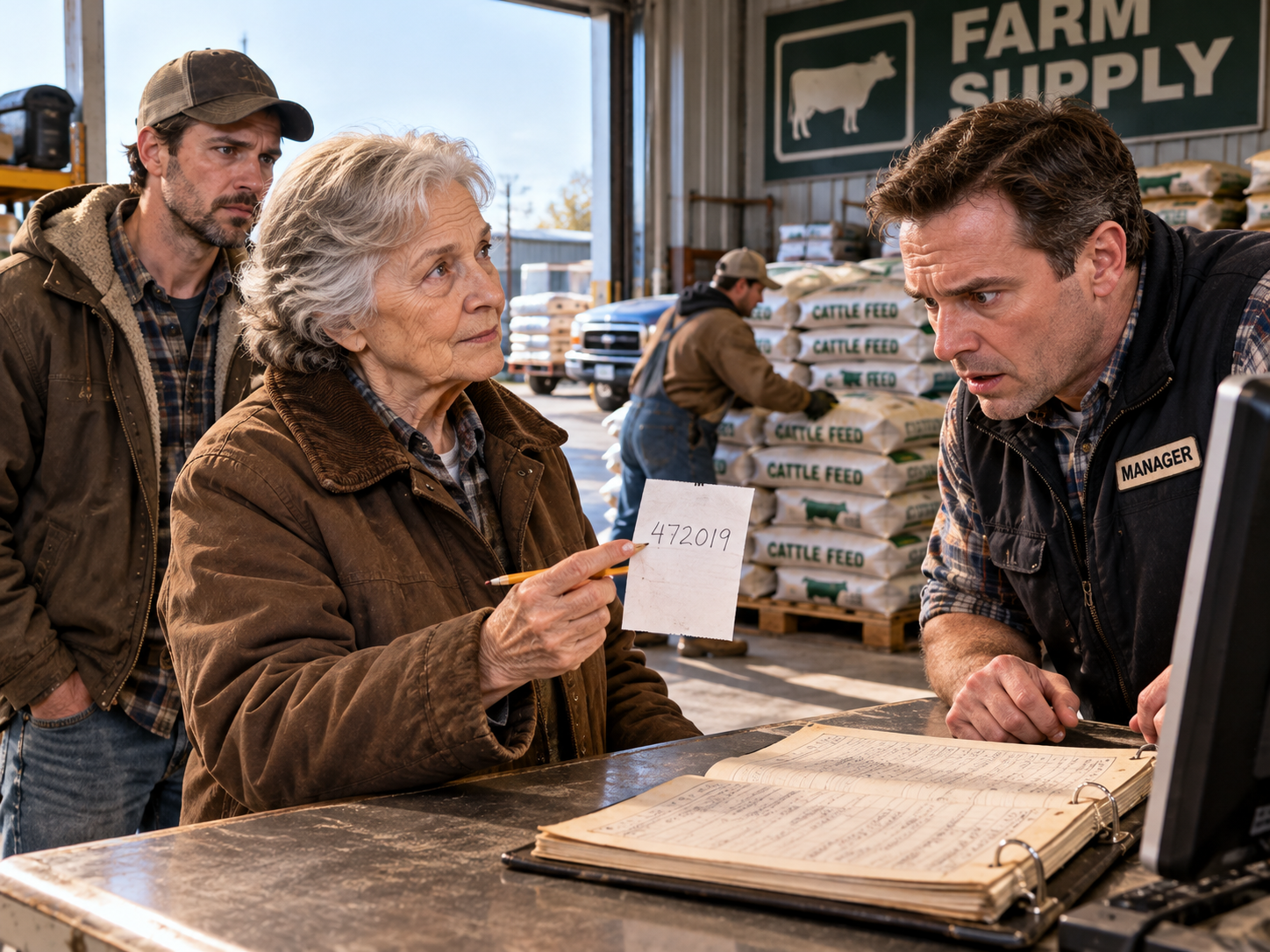
By the time winter settled over the Iowa fields, the dispute at the farm supply store had stopped being something people discussed whenever they saw Mom in town. That was a relief to her. She had never wanted to become known as the woman who had forced a manager to honor an old agreement. She wanted to be known, if anyone thought about her at all, as someone who kept her word, paid her bills, and expected other people to take their commitments seriously. On our farm, the days continued to follow the same demanding rhythm: feeding cattle, checking equipment, balancing accounts, and preparing for whatever weather arrived next.
I believed the matter was finished. The agreement had been located and reviewed, the reserve had been reconciled, and the store had acknowledged the continuing commitment within its original scope. Travis had apologized and updated the inventory procedure. Martin Hale had ensured that the relevant documents were preserved together. We had our copies, the store had its own, and nobody was claiming that our family owned part of the business or was owed money. I could see no unfinished business, and I was ready to let the entire episode settle into memory.
Then, early one December morning, Mom received a telephone call from Travis. I was at the kitchen table with a stack of receipts when she answered. He explained that he wanted to confirm one additional detail about the store’s records. A staff member had been organizing older customer files and had found a separate index referring to historical agreements. The index did not change anything Martin had concluded, but it raised a practical question about how the store should identify records that might affect future inventory decisions.
Mom listened without interrupting. When Travis finished, she asked whether the agreement itself had been moved or altered. He said no. The original papers remained together, and the new index was simply another way to locate them. He wanted to make certain that the reference used in the index was clear enough for a future manager to follow without relying on someone remembering the story. Mom told him that sounded sensible, provided the index described the agreement accurately and did not suggest rights beyond those written in the original documents.
After she ended the call, I asked what the new index said. She explained that it identified the old agreement by its reference number and directed staff to the file containing Walter’s letter, the ledger entries, and the closing statement. It also indicated that any question about the agreement’s scope should be referred to management and, when necessary, reviewed with legal advice. There was nothing dramatic in it. The store was not reopening the dispute or discovering a new debt. It was trying to prevent the same confusion from returning under a different manager.
“Why did he need to call you about that?” I asked.
“Because I was involved in the original arrangement,” Mom replied. “And because he wants to be certain he understands what the papers say.” She returned to the receipts as though the matter required no more attention. I realized then that the phone call was evidence of something we had hoped would happen: Travis had begun asking questions before a problem forced him to ask them.
Later that week, I went to the store to collect supplies for a repair. Travis showed me the revised index, though he made it clear that the original documents remained the authoritative record. The index was plain and functional. It listed the six-number reference, described the associated agreement as a commitment concerning essential supplies during qualifying shortages, and directed the reader to the complete file. It did not say that our family received automatic priority for every product, nor did it claim that the store had to satisfy every request regardless of inventory.
I appreciated the care he had taken. The first time I saw those numbers, I had thought they were a private clue that would unlock some extraordinary secret. Now I saw their proper place in a working system. They were a bridge between records, not a substitute for them. A person who found the index would still need to read the agreement, understand the circumstances it covered, and check whether any valid change had been made. But that person would no longer have to guess that an important document might exist.
Travis told me the store was reviewing other archived arrangements as well. Some involved ordinary customer terms, some involved deliveries, and some were simply old records that needed to be classified correctly. He was not assuming that every historical document created a continuing obligation. Martin had advised him to distinguish records that were informational from those that might affect current decisions. The goal was not to turn the store into a museum of old promises. It was to make sure that legitimate obligations were neither forgotten nor mistakenly expanded.
I asked whether the review had uncovered anything else concerning our agreement. Travis said it had not. The reserve remained closed, the final balance had been returned to the store’s operating funds, and there was no outstanding amount owed to our family. No signed cancellation or amendment had been found in the records reviewed. The new index did not alter those findings. It simply made the file easier to locate. His answer reassured me because it showed that he understood the difference between improving recordkeeping and inventing new facts.
When I told Mom about the visit, she asked whether the index was accurate. I said it was. She nodded and went back to her accounts. “That is good,” she said. “Then someone can find the papers without needing to know me.” That sentence stayed with me. At first, the agreement had depended on her memory to bring it back into view. The whole point of the new procedure was to make sure that the next person did not need to rely on her memory at all.
A few days later, a heavy delivery arrived at our farm. My brother and I unloaded it while Mom checked the invoice and verified the quantities. The work took most of the morning, and by lunchtime my back ached from lifting. As we put the last items away, my brother asked whether the store had made any further concessions to us because of the dispute. I told him it had not. We paid the posted price for what we bought, just as we had before. There was no discount, no credit, and no private arrangement that placed our farm above the others.
He seemed satisfied with that. “So the only thing that changed is that they have to check first.”
“Only if the circumstances fit the agreement,” I corrected. “And they still have to read what it says.”
He laughed at my seriousness, but I meant it. The narrowness of the agreement was what made it credible. If we claimed too much, we would weaken the very point Mom had worked to establish. The store had not promised to guarantee our farm’s success. It had promised to consider an existing commitment when essential supplies were scarce. Honoring that commitment did not require anyone to pretend that every shortage could be solved fairly for everyone at once.
On Sunday afternoon, Mom took a folder from the cabinet and compared our copy of the written acknowledgment with the list of documents Martin had recommended preserving. She confirmed that the original agreement, Walter’s letter, the relevant ledger references, and the closing statement were all accounted for. The receipt with the six numbers remained beside them. She did not add anything else. When she was satisfied, she returned the folder to the cabinet and locked the door as she always did when she finished with the household records.
I asked whether she thought Walter would have approved of the store’s new index. She considered the question while folding a dish towel. “I think he would have approved of people taking the trouble to understand what he wrote,” she said. “The index is useful because it leads to the agreement. It does not replace the agreement.” That was the clearest way she could have put it. Walter had not created a code so future people could obey it blindly. He had created a way to connect the records that explained the arrangement.
For years, the six numbers had rested in Mom’s memory without causing her any trouble. When the moment came, she had written them on the back of a canceled receipt. They had directed Travis toward a ledger, the ledger toward an agreement, and the agreement toward a decision that could be reviewed. Now the same numbers appeared in a formal index. Their meaning had not changed, but the chance that someone would understand them had improved.
The next time I visited the store, I saw an employee using the index to locate an older customer record. She found the file, checked the relevant pages, and returned the documents to their place. The process took less than a minute. I had no reason to believe the employee knew anything about our family, and that was exactly what made the sight reassuring. The system was beginning to function without requiring a personal connection to the people who had made the original promise.
I did not tell Mom about that small moment until several days later. She smiled, then asked whether the employee had returned the papers properly. I said she had. Mom nodded as though that was the most important detail. She was not interested in the symbolic value of a new index. She wanted the documents to remain intact, accessible, and accurate. In her mind, the best proof that the lesson had lasted would be a future decision made correctly by someone who had never heard the story of the twenty bags.
As the month moved toward its end, the store continued to serve customers of every size. Our farm remained one among many. The larger operation that had offered more money still did business there, and Travis had not turned our agreement into a general rule against competitive offers. He had simply accepted that an offer could not be considered in isolation from obligations the store had already undertaken. That distinction kept the solution practical, and it prevented the incident from becoming a contest between one farm and another.
The new index did not erase the original mistake, but it made the correction more durable. It gave the next manager a starting point, a clear description, and a direction to the actual documents. It also made clear that questions about scope needed to be reviewed rather than answered from memory or convenience. The agreement was still limited, the reserve was still settled, and the evidence still supported the same conclusion Martin had reached. Nothing had grown larger than the facts.
I had begun the story thinking that Mom’s memory was the only thing standing between our family and an unfair decision. By the end of that December, I understood that her memory had been the first step, not the final protection. The lasting safeguard was the work that followed: careful review, accurate records, a written acknowledgment, and a procedure that did not depend on one person being present to remind everyone else. Mom had brought the promise back into view. The store was now responsible for keeping it visible.
Click here to continue reading: PART 14: THE COST OF FORGETTING
The Store Manager Took Back My Mother’s Last Twenty Bags of Cattle Feed, Until Six Numbers on a Receipt Changed His Expression
Part 13 of 20

