
As January moved toward February, the farm entered the part of winter when every ordinary task seemed to require extra effort. Water froze more quickly, machinery started reluctantly, and the wind found every gap in a coat. Our work left little room for long discussions about the store, but the experience had changed how I approached the business side of farming. I paid closer attention to written terms, kept better records of conversations that affected deliveries, and made sure my brother and I agreed on what had actually been promised before either of us relied on it.
Mom approved of the habit, though she warned me not to turn every conversation into a contract. Some matters were simple, and people could still be trusted to make ordinary arrangements in good faith. The important thing was to recognize when a decision carried consequences that might be disputed later. A delivery date, a quantity, a price, or an existing commitment could matter if circumstances changed. Writing down those details did not accuse anyone of dishonesty. It helped everyone remember the same facts.
I found myself returning to the distinction between what we knew and what we merely suspected. We knew the store had possessed the old agreement. We knew the reserve had been closed and reconciled, with the remaining balance returned to the store’s operating funds. We knew no outstanding money was owed to our family. We knew Martin had not found a signed cancellation or amendment in the records he reviewed. We did not know that no other document could possibly exist somewhere. We knew the agreement applied within its stated scope, not to every supply or every shortage.
Before the dispute, I might have treated those distinctions as unnecessary details. Now I saw that they were what made the outcome defensible. If we had exaggerated the financial record into a claim for money, we would have distracted from the actual commitment. If we had called the agreement proof of ownership, we would have misrepresented it. If we had insisted that no cancellation could ever exist simply because none had been found, we would have claimed certainty beyond the evidence. The facts were strong enough without being enlarged.
One evening, I asked Mom whether she had ever considered taking the matter further after the feed was sold to us. She looked up from her accounts. “Taking it where?” she asked. I explained that she could have demanded a more formal public acknowledgment or tried to make the dispute a bigger issue in town. She shook her head. “For what purpose? The feed was sold, the records were reviewed, and the store agreed to honor the commitment. If I believed the agreement had been ignored again, that would be different. But I do not need to create another problem to prove the first one mattered.”
Her answer made sense, though I had to admit that part of me had wanted a more dramatic resolution. I wanted the manager’s original decision to carry a visible consequence. I wanted everyone who had dismissed Mom’s concern to recognize that she had been right to insist. But the actual result had addressed the problem. A public argument would not make the original agreement clearer or the store’s procedure more reliable. It might simply make it harder for everyone to move forward.
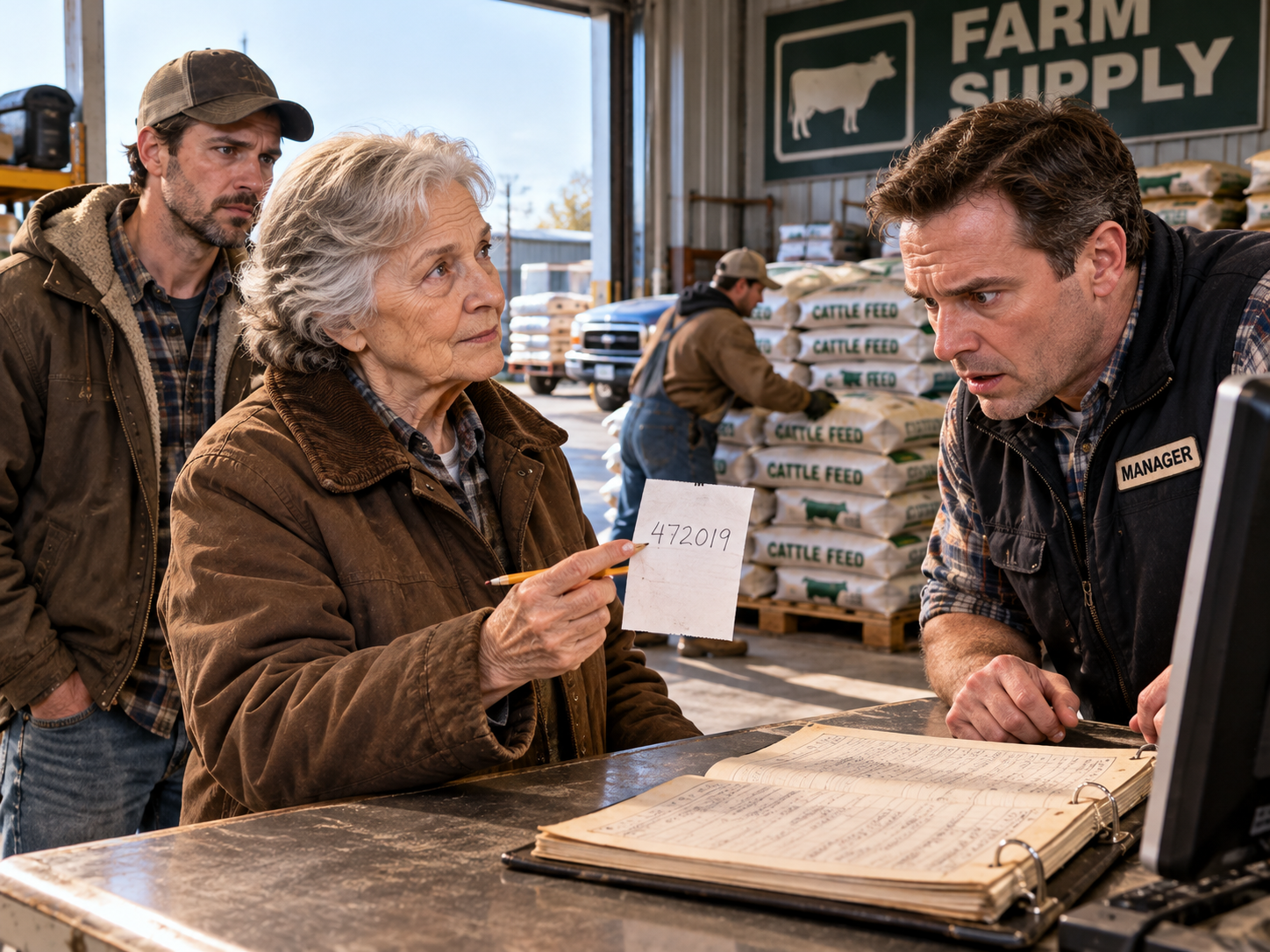
The store’s own response was becoming the best evidence that the matter had been taken seriously. The original papers remained together. The six-number reference had been added to the index. The inventory procedure required staff to check for relevant commitments during shortages before diverting the last essential stock solely because a larger buyer offered more. Martin’s review and written acknowledgment remained on file. Those measures did not guarantee perfect behavior, but they created a path for a future manager to make a more informed decision.
During a routine visit, I asked Travis how the procedure was working. He said it had not caused any major difficulties. Most transactions did not involve an old agreement, and the inventory system handled ordinary purchases as before. The new step mattered when the stock was scarce or when someone raised a question about a prior commitment. In those situations, staff could check the index and consult the relevant file rather than making assumptions. The procedure had become another part of the store’s work, not a constant interruption.
“Does it bother you that your father’s agreement was forgotten?” I asked.
Travis took a moment before answering. “Yes,” he said. “But I also know I cannot change what happened before I understood it. I can make sure I handle it properly now.” He did not sound defensive. He sounded like someone who had stopped trying to escape an uncomfortable fact and started deciding what to do with it. I respected that answer more than another apology would have meant.
I told Mom about the conversation. She said Travis’s response was reasonable. She had never expected him to carry personal guilt for every year the agreement had sat unnoticed. His responsibility began when the problem came to his attention. At that point, he had to review the records, correct the decision, and preserve the information so it could be found again. He had done those things. The store could not rewrite the past, but it could change what happened next.
My brother approached the matter more simply. He said we had needed feed, the store had nearly refused to sell it to us, and Mom had reminded the manager of an agreement. Then we had obtained the feed and returned to work. I told him that was the practical sequence, but it left out the importance of the financial records and the written acknowledgment. He shrugged and said the details mattered to the people who had to manage them. In a way, he was right. The agreement did not need to occupy every hour of our lives to remain important.
I thought about the difference between a promise and a favor. A favor depended on someone's willingness to help in a particular moment. A promise created an expectation that had to be considered when the relevant circumstances arose. Mom had not asked Travis to do us a favor by selling the feed at the posted price. She had asked him to honor a written commitment that the store had inherited along with its records. Once Martin reviewed the evidence, the issue was no longer about whether Travis liked our family or wanted to be generous. It was about the obligation the store had accepted.
That distinction also protected Travis from the wrong kind of pressure. Mom was not asking him to put our farm first in every decision. She was not asking him to give us discounts, ignore inventory limits, or deny other customers supplies when the agreement did not apply. She was asking him to consider a specific commitment within its boundaries. If the facts of a future shortage fell outside those boundaries, the store could make its decision under its ordinary procedures. Honoring an agreement did not mean abandoning judgment; it meant exercising judgment with the agreement in view.
One Saturday, I saw Travis explain that point to another customer who had heard a distorted version of the story. The customer believed our family now had a standing right to receive the last of any product in the store. Travis corrected him calmly. He explained that the arrangement concerned essential supplies during qualifying shortages and applied within its written terms. It did not give our family ownership of inventory or an unlimited priority. The customer seemed surprised, but he listened. I was glad Travis had chosen accuracy over the easier path of letting the rumor continue.
The exchange showed me that a true story could become false through exaggeration even after the original problem was solved. Some people wanted Mom to be a clever woman who had uncovered a secret claim. Others wanted Travis to be a dishonest manager who had tried to cheat a widow. Neither version matched what had happened. Mom had remembered an agreement, and Travis had failed to check it before changing a sale. The records had clarified the matter, and he had accepted the correction. The truth was less sensational, but it was more useful.
Mom was especially firm when people tried to turn her into a symbol. She would accept a kind word, then redirect the conversation toward the practical lesson. She explained that Walter had kept the records and that Martin had reviewed them. She reminded people that the store had sold the feed at the posted price, not handed it over as compensation. She would not let the story become a claim that our family deserved special treatment because of something our parents had done decades earlier. She wanted the commitment honored, not converted into a personal privilege.
I began to see that restraint was one of the strongest parts of her position. Because she did not ask for more than the agreement supported, the store could acknowledge its responsibility without fearing that every concession would become a demand for additional benefits. Because she accepted the closure of the reserve and the absence of an outstanding debt, the financial question stayed settled. Because she recognized the limits of the records reviewed, she did not pretend to have proof that no other document could exist. Her credibility came partly from refusing to overstate what she knew.
The same restraint helped us maintain our relationship with the store. We continued paying our bills, placing orders, and asking ordinary questions. We did not use the agreement as a threat in unrelated transactions. Travis did not treat every visit as a reminder of his mistake. The store served us as a customer, and we dealt with it as a business. If a future shortage brought the agreement into play, the records and procedure were there. Until then, the matter could remain quiet.
On a cold afternoon, Mom and I reviewed the folder one final time for our own peace of mind. The documents were in order, and the copy of the written acknowledgment matched the record she had kept. The six numbers were still legible on the old receipt. We placed it beside the copies of the agreement and returned everything to the cabinet. Mom said she hoped we would not need to open the folder again for a long time. I agreed.
But I understood that keeping the folder did not mean expecting another dispute. It meant respecting the work our parents had done and the responsibility that came with an agreement that outlived them. If the store needed to review it someday, the record was there. If nobody needed it for years, that would be even better. The value of a safeguard was not measured by how often it was used, but by whether it was available when it mattered.
I no longer wanted the story to end with Travis looking shocked or Mom proving him wrong. Those were only moments in a longer process. The more important ending was that the store had learned to check before deciding, and our family had learned to keep the evidence organized without turning every future transaction into a test of trust. The agreement remained exactly what it had always been: a limited, written commitment about essential supplies during qualifying shortages.
When I thought about my father and Walter, I felt grateful that they had written it down. Their arrangement had not prevented every misunderstanding, but it had given us a way to resolve one decades later. The reserve had served its temporary purpose and been closed properly. The separate commitment had remained relevant. The ledger, letter, and closing file had preserved the distinction. Without those records, Mom’s memory alone might not have been enough to persuade anyone who had never known the people involved.
What we could claim was clear. We could claim that the store had made a commitment and that the records supported honoring it in the situation that arose. We could claim that the sale had been changed without the agreement being checked, and that the store later corrected its decision. We could claim that the procedure had been updated and the documents preserved. What we could not claim was ownership, a hidden fortune, or an unlimited right to supplies. We could not claim certainty about every document that might ever have existed. The truth needed no additions.
By then, the story had taught me something I had not expected. A person did not protect a promise by making it sound bigger than it was. A person protected it by knowing exactly what it said, keeping the evidence, and insisting that it be considered when the relevant moment came. Mom had done that without shouting, without demanding a reward, and without asking the store to treat our family as more important than its other customers.
The agreement had survived thirty-two years because someone had written it down. It had become useful again because someone remembered how to find it. And it had a better chance of surviving the next thirty-two years because the store had finally made room for it in the way it worked.
Click here to continue reading: PART 16: A PROMISE KEPT IN ORDINARY WAYS
The Store Manager Took Back My Mother’s Last Twenty Bags of Cattle Feed, Until Six Numbers on a Receipt Changed His Expression
Part 15 of 20

