
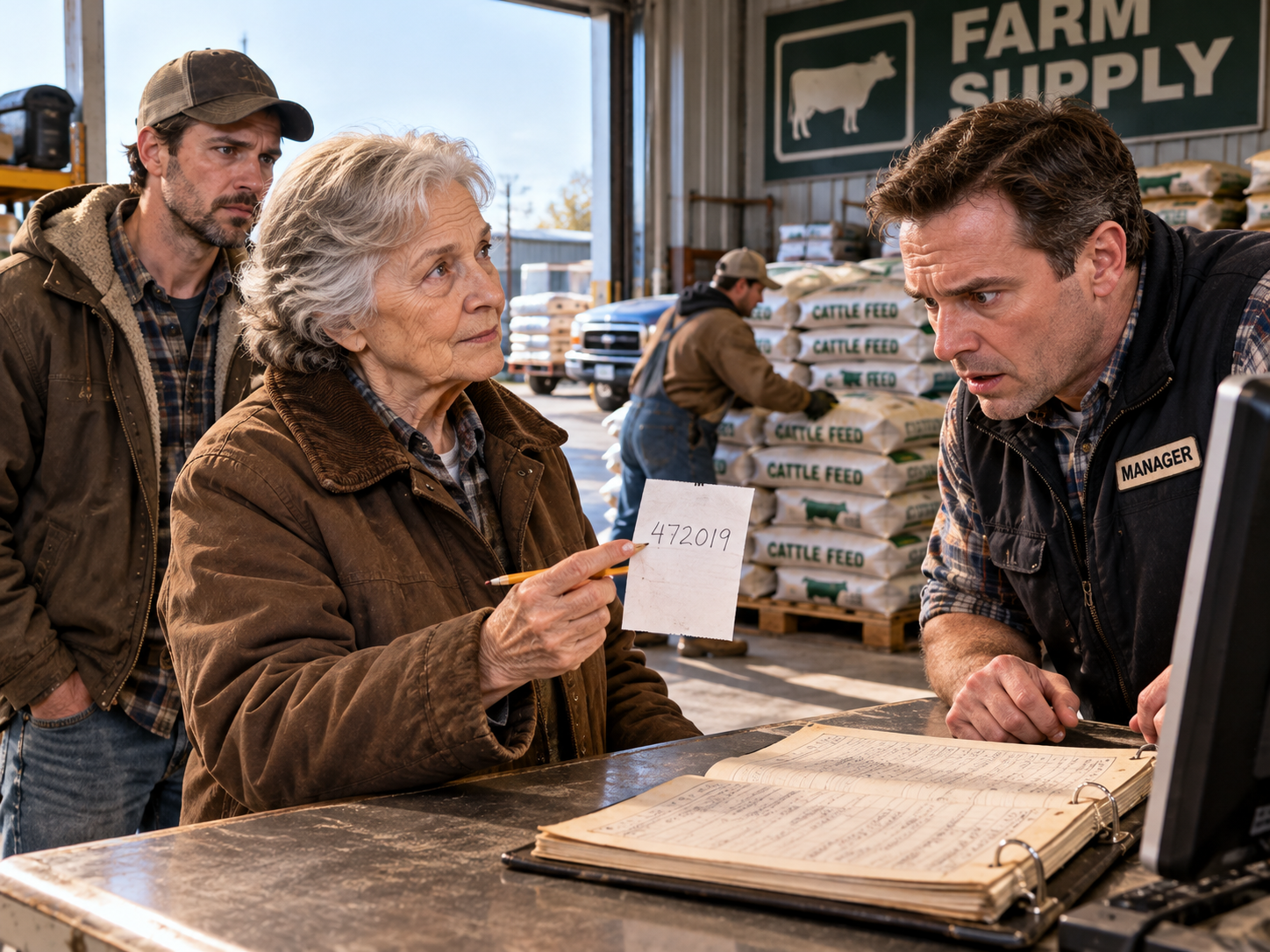
The last stretch of winter passed without another shortage that brought our agreement into question. The store continued its business, and our farm continued its work. Snow came and went, the ground froze hard, and the cattle settled into their winter routines. I sometimes thought about how different the season might have been if Mom had not remembered the six numbers. We might have driven forty miles to find feed, lost valuable time, and faced a harder week in bad weather. Instead, we had obtained what we needed and returned to the work waiting at home.
But the result had never depended on the numbers alone. Mom had known why they mattered, Travis had chosen to look for the records, and Martin had examined the evidence carefully. The original agreement, Walter’s letter, the ledger references, and the closing statement had each contributed something different. Together, they showed that the temporary financial reserve had been settled while the separate commitment about essential supplies remained relevant within its scope. The record was strong enough to guide the store’s decision without supporting claims beyond what it actually said.
I became more comfortable with the idea that a story could end without every question about the future being answered. We did not know whether another shortage would ever bring the agreement into use. We did not know who would manage the store years from now or whether the inventory system would change again. We did know that the documents had been preserved, the reference had been indexed, and the current manager had accepted responsibility for checking the agreement when circumstances required it. That was a reasonable foundation for the future, even if it was not a guarantee.
One morning in late February, Mom asked me to drive her into town. She needed a few household items and wanted to check the price of a replacement part for an old piece of equipment. We stopped at the farm supply store first. The parking lot was partly covered in dirty snow, and the front door opened with the same familiar scrape. Inside, customers moved between the aisles, employees answered questions, and the register chimed whenever someone completed a purchase. Nothing about the place suggested that an agreement written decades earlier had nearly been forgotten there.
Travis greeted Mom and asked whether the farm had come through the latest cold spell without trouble. She told him we had managed, then asked about a shipment he had mentioned during her last visit. He explained that it had arrived late but that the store had notified the affected customers and adjusted the orders. Their conversation was straightforward. They did not speak as adversaries or as people who needed to revisit a painful moment. They spoke as two people who had a business relationship and had learned something useful from a difficult misunderstanding.
While Mom checked the price of the part, I noticed the small reference label near the office shelves. It was not a public display, and no customer would have known what it meant. It simply directed staff to the historical agreement file. I found myself smiling at how ordinary it looked. The six numbers that had once seemed mysterious were now part of a practical recordkeeping system. They did not need to impress anyone. They needed to be findable.
Travis noticed me looking toward the shelf and explained that the index had been incorporated into the store’s internal reference materials. He had also told the employees that the existence of an old agreement did not automatically determine the answer to every question. They still had to read the original terms and check the facts of the situation. If the meaning was unclear, they should ask him and, when appropriate, seek Martin’s advice. He wanted the staff to know both that the commitment mattered and that its limits mattered too.
“That seems right,” I told him.
“It is the least I can do,” he replied. Then he paused. “Actually, it is what I should have done before.”
I appreciated that he could say it without trying to turn the moment into another apology. He had already acknowledged the mistake, and the store had changed its procedure. Repeating regret would not add much. What mattered was that he understood the original failure: he had acted on the higher offer without checking whether an existing commitment applied. The correction was now part of the way he approached such decisions.
When Mom returned, she had purchased the replacement part at the posted price. Travis printed the receipt and handed it to her. She checked the amount, thanked him, and placed it in her bag. The exchange was so ordinary that anyone watching would have assumed nothing unusual had ever happened between them. That was how Mom wanted it. She had not fought to make the dispute a permanent feature of every visit. She had fought to have the agreement recognized, and once that happened, she was willing to let the relationship move forward.
On the drive home, I asked whether she felt the matter was finally behind us. She looked out at the snow-covered fields and thought for a moment. “The November problem is behind us,” she said. “The agreement is still there, and it should remain there. Those are different things.” I asked what she meant. She explained that the dispute had been resolved, but the commitment itself had not become irrelevant. It still had to be considered if a future shortage fell within its scope. We did not need to think about it every day, but we could not pretend it no longer existed.
I understood. An agreement was not a problem merely because it remained in force. It was part of the store’s responsibilities, like any other valid commitment. The point was not to keep the conflict alive. The point was to let the agreement exist quietly, ready to be consulted if the relevant circumstances returned. A promise did not need to be constantly discussed to be honored. It needed to be understood and acted upon when required.
At home, Mom put away the receipt and updated her accounts. She recorded the purchase, checked the balance, and returned the ledger to its place. I watched her for a moment, thinking about how similar the work looked to what she had done before the dispute. Nothing in her routine had changed dramatically. She still recorded what we bought, tracked what we owed, and kept copies of important documents. The difference was that I now understood how much these ordinary habits could matter decades later.
My father had kept records for the farm, and Walter had kept records for the store. Their agreement had connected those two worlds during a difficult season. Neither man could have known exactly how the arrangement would be tested years afterward, but they had written it down because they wanted the commitment to be clear. The reserve records had later shown that the financial portion was closed, while the separate supply promise remained. The distinction had survived because the documents preserved it, even when the people who remembered the original conversations were no longer there to explain them.
I sometimes wondered whether the original agreement could have been written more clearly. Perhaps a more detailed indexing system could have prevented the confusion. Perhaps the store could have included the commitment in its procedures long ago. But there was little value in imagining a perfect past. The agreement had been clear enough for Martin to review, and the supporting records had allowed him to reach a careful conclusion. The problem was not that the documents said nothing. The problem was that no one had looked at them before making the sale decision.
That was why the store’s new procedure mattered. It did not change the past or enlarge the agreement. It created a point in the decision-making process where someone had to check for existing obligations before redirecting the last essential stock in a qualifying shortage. It also made the historical file easier to locate and provided a path for questions that required further review. A small procedural change could not eliminate every mistake, but it could prevent a familiar kind of mistake from happening unnoticed.
My brother put it in simpler terms when we were unloading another delivery. “At least next time, they will look before deciding,” he said. I agreed. We did not need to know whether another shortage would occur or whether the agreement would ever have to be used again. The store had acknowledged it, and the procedure was in place. That was a meaningful result even if it never led to another dramatic moment.
The town gradually returned to its ordinary concerns. Farmers discussed seed orders, machinery repairs, feed prices, and the weather. The store continued serving customers who needed everything from fencing supplies to basic equipment. Our family remained one of those customers. No one was publicly rewarded or punished. There was no hidden wealth, no ownership claim, and no ongoing financial dispute. The reserve had been closed and reconciled. The agreement remained a limited commitment, preserved for the circumstances it was written to address.
I was grateful that the story had not become what some people wanted it to be. It would have been easy to turn Mom into a woman who outsmarted a manager with a secret code, or to portray the store as a business that cared only about money. Those versions might have sounded more dramatic, but they would have obscured the lesson. Mom had remembered a genuine agreement. Travis had failed to check it. Martin had reviewed the evidence. The store had corrected the sale and updated its procedures. Each person’s role was specific, and the facts did not require anyone to be made into a caricature.
Mom’s strength had been in knowing what she was asking for and what she was not asking for. She had not demanded a discount, compensation, or special treatment. She had not claimed a right to every product in the store. She had not treated the closed reserve as an unpaid debt. She had asked the store to honor a commitment about essential supplies during qualifying shortages, and she had accepted the evidence that explained its limits. That restraint made the request harder to dismiss as personal entitlement.
Travis’s responsibility had been equally clear. He had to recognize that a better offer was not the only consideration when a prior commitment might apply. Once the agreement was identified, he had to review it honestly, accept the findings, and make sure the record could be found again. He did not have to know every conversation his father had held thirty-two years earlier. He did have to take care of the obligations that came with the business he now managed. By the end, he had taken that responsibility seriously.
Martin’s role had been to keep the facts in order. He had separated the financial reserve from the continuing supply commitment, reviewed the closing records, and avoided claims beyond the evidence. His caution had prevented the story from becoming a dispute about money that was not owed or ownership that did not exist. The written acknowledgment and updated procedure reflected what the documents supported, rather than what anyone might have wished them to say.
And Mom’s role had been to remember. She remembered the six numbers, the agreement, and the reason Walter had given them to her. But she had also remembered the condition attached to them: they were to be used only when there was no other choice. She had waited until the ordinary conversation failed, then directed the manager toward the records. Once the evidence had been reviewed and the decision corrected, she had allowed the matter to settle. She did not confuse persistence with endless conflict.
When spring eventually approached, the fields began to soften and the farm’s work shifted toward the next season. The folder remained in the cabinet. The store’s copy remained in its archive. The index remained available to employees who needed to check a possible commitment. The six numbers had become less mysterious, not because their history had faded, but because their purpose was now understood by the people responsible for preserving it.
I no longer thought the true ending depended on whether another shortage would ever test the agreement. The story had already reached its meaningful conclusion. The feed had been purchased and used. The reserve had been settled, with no outstanding money owed to our family. The continuing commitment had been identified and preserved within its original scope. The store had acknowledged its mistake and adopted a better process. Our family had returned to farming, and the store had returned to serving its customers.
What remained was not a claim over the store, a secret fortune, or a permanent advantage for our farm. What remained was a promise, written down when two families understood that a local business and the farms around it depended on one another. Time had nearly buried it, but the records had survived. Mom had remembered how to find them, and the store had finally learned how to keep them accessible.
Years from now, another manager might open the file and see only an old agreement, a letter, a ledger reference, and a closing statement. That manager might never know the cold morning when twenty bags of feed were nearly sold elsewhere, or the seventy-four-year-old woman who wrote six numbers on a receipt. But if the manager read the papers carefully, the essential point would still be there. The store had made a commitment, and the commitment deserved consideration when the conditions it described arose.
That was all Mom had asked. She had not wanted to own the store’s future or rewrite its history. She had wanted the people running it to understand what had already been promised and to act accordingly. The final result was not extraordinary because it made our family powerful. It mattered because it restored a practical obligation to its proper place and made it less likely that the same mistake would be repeated.
I still remember the receipt, the six numbers, and the silence that followed when Travis recognized their significance. But when I think about the story now, I remember something quieter: Mom checking the documents, Travis correcting the index, Martin keeping the legal distinctions clear, and the store continuing its work without another confrontation. Those ordinary actions were what gave the old agreement a future.
The promise had survived the people who made it. It had survived a closed reserve, a dusty ledger, and years of being overlooked. It survived because the records remained, because someone remembered, and because others eventually chose to look. No one had to become a hero for the commitment to matter. They only had to take it seriously.
Mom never asked the store to remember her family as heroes. She only asked it to remember its own word.
Click here to continue reading: PART 17: THE RECORD THAT NO LONGER NEEDED A WITNESS
The Store Manager Took Back My Mother’s Last Twenty Bags of Cattle Feed, Until Six Numbers on a Receipt Changed His Expression
Part 16 of 20

