
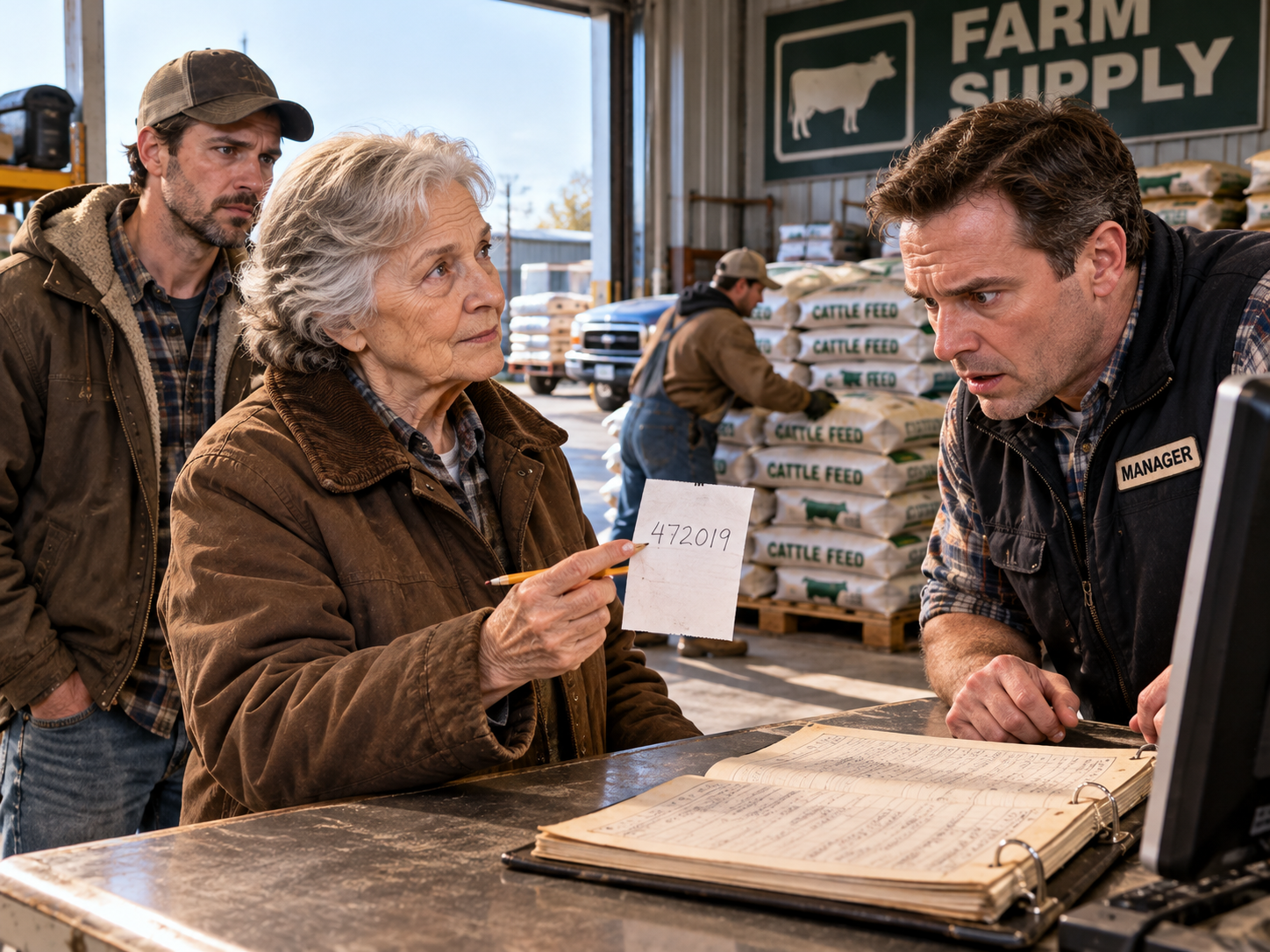
By the time the first signs of spring appeared along the Iowa roads, the story of the twenty bags of cattle feed had become something I rarely mentioned unless someone asked directly. The incident belonged to the previous season, but its lesson had followed us into the new one. Our farm was busy again, the cattle needed their usual care, and the equipment that had survived winter required maintenance before the ground became workable. The agreement at the farm supply store remained in its file, where it belonged, and I had begun to understand that its greatest value might be that we would never need to argue about it again.
Mom seemed comfortable with that possibility. She did not ask Travis for regular updates, and she did not visit the store to make sure the agreement remained on the shelf. She had received the written acknowledgment, kept her own copies, and seen the reference added to the store’s records. If the store needed to consult the agreement in the future, the procedure was there. If it never needed to consult it again, that would mean the particular circumstances covered by the promise had not returned. Either outcome was preferable to another dispute.
I had once thought that a person proved a commitment mattered by reminding everyone about it. Now I understood that constant reminders could become a substitute for the more important work of preserving the commitment properly. Mom had reminded Travis when she had to. Martin had explained the documents. The store had updated its records. After that, the responsibility belonged to the people who would use those records in their ordinary work. Mom could not stand behind every future decision, and she had never intended to.
One morning, while we were checking the cattle, my younger brother asked whether I thought the store would ever forget the agreement again. I told him that I could not promise it would not. Records could become disorganized, managers could change, and people could overlook things. But I believed the store was better prepared now than it had been before. The original agreement had been preserved, the supporting papers had been assembled, and the index gave employees a way to locate the file. Those measures did not guarantee perfect judgment, but they reduced the chance that the same mistake would happen simply because nobody knew where to look.
My brother nodded and returned to his work. He was less interested in the paperwork than I was, but he understood the practical point. The agreement had mattered when our feed supply was threatened, and now it was recorded where a future manager could find it. We did not need to keep discussing the incident to make those facts true. The cattle were fed, the farm was functioning, and our attention belonged to the work in front of us.
A few days later, I stopped at the store to purchase supplies for a repair. Travis was helping an employee review an incoming order, so I waited near the counter. They were checking the quantities against the delivery paperwork, comparing what had arrived with what had been ordered. When one item appeared to be missing, Travis asked the employee to confirm the count before marking the delivery complete. The employee checked again and found the missing item in another container. They corrected the record and moved on.
The moment lasted less than a minute. It had nothing to do with our family or the old agreement. Still, I noticed it because I had become more aware of how small habits shaped decisions. Travis had learned that an assumption could become an error when nobody checked the details. He was now asking for confirmation before finalizing the record. Perhaps he had always done that in other circumstances. Perhaps the November dispute had made him more attentive. I could not know, and I did not need to know. The useful thing was that he checked.
When Travis finished with the delivery, he greeted me and asked how the farm was doing. I told him we were preparing for the next season. He mentioned that the store was updating some of its inventory procedures before the busier months, then asked whether we had experienced any difficulty obtaining supplies since November. I told him we had not. He said he was glad to hear it, and we left the subject there. Neither of us needed to turn an ordinary conversation into another review of the past.
On the drive home, I considered how differently that conversation might have gone a few months earlier. In November, I had entered the store expecting to purchase feed and leave. Instead, I had watched Mom face a refusal that threatened to leave us short at a critical time. Travis had acted on the larger offer without checking the old agreement. The discovery of the six-number reference had changed the direction of the morning, but it had not instantly solved everything. The documents still had to be located, the reserve had to be understood, and the agreement’s scope had to be established.
The actual resolution had depended on several people doing different jobs. Mom had remembered the reference and directed Travis toward the records. Travis had allowed the review to proceed and accepted the result. Martin had separated the settled financial reserve from the continuing supply commitment. The original agreement, Walter’s letter, the ledger, and the closing file had supported the conclusion. The store had sold us the twenty bags at the posted price and established a better way to find the agreement in the future. No single person had accomplished all of that alone.
When I explained this to Mom, she said it was important not to give the six numbers more credit than they deserved. “They helped us find the records,” she said. “The records showed what had been agreed.” She was right. The numbers had been the key to locating the relevant history, but they were not a secret command that forced the store to do anything. Their meaning came from the documents they connected. Without those documents, the numbers would have been little more than six digits written on a piece of paper.
That distinction had become important to me because I had initially imagined the numbers as a dramatic revelation. I had expected them to expose something extraordinary about the store or our family. Instead, they led to a practical agreement made during a difficult season decades earlier. The reserve had been closed properly, and the remaining balance had returned to the store’s operating funds. Our family was not owed money. The agreement did not establish ownership or an unlimited right to supplies. Its continuing relevance was specific, and its value lay in the commitment it preserved.
Mom had never been disappointed by that answer. She had known what the agreement was about, and she had not expected it to contain more than it did. The purpose of the reserve had been temporary financial support during a difficult period. The supply commitment was separate. Walter had intended the financial account to be reconciled without erasing the ongoing obligation concerning essential supplies. The records had confirmed that distinction. Once the store understood it, there was no need to invent a larger claim.
Later that week, Mom asked me to bring her the folder containing our copies. She wanted to check that the receipt with the six numbers was still together with the acknowledgment and the copies of the agreement. I took the folder from the cabinet and placed it on the table. We reviewed the contents, confirming that the papers were complete and in good condition. Nothing had changed. She returned the folder to its place and thanked me.
I asked whether she thought we should keep a separate copy somewhere else in case anything happened to the first one. She considered the idea and agreed that a second copy would be sensible, provided we kept it secure and made clear that it was a copy. We did not need to distribute it around town or ask other people to preserve it. We simply needed to avoid placing all our records in one vulnerable location. It was an ordinary precaution, the same kind we used for important farm documents.
As I made the copy, I read the agreement again. The wording was straightforward. It concerned essential supplies during shortages, established local farm customers, and the store’s responsibility not to divert the last available stock solely because a larger buyer offered more when a qualifying prior commitment applied. It did not promise that every item would always be available. It did not prevent the store from serving commercial customers. It did not give our family control over inventory. Its limits were part of its meaning, not obstacles to be ignored.
I understood why Mom had insisted that Martin review the entire record instead of relying on the six numbers alone. A reference could lead someone to the right place, but only the full documents could explain the obligation. The closing statement mattered because it clarified the reserve. Walter’s letter mattered because it explained the intended relationship between the temporary financial arrangement and the continuing supply commitment. The original agreement mattered because it set the actual terms. Each piece supported the others without turning the arrangement into something it had never been.
When I finished copying the papers, I returned the original folder to Mom. She placed the second copy in a separate file and wrote a simple label on the front. There was no ceremony. We did not speak about justice or victory. We were just taking care of a record that had proved useful once and might be useful again. That quiet act seemed more faithful to the spirit of the agreement than any public declaration would have been.
Spring work gradually took over our attention. We checked equipment, planned purchases, and prepared the farm for changing conditions. The store remained one of the places where we did business. Travis continued serving our family and the larger commercial operation alike. We paid the posted prices, and the store handled our orders under its ordinary procedures. The agreement did not intrude into unrelated transactions, and we did not invoke it when it did not apply.
I began to appreciate that a promise could be both important and quiet. It did not have to dominate every relationship or become a permanent source of conflict. It could remain in the background, available when the circumstances it covered arose. The people responsible for it could go about their lives without constantly proving that they remembered it. What mattered was that the promise remained accessible and that the next person who needed to understand it would not have to depend on a fading memory.
The old record no longer needed Mom to stand beside it every day. Her memory had brought it back into view, but the store’s updated procedure now gave it a place in the business. That was the real change. The agreement had moved from an overlooked file to an acknowledged responsibility. It had not become larger or more powerful. It had become easier to understand and harder to ignore.
Click here to continue reading: PART 18: THE PEOPLE WHO CAME AFTER
The Store Manager Took Back My Mother’s Last Twenty Bags of Cattle Feed, Until Six Numbers on a Receipt Changed His Expression
Part 17 of 20

