
The final ownership meeting took place on a bright morning in late spring.
Mr. Harris stood beside Mike in the break room while employees gathered around the tables. He looked a little emotional, though he tried to conceal it behind his usual practical manner.
The store's transition arrangements had been completed.
A new ownership group would take responsibility for the business, while Mike would remain store manager.
The employees' existing roles would continue, and any future changes would be communicated through the normal management process.
I listened carefully.
For months, we'd known the transition was coming.
Still, hearing the final announcement made it real.
Mr. Harris had been part of the store for most of my working life.
He'd hired Mike, supported community projects, and helped establish the grocery assistance fund after Emily's unexpected donation.
I wondered what the store would feel like without him.
After the meeting, several employees approached him to offer congratulations and thanks.
Denise hugged him.
Tyler shook his hand.
Megan told him she appreciated the training opportunities she'd received.
I waited until the crowd thinned.
Then I stepped forward.
"Thank you for everything," I said.
Mr. Harris smiled.
"You've done good work here, Rachel."
"So have you."
He laughed softly.
"That's kind of you."
I hesitated.
"I'm especially grateful you supported the assistance fund."
His expression grew thoughtful.
"That program belongs to the store now."
"I know."
"That's the best part."
I nodded.
He was right.
The fund had survived its early uncertainties, improved its procedures, and become part of the store's regular community work.
Its future would depend on continued oversight and support, not nostalgia for the people who started it.
A few days later, the new ownership representatives met with Mike and the department leads.
I attended the portion concerning front-end operations and employee training.
The representatives asked practical questions about staffing, customer service procedures, and the assistance fund.
Mike explained the program's financial controls.
The accounting supervisor reviewed the records.
I described how employees were trained to respond discreetly when customers experienced payment difficulties.
The representatives listened carefully.
One asked whether the fund had created additional administrative burdens.
Mike answered honestly.
"It requires oversight, but we've incorporated that into our regular review process."
Another asked whether the program's limits were clearly documented.
"They are," I said.
I handed over the training summary.
The meeting ended without any dramatic announcement.
The new owners confirmed that the assistance fund would continue under the existing procedures, subject to regular review.
I felt relieved.
There would always be uncertainty in business.
But the program had been treated as a serious responsibility rather than a sentimental project.
That mattered.
The following week, Emily visited the store with the twins.
They were walking confidently now, though their confidence exceeded their judgment.
One tried to reach a display of crackers.
The other was fascinated by the wheels of a shopping cart.
Emily guided them with practiced patience.
When she reached my register, I smiled.
"You're getting good at keeping up with them."
She laughed.
"I've stopped pretending I can predict what they'll do."
I scanned her groceries.
She asked how the ownership transition had gone.
I told her the store would continue operating normally and that the assistance fund was remaining in place.
Her expression softened.
"I'm glad."
"So am I."
She looked toward the small notice near customer service.
"It's strange to think that all of this started because I couldn't pay for diapers."
I paused.
"That was the moment we met. But the program happened because a lot of people chose to help."
She nodded.
"I know."
One of the twins tugged at her sleeve.
She bent down to speak to him.
I watched her for a moment.
The exhausted young mother I'd met on that Friday evening was still there in some ways.
She still had difficult days.
She still worried about her children.
But she had grown more confident, and her life had become steadier.
I was glad I'd been able to witness some of that change.
When the transaction was complete, Emily handed me a small folded note.
"Don't open it until you get home," she said.
I looked at her.
"Another envelope?"
She laughed.
"Nothing dramatic this time."
I smiled.
"All right."
She gathered the groceries and guided the twins toward the doors.
Before leaving, she turned back.
"See you soon, Rachel."
"See you."
I placed the note in my apron pocket.
The rest of the shift passed normally.
I helped Megan with a return, answered a question about the assistance fund, and reviewed the next week's training schedule with Tyler.
Denise stopped by during a quiet moment.
"Everything okay?"
I nodded.
"Yes."
She looked at the folded note peeking from my pocket.
"What's that?"
"Emily left it."
Denise smiled.
"That woman likes writing you letters."
I laughed.
"Apparently."
At home, I made dinner before opening the note.
I wanted to sit down and read it without rushing.
The paper was folded twice, with my name written on the outside.
Inside, Emily had written a short message.
She thanked me for being her friend, not just the cashier who helped her during a difficult evening.
She wrote that the twins were growing quickly and that she hoped they would someday understand how much ordinary kindness could matter.
Then she added something that made me pause.
She said she no longer thought of that Friday as the day she failed to buy diapers.
She thought of it as the day someone treated her with respect when she felt she had very little left.
I read the sentence again.
It was the clearest explanation she'd ever given me of what the moment meant.
The eight dollars and forty-two cents had purchased the missing portion of her groceries.
But the way I'd offered the help had allowed her to leave without feeling judged.
That was what she remembered.
I placed the note beside the others in my drawer.
The collection had grown over time.
There was the original letter, the photograph of the newborn twins, later pictures of them sitting and standing, and the autumn festival photograph beside their pumpkins.
Each represented a different part of Emily's life.
The original envelope no longer seemed like the center of the story.
It was simply the beginning of our friendship.
A few weeks later, the store held a small gathering to thank Mr. Harris for his years of ownership.
Employees brought food, shared memories, and signed a card.
There were no elaborate speeches.
Mr. Harris preferred it that way.
Mike thanked him for supporting the staff and maintaining the store through difficult years.
Denise told a funny story about a delivery mix-up from long ago.
Tyler described how much he'd learned since joining the team.
When it was my turn, I kept my words brief.
I thanked Mr. Harris for listening when employees had ideas and for understanding that community programs needed both compassion and accountability.
He smiled and nodded.
Afterward, he approached me near the coffee table.
"Rachel, keep doing what you're doing."
I laughed softly.
"I'll try."
He looked toward the front of the store.
"Remember, though, you don't have to carry everything yourself."
The words made me smile.
Denise had told me the same thing.
So had Mike.
Even Emily, in her own way, had reminded me.
"I know," I said.
Mr. Harris nodded.
"Good."
The next morning, I arrived for my shift before the store opened.
The front end was quiet.
I checked the register supplies, reviewed the staffing schedule, and helped Megan prepare her station.
Tyler was organizing the training materials for a new employee.
Denise was speaking with Mike near customer service.
Everyone had work to do.
The store was changing ownership, but the daily rhythm remained familiar.
I walked past the register where Emily had stood with the twins.
For a moment, I stopped.
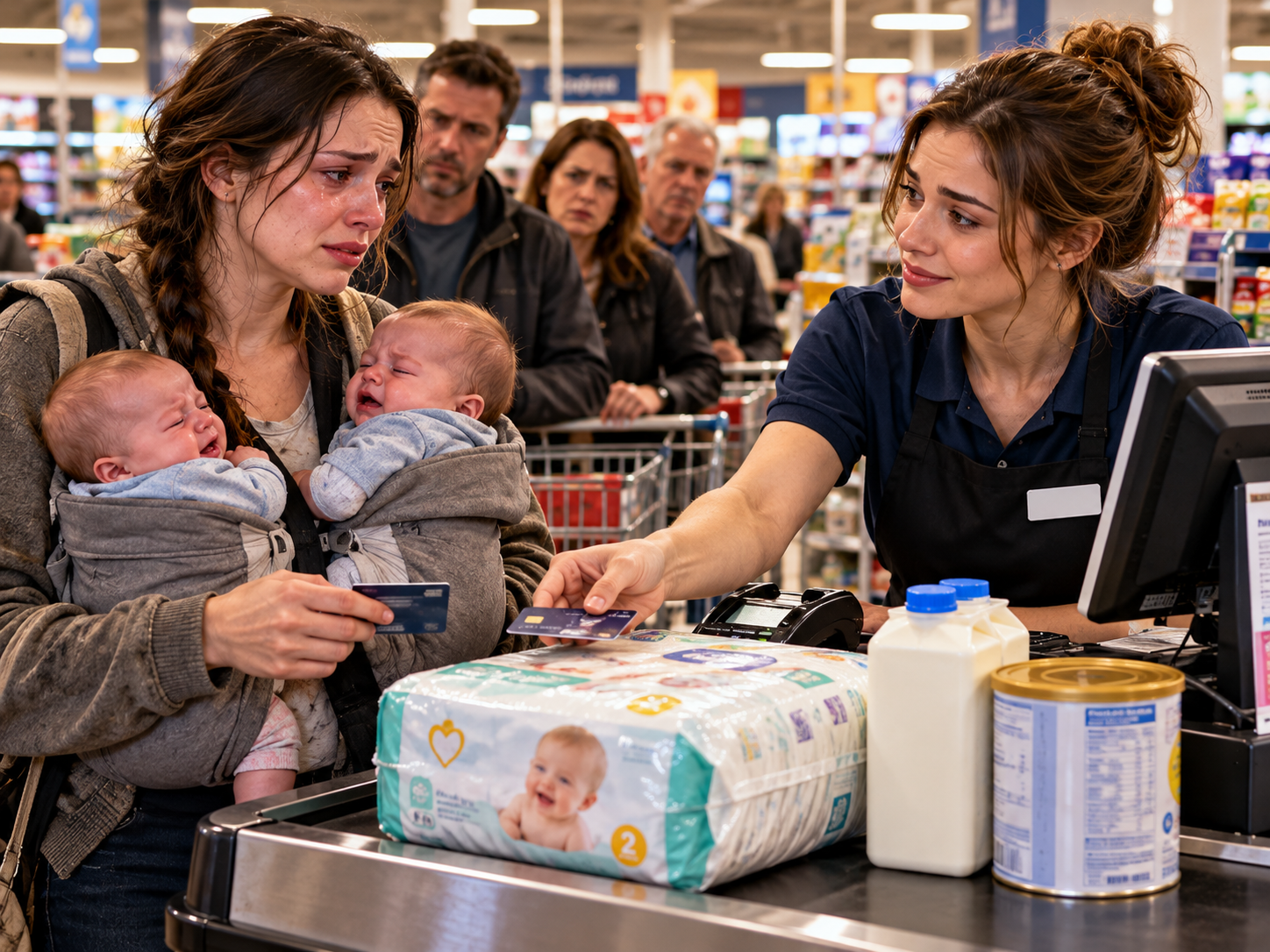
I remembered the Friday evening rush, the declined payment, and the impatient customers behind her.
I remembered reaching for my own card.
At the time, I'd been worried about whether Mike would question the transaction.
The next morning, he'd called me into his office and handed me an envelope.
I had opened it expecting nothing.
Inside was a letter, a photograph, and a gift so unexpected that I'd needed to sit down.
That moment had changed the direction of my life in ways I couldn't have predicted.
Not because the money made me wealthy.
I hadn't kept it.
Not because the story made me famous.
It hadn't.
But because it led to a friendship, a community program, and new responsibilities that helped me recognize abilities I'd overlooked.
The store's assistance fund continued helping customers.
Employees were trained to protect privacy and respond respectfully.
The program's records were reviewed, its limits maintained, and its future supported by people beyond those who had started it.
Emily was raising her sons, working, and building a stable life.
I was still a cashier, though now I helped train others and contribute to the store's operations.
Neither of us had become someone entirely different.
We had simply grown.
A customer approached my register carrying a basket of groceries.
I smiled.
"Good morning."
She returned the greeting and began placing items on the belt.
I scanned them, answered a question about a sale, and packed her bags.
She paid and left.
The next customer stepped forward.
The day continued.
I didn't know what difficulties the people in front of me had experienced before entering the store.
I didn't know what would happen after they left.
I couldn't solve every problem.
I couldn't always offer financial help.
But I could listen.
I could explain.
I could treat people with patience when something went wrong.
And I could trust the people around me to do their part.
That was what the original eight dollars and forty-two cents had taught me.
Not that every small kindness would lead to an extraordinary reward.
Most wouldn't.
But that a person could make a difficult moment less painful simply by choosing to respond with care.
I reached for the next item on the conveyor belt.
The scanner beeped.
The customer smiled.
And another ordinary day began.
The End
Read more original stories on Feel Every Story.
The Young Mother Had Already Been Refused Twice When I Made a Decision That Could Have Cost Me My Job
Part 20 of 20

