
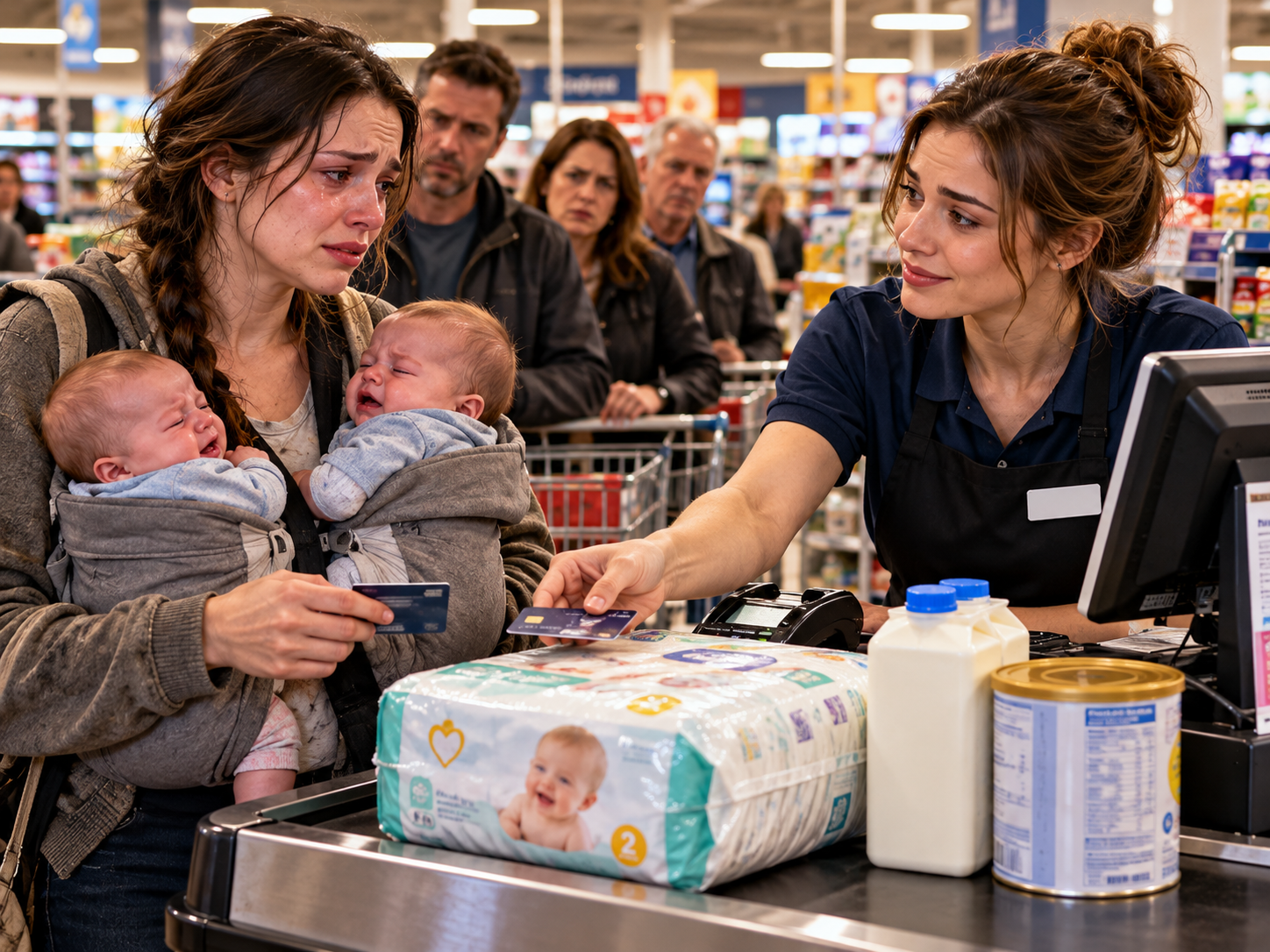
Mike held the envelope toward me, but for a moment I didn't reach for it. My mind was still caught on the fact that the young mother had returned to the store. I pictured her carrying both babies through the automatic doors again, perhaps after finally getting them settled at home. Why would she make another trip? Had there been a problem with the diapers? Had she discovered that the transaction hadn't gone through correctly? I looked at Mike, hoping his expression would provide some clue, but he simply waited.
“Is something wrong?” I asked.
He shook his head. “I don't think so.”
The answer wasn't especially reassuring. Mike was usually direct, and his careful tone made me more nervous. I took the envelope. It was plain white, with my first name written across the front in slightly uneven handwriting. There was no return address or decorative seal. The paper felt thicker than I expected, and I could tell something had been folded inside. I turned it over, looking for a note on the back, but there was nothing.
“She asked for you by name,” Mike said. “When I told her you'd already gone home, she seemed disappointed. Then she asked whether I could give this to you personally.”
I looked up. “Did she say what it was?”
“No. She said it was important.”
I slipped my finger beneath the flap and opened it carefully. Inside was a folded sheet of notebook paper and a smaller envelope. I unfolded the note first. The handwriting was hurried but legible, with several words crossed out and rewritten. The woman had addressed it to me by name and thanked me for helping her at the register. She wrote that the previous evening had been one of the hardest days she'd experienced since her twins were born. She hadn't expected a stranger to notice how frightened she was, much less help her without asking for an explanation.
I read the first paragraph twice. The note continued, explaining that she had returned to the store because she couldn't bear the thought of leaving without properly thanking me. She wrote that the diapers mattered more than I could have known and that my kindness had allowed her to go home with everything her babies needed for the night. The words were simple. There was no elaborate language or attempt to make the situation sound dramatic. Perhaps that was why they affected me so strongly. I could hear her tired voice in every sentence.
Then I reached the final lines.
She wrote that she'd left something else in the envelope, not because she believed kindness should be repaid, but because she wanted me to understand that my help had reached someone who had almost stopped expecting help from anyone. She asked me to open the smaller envelope when I was ready.
I looked at Mike. “Did you read this?”
He shook his head. “She gave it to me sealed. I didn't open it.”
I believed him. Mike could be strict about store procedures, but he respected personal matters. I set the letter on my lap and opened the smaller envelope. Inside was a photograph of the twins, taken when they were much younger, and a folded piece of paper that looked like a receipt. I unfolded it. At first, I couldn't understand what I was seeing. It was a money order for an amount far larger than the eight dollars and forty-two cents I'd paid.
My hands began to shake.
I checked the amount again, convinced I had misread it. The money order was made payable to me, Rachel, and the figure was enough to cover several months of my rent. I looked from the document to the photograph and back again. My mind refused to connect the exhausted woman at the register with this unexpected gift. She had been unable to complete a small grocery purchase. How could she return hours later with money like this?
“Mike,” I whispered, “I don't understand.”
He leaned forward. “What is it?”
I handed him the money order without letting go of the letter. He studied it, then looked at me with genuine surprise. “Well,” he said quietly, “I can see why she wanted you to receive it personally.”
My knees felt weak. I sat down in the chair beside his desk, still holding the photograph. The twins were wrapped in matching blankets, their tiny faces turned toward each other. I remembered the crying baby at the register and the sleeping one whose mouth had remained slightly open. The photograph made them seem even more fragile. I couldn't imagine what their mother had endured, and the money order only deepened my confusion.
“There must be a mistake,” I said.
Mike placed the document carefully on the desk. “Maybe there's an explanation in the letter.”
I read the note again, searching for something I'd missed. Near the bottom, beneath the lines I'd already read, was a short postscript. The woman had written that she hadn't had access to the money when she came through my register. She explained that an emergency transfer from a relative had arrived later that evening, after she'd returned home. She had used part of it to purchase the money order because she wanted to do something meaningful for the person who helped her before the money arrived.
I stared at the words. The explanation answered one question but created another. Why would someone who had just struggled to buy diapers give away such a large portion of an emergency transfer? The young woman still had two infants to care for. She needed formula, diapers, food, and a thousand other things I could barely imagine. I felt a rush of concern. I had helped her because she was in a difficult situation. I didn't want my small gesture to become another burden she felt obligated to carry.
“I can't take this,” I said.
Mike looked at me. “Rachel, she clearly wanted you to have it.”
“I know. But she needs it more than I do.”
He considered that. “You don't know her full circumstances.”
“No,” I admitted. “But I know she couldn't pay for diapers yesterday.”
Mike folded his hands on the desk. “Then maybe you should think about what you want to do before making a decision.”
I appreciated his calmness, but I couldn't stop looking at the money order. The amount was extraordinary compared with what I'd given. I had expected nothing in return. Even a thank-you note would have felt generous. This was something else entirely. It made me uncomfortable because I didn't know whether accepting it would honor the woman's intention or undermine the help I'd offered.
Mike asked whether I wanted a few minutes before starting my shift. I nodded. He stepped out of the office, leaving me alone with the envelope and its contents. I read the letter once more. The young woman had signed only her first name, Emily. I repeated it silently, attaching it to the face I remembered from the register. Emily. A tired mother with two babies, a braided hairstyle, and trembling hands. She had been embarrassed by needing help. Now she had returned with a gift so large that I was the one struggling to accept it.
I studied the photograph again. The babies looked peaceful, their cheeks round and their eyes closed. I wondered whether Emily had taken the picture herself or whether someone had helped her. I thought about the way she'd carried them through the store, one sleeping and one crying, while trying to manage her purse and groceries. She hadn't looked like someone who had much support. Yet a relative had sent money during an emergency. Perhaps her circumstances were changing. Perhaps the transfer had arrived just in time. I couldn't know.
When Mike returned, I told him I wanted to find a way to contact Emily. He nodded. “She didn't leave a phone number with me. But she said she'd come back later in the week if you wanted to speak with her.”
I looked up sharply. “She said that?”
“Yes. She seemed to think you might have questions.”
I let out a breath I hadn't realized I was holding. At least I would have a chance to understand her intentions. I asked Mike whether I could keep the envelope in a secure place until we spoke. He offered to lock it in the office safe, but I preferred to take it home and store it with my personal documents. He agreed, reminding me that the money order was mine to handle as I chose. Then he asked whether I felt ready to work.
I nodded, though my thoughts were still scattered. I placed the photograph and letter back inside the envelope, leaving the money order in its smaller sleeve. Mike walked me to the door. Before I left, he said, “Rachel, whatever you decide about the money, I want you to know something. You handled that customer with kindness. I watched the transaction record this morning. You didn't break any rules.”
Relief washed through me. I hadn't realized how much I'd feared losing my job until he said it. I thanked him, and he gave a small nod. “Now go help Denise before she starts complaining that I stole her best cashier.”
I laughed, grateful for the familiar humor. When I returned to the front of the store, Denise looked at me anxiously. “Well?” she whispered. I told her Mike wasn't angry and that the customer had left a thank-you note. I didn't mention the money order. I needed time to understand it before sharing the details. Denise smiled with relief and returned to her register.
The rest of the morning passed in a blur. I scanned groceries, answered questions, and counted change, but part of my mind remained in Mike's office. Every time a young mother entered the store, I looked up, wondering whether it was Emily. I knew she might not return that day. Mike had said later in the week. Still, I couldn't help watching the doors.
During my lunch break, I sat alone in the employee room and read the letter again. I was struck by one sentence near the middle. Emily had written that she was ashamed of how frightened she'd become when her card was declined. She said the complaints from the line made her feel as though she were failing her children in front of everyone. Then she described the moment I paid the difference. She hadn't expected help, and the surprise had nearly overwhelmed her.
I understood that feeling more than she knew. Years earlier, I'd experienced a period when every expense required calculation. I remembered standing in grocery aisles comparing prices and returning items to shelves because I couldn't afford them. I remembered the embarrassment of asking a friend for a small loan and promising to repay it as soon as my paycheck arrived. Those memories had influenced my decision at the register, though I hadn't consciously thought about them at the time.
After work, I drove home and placed the envelope on my kitchen table. I made dinner but barely tasted it. The money order lay beside my plate, its amount visible through the clear sleeve. I kept thinking about Emily's babies. If she had received emergency assistance, she might need every dollar for their care. I couldn't accept such a large gift without understanding whether she could truly afford it.
I considered returning the money order to Mike and asking him to give it back if Emily returned. But that felt too impersonal. She had written a thoughtful letter and made a deliberate choice. Rejecting it without speaking to her might make her feel that I hadn't valued her gratitude. I wanted to respect her intention while also protecting her from an unnecessary sacrifice.
I decided to wait.
Over the next two days, I carried the envelope in my bag whenever I went to work. I didn't cash the money order or deposit it. I simply kept it safe. Each morning, I asked Mike whether Emily had returned. Each time, he shook his head. I tried not to worry. She had two infants and a complicated life. Visiting the grocery store to discuss a gift might not be her highest priority.
On Monday afternoon, just as my shift was nearing its end, Denise approached my register. Her expression was different from the nervous look she'd worn on Saturday. This time, she seemed almost excited.
“Rachel,” she said quietly, “there's someone asking for you.”
I looked toward the entrance.
Emily stood near the customer service desk with the twins in their carrier. Her hair was braided back, and she looked tired, but there was a steadiness in her expression I hadn't seen on Friday. She held a small diaper bag against her hip and watched me approach.
When our eyes met, she smiled.
“I hoped you'd be here,” she said.
I reached into my bag and touched the envelope.
“I've been hoping to see you too.”
Click here to continue reading: PART 3: When Emily Returned With Her Twins, Rachel Finally Learned Why the Gift Mattered and Faced a Choice Neither Woman Expected
The Young Mother Had Already Been Refused Twice When I Made a Decision That Could Have Cost Me My Job
Part 2 of 20

