
The anniversary arrived without an announcement.
I noticed it while reviewing the schedule for the following week. The date appeared beside a Friday shift, and something about it made me pause.
I counted backward.
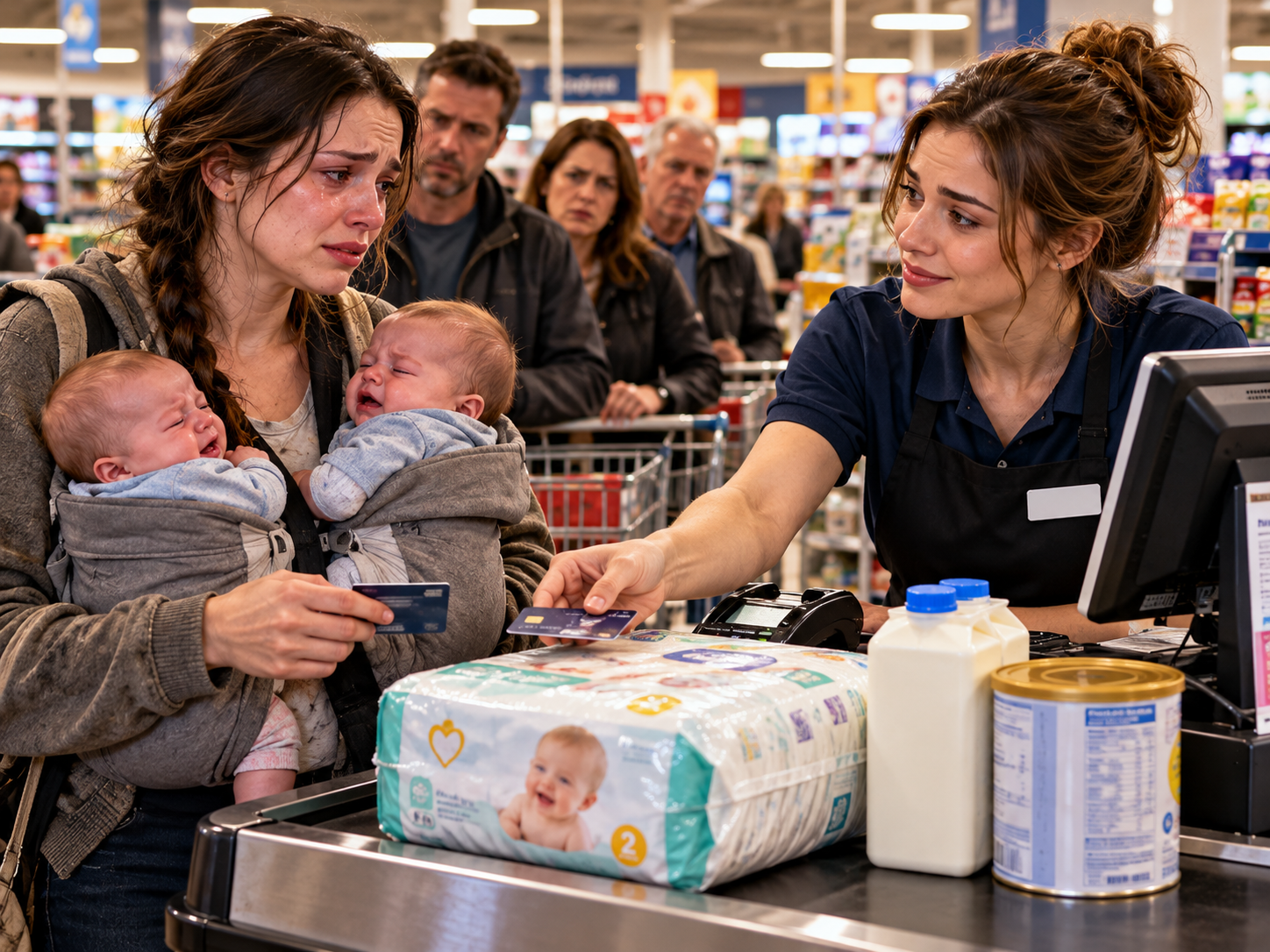
A year had passed since Emily stood at my register with two infant twins, a carton of milk, formula, and diapers she couldn't afford.
I remembered the amount immediately.
Eight dollars and forty-two cents.
It was strange how clearly those numbers remained in my mind.
I had processed thousands of transactions since that evening. Most had disappeared from memory before the end of the shift.
But I could still picture Emily's trembling hands, the red word on the payment terminal, and the way she looked down when someone behind her complained.
I could still hear her asking me to remove the diapers.
At the time, I thought I was making a small decision that would matter only for a few minutes.
I had no idea what would follow.
The next morning, Mike called me into his office and handed me an envelope.
Inside were Emily's letter, a photograph of her twins, and a money order so unexpected that I had to sit down.
The money had arrived through an emergency transfer from a relative after Emily returned home.
She had wanted to share some of that relief with the person who helped her before it arrived.
I hadn't felt comfortable accepting such a large gift.
Together, we found another purpose for it.
The grocery assistance fund was now an established part of the store's community work.
Its records were reviewed, its limits were clear, and its procedures had improved through experience.
It had helped customers facing immediate shortfalls without requiring them to explain their circumstances in front of strangers.
The program hadn't solved every financial difficulty in town.
Nobody claimed it could.
But it provided practical help at moments when a small amount made a meaningful difference.
On the anniversary morning, I arrived at work early.
The store smelled of fresh bread, floor cleaner, and coffee from the small machine near customer service.
Denise was arranging bags beneath her register.
She looked up when I approached.
"You're early."
"I couldn't sleep."
"Everything okay?"
I smiled.
"Yes. I just realized what day it is."
She looked confused.
Then her expression changed.
"Emily?"
I nodded.
Denise smiled.
"A year already?"
"Apparently."
She leaned against the counter.
"Feels like yesterday."
I looked toward the register where Emily had stood.
The conveyor belt was moving smoothly. A display of seasonal candy occupied the space beside it, and the payment terminal had been replaced several months earlier.
The surroundings had changed slightly.
The memory hadn't.
Mike appeared near customer service carrying a folder.
When he saw us talking, he asked what was happening.
Denise told him about the anniversary.
He looked toward my register.
"Eight forty-two," he said.
I laughed.
"You remember?"
"Of course I remember."
He smiled, then returned to his work.
I appreciated that he didn't turn the moment into a speech.
The fund had become part of our routine, and the anniversary didn't require a ceremony.
Still, I felt a quiet gratitude.
Mr. Harris had supported the program when he could have dismissed it as too complicated.
Mike had helped establish procedures.
Denise and the other employees had learned how to handle assistance discreetly.
Customers had contributed voluntarily.
Emily had made the first significant donation.
No single person owned what we'd built.
During the morning rush, I helped Tyler resolve a pricing issue.
He had become a capable cashier over the past several months, and I no longer needed to stand beside him during every difficult transaction.
When he called for assistance, I watched him explain the problem calmly to the customer.
He listened, checked the shelf information, and corrected the total.
Afterward, he looked at me.
"Was that okay?"
"That was exactly right."
He smiled with relief.
I returned to my register feeling proud.
My new position had taught me that helping someone learn could be as satisfying as solving a problem myself.
I wasn't always patient.
Some days I was tired, distracted, or frustrated by repeated mistakes.
But I was learning to pause before reacting.
I remembered how much difference that pause had made when Emily's card was declined.
Later that morning, a young father came through my line carrying a sleeping toddler.
He purchased bread, eggs, milk, and several other groceries.
His payment went through without difficulty.
I packed his bags and wished him a good day.
As he walked away, I realized how important it was not to turn every customer into a reminder of Emily.
Most people simply wanted to buy groceries and go home.
They deserved ordinary courtesy, not assumptions about their lives.
The assistance fund was available when needed.
Otherwise, the work remained what it had always been.
Around noon, Emily arrived.
I saw her before she reached the register.
The twins were sitting in a stroller now, looking around with bright, curious expressions.
One held a small stuffed animal. The other was trying to pull off his sock.
Emily looked healthier and more rested than she had the previous year, though she still wore the practical expression of someone managing two children who rarely wanted the same thing at the same time.
She smiled when she saw me.
"Rachel!"
I stepped around the counter during a quiet moment.
"Look at these two."
Emily laughed.
"They've decided walking is their next project. I'm not ready."
The twins watched me with serious interest.
I crouched slightly and said hello.
One smiled.
The other stared at my name tag.
Emily told me they were doing well.
Her part-time work had become more consistent, and the childcare arrangement with her relative was helping her maintain a routine.
She still had difficult days.
The babies still woke at night.
Bills still required planning.
But she no longer felt as though one unexpected expense would undo everything.
I was glad.
We talked for several minutes before I returned to my register.
Emily placed her groceries on the belt, including a package of diapers.
I noticed it immediately.
She noticed me noticing.
We both smiled.
"Different size now," she said.
"Much bigger."
I scanned the items and told her the total.
She tapped her card.
The payment was approved.
It was an ordinary transaction.
For some reason, that made my eyes sting.
Emily collected her receipt and began arranging the bags beneath the stroller.
Before leaving, she reached into her purse and handed me a small card.
"I made this for you," she said.
I looked at her.
"Emily, you didn't have to."
"I know."
I opened it after she left.
Inside was a recent photograph of the twins sitting together on a blanket.
Beneath it, Emily had written a short message thanking me for treating her with dignity on a day when she felt she had none left.
There was no money.
No elaborate gift.
Just a photograph and a few sentences.
I placed the card carefully in my apron pocket.
At the end of my shift, I showed it to Mike.
He smiled when he saw the twins.
"They've grown."
"They really have."
He handed the card back.
"How's it feel?"
I considered the question.
"Good. A little strange."
"Why strange?"
"Because I never thought any of this would happen."
Mike nodded.
"Most things that matter don't arrive with much warning."
I smiled.
"That sounds like something Mr. Harris would say."
"Don't tell him. He'll take credit."
We laughed.
After work, I went home and opened the folder where I kept Emily's original letter.
I placed the new photograph beside the old one.
In the first picture, the twins were tiny, wrapped in matching blankets.
In the second, they were sitting upright, smiling at the camera.
A year separated the photographs.
For Emily, that year had meant sleepless nights, work, childcare, bills, and the daily effort of raising two children.
For me, it had meant a new responsibility at the store, a deeper understanding of the assistance program, and the unexpected opportunity to help train other employees.
Neither life had become perfect.
That wasn't the point.
We had both continued forward.
I looked again at the letter Emily had written after the declined payment.
She had described how embarrassed she'd felt at the register and how much it mattered that I helped without making her explain herself.
I remembered the long line, the impatient customer, and the crying baby.
I remembered reaching for my own card.
At the time, I hadn't considered whether anyone would notice or whether the decision would lead to something larger.
I simply knew that I could cover the difference.
The money had never been repaid to me personally.
I was glad.
The amount belonged to that moment, and I didn't want to turn it into a debt.
Emily had already given me something more meaningful through her letter and the generosity that helped establish the fund.
The store had carried the work forward.
Other customers had contributed.
The program had become something useful beyond either of us.
I put the photographs back in the folder and closed it.
Tomorrow, I would return to the same grocery store.
I would tie on my apron, check the registers, help train new employees, and spend hours scanning items for people whose lives I knew only in fragments.
Some customers would be cheerful.
Others would be tired, impatient, distracted, or worried.
Most transactions would pass without anything unusual happening.
That was fine.
I didn't need another envelope, another extraordinary gift, or another dramatic story to remind me why the work mattered.
I had learned that kindness was most useful when it respected the person receiving it.
I had learned that generosity needed care and accountability if it was going to last.
And I had learned that a small decision could change the direction of a day without requiring anyone to become a hero.
I turned off the kitchen light and went to bed.
The next morning would bring another shift.
I was ready for it.
Click here to continue reading: PART 9: A New Cashier’s Mistake Brought Rachel Back to the Moment That Changed Her Life and Forced Her to Make a Difficult Choice
The Young Mother Had Already Been Refused Twice When I Made a Decision That Could Have Cost Me My Job
Part 8 of 20

