
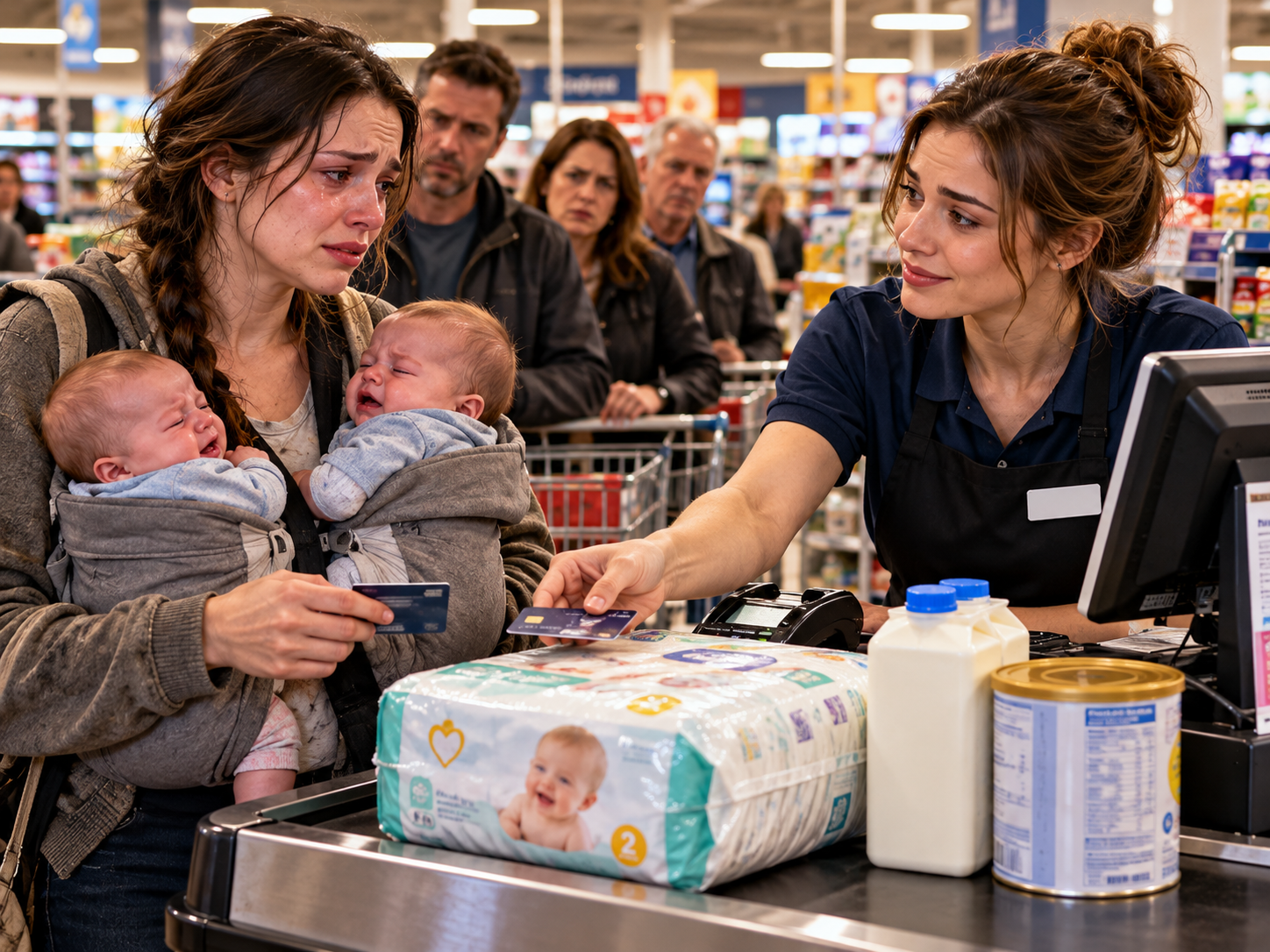
Emily shifted the carrier against her chest as I approached the customer service desk. The twins were awake this time, both looking around with the unfocused curiosity of very young babies. One had a fist pressed against his cheek, while the other watched the overhead lights with solemn concentration. Emily looked less frightened than she had on Friday, but exhaustion still showed around her eyes. She smiled when she saw me, then glanced toward the envelope in my hand. I could tell she knew what I wanted to discuss.
“Thank you for coming back,” I said.
She shook her head. “I should be thanking you.”
I looked toward the registers. The afternoon rush hadn't started yet, and Denise had offered to cover my station for a few minutes. Mike had also said I could take a short break if Emily returned. I asked whether she'd be comfortable sitting in the small seating area near the front windows. She agreed, and we moved toward a table away from the busiest part of the store. I pulled out a chair for her, then sat across from her with the envelope between us.
For a moment, neither of us spoke. Emily adjusted the carrier and gently touched the cheek of the baby nearest her. He made a small sound and turned toward her hand. I remembered how desperate she'd looked when her card was declined, and I felt a sudden tenderness that made it difficult to begin. Finally, I placed the envelope on the table.
“I read your letter,” I said. “It meant a lot to me.”
Her eyes filled slightly. “I meant every word.”
“I know you did. But I need to ask about the money order.”
She looked down at the envelope, then back at me. “I thought you might.”
I took a breath. “Emily, I helped because you needed diapers. I didn't expect anything back. What you left is far more than I gave you, and I'm worried you're giving away money you need for yourself and the babies.”
She listened without interrupting. When I finished, she looked toward the windows for a moment. The parking lot beyond them was bright with afternoon sunlight. A woman pushed a shopping cart toward her car while a child walked beside her holding a balloon. Emily watched them, then turned back to me.
“I understand why you're worried,” she said. “But I need you to know something about Friday.”
I waited.
She explained that the twins had been born several weeks earlier than expected. Their arrival had disrupted plans she'd made for work, housing, and childcare. She had been trying to manage expenses while waiting for assistance from a relative who lived several hours away. The relative had promised to send money, but the transfer was delayed. Emily had checked her account before leaving home and believed enough remained to buy the essentials. By the time she reached my register, the balance had changed because another payment had cleared.
“I wasn't trying to buy anything extra,” she said. “I just needed formula and diapers.”
“I know,” I replied.
She looked down at the twins. “I kept thinking I should have checked again. I should have brought cash. I should have planned better.”
Her voice tightened. I wanted to tell her that no amount of planning could prevent every unexpected expense, but I let her continue.
“When the card declined, I felt like everyone could see that I wasn't managing,” she said. “Then people started complaining, and I thought I was going to cry right there.”
I remembered the man behind her and the way she'd tried to make herself smaller. I nodded.
“Then you paid the difference,” she continued. “You didn't ask me questions. You didn't make me explain why I was short. You just helped.”
I looked at the envelope. “It was eight dollars and forty-two cents.”
Emily shook her head. “That's what it cost you. It meant something different to me.”
The words settled between us. I didn't know how to answer.
She explained that when she returned home, the emergency transfer finally arrived. It was enough to cover the immediate bills and provide some breathing room while she arranged more stable support. She had sat at her kitchen table with the twins sleeping nearby, looking at the bank notification and thinking about what had happened at the store. She wanted to thank me in a way that showed how deeply the moment had affected her.
“I know the amount looks strange,” she said. “But I didn't choose it because I thought you needed money. I chose it because I wanted to do something generous while I finally could.”
I looked at her carefully. “Are you sure you can afford it?”
She nodded. “I wouldn't have brought it if it meant taking something from the babies.”
I wanted to believe her. She spoke with more confidence than she had on Friday, and the explanation made sense. Still, I couldn't ignore the responsibility I felt. She was a young mother with two infants, recovering from a difficult period. I had helped her because I wanted to ease a burden, not create another.
“Emily,” I said gently, “your letter is more than enough. I mean that. I would treasure it even if there were nothing else inside.”
She smiled, but her eyes were wet. “I know. That's part of why I wanted to give you something.”
We sat quietly for a moment. One of the twins began fussing, and Emily adjusted the carrier. I offered to hold her diaper bag while she settled him. She thanked me and gently rocked from side to side until his cries softened. Watching her, I thought about how much energy caring for two infants must require. Every small task seemed to involve an extra layer of effort. Even sitting at a table for a conversation required planning around their needs.
When the baby quieted, Emily looked at me again. “Can I tell you something else?”
“Of course.”
She hesitated. “I almost didn't come back. I was afraid you'd think I was being foolish.”
I smiled. “I don't think you're foolish.”
“I just wanted you to understand that Friday mattered.”
“I do understand.”
She looked down at her hands. “Maybe not completely.”
There was no accusation in her voice. She was trying to find words for something difficult. I waited.
“Before I came into the store, I'd been sitting in my car for almost ten minutes,” she said. “I was trying to decide whether I could afford everything on my list. The babies were restless, and I was exhausted. I kept thinking that if I couldn't even buy diapers without worrying, I wasn't doing a good enough job.”
I felt my throat tighten.
“Then I went inside, and the card didn't work. It felt like proof of everything I was afraid of.”
She paused, blinking rapidly.
“When you helped me, you didn't act like I was a failure. You acted like I was a person having a hard day.”
I looked away for a moment, toward the shelves beyond the seating area. I had no grand answer to that. I had simply seen someone struggling and paid the difference. Yet I understood why the way help was offered could matter as much as the help itself. I remembered times when people had made me feel small for needing assistance. I also remembered the rare kindnesses that allowed me to accept help without shame.
“Emily,” I said quietly, “you were taking care of your babies. That's what I saw.”
She pressed her lips together and nodded.
We talked for several more minutes. She told me the twins' names and explained that they had very different temperaments despite looking so much alike. The quieter one loved being carried close to her chest. The more vocal one seemed determined to announce every discomfort to the world. I laughed as she described the difference. She smiled more easily now, and for the first time, I could see the young woman beneath the exhaustion.
Eventually, I returned to the money order. “I still don't feel comfortable taking all of this,” I admitted.
Emily looked disappointed, but she didn't argue immediately.
“I appreciate what you're trying to do,” I continued. “And I believe you when you say you can afford it. But I helped you because I wanted you to have what you needed. I don't want the kindness to turn into something either of us feels obligated to repay.”
She considered my words.
“What if we found another way?” I asked.
She looked curious. “What do you mean?”
I thought for a moment. “What if I kept your letter and the photograph, and we used the money for something that would help other families? Maybe the store could organize a small emergency fund for customers who come up short on essentials. Diapers, formula, groceries. Nothing complicated. Just a way to help when someone needs a few dollars.”
Emily stared at me.
I hurried to add, “Only if that's something you'd want. It's your money. I wouldn't do anything without your agreement.”
She looked down at the envelope, then toward the registers. For a long moment, she didn't speak. I worried I'd offended her by suggesting that her gift be used differently. Then she smiled, and tears began sliding down her cheeks.
“That,” she whispered, “would be beautiful.”
I felt relief wash through me.
“Are you sure?”
She nodded. “I wanted the money to mean something. If it helps another mother avoid what happened to me, that's more than I could have hoped for.”
We discussed the idea carefully. I explained that I'd need to speak with Mike before promising anything. The store would have to decide whether it could manage such a fund, how donations would be handled, and what rules would protect both customers and employees. I didn't want to create a system that depended on informal decisions at the register. Emily understood. She said she was willing to contribute the money if the store could establish a proper arrangement.
Before leaving, she reached across the table and took my hand briefly.
“Rachel, you don't have to do all this.”
I smiled. “Neither did you.”
She laughed through her tears.
I walked her toward the entrance and helped hold the door while she adjusted the carrier. The twins were quiet now, one asleep and the other staring at the ceiling. Emily thanked me again, but this time the words felt less burdened by embarrassment. She seemed relieved that we'd found a way to honor her intention without creating discomfort between us.
After she left, I returned to Mike's office. He was reviewing inventory paperwork when I knocked. I told him about the conversation and explained the idea of an emergency assistance fund. He listened carefully, asking questions about how it would operate and whether the store could legally and practically manage donations. I admitted that I hadn't worked out the details. I only knew that Emily wanted her gift to help someone, and I wanted to make sure it was handled responsibly.
Mike leaned back in his chair.
“Rachel,” he said, “I think we should look into it.”
I felt a small surge of hope.
He continued, “But we need to do it properly. No cash sitting in drawers, no employees making undocumented decisions, and no promises we can't keep.”
I nodded. “I agree.”
He looked at the envelope on his desk. “If the owner approves, we could set up a small program through the store's existing community assistance account. We already work with local charities. There may be a way to do this without creating a new system from scratch.”
I hadn't known the store had such an arrangement. Mike explained that the owner occasionally supported local food drives and emergency grocery vouchers, though the programs were usually organized through community groups rather than individual transactions. He offered to speak with the owner and our accounting office about whether Emily's contribution could be accepted for that purpose.
I thanked him, then hesitated. “Mike, I don't want this to become a publicity thing. Emily didn't ask for attention.”
He nodded. “Neither did you.”
We agreed that any program should protect the privacy of people receiving help and avoid using Emily's story without her permission. Mike said he'd contact me once he had more information. I returned to my register feeling hopeful but cautious. The idea might not work. There were rules, costs, and responsibilities to consider. Still, for the first time since opening the envelope, I felt that the money might find a purpose that honored what Emily had intended.
That evening, I went home with the letter and photograph safely tucked in my bag. The money order remained uncashed while Mike explored the possibility of a formal donation. I placed Emily's note on my kitchen table and read it again. Her words reminded me that a small act could carry meaning far beyond its cost. But I also understood that good intentions needed careful handling if they were going to become something lasting.
Before bed, Mike sent me a message.
He had spoken with the store owner.
They wanted to meet with me the following morning.
Click here to continue reading: PART 4: The Store Owner’s Decision Transformed Emily’s Unexpected Gift Into Something Neither Woman Had Imagined When the Card Was Declined
The Young Mother Had Already Been Refused Twice When I Made a Decision That Could Have Cost Me My Job
Part 3 of 20

