
I arrived at work early the next morning, carrying Emily's letter and the photograph of her twins in a small folder. Mike had asked me to meet him and the store owner before my shift began. I wasn't sure what to expect. The idea of an emergency assistance fund had seemed simple when Emily and I discussed it at the customer service table, but I knew the practical details could be complicated. The store would need a way to accept donations, record transactions, protect customers' privacy, and make sure employees understood when assistance could be offered.
The owner, Mr. Harris, was waiting in Mike's office when I arrived. He was a quiet man in his late sixties who had owned the grocery store for more than twenty years. I saw him occasionally during inventory reviews or holiday events, but we rarely spoke at length. He greeted me warmly and asked me to sit. Mike closed the door and placed a folder on the desk. I noticed several pages of notes inside, along with a copy of the store's existing community assistance procedures.
Mike began by explaining that he'd told Mr. Harris about the transaction and Emily's return. He had also described our conversation about using the money to help other customers. Mr. Harris listened while I confirmed the details. I emphasized that Emily had been unable to pay for diapers, that I'd covered the difference with my own card, and that she later returned with a thank-you letter and a substantial money order. I explained why I felt uncomfortable accepting the money personally and why Emily had supported the idea of using it to help others.
Mr. Harris sat quietly for a moment, then looked at me. “Rachel, why did you pay for her groceries?”
The question was simple, but I found myself searching for an answer that didn't sound rehearsed.
“She needed diapers,” I said. “She was short by eight dollars and forty-two cents. I could cover it.”
He nodded. “That's all?”
I thought about the young woman's trembling hands and the complaints from the line. “She was embarrassed,” I added. “I didn't want her to leave feeling worse than she already did.”
Mr. Harris looked down at the papers in front of him. “Mike tells me you didn't make a scene about it.”
“No, sir.”
“And you didn't tell anyone to put it on the store's account.”
“No. I used my own card.”
He nodded again, then turned to Mike. “That's the part I like.”
I wasn't sure what he meant, but he continued before I could ask. He explained that the store had supported local families through food drives and charitable partnerships for years. The programs were useful, but they sometimes moved slowly. A family needing help with groceries that evening might not know where to turn or might feel uncomfortable asking for formal assistance. He had been considering whether the store could create a small, carefully managed fund for urgent purchases of essential items.
“Your idea fits something we've already been discussing,” he said.
I looked at Mike, surprised.
Mr. Harris opened the folder and showed me a draft procedure. The proposed program would allow designated supervisors to approve limited assistance for customers who were unexpectedly short on essential groceries. It would not operate as an open cash drawer or an informal system controlled by individual cashiers. Instead, donations would be recorded through the store's accounting process, and assistance would be applied through documented transactions. The program would focus on necessities such as food, formula, and diapers.
I read the document carefully. The limits were modest, and the approval process seemed practical. Customers wouldn't be required to explain their personal circumstances in front of a line of strangers. If someone needed help, a supervisor could handle the situation discreetly. The store would also coordinate with local organizations that provided longer-term assistance, so the fund wouldn't be treated as a substitute for broader support.
“Would Emily's donation be enough to start it?” I asked.
Mr. Harris smiled. “It would help. But I don't think she should carry the whole responsibility.”
He explained that the store was prepared to contribute an initial amount from its community budget, subject to final approval of the procedures. The owner also wanted to invite employees to participate voluntarily if they wished, without pressure or public recognition. Customers could donate through an approved process once the program was established. The goal was to create something sustainable rather than a one-time gesture that disappeared after the money was spent.
I felt my throat tighten.
“That's more than I expected,” I said.
Mr. Harris shook his head. “You started the conversation. Mike helped us see how it could work. Now we need to make sure we do it responsibly.”
We discussed the details for nearly an hour. Mike raised questions about training cashiers, documenting assistance, and preventing confusion during busy periods. Mr. Harris wanted clear limits and regular reviews. I suggested that the program avoid requiring customers to tell their stories publicly. I remembered how Emily had looked when the people behind her began complaining. If the fund was going to help anyone, it needed to preserve dignity as well as provide money.
Mr. Harris agreed. He said the store would not use photographs or personal stories without explicit permission, and customers receiving assistance would not be expected to provide testimonials. The program would be described simply as a community grocery assistance fund. Its purpose would be to help people with immediate needs, not to generate publicity for the store. I felt relieved. Emily's experience belonged to her, and I didn't want it turned into a story she couldn't control.
Before the meeting ended, Mr. Harris asked whether I would be willing to help review the program after its first month. I agreed, provided my role remained limited to offering feedback rather than making financial decisions outside my responsibilities. He smiled at that. “Good answer,” he said. “We want employees involved, but we also want proper oversight.” Mike nodded approvingly. I left the office feeling both excited and slightly overwhelmed. A few days earlier, I'd paid a small amount at the register. Now the store was preparing to create a formal way to help others in similar situations.
The next step was speaking with Emily. Mike contacted her through the information she'd provided when arranging the return visit, and she agreed to come in later that week. We met in the same seating area near the front windows. The twins were awake and unusually quiet, their small faces turned toward the light. Emily looked curious when I told her Mr. Harris wanted to speak with her. I reassured her that nothing was wrong. Then Mike joined us and explained the proposed fund.
Emily listened without interrupting. When Mike described the store's planned contribution and the procedures for helping customers discreetly, her eyes filled with tears. She looked at me, then at the twins. “I never imagined this,” she said. I smiled. “Neither did I.” Mike explained that the store would accept her donation only if she remained comfortable with the decision. He also made clear that she could keep the money or reduce the amount without disappointing anyone. Emily took a long moment before answering.
“I want to contribute,” she said. “But I appreciate you asking.”
Mike nodded. He reviewed the donation process with her, making sure she understood how the funds would be used and recorded. Emily asked several practical questions about whether assistance would be limited to mothers with babies. Mike explained that the program would help customers facing immediate difficulty purchasing essential groceries, regardless of family circumstances. The focus would be on urgent need and responsible administration. Emily seemed pleased. “That's better,” she said. “People struggle in different ways.”
When the paperwork was complete, Emily turned to me. “I hope you don't think I was trying to make you feel obligated.”
I shook my head. “I never thought that.”
“I just wanted to give something back.”
“You have,” I said. “More than you know.”
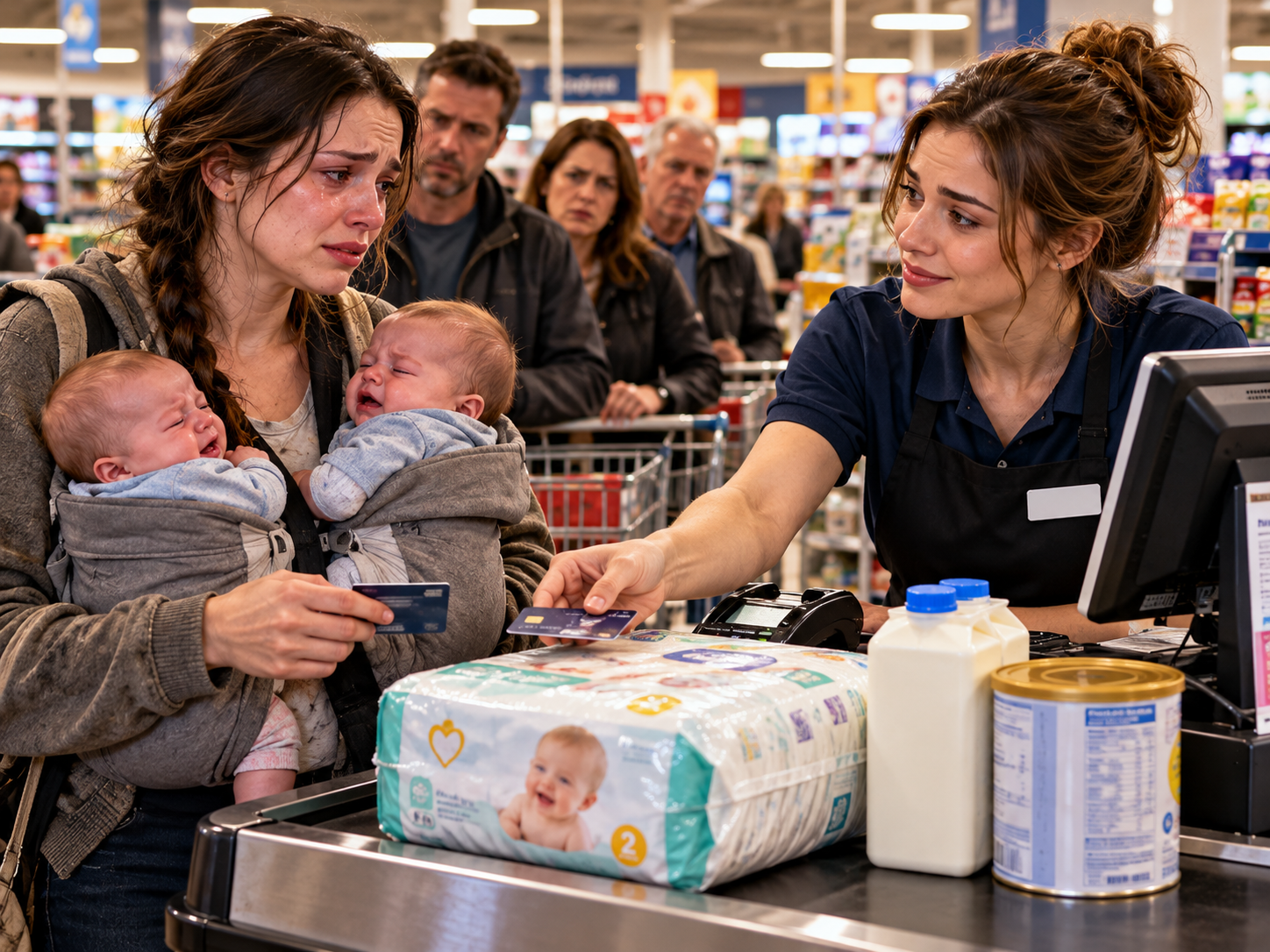
She smiled through her tears. For a moment, I remembered her standing at my register with a declined card and two restless babies. The difference in her expression was striking. She still looked tired, but she no longer seemed ashamed. I hoped that change had as much to do with the support she was receiving as with the money transfer. I wanted her to understand that needing help didn't make her less capable or less deserving of respect.
Over the following weeks, Mike and Mr. Harris finalized the procedures. The store's accounting office established a separate record for the fund, and supervisors received training on how to approve assistance. Employees were told about the program during a staff meeting. Mike emphasized that participation in donations was voluntary and that customers' privacy came first. Denise sat beside me, listening carefully. When the meeting ended, she leaned over and whispered, “You really started something.” I shook my head. “Emily did too.”
The fund began operating quietly the next month. There was no ribbon-cutting ceremony or public announcement featuring Emily and her twins. A small notice near the customer service desk explained that the store supported a community grocery assistance program and provided information for anyone who wanted to contribute. Supervisors handled requests discreetly, and the accounting office reviewed the transactions regularly. The system wasn't perfect, and we made small adjustments as we learned what worked. But it was real, and it was helping people.
One afternoon, an elderly man came through my line with bread, eggs, and a few canned goods. His card was declined because of a temporary account problem. He looked embarrassed and began removing items from the counter. I remembered Emily immediately. This time, instead of reaching for my own card, I quietly asked whether he'd like me to call a supervisor. He hesitated, then nodded. Mike came over, spoke with him privately, and approved assistance through the fund. The man left with his groceries and a simple thank-you. Nobody in the line needed to know the details.
Afterward, I stood at my register for a moment, feeling the weight of what had changed. The fund hadn't solved every hardship in town. It couldn't replace stable income, affordable housing, or broader community support. But it had created a practical way to respond when someone faced an immediate problem at the checkout counter. The help was modest, carefully managed, and offered without requiring public humiliation. That mattered.
Emily visited occasionally with the twins. As the months passed, they grew heavier and more curious, reaching for everything within sight. She told me that her circumstances had become more stable and that she was receiving the support she needed. I was glad to hear it. We never treated her donation as something she had to justify or discuss repeatedly. Sometimes she stopped simply to say hello. Other times she bought groceries and hurried home before the babies became restless. Our conversations were ordinary, and I liked them that way.
The letter she had written remained in a drawer at home, beside the photograph of the twins. I took it out occasionally, not to remind myself that I'd done something admirable, but because it captured a moment when two strangers had treated each other with kindness during a difficult day. I had helped Emily without expecting anything. She had responded with generosity when her circumstances allowed it. Together, with Mike and Mr. Harris, we'd found a way to extend that kindness beyond the original transaction.
One evening, after a long shift, I walked through the nearly empty store toward the employee exit. The refrigerators hummed, and the bakery lights had been dimmed. Mike was standing near the customer service desk, reviewing paperwork. He looked up as I passed. “Rachel,” he said, “we finished the first quarterly review of the fund.” I stopped. “How did it go?” He smiled. “Better than we expected. The procedures are working, and the donations have been steady.” I felt a quiet satisfaction. “That's good.” He nodded. “It is.”
Outside, the parking lot was cool beneath the evening sky. I walked to my car, thinking about the Friday when Emily's card was declined. At the time, I had no idea what she would leave for me the next morning. I couldn't have imagined the envelope, the letter, the photograph, or the money order. I certainly couldn't have predicted that the store would establish a formal assistance program because of our conversation. The events had unfolded through a series of small decisions, each made by someone willing to take responsibility for the next step.
I started the car and sat for a moment before driving home. The original eight dollars and forty-two cents had never returned to my account. I didn't miss it. What remained was the memory of Emily's face when she realized she could take the diapers home, and the knowledge that other customers might now receive help without standing alone beneath the fluorescent lights while strangers waited impatiently behind them.
I had thought the envelope would reveal something extraordinary about the woman I'd helped. Instead, it revealed how much an ordinary act could matter when it arrived at the right moment. Emily hadn't needed me to rescue her life. She had needed a little help on a difficult evening, offered without judgment. Her gratitude had become an opportunity for others to receive the same consideration. That was enough.
I drove home through the familiar streets of our small town, passing houses with porch lights glowing and families settling in for the night. Tomorrow, I would return to the store, tie on my apron, and stand behind the same register. Most transactions would be ordinary. Some customers would be cheerful, others tired or impatient. I wouldn't know what burdens they carried into the store. But I would remember that the person standing across from me might be having a harder day than I could see.
And sometimes, eight dollars and forty-two cents could make that day a little easier.
Click here to continue reading: PART 5: Months After the Grocery Fund Began Helping Families, Rachel Discovered That Doing Good Work Could Bring Responsibilities She Had Never Expected
The Young Mother Had Already Been Refused Twice When I Made a Decision That Could Have Cost Me My Job
Part 4 of 20

