
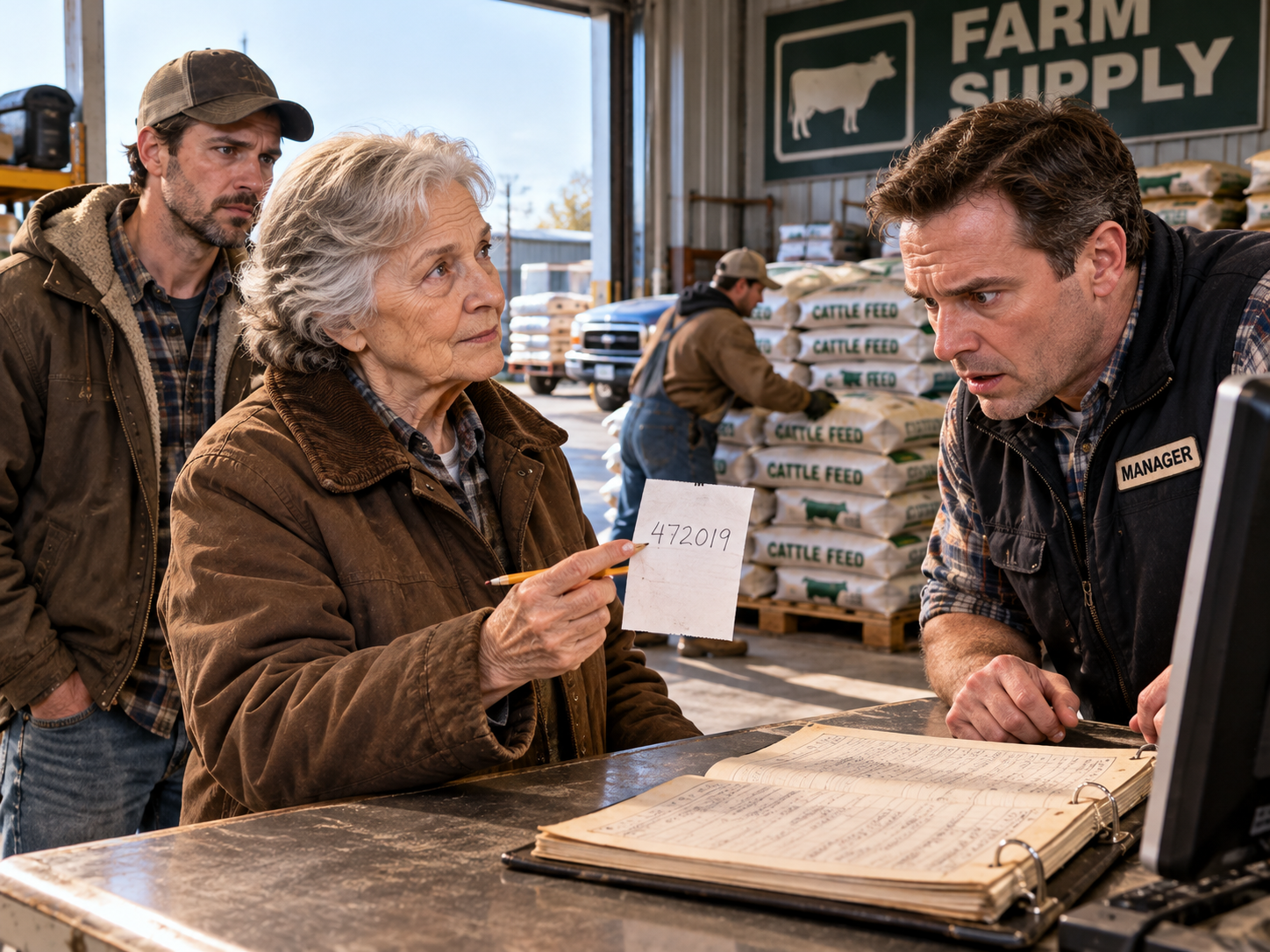
Travis did not turn the ledger toward us immediately. He kept one hand on the open page, as if he were afraid that someone might remove it before he could understand what he was seeing. The store continued around us—the bell above the entrance rang, a delivery truck rumbled past the loading door, and someone in the next aisle asked an employee where to find gate hinges. Yet the manager seemed unable to hear any of it.
"Who else knows about these numbers?" he asked Mom.
She considered the question. "Your father knew. My husband knew. And I did."
"Anyone else?"
"Not that I ever told."
He ran a finger beneath the old entry. The handwriting was faded but legible, and the paper had yellowed around the edges. I could make out dates, dollar amounts, and a sequence of names written in a narrow column. One line contained my father's surname. Another contained Walter Miller's initials. Beside them were the six numbers Mom had written on the receipt.
I leaned over the counter, but Travis closed the binder slightly.
"I need to check something," he said.
"You've had thirty-two years to check it," Mom replied. "I'm not asking you to decide anything yet. I'm asking you to read what's there."
He looked as though he wanted to object, but he turned the binder back toward us. The entry was dated in November, thirty-two years earlier. It recorded a transaction involving the store, Walter Miller, and my parents. Beneath the main entry was a brief notation in a different ink, followed by a reference to an attached agreement.
Travis traced the notation with his finger. "This can't be right."
"What can't be right?" I asked.
He ignored the question and flipped backward through the pages. The binder contained records arranged by year, with account entries written in columns. He searched for the same six digits, found a second reference, then returned to the page he had first opened. His movements became faster, and his breathing grew noticeably shallower.
Mom waited.
I had never seen her look so patient while someone else struggled with an answer. She was not smiling, and she did not appear pleased by Travis's discomfort. She looked more like someone who had spent years carrying a sealed envelope and had finally watched the person it belonged to recognize his own name.
Travis reached a page near the back of the binder and stopped again. This entry included a figure that made him sit down on the stool behind the counter. He rubbed his forehead, then looked at Mom with an expression that mixed disbelief with something close to embarrassment.
"Your husband put money into the business?"
Mom nodded once. "Yes."
"How much?"
"That depends on which entry you're reading."
He turned the binder so I could see. The first amount was larger than I expected for a farm family of that period. A second entry showed a later payment, and a third referred to supplies provided during a difficult season. The amounts were not all cash. Some were recorded as credit, some as goods, and some as a balance carried forward.
I looked at Mom. "You and Dad never told us."
"There was no reason to involve you boys in it then," she said. "You were young, and the arrangement was between your father, Walter, and me."
Travis asked whether Dad had been a business partner in the store. Mom shook her head.
"Not in the way you're thinking."
"Then what was this?"
"Read the attached agreement."
He searched the binder again, turning pages carefully now. The paper edges crackled beneath his fingers. A thin sheet had been folded between two pages, its corners softened by age. A handwritten note on the outside directed the reader to a separate file kept with the original business records.
Travis looked toward his office.
"I thought those old files had been cleared out."
"Did your father clear them out?" Mom asked.
"I don't know."
"Then you should find out before deciding they don't exist."
He stood abruptly and went back into the office. This time, he left the binder open on the counter. I leaned closer to the page. The entry beside my father's name referred to an advance made during a period when the store had been struggling to keep its shelves stocked. Another notation mentioned a shortage of essential farm supplies and an understanding about how remaining inventory would be handled if the store faced another shortage.
The wording was abbreviated, and I could not tell whether it referred to a binding agreement, a promise, or merely an internal instruction. But I could see that the six numbers were a reference code linking several separate records. They were not a random sequence Mom had invented to frighten Travis. They had been used by Walter to connect the transaction to an older agreement.
I asked Mom what had happened thirty-two years earlier.
She took a breath and looked toward the office door.
"Your father and Walter were trying to keep the store open."
I knew the broad outline of that history. Walter had taken over the business from his own father and expanded it during the years when local farms were growing. Then a difficult stretch of weather and rising costs had left several customers unable to pay on time. The store had been caught between bills coming due and farmers who needed supplies before they could produce the money to pay them.
Dad had helped neighbors through hard seasons, but I had never heard that he had helped Walter keep the business running. Mom said the problem had become serious enough that Walter was considering selling the store or closing its doors. The decision would have affected farmers throughout the area, especially those who relied on the shop for urgent purchases and small orders.
"Your father believed a local store was more than a place to buy things," she said. "He believed it was part of what allowed small farms to keep going. If the store closed, people would have to travel farther for feed, medicine, and equipment. Some could manage that. Others couldn't."
"So Dad gave Walter money?"
"Your father and I made a decision together. We provided help when Walter needed it, and we agreed on terms. It wasn't a gift."
She did not elaborate. I could tell she was choosing her words carefully, not because she wanted to hide the past from me, but because she wanted the records to speak for themselves.
Travis returned carrying a narrow file folder and a smaller notebook. He placed both beside the ledger. The folder had a label written in Walter's hand, and the six numbers appeared on its front. He opened it and found several sheets of paper, including a typed document with signatures at the bottom.
He read the first page, then the second. His face tightened when he reached a paragraph near the middle. He read it once silently and then began again, slower this time.
"What does it say?" I asked.
Travis looked at Mom before answering.
"It describes an agreement about priority access to essential supplies during a shortage."
Mom nodded. "Keep reading."
The document explained that my parents had provided financial support and agricultural supplies to help Walter stabilize the store during the earlier crisis. In return, Walter had agreed to maintain a reasonable supply of essential goods for established local farming customers when possible, and not to divert the last available stock solely because a larger outside buyer offered a higher price. The arrangement included a process for identifying the agreement through the six-digit reference code.
It was not an unlimited promise to supply any product at any time. It did not mean our farm could take whatever the store had or demand that every other customer be turned away. It was a more specific commitment, designed for periods when essential supplies were scarce and a larger buyer's purchasing power might leave smaller local farms with nothing.
The document also recorded that the arrangement would be reviewed if the store's ownership or management changed. A later notation referred to a continuation of the understanding under Walter's management, but it was not clear from the page alone whether Travis had formally accepted the same obligation when he took over.
I felt anger rising again, but now it was mixed with confusion. If Walter had made this agreement, why had Travis never heard of it? Had the documents been lost? Had someone decided the arrangement no longer mattered? Or had Travis inherited the store without understanding the obligations that came with it?
"Did your father tell you about this?" Mom asked him.
Travis shook his head slowly. "He told me there were old customer arrangements. He said some things were handled differently back then. But I never saw this agreement."
"Did you look for it?"
He did not answer.
The silence was enough. Travis had made a decision that morning based on the idea that the largest offer should take priority. He had done so without checking whether the store had made a prior commitment to the people standing in front of him. The ledger had not created that commitment. It had simply preserved evidence of something he had never bothered to understand.
Mom did not gloat. She asked him to read the final page.
It contained Walter's signature, my father's signature, and Mom's. Beneath them was a short handwritten note explaining that the six numbers should be used only if the store's ordinary obligations were being ignored and there was no practical way to resolve the matter through the usual channels. Walter had written that the reference existed to prevent the agreement from being forgotten when the people who made it were no longer there to explain it.
My mother's signature was unmistakable.
I stared at it. She had been forty-two when she signed that document. Dad had still been alive, and I had been a child who knew the farm as a place of chores, mud, and long afternoons in the machinery shed. I had no idea that my parents had taken on a responsibility that could one day bring us back to the store under circumstances like these.
Travis carefully laid the pages side by side.
"I need to contact our attorney," he said.
"You may do that," Mom replied. "But the cattle still need feeding today."
He looked toward the loading door, where the twenty bags remained on the pallet. The commercial buyer had offered more money, and Travis had accepted that offer before checking the old agreement. The immediate problem had not disappeared simply because he had found a document.
"I can't just hand you the feed without checking what this means," he said.
Mom nodded. "Then check it quickly. The weather is changing, and we came here for a reason."
For the first time, I saw a hint of urgency cross her face. She had remained calm throughout the morning, but she was not indifferent to the consequences. We had cattle waiting at home, and freezing rain was moving into the area. A legal question might take days to settle; the animals needed their feed before evening.
Travis picked up the phone and called his attorney. While he waited for an answer, he asked an employee to stop any further movement of the twenty bags until he could clarify the order. The employee nodded and returned to the loading area.
Mom stood beside the counter, her gloved hands folded neatly in front of her.
I wanted to ask why she had kept the agreement secret for so long, but I held back. The answer mattered, and I would ask her when we had time to hear it properly. Right then, the more urgent question was whether the store would honor a promise its founder had made to our family—and whether Travis would accept that the old ledger described a responsibility, not merely an embarrassing piece of history.
Click here to continue reading: PART 3: Walter Miller’s Signed Agreement Confirmed My Mother Had Helped Save the Store, but Travis Found a Second Record That Complicated Everything
The Store Manager Took Back My Mother’s Last Twenty Bags of Cattle Feed, Until Six Numbers on a Receipt Changed His Expression
Part 2 of 20

