
The first warm day of March arrived without much warning. I woke in Rockford to sunlight spilling across the bedroom floor and the sound of water dripping from the gutters. By breakfast, I had opened the curtains in every room, and by noon, I had taken the cabin keys from the drawer where I kept them beside my wallet. The roads north would still be muddy in places, but the thought of Birch Lake had settled into me with the familiar insistence of a place that was waiting.
I packed slowly. A few groceries went into the cooler, along with the soup containers I had prepared the night before. I added a stack of towels, my winter boots, and the book I had abandoned during the coldest weeks. Before leaving, I checked the weather forecast and called the cabin’s local service company to confirm that the heating system had remained in good condition. I no longer considered these routines tedious. They were part of caring for something that belonged to me.
The drive took a little longer than usual because the snowmelt had left several stretches of road uneven. When I turned onto the lane leading to the cabin, I saw dark earth emerging along the shoulders and small pools of water reflecting the bare branches. The lake itself remained partly frozen, but the ice near the shore had begun to retreat. I parked, took my bags inside, and stood for a moment in the kitchen listening to the furnace.
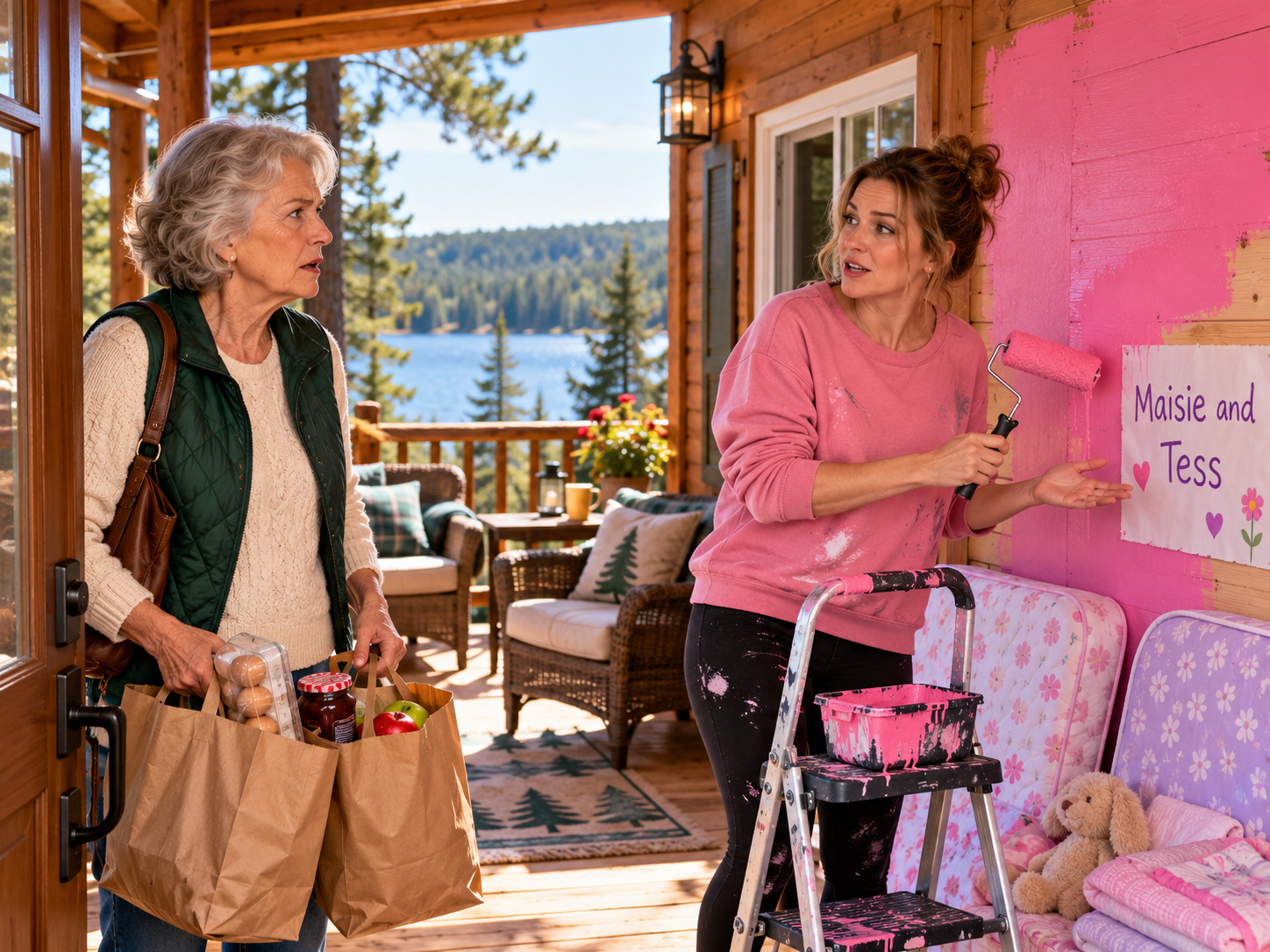
Nothing was wrong. The locks turned smoothly, the windows were secure, and the camera system showed no unexpected activity during my absence. I put the groceries away and carried a cup of tea to the porch. The cedar boards were cold beneath my shoes, and the faint marks left by the pink paint were visible where the light fell across the wood.
For months, those marks had reminded me of the day Tanya crossed a boundary I had stated plainly. Lately, I had begun to see them differently. They still represented a violation, and I had no intention of pretending otherwise. But they also reminded me that I had repaired the damage without giving up the cabin. I had not needed to erase every trace of what happened to reclaim the place.
That afternoon, while I was unpacking the last box, my phone rang. Brian asked whether I had made it safely to the lake and whether the road had been manageable. I told him I was settled and that the cabin was warming up nicely.
“Good,” he said. “The girls were asking when you might be going back.”
“They're welcome to ask.”
He laughed softly. “They wanted to know whether the ice had melted yet. Tess wants to see the ducks again.”
I looked out toward the water. “Not completely. There are still patches near the middle, and the shore is muddy. But when the weather is right, you can bring them for an afternoon.”
“Would next month be too soon to ask?”
“Next month is fine. We can decide closer to the date, depending on the weather.”
“All right. We won't make plans until we check with you.”
The sentence was ordinary, but I noticed the care with which he said it. He was not assuming that a future visit was guaranteed. He was asking whether a possibility could remain open.
After we hung up, I carried my cup back inside and placed it in the sink. I felt a small flicker of hope, followed by the instinct to protect myself from feeling too much of it. Trust had become something I approached carefully, not because I wanted to remain suspicious, but because I had learned that progress was best judged by what people did consistently over time.
The following week, I received a message from Tanya asking whether I would like the girls to bring their drawings again when they visited. She said they had started another project at school, this time about a place that mattered to their family. She wanted to make sure I was comfortable with them including the cabin.
I replied that I would be happy to see what they made. I also told her that the girls could draw the cabin whenever they wished; they did not need permission to remember a place they had visited. What required permission was using the property, changing anything there, or making plans on my behalf.
Tanya answered that she understood the distinction. Then she sent a photograph of the girls sitting at the kitchen table, their pencils spread between them. Tess had drawn a long blue strip for the lake, while Maisie was sketching the porch with its brown cedar boards. In the corner of the picture, Tanya had written, They wanted to show you before they finished.
I studied the photograph for a while. The drawing was imperfect, with a roof that leaned slightly to one side and windows of different sizes. Yet the porch was brown, and the chairs were where the girls remembered them. It was a small thing, but it made me smile.
As March gave way to April, the family’s visits became easier to discuss. Brian and Tanya did not ask to stay overnight, and I did not offer. They did not need to prove their respect by pretending they no longer wanted to spend time at the cabin. I did not need to prove my love by making every visit longer than I wanted. We were learning to let a simple afternoon be enough.
One Sunday, Brian called with a different kind of question. The girls’ school was planning a spring nature day, and he wondered whether I would be willing to tell them about the birds and plants around the lake. He said he could bring them to the cabin, but he understood if I preferred not to turn my home into a school activity.
I considered it. I enjoyed showing the girls things I had noticed over the years: the way the light changed along the shore, the tracks small animals left in the soft earth, and the birds that returned when the weather warmed. I did not want a crowd at the cabin, but three family members and a few hours outdoors sounded pleasant.
“You can bring them on a Saturday morning,” I said. “Just the four of us. We can walk along the shore and look at what's coming back.”
“Thank you, Mom. I'll check with Tanya and the girls, then we'll ask you about a date.”
He followed through two days later, suggesting the second Saturday in April. I checked my calendar, agreed, and told him to bring boots the girls would not mind getting muddy. He wrote back that Tess was already looking for her rain boots.
The morning of the visit was bright but chilly. I arrived early, opened the curtains, and made a pot of coffee. I packed a small bag with field guides, binoculars, and a notebook I had kept for years. Walt had been the one who first taught me to identify the birds at Birch Lake. He could recognize a call before I could locate the branch it came from, and he used to tease me when I insisted on checking the guidebook after he had already named the bird.
I missed him as I prepared the bag, but the memory brought warmth rather than the sharp ache it once had. I had not brought my family to the cabin to replace those moments. I was inviting them to make new ones alongside the old.
Brian's car pulled into the driveway shortly after ten. He waited until I opened the door before letting the girls out. Maisie carried a small notebook, and Tess had a pair of binoculars hanging around her neck. Tanya had packed water and snacks, but she asked where I wanted them left instead of deciding which cupboard to use.
We walked down the path together. The ground was soft from the melting snow, and the water lapped against the stones near the edge. Tess wanted to know whether the lake would freeze again. I explained that cold nights might still bring a thin layer of ice close to shore, but the season was changing.
Maisie spotted a bird perched on a branch above the water. I handed her the binoculars and helped her adjust the focus. It was a common merganser, its dark head sharply outlined against the pale sky. The girls took turns looking, and Brian crouched beside them to read the description in the field guide.
For nearly an hour, we moved slowly along the shore, pausing whenever one of the girls noticed something. They found small green shoots emerging beside a fallen log and argued gently over whether a cluster of tracks belonged to a rabbit or a squirrel. I let them examine the ground, then showed them how the shapes and spacing of the prints could offer clues.
There was no argument about the cabin, no request to change anything, and no hint that the afternoon was a step toward moving in. We were simply outside together. I realized how much I had missed being able to enjoy my family without calculating the hidden cost of every invitation.
When we returned to the porch, I set out sandwiches and apple slices. The girls spread their notebooks across the table and began drawing the birds they had seen. Tanya sat in the chair nearest the window, while Brian leaned against the railing with his coffee. He asked about the carpenter who had repaired the cedar and whether the wood needed another treatment before summer.
I told him what the carpenter had recommended. Brian listened, then asked whether I wanted help arranging the next maintenance visit. I said I could handle the appointment, but I would let him know if I needed someone to move the heavier furniture.
“Okay,” he said. “Just let me know if you want a hand.”
He did not turn my answer into an argument or offer to take over. It was such a simple exchange that I almost missed how different it was from the day he had treated the cabin as a place already promised to him.
Before leaving, Maisie asked whether she could keep a copy of the bird list I had written in my notebook. I made a photocopy for her and showed her where to find the names in the field guide. Tess asked whether she could come back when the ducks had babies. I told her we could talk about it when the season arrived.
“Does that mean yes?” she asked.
“It means we will ask again when we know more.”
She considered this, then nodded. “Okay. We'll ask.”
After they drove away, I collected the cups and brushed crumbs from the table. The cabin returned to its quiet state, but the silence felt fuller than it had before their visit. I could still hear Tess's questions and see Maisie's careful sketches. Their presence had not diminished the place. Because the visit had happened on terms I chose, it had added something to it.
That evening, I sat on the porch and watched the last light move across the lake. I thought about the woman I had been the day I discovered Tanya painting my cedar porch pink. I had felt anger, disbelief, and a kind of humiliation I could hardly describe. My son had known I said no, yet he had allowed the plan to move forward. The home I had bought for peace had become the center of a family dispute.
I could not change that day. I could not guarantee that no one would ever disappoint me again. But I could decide what happened next, and I could allow good moments to exist without treating them as evidence that I should loosen every boundary.
The porch remained mine. The locks remained changed. The cameras remained in place. And the next visit would happen because I wanted it, not because anyone had quietly decided it was inevitable.
For the first time, that arrangement felt less like a defense and more like a life.
Click here to continue reading: PART 18: When My Granddaughters Asked What Had Happened to the Pink Porch, I Had to Find a Way to Tell the Truth Without Making Them Choose Sides
I Bought the Cabin for Peace, but My Daughter-in-Law Had Already Decided Which Parts of My Life She Could Take
Part 17 of 20

