
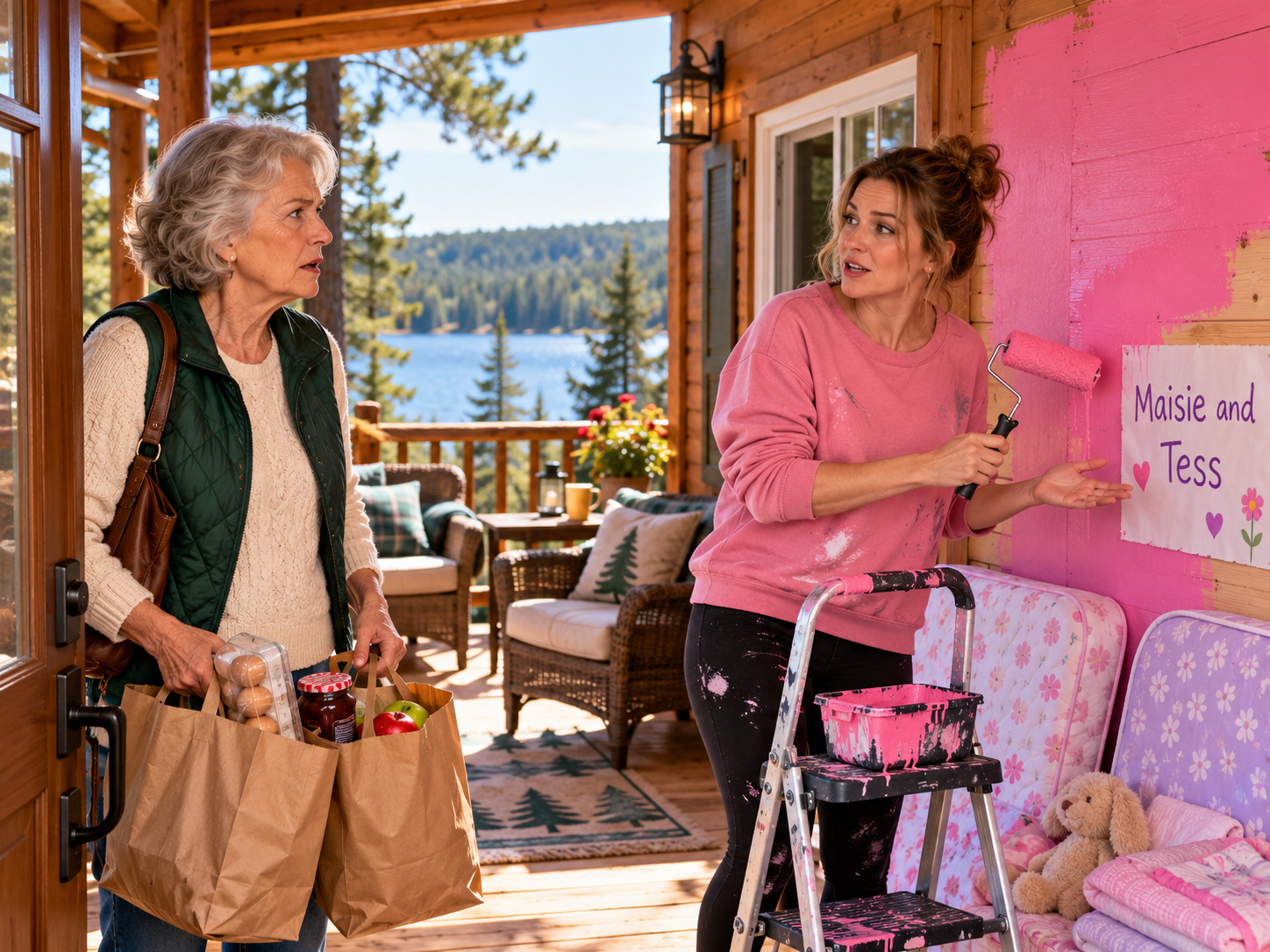
The question came in late April, on a Sunday when the rain had finally stopped and the lake was beginning to show its spring colors. Brian had called that morning to ask whether he could bring the girls for a short visit. He explained that they wanted to see whether the ducks had returned, and I agreed, provided the roads remained clear and they left before dinner.
They arrived shortly after one. Maisie carried the notebook she had used during our nature walk, and Tess brought a paper bag filled with crackers she insisted were for the ducks. I told her that we would not feed the birds unless we knew it was safe for them, and she accepted the explanation with the solemnity of a child who had hoped for a different answer but was willing to listen.
Tanya stayed in the kitchen with me while Brian took the girls toward the shore. We made tea and talked about the weather, the girls’ school, and the small repairs each of us had been putting off. The conversation was comfortable enough that I noticed I was no longer monitoring every word for signs of an argument. We were not close in the way we had been before the cabin dispute, but neither were we walking around it as though one wrong sentence might bring the whole thing back.
A little while later, the girls came running up the path, their boots muddy and their hair damp from the mist. Tess reached the porch first, then stopped abruptly beside one of the cedar posts.
“Grandma,” she said, looking at the boards, “why are there still little marks here?”
Maisie came closer. She ran a finger over one of the faint places where the pink paint had been removed. “It looks like something was painted on it.”
The question was innocent. Neither girl sounded angry or accusing. They were simply curious about a change they had noticed, and I knew they had seen photographs of the cabin before the porch was repainted. I could have told them that the wood had weathered unevenly or that a repair had been necessary. Instead, I decided to give them an answer they could understand without making them responsible for an adult conflict.
“Someone painted the porch without asking me first,” I said. “The color wasn't what I wanted, so I had the paint removed and the wood repaired. The carpenter did a good job, but some marks remained.”
Tess looked from the boards to me. “Who painted it?”
I paused. I did not want to lie to her, and I did not want to turn her curiosity into a reason to condemn her mother. The girls loved Tanya. Whatever she had done, it was not their responsibility to carry my anger or decide which adult deserved their loyalty.
“Your mother painted it,” I said. “She thought it would be a good change, but she should have asked me first. This is my home, and I get to decide what happens to it.”
Maisie lowered her eyes to the porch boards. “Did you get mad?”
“Yes,” I said honestly. “I was very upset. Someone had changed something important to me without permission.”
“Are you still mad at Mom?” Tess asked.
The question landed more heavily than the others. I looked at her small face and thought about all the different ways adults could make children feel responsible for feelings they had not created. I wanted her to understand that a mistake did not have to define a person forever, but I also did not want to suggest that saying sorry made every consequence disappear.
“I was hurt by what happened,” I told her. “Your mother apologized, and she has been trying to do better. I can accept that she is trying while still remembering what happened. Both things can be true.”
Tess thought about this for a moment. “So you can forgive someone and still say no?”
I smiled a little. “Yes. Forgiving someone doesn't mean you have to say yes to everything. You can love someone and still tell them what is okay and what isn't.”
Maisie looked at the boards again. “Then if I borrow Tess's markers, I have to ask even if she lets me borrow them most of the time?”
“Exactly. And if Tess says no, you have to respect that.”
Tess nodded with satisfaction, as though a principle she had been trying to understand had finally settled into place. Then she asked whether they could help me sweep the porch. I handed them a small broom and a dustpan, and we spent the next few minutes clearing away the leaves and grit that had collected near the steps.
From the kitchen doorway, Tanya had heard enough to understand what we were discussing. She did not interrupt or correct me. When the girls went inside to wash their hands, she remained on the porch with me.
“I heard what you told them,” she said quietly.
“I hope I handled it well.”
“You did.” She looked at the boards. “I know it must be hard to explain what I did without making me sound like a terrible person.”
“I wasn't trying to make you sound like anything. They asked a question, and I answered it.”
She nodded. “I appreciate that you didn't lie to them. I also appreciate that you didn't make them feel like they had to be angry with me.”
I leaned against the railing. “They shouldn't have to take sides. This was between adults. They need to learn to ask permission and respect other people's choices, not decide which of us was right.”
Tanya looked down at her hands. “I wish I had understood that before I picked up the paintbrush.”
“I wish you had, too.”
There was no accusation in my voice, but there was no reason to soften the truth, either. We stood together for a moment, listening to the water move against the shore.
Then Tanya said, “I've been thinking about how I used to explain what happened. I would say we were desperate, or that we needed space, or that we thought you would eventually agree. Those things may explain what I was feeling, but they don't change what I chose to do.”
I turned toward her. “That's an important difference.”
“I know. I'm trying to remember it when things get difficult.”
I believed she was making an effort. That did not mean I had forgotten the pink porch or the duplicated key, and it did not mean I would trust her with unrestricted access to the cabin. But I could recognize genuine progress without pretending the past had never happened.
When Brian returned from the shore, he found us standing quietly by the railing. He asked what we were discussing, and Tanya told him that the girls had noticed the paint marks. She explained that I had answered their questions honestly.
Brian looked uncomfortable. “I'm sorry they had to think about any of this.”
“They were curious about the porch,” I said. “They asked a question, and we answered it. They don't need to carry our mistakes.”
He nodded. “You're right.”
We spent the rest of the afternoon inside because the weather had turned colder. The girls spread their notebooks across the table, and I helped them identify a bird they had drawn near the shoreline. Brian read aloud from the field guide while Tanya prepared a snack. The conversation moved naturally from birds to school to the girls' plans for summer vacation.
At one point, Tess announced that she wanted to make a sign for the porch that said, Please ask Grandma before changing things. Maisie thought the wording sounded too strict and suggested, Grandma's Cabin—Ask Before You Change Anything. They argued cheerfully over the size of the letters.
I let them finish their discussion before telling them that I didn't need a sign. The rule was simple enough to remember without putting it on the wall.
“Besides,” I added, “I would rather have a sign that says something nice about the lake.”
The girls accepted that challenge and began inventing phrases about birds, trees, and the water. By the time their parents were ready to leave, they had filled an entire page with suggestions. I kept the page on the desk beside their earlier drawings.
After they left, I returned to the porch. The marks in the cedar were almost invisible from a distance, but I could still find them if I looked closely. For months, I had thought of them as proof that the cabin had been invaded. Now they also reminded me of the conversation I had just had with my granddaughters.
I had told them the truth without asking them to hate their mother. I had acknowledged the hurt without pretending that forgiveness required me to erase my own boundaries. The conversation had not been easy, but it had not damaged the relationship, either.
That evening, Brian sent me a text thanking me for the way I had spoken to the girls. He said they had talked about asking permission on the drive home, and Tess had declared that she was going to make a sign for her bedroom door reminding everyone to knock.
I answered that I was glad the conversation had been useful. Then I put the phone away.
The following morning, Tanya sent a separate message. She said she was grateful that I had not made the girls feel responsible for what happened, and that she hoped she could continue showing them that an apology meant changing behavior, not simply saying the right words.
I wrote back, That is what matters most.
I did not add a heart or promise that everything was forgiven. The words were enough.
As spring advanced, the girls' drawings accumulated on my desk. They drew the lake at different times of day, the porch after rain, and the birds they hoped to see when summer arrived. None of their pictures showed a pink wall. The cabin was brown, the water was blue, and the people were small figures standing near the shore.
I began to understand that the home I had fought to protect could also become a place where my family learned something better than entitlement. That did not mean I had to open it to everyone whenever they wished. It meant that the invitations I chose to give could carry meaning precisely because they were freely given.
I still checked the locks each evening. I still kept the camera recordings available. I still declined requests when the timing did not suit me. Those habits no longer felt like signs that I expected the worst from my family. They were ordinary ways of caring for my property and my peace.
One late afternoon, I walked down to the lake alone. The ice had disappeared from the near shore, and small waves moved around the stones. I thought about Walt and the life we had built, about the years of night shifts, and about how long I had believed that being a good mother meant absorbing every difficulty my son encountered.
I had loved Brian fiercely. I still did. But love could not mean allowing him to make decisions about my life because his own life had become difficult. Nor could it mean asking my granddaughters to pretend nothing painful had happened.
I could love them honestly, with the truth included.
When I returned to the cabin, the porch was quiet beneath the evening light. I ran my hand over the cedar rail and went inside, closing the door behind me.
The marks were still there. So was the home I had chosen, the life I had reclaimed, and the possibility of a family relationship built on something more durable than assumptions.
Click here to continue reading: PART 19: When Brian Asked Whether He Could Finally Have a Key, I Had to Decide What Trust Meant After All the Apologies and Promises We Had Made
I Bought the Cabin for Peace, but My Daughter-in-Law Had Already Decided Which Parts of My Life She Could Take
Part 18 of 20

