The years after that anniversary became gentler.
Not uneventful.
Just gentler.
My parents grew older. Kyle's children grew into teenagers, then young adults. The family gatherings became less crowded because everyone's lives became busier, but the lake house remained the one place where people still seemed willing to slow down.
I kept working at St. Mercy Medical Center, although I eventually reduced my hours. Twelve-hour shifts had once seemed normal. Later, I began to understand that exhaustion was not something I needed to prove I could survive.
My parents noticed the change.
“You're home more,” Mom said one evening.
“I am.”
“Do you miss the old schedule?”
“No.”
Dad looked at me over his newspaper.
“Good.”
“You used to admire how much I worked.”
“I admired your work ethic,” he said. “I don't admire unnecessary suffering anymore.”
I smiled.
“That is progress.”
He folded the newspaper.
“Don't sound so surprised.”
“I've known you a long time.”
He laughed.
The lake house changed too.
I replaced the roof.
The porch was rebuilt.
The kitchen was renovated.
The old security system was upgraded.
None of those changes felt like surrender.
They felt like maintenance.
The house remained mine, and I remained responsible for deciding how it was used.
But by then, my family no longer needed reminders.
They asked.
I answered.
They respected it.
The rhythm had become so ordinary that I sometimes forgot how extraordinary it would have seemed years earlier.
One spring, my father called.
“Claire, are you sitting down?”
“No.”
“You should.”
I laughed.
“What happened?”
“I got a letter from the insurance company.”
“That doesn't sound like something that requires sitting.”
“They want an inspection.”
“Okay.”
“They're sending someone next week.”
“Fine.”
He sighed.
“Your mother thinks it's serious.”
“It's probably routine.”
“I told her that.”
“What did she say?”
“She said I always think everything is routine until it isn't.”
I laughed.
“That sounds like Mom.”
The inspection went smoothly.
There were a few repairs recommended.
Nothing major.
I arranged them.
Dad offered to help.
I told him he didn't need to.
He came anyway.
We spent a Saturday replacing a section of railing.
He held the tools.
I measured.
At one point, he looked at me.
“You know what?”
“What?”
“You're very bossy.”
“You taught me.”
He laughed.
“Fair.”
We worked until sunset.
When we finished, he ran his hand along the new railing.
“Solid.”
“Yes.”
“Good.”
We sat on the porch.
He looked tired.
“You okay?”
“Yes.”
“You're quiet.”
“I was thinking.”
“That is dangerous.”
He smiled.
“I was thinking about the first time I stood on this porch.”
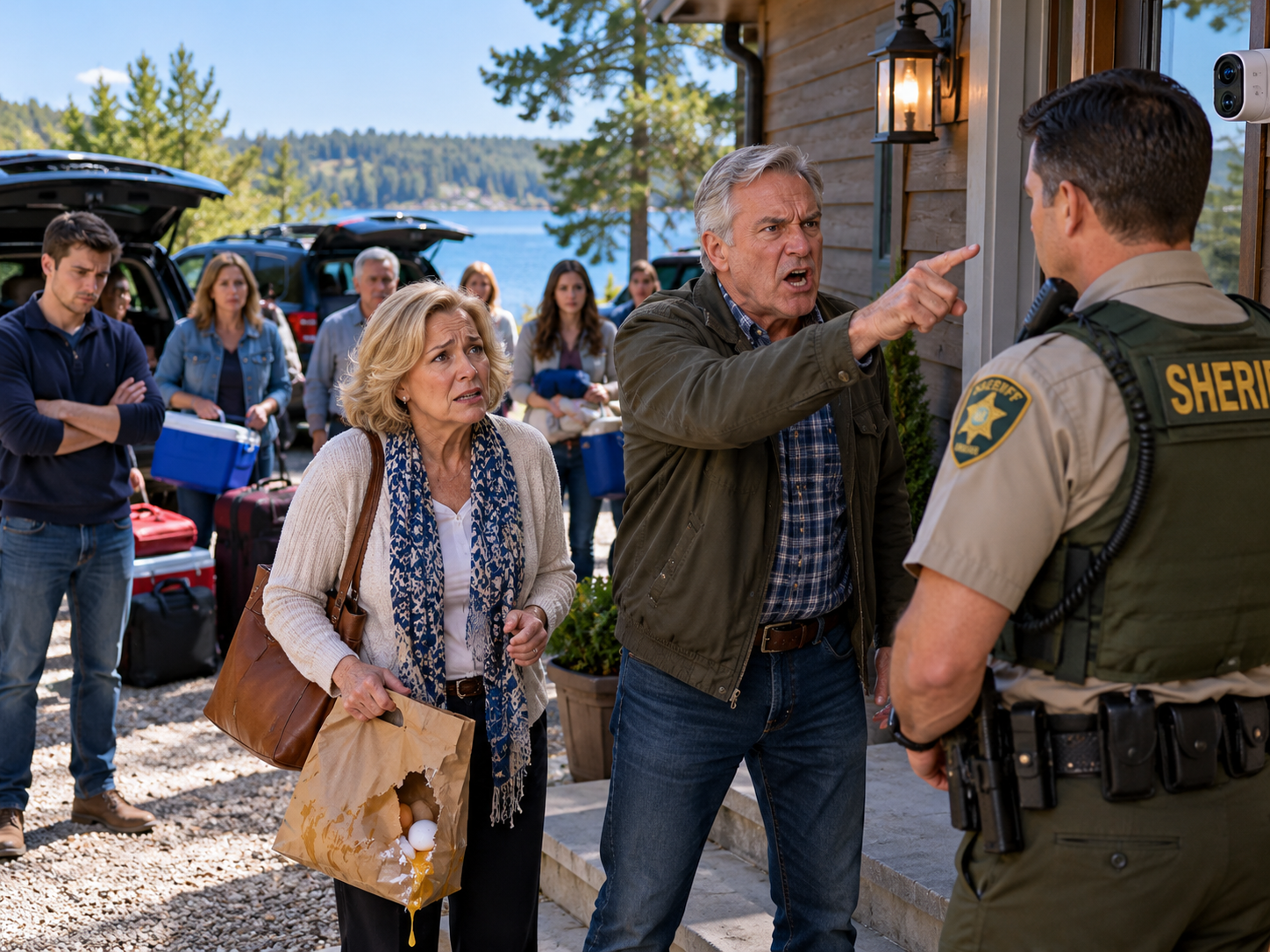
“When you arrived with twenty people?”
“Yes.”
“You were not exactly welcome.”
He laughed.
“I know.”
“I still remember the deputy.”
“So do I.”
He shook his head.
“I was so angry.”
“You were.”
“I thought I had been humiliated.”
I waited.
“Now I think the humiliation was realizing how little I understood you.”
I looked at him.
“You understand me now.”
“I try.”
“That matters.”
He nodded.
The conversation moved on.
Neither of us needed to revisit the details.
They had already become part of the family's history.
Later that year, my mother began talking about downsizing.
“I don't want a huge house anymore,” she said.
Dad looked offended.
“You love that house.”
“I love you more.”
“That sounds suspicious.”
She laughed.
They eventually moved into a smaller place closer to the medical center.
The move was difficult.
Decades of possessions had accumulated.
Photographs.
Furniture.
Old dishes.
Boxes of paperwork.
I helped sort everything.
One afternoon, Mom handed me a small envelope.
“What is this?”
“Open it.”
Inside was the original Christmas card she had given me years earlier.
There was nothing unusual about it.
Except on the back, she had written something.
I read it.
I didn't understand your no was real. I do now.
I looked at her.
“You kept this?”
“So did you.”
“I forgot I had it.”
“I didn't.”
She sat beside me.
“I wanted you to have it.”
I folded the card carefully.
“Why?”
“Because I never want to forget the moment I finally understood.”
I nodded.
That mattered.
Not because my mother needed to punish herself.
Because she wanted to remember the change.
I put the card in the same folder where I kept the old sheriff's report.
Not because they belonged together.
But because they marked opposite ends of the same story.
One documented the day my family crossed a boundary.
The other documented the day my mother admitted she understood it.
That evening, Dad asked me about the lake house.
“Have you decided what you're doing with it someday?”
“Not completely.”
He nodded.
“I've been thinking.”
“About?”
“If you ever don't want the responsibility, sell it.”
I looked at him.
“You wouldn't want it?”
He smiled.
“I love the house.”
“But?”
“But I finally understand that loving something doesn't mean owning it.”
I smiled.
“That took you a while.”
He laughed.
“It did.”
The following summer, my father turned seventy-five.
We celebrated at the lake.
The grandchildren were adults now.
One had moved overseas.
Another was finishing university.
The youngest was learning to drive.
The family looked different.
Older.
Wiser.
More scattered.
But when everyone gathered around the same table, something familiar remained.
Dad raised his glass.
“To everyone who came.”
Everyone laughed.
Then he looked at me.
“And to Claire, who still controls the thermostat.”
I laughed.
“Someone has to.”
The evening was warm.
After dinner, the younger family members went down to the dock.
I stayed with my parents.
Mom leaned against Dad.
Dad held her hand.
They looked tired.
Happy.
Older than they had been when the story began.
I realized something then.
Time had given us something arguments never could.
Perspective.
The lake-house weekend had once felt enormous.
Now it was one chapter in a much longer life.
Important.
Painful.
Necessary.
But not everything.
My father looked toward the water.
“Do you think families ever completely change?”
I considered it.
“No.”
He nodded.
“I don't either.”
“People change. Habits return. Then people notice.”
“That's probably true.”
“The important thing is what happens after.”
He smiled.
“Like the house.”
“Exactly.”
We sat quietly.
Later that night, I walked through the empty rooms.
The family had left dishes on the table.
Blankets were scattered over the sofas.
Someone had forgotten a phone charger.
It felt lived in.
I smiled.
Years ago, I had feared that letting people in would mean losing control.
Now I understood that control had never been the goal.
Choice was.
The next morning, I found my father's old fishing hat on the dock.
I picked it up.
Inside the band was a tiny piece of paper.
Dad had written my name on it.
I laughed.
He had always been afraid of losing things.
I carried the hat back to the house.
When he saw it, he smiled.
“I wondered where that went.”
“You left it.”
“Good thing you were here.”
“Good thing you asked me to be.”
He smiled.
That was enough.
Click here to continue reading: PART 18: When My Parents Asked Me to Think About the House After They Were Gone, I Realized the Boundary I Had Fought For Needed to Survive Even Without Me
Twenty People Arrived Expecting a Welcome, but My Locked Door and One Quiet Phone Call Forced My Parents to Face a Problem They Had Never Expected
Part 17 of 20