The following spring, I received a message from Dad.
Can we talk about the lake house?
I smiled.
I knew what he meant.
I called him.
“What about it?”
“Your mother wants to celebrate our anniversary there.”
“Okay.”
“She wants to invite everyone.”
“How many?”
“Fourteen.”
I laughed.
“Dad.”
“I know.”
“Who?”
He listed the names.
Everyone I expected.
No surprise guests.
No strangers.
No one who hadn't been part of our family circle.
“And?” I asked.
“And she wants to know if you're comfortable with it.”
I was silent.
The question mattered.
Not because fourteen people were impossible.
Because I knew they were asking rather than assuming.
“Yes,” I said.
Dad exhaled.
“Really?”
“Yes.”
“Thank you.”
“But I have conditions.”
“Of course.”
“Everyone leaves by eight.”
“Agreed.”
“Anyone who drinks stays overnight or has a designated driver.”
“Agreed.”
“Someone helps clean up.”
“Absolutely.”
“And no one uses the hot tub.”
He laughed.
“Your mother will be disappointed.”
“She can survive.”
He laughed again.
“I'll tell her.”
The anniversary arrived.
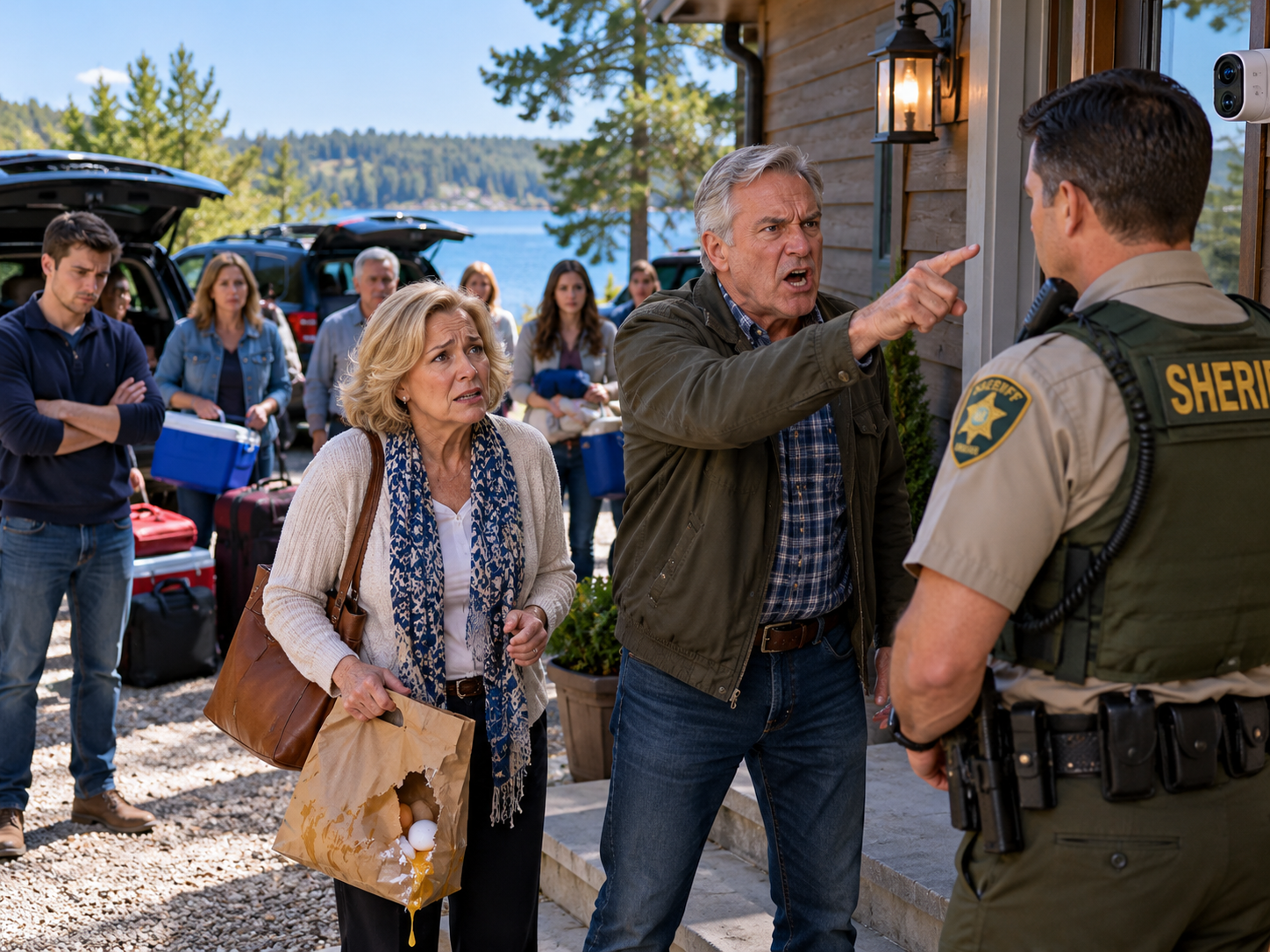
The house filled with people.
Not twenty unexpected guests.
Fourteen invited ones.
The difference was not visible in the number.
It was visible in the way everyone behaved.
People asked where things were.
They helped carry food.
They took their shoes off.
They cleaned up.
They thanked me.
My mother stood in the kitchen looking around.
“This is beautiful.”
“It is.”
She touched my arm.
“Thank you.”
“You're welcome.”
Dad came in carrying a tray.
“Where do you want this?”
“Dining room.”
He nodded.
He walked away.
I watched him.
The man who had once stood outside demanding entry now asked where he could put a tray.
It was almost absurd how much could change in a few years.
That evening, everyone gathered around the table.
Dad raised his glass.
“To another year.”
Everyone lifted theirs.
He looked at Mom.
Then at me.
Then around the table.
“I think this is what we should have been doing all along.”
Mom squeezed his hand.
The conversation moved on.
Later, after everyone had gone, I stood in the kitchen with Mom.
She was drying dishes.
“You know,” she said, “I almost didn't ask you.”
“Why?”
“I was afraid you would say no.”
I smiled.
“You were allowed to ask.”
“I know.”
“And I was allowed to say no.”
She nodded.
“I finally understand that.”
I put away a plate.
“That's the whole thing.”
She looked at me.
“The whole thing?”
“Yes.”
She smiled.
“I suppose it is.”
We finished cleaning.
Then she hugged me.
“I'm proud of you.”
“Thank you.”
She pulled back.
“And I'm proud of myself too.”
I laughed.
“You should be.”
She laughed.
When she left, the house became quiet.
I stepped onto the porch.
The lake reflected the moon.
My phone buzzed.
A message from Kyle.
Great weekend. Thanks for having us.
I replied:
Glad you came.
Then another message.
Dad says you're the best host.
I laughed.
Tell Dad he's still banned from touching the thermostat.
Kyle sent a laughing emoji.
A few minutes later, Dad called.
“Thermostat?”
“I heard.”
“I barely touched it.”
“You changed it six degrees.”
“I was cold.”
“You were wearing a sweater.”
“Still cold.”
I laughed.
“Goodnight, Dad.”
“Goodnight.”
He paused.
“Claire?”
“Yes?”
“Thank you for letting us have this.”
I looked toward the house.
“You're welcome.”
“I mean it.”
“I know.”
We ended the call.
I stayed outside for a while.
The house was quiet.
The lake was quiet.
The road was empty.
I thought about how much of my life had been spent trying to prevent conflict.
I used to believe that if I explained myself correctly, nobody would be disappointed.
That if I gave enough, nobody would demand more.
That if I stayed agreeable, I could keep everyone happy.
The lake house had taught me otherwise.
Someone else's disappointment was not proof that I had done something wrong.
Someone's anger did not automatically mean I needed to apologize.
And family love did not give anyone a permanent key to my life.
Those lessons had changed more than my relationship with my parents.
They had changed me.
At work, I became better at saying no to extra shifts when I was exhausted.
With friends, I stopped agreeing to plans I didn't want.
With money, I stopped lending what I could not afford to lose.
With relationships, I began paying attention to whether people respected small boundaries before trusting them with larger ones.
The lesson followed me everywhere.
Not as fear.
As clarity.
A year later, my father called me from the lake.
“We're here.”
“Who is?”
“Your mother and me.”
“Okay.”
“We wanted to see the house.”
“You're allowed.”
He laughed.
“I know.”
“Why did you call?”
“Because I wanted to.”
I smiled.
“Fair enough.”
He became quiet.
Then he said, “You know, when I think about that first weekend, I sometimes feel ashamed.”
“You don't need to.”
“I know.”
“Then why say it?”
“Because shame and responsibility aren't the same thing.”
I smiled.
“That sounds like something I would say.”
“I've learned from you.”
We both laughed.
He continued.
“I can't change what I did.”
“No.”
“But I can make sure I don't repeat it.”
“Yes.”
“That has to count for something.”
“It counts for a lot.”
He was silent.
Then he said, “Your mother wants to know if we're allowed to stay another night.”
I laughed.
“Ask me properly.”
He laughed too.
“She asks whether we may stay another night.”
“Yes.”
“Thank you.”
That evening, I drove to the lake.
My parents were sitting on the porch.
Mom had made tea.
Dad was reading.
They looked peaceful.
I sat between them.
No one talked about the first weekend.
No one needed to.
The lake house had stopped being the battlefield where my family learned about boundaries.
It had become the place where those boundaries quietly held.
The sun went down.
The water turned dark.
Mom leaned against my shoulder.
Dad closed his book.
For a while, none of us spoke.
I looked at the front door.
The same door.
The same lock.
The same house.
But everything behind that door meant something different now.
Years ago, I had thought protecting the house meant keeping everyone out.
Then I learned that wasn't true.
Protecting it meant making sure every person inside was there because I had chosen to open the door.
That included my parents.
That included Kyle.
That included friends.
And, when I needed it, it included only me.
The choice remained mine.
That was what had changed.
Not the locks.
Not the property.
Not the lake.
Me.
I had stopped confusing love with obligation.
My parents had stopped confusing family with entitlement.
And somewhere between those two changes, we had found a way to remain a family without anyone owning anyone else.
The next morning, I woke to the smell of coffee.
I walked into the kitchen.
Dad was making it.
Mom was setting out breakfast.
Neither looked at me as though I owed them anything.
Dad handed me a cup.
“Morning.”
“Morning.”
“Sleep well?”
“Yes.”
He smiled.
“Good.”
I looked through the window toward the lake.
The water was bright beneath the morning sun.
The house was quiet.
My family was here.
And for the first time, I understood that the most important thing about that house had never been the door.
It was the person who held the key.
And I finally knew that having the key did not mean I had to keep the door closed.
It meant I could decide when to open it.
Click here to continue reading: PART 13: When My Parents Started Treating the Lake House Like a Home They Had To Earn Access To, I Realized Trust Could Become More Comfortable Than Suspicion
Twenty People Arrived Expecting a Welcome, but My Locked Door and One Quiet Phone Call Forced My Parents to Face a Problem They Had Never Expected
Part 12 of 20