
Years after the lottery win, people occasionally asked why I hadn't built something enormous with the money.
They never asked me directly.
They asked other people.
Sometimes a business associate would wonder why I wasn't buying companies.
Sometimes someone connected to an investment would ask whether I planned to become more visible.
Sometimes an acquaintance would assume that wealth naturally required a larger public life.
I understood the assumption.
I simply didn't share it.
My life was intentionally small.
My house was large enough.
My investments were diversified.
My charitable commitments mattered.
My family relationships were stable.
I didn't need a company with my name on the building.
I didn't need a magazine profile.
I didn't need a private jet parked somewhere just to prove I could afford one.
The first years after winning had been about learning what money could do.
The years after that were about learning what it didn't need to do.
It didn't need to make me important.
It didn't need to make my family proud.
It didn't need to make strangers respect me.
It only needed to give me choices.
And it did.
One morning, Ms. Vance arrived for our annual review.
She looked around the office.
“You've changed the furniture.”
“Finally noticed?”
“I notice everything.”
“You're frightening.”
She smiled.
We reviewed the investments.
Everything was stable.
The foundation had expanded its support.
The trusts remained structured.
Nothing required dramatic action.
She closed the folder.
“Any major purchases?”
“No.”
“Any major sales?”
“No.”
“Any family requests?”
I laughed.
“No.”
She looked amused.
“You know, most people with your resources have complicated family situations.”
“Mine was complicated before the money.”
“Fair.”
She stood.
“Then perhaps you've already learned the hardest lesson.”
“What lesson?”
“Money doesn't simplify people.”
“No.”
“It reveals them.”
I thought about my family.
“That sounds familiar.”
She nodded.
“Just remember that it reveals you too.”
After she left, I thought about that.
The lottery had revealed things about me I hadn't wanted to admit.
I had wanted approval.
I had feared rejection.
I had confused patience with endurance.
I had stayed too long because I wanted evidence.
I had also learned that I could leave.
The money had revealed all of that.
Maybe that was why I had never regretted winning.
Not because the money was wonderful.
Because it had forced honesty.
That afternoon, I received an invitation from Vanguard Dynamics.
A charity event.
My first instinct was to decline.
Then I saw my father's name among the retired employees being honored.
I decided to attend.
I arrived quietly.
The building looked almost exactly as I remembered.
The same glass entrance.
The same polished floors.
The same elevators.
For a moment, I could almost smell the industrial cleaner from my old night shifts.
I stood in the lobby.
Nobody recognized me.
That was strangely comforting.
I walked through the building and remembered the hours I had spent there.
While my father had been a senior director upstairs, I had been downstairs cleaning spaces most people never noticed.
I had learned the building by sound.
Which doors squeaked.
Which elevators were slow.
Which lights flickered.
Which offices stayed warm.
Which corridors were empty after midnight.
I remembered being invisible.
Then I remembered that invisible did not mean unimportant.
The building had depended on people like me.
The work had mattered.
The job had mattered.
I had simply been ashamed because I thought my father would be ashamed.
That realization had taken years.
At the event, I found my father.
He smiled when he saw me.
“You came.”
“I did.”
He introduced me to several former colleagues.
“This is my son, Daniel.”
There was pride in his voice.
Not because of the money.
Not because of the car.
Just because I was his son.
One man asked what I did.
My father answered before I could.
“Daniel manages investments and supports several organizations.”
I looked at him.
He smiled.
Then the man asked, “Interesting. How did you get into that?”
I answered simply.
“Life.”
My father laughed.
“That sounds like him.”
Later, we stood near the window.
“I never thought I'd bring you here like this,” he said.
“Neither did I.”
“Does it feel strange?”
“Yes.”
“Bad strange?”
“No.”
He nodded.
“I used to be embarrassed that you worked here at night.”
“I know.”
“I regret that.”
“I know.”
“But now?”
“Now I think you understand.”
He smiled.
“I do.”
We watched people moving across the lobby.
Then he said, “You know what bothers me?”
“What?”
“I spent thirty years thinking leadership meant knowing what other people should do.”
“And?”
“Now I think leadership might mean listening long enough to understand what they need.”
I smiled.
“Retirement looks good on you.”
He laughed.
“Don't tell anyone.”
I didn't.
When I returned home that evening, I thought about the building.
The job.
The basement.
The lottery.
The Bugatti.
The family.
All of it seemed connected.
Not by money.
By perception.
I had spent years believing that people became valuable when their circumstances improved.
I now knew the opposite.
Circumstances could change.
Value did not.
The next Sunday, my family gathered again.
Trent brought bread.
My father made a terrible joke.
My mother made lemon cake.
I brought one too.
“You made one?” she asked.
“Yes.”
“Why?”
“I wanted to compare.”
She narrowed her eyes.
“Compare what?”
“Mine and yours.”
“You're trying to start a competition.”
“Maybe.”
Trent laughed.
“I knew it.”
We tasted both.
My father carefully considered each.
“Well?”
My mother stared at him.
He looked terrified.
“They're both good.”
We burst out laughing.
“That was the correct answer,” Trent said.
My father sighed with relief.
Dinner continued.
Afterward, Trent and I washed dishes.
He looked at me.
“You ever think about how weird this is?”
“All the time.”
“Good.”
He rinsed a plate.
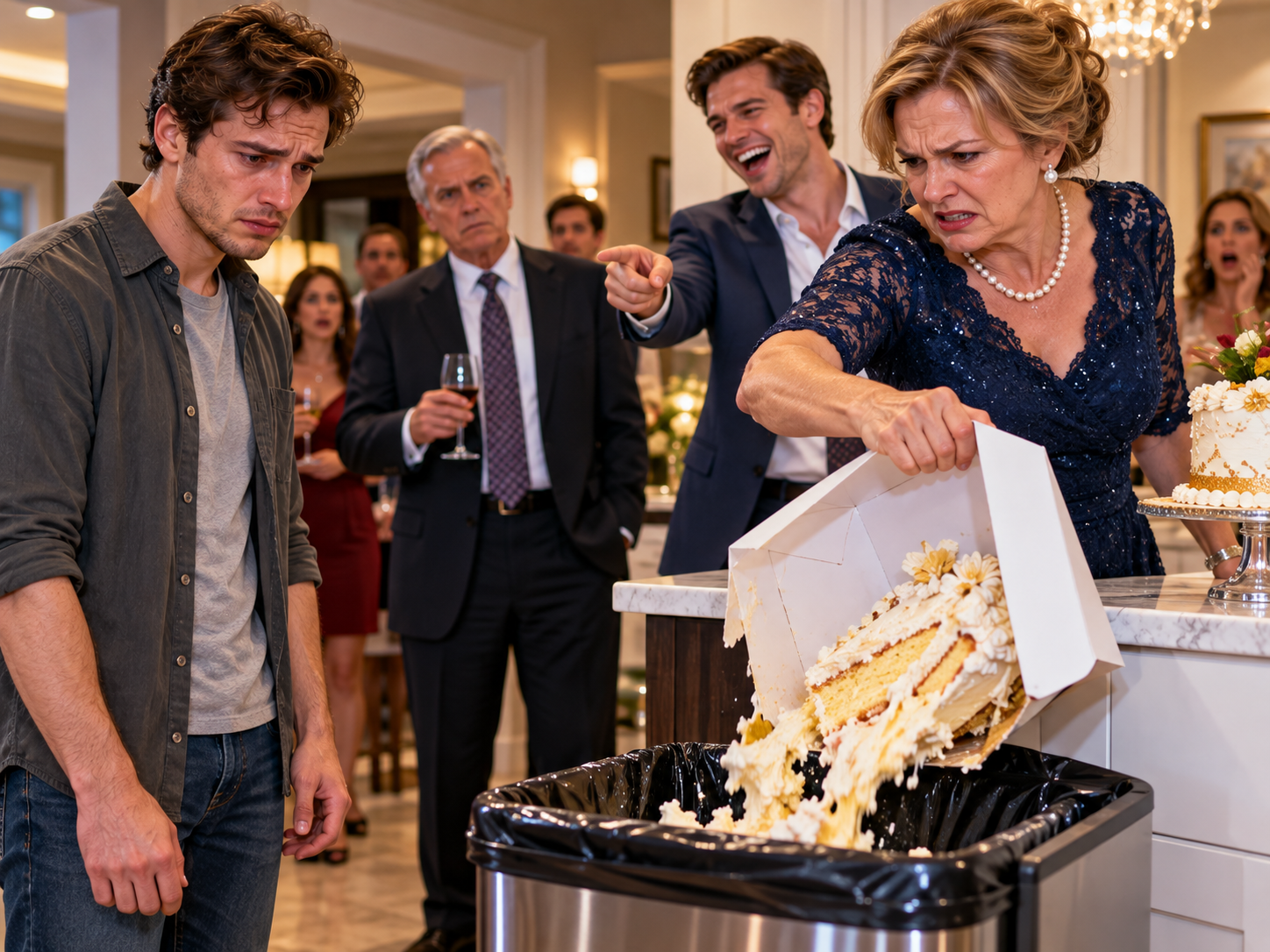
“Do you think Mom ever thinks about that night?”
“The cake?”
“Yeah.”
“Probably.”
He shook his head.
“I still remember laughing.”
“I know.”
“I hate that I did.”
“You don't have to hate yourself forever.”
“I don't.”
He dried the plate.
“But I remember.”
“That's enough.”
He nodded.
We put the dishes away.
When I returned to the living room, my mother was looking through old photographs.
She handed me one.
It showed all four of us at a much younger age.
“We looked happy,” she said.
“We were.”
“Were we?”
“Sometimes.”
She smiled.
“I think that's important.”
“What is?”
“Knowing the bad years don't erase the good ones.”
I looked at the photograph.
She was right.
The past wasn't a courtroom.
It didn't have to produce one final verdict.
People could hurt each other and still love each other.
People could love each other and still hurt each other.
Both could be true.
What mattered was what happened afterward.
Did they deny it?
Did they repeat it?
Or did they face it?
My family had finally chosen the third.
That was why I could stay.
Not because the past was harmless.
Because the future was different.
That night, I drove home.
The road was empty.
The trees were dark.
I thought about the first time I had driven the Bugatti to my parents' house.
I had watched their faces change.
I had seen surprise.
Then calculation.
Then questions.
At the time, I had thought that moment proved something.
Now I saw it differently.
The car had revealed what they thought money meant.
But the years afterward revealed what family could mean.
That mattered more.
I reached home.
I parked.
I walked inside.
The kitchen was quiet.
I opened the refrigerator.
There was half a lemon cake left.
I smiled.
I cut a slice.
I stood by the window and ate it.
It tasted ordinary.
That was perfect.
Because after everything, ordinary had become one of the richest things I owned.
Click here to continue reading: PART 16: When my mother asked me to bring two lemon cakes for another Sunday dinner, I realized the story had never really been about the lottery at all
The night I realized my family would never see me differently was also the night I quietly decided that leaving them behind would require more than simply walking away
Part 15 of 20

