The following Sunday, I drove to my parents’ house without the strange nervousness I used to feel whenever I turned onto their street. The neighborhood looked exactly as it always had, with trimmed hedges, familiar driveways, and porch lights beginning to glow against the late afternoon gray. Yet something inside me had changed enough that the place no longer seemed larger than my life. It was simply a house.
My matte-black Bugatti sat in the driveway for a moment before I shut off the engine. I had stopped thinking about the car as a statement. It was transportation, expensive transportation, certainly, but nothing more. The first time I had driven it there, everyone had seen a symbol. I had seen an exit.
This time, I carried a box from my kitchen.
Inside were two lemon cakes.
I smiled at the absurdity of it as I walked toward the front door. My mother had specifically asked for lemon dessert, and after everything that had happened, I couldn't resist bringing two. One was a simple lemon cake with cream frosting. The other was smaller, covered with thin curls of white chocolate.
When I knocked, my mother opened the door before I could knock again.
“Daniel.”
She said my name differently now.
There was still affection in it, but it no longer carried that old mixture of disappointment and impatience. She looked at the boxes in my hands and gave a nervous smile.
“You actually brought them.”
“You asked.”
“I did.”
For a second, neither of us moved.
Then she stepped aside.
“Come in.”
The house smelled like roasted vegetables, garlic, and something simmering slowly on the stove. It was familiar enough to make me remember being a child, coming through this same door after school, dropping my backpack beside the stairs while my mother told me to put it away.
Some memories become painful only after you understand them differently.
My father was standing near the dining room window. He turned when I entered.
“Good to see you, son.”
“Good to see you too.”
There was no grand embrace. No dramatic speech. I was grateful for that.
My father had finally learned that an apology did not have to be performed to be sincere.
He took one of the cake boxes from me.
“Where should I put this?”
“Kitchen is fine.”
He carried it away.
I watched him disappear through the doorway and realized that three years earlier, he would have asked whether I had bought something from a bakery because he never believed anything I made could be worth much effort.
Now he was simply carrying my cake.
That small difference mattered.
My mother followed me toward the kitchen.
“I wasn't sure what to cook,” she said. “I kept changing the menu.”
“You didn't have to.”
“I know.”
She paused.
“I wanted to.”
That sentence stayed with me.
For years, I had heard my family talk about what they had to do for me. Feed me. Give me a basement room. Let me stay temporarily. Remind me to find a better job. Push me harder. Correct me.
I had rarely heard anyone say they wanted to do something for me.
We sat down at the dining table when everything was ready. My father served the food. My mother asked about my house. She asked whether the wooded property was quiet enough. She asked whether I still liked working on the garden myself or whether I had hired someone.
I answered each question.
Then she asked something more personal.
“Are you happy there?”
I looked at her.
“I am.”
She nodded.
“Good.”
There was no hidden lesson attached to the answer.
No suggestion that happiness was temporary.
No warning that I should be doing something more impressive.
Just good.
My father ate quietly for a while before saying, “I drove past Vanguard last week.”
I set my fork down.
He noticed.
“I wasn't going there for anything,” he continued. “I had an appointment nearby.”
“I see.”
“I thought about you.”
I didn't respond immediately.
“I didn't know,” he said. “About the night work.”
“I know.”
“I should have.”
“Yes.”
My father looked down at his plate.
There were times when silence could be cruel. This wasn't one of them.
This was the silence of someone finally understanding that another person deserved an answer.
“I spent thirty years there,” he said. “I knew people who worked nights. People who cleaned offices, maintained equipment, handled security, stocked supplies. I knew how much the building depended on them.”
He swallowed.
“And somehow, when it was my son doing one of those jobs, I couldn't see it.”
“You saw what you expected to see.”
He nodded slowly.
“That may be the worst part.”
I didn't tell him he was wrong.
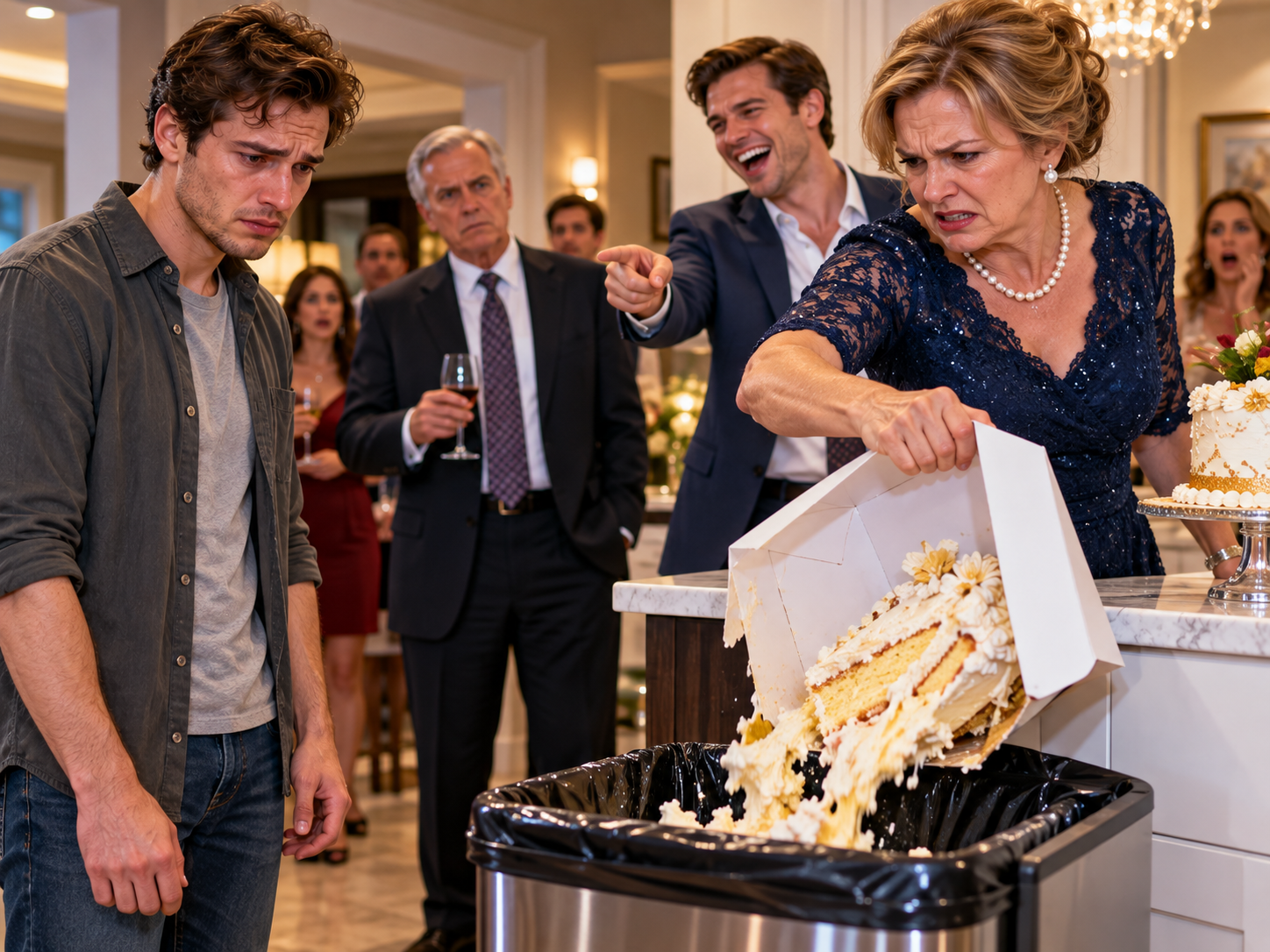
After dinner, my mother brought out the lemon cakes.
She placed the smaller one in front of herself.
“This one first,” she said.
I laughed.
“Why?”
“Because I'm still nervous.”
“About cake?”
“About what the cake means.”
I looked at her.
She took a breath.
“I know you told me it wasn't about the cake.”
“It wasn't.”
“I know.”
She cut a slice.
For a moment, she simply stared at it.
Then she tasted it.
Her expression changed.
Not dramatically.
Just enough.
“This is good.”
“It is.”
She looked almost offended that she had never known.
“I wish I'd tasted the first one.”
That sentence carried more weight than she probably intended.
I leaned back in my chair.
“So do I.”
She looked at me.
“I know I can't change that.”
“No.”
“I threw something away before I understood what it was.”
I nodded.
“That happens.”
“But it shouldn't have.”
“No.”
My father reached for his coffee.
“We can't undo three years,” he said.
“No.”
“But we can stop wasting the years we have left.”
I looked at both of them.
That was the first time I felt something loosen inside me.
Not forgiveness.
Not completely.
Something smaller.
Possibility.
The evening ended without another apology.
That was important.
They didn't keep digging for absolution.
I drove home through the dark, the road winding beneath tall trees. When I arrived, the house was quiet. I parked the Bugatti beneath the covered entrance and walked inside.
For the first time, the house did not feel like a trophy.
It felt like home.
I poured myself a glass of water and stood by the window.
The lottery money was still there.
The investments were still there.
The accounts, trusts, properties, and carefully structured assets were all exactly where Ms. Vance had arranged them.
None of it had changed the strange truth I had learned.
Money could make a door easier to open.
It could not make people walk through it.
My phone rang.
It was Trent.
I stared at his name for a second before answering.
“Hey.”
“Are you busy?”
“No.”
There was a long pause.
“I wanted to thank you.”
“For what?”
“The people you connected me with.”
I leaned against the kitchen counter.
“How is it going?”
“Bad.”
I smiled faintly.
“At least you're honest.”
“Yeah.”
He laughed once, but there was no humor in it.
“The accountant showed me numbers I should have looked at years ago.”
“That happens.”
“No. I mean, Daniel…”
His voice became quieter.
“I built my whole life around looking successful.”
I said nothing.
“I thought if everybody believed I was doing well, then eventually I would be doing well.”
“That isn't how it works.”
“I know that now.”
Another pause.
“I'm selling the Bellevue property.”
I nodded even though he couldn't see me.
“That was your decision.”
“It was.”
“You don't need my permission.”
“I know.”
He exhaled.
“I just wanted you to know.”
“I appreciate that.”
He was quiet again.
Then he said, “I used to think you were jealous of me.”
“I wasn't.”
“I know.”
“You were the one who kept comparing us.”
“I know.”
His voice cracked slightly.
“I was scared.”
“Of what?”
“That you'd eventually become everything I pretended to be.”
I closed my eyes.
There it was.
The truth underneath all the polished clothes, expensive restaurants, confident speeches, and dismissive jokes.
Fear.
Not an excuse.
Just the truth.
“You don't have to compete with me, Trent.”
“I know.”
“You don't have to compete with anyone.”
“I know.”
We ended the call a few minutes later.
I didn't feel victorious.
I felt tired.
But it was a different kind of tired.
The kind that comes after something has finally been said aloud.
Weeks passed.
My parents continued changing in small ways.
My mother started asking questions and waiting for answers instead of turning them into advice. My father began telling me about things he had never mentioned before, including mistakes he had made at work, opportunities he had missed, and moments when he had been afraid of failing.
Sometimes he caught himself.
Sometimes my mother did too.
Old habits don't disappear because someone says sorry.
They weaken through repetition.
One afternoon, my father called while I was walking through the woods behind my house.
“I have a question.”
“Go ahead.”
“Do you still want to keep the job?”
I knew exactly what he meant.
My old night maintenance job at Vanguard.
“I left a while ago.”
“I didn't know.”
“I didn't tell you.”
“Why?”
“Because it wasn't important anymore.”
He was silent.
Then he said, “I'm glad you did it.”
I stopped walking.
“Why?”
“Because you were supporting yourself when I thought you were doing nothing.”
I looked toward the trees.
“Dad…”
“I know. I know I can't rewrite that.”
“No.”
“But I can tell you now.”
I smiled.
“Thank you.”
When the call ended, I stayed outside for another twenty minutes.
The air smelled like wet earth.
For years, I had thought closure would feel like triumph.
It didn't.
It felt quiet.
That was better.
Click here to continue reading: PART 6: Trent came to my house without asking for money, and for the first time since we were boys, he seemed more interested in telling me the truth
The night I realized my family would never see me differently was also the night I quietly decided that leaving them behind would require more than simply walking away
Part 5 of 20