The day came quietly.
There was no dramatic announcement.
No crowd.
No final confrontation.
Just a small family gathered around a kitchen table.
Daniel was beside me.
Sophia sat across from us.
His son stood near the window.
The old watch rested inside its worn wooden box.
Daniel placed the box on the table.
“This belongs to you now.”
His son looked at him.
“Are you sure?”
“Yes.”
The young man did not touch it immediately.
“What does Grandpa think?”
I smiled.
“I think your father has earned the right to decide.”
The boy looked at Daniel.
“Why me?”
“Because you're ready.”
The boy opened the box.
He lifted the watch carefully.
The scratched glass caught the afternoon light.
“It still works.”
Daniel nodded.
“It has survived a lot.”
The boy looked at me.
“What happened to it?”
I smiled.
“That's a long story.”
“I want to hear it.”
Daniel looked at me.
I nodded.
So we told him.
Not every detail.
Not to turn the past into entertainment.
But enough.
We told him about his great-grandfather.
About hard work.
About his grandmother.
About the house.
About the mistake Daniel had made.
About the consequences.
About the foundation.
About the years of work afterward.
And finally, about the letter.
His grandmother's letter.
The boy listened without interrupting.
When we finished, he looked at Daniel.
“Were you ashamed?”
“Yes.”
“Are you still?”
“Sometimes.”
“Why?”
“Because I can't change what I did.”
The boy looked at me.
“Did Grandpa forgive him?”
I answered.
“Yes.”
Daniel added, “But forgiveness didn't mean everything went back to the way it was.”
The boy nodded.
“Because it shouldn't.”
Daniel smiled.
“Exactly.”
He put the watch on the young man's wrist.
It was slightly loose.
The boy tightened the strap.
Then he looked at the scratched glass.
“I'll take care of it.”
Daniel nodded.
“That's all I ask.”
The boy looked at me.
“What does it mean to inherit something?”
I thought for a moment.
“It means you receive something you did not create.”
He listened.
“And what you do with it tells you whether you understood where it came from.”
The boy nodded.
“I think I understand.”
That afternoon, we walked through the foundation's newest community center.
Daniel's son had helped design it.
Daniel had supervised its funding.
I had watched from a distance.
The building was modest.
Useful.
Bright.
There was a classroom.
A workshop.
A small library.
A community kitchen.
The financial education program operated from one of the rooms.
On the wall hung a photograph of Daniel's mother.
Beside it was a simple sentence:
What you inherit is not what makes you worthy. What you do with it does.
The boy read it.
“That sounds like the watch.”
“It is.”
He touched the watch on his wrist.
“I think I like it.”
Daniel smiled.
“So do I.”
We continued walking.
People were using the building.
Children were studying.
Older residents were attending classes.
Workers were repairing equipment.
Nothing about it looked luxurious.
Everything about it looked alive.
I stopped near the doorway.
Daniel noticed.
“You tired?”
“A little.”
He put a hand on my shoulder.
“We can go home.”
I smiled.
“Home.”
The word sounded different now.
For years, I had thought home was a particular building.
A property.
A deed.
A set of rooms.
Now I understood.
Home was the people who could sit together after the worst things had happened and still choose to remain family.
We drove back separately.
That evening, Daniel came to my house.
He brought dinner.
We sat at the same kitchen table where his son had once asked about the watch.
Daniel opened the box.
“It looks good on him.”
“Yes.”
“I never thought I'd see this day.”
“Neither did I.”
He smiled.
“Do you remember the first time you gave it to me?”
“Yes.”
“I barely cared.”
“I remember.”
“I thought it was just an old watch.”
“It was.”
“Now I think it's one of the most valuable things we own.”
I corrected him.
“Not own.”
He smiled.
“Right.”
“Carry.”
He nodded.
“Carry.”
We ate.
After dinner, Daniel washed the dishes.
I watched him.
There was something almost ordinary about it.
That was the beauty.
The extraordinary part of our story had ended.
What remained was ordinary life.
The kind we had once taken for granted.
Before he left, Daniel stood at the door.
“Dad?”
“Yes?”
“Are you happy?”
I looked at him.
“Yes.”
“Even with everything that happened?”
“Yes.”
He seemed surprised.
“Why?”
“Because I wouldn't choose the pain.”
I paused.
“But I am grateful for what we learned.”
He nodded.
“I feel the same.”
He hugged me.
Then he left.
I stood at the door until his car disappeared.
That night, I sat in the study.
The house was quiet.
On the desk was a copy of the first deed.
I looked at it one final time.
The property had once seemed like proof of everything I had built.
Now it was just paper.
The real legacy was somewhere else.
In the community centers.
In the shelters.
In the students who had learned financial responsibility.
In the workers who had received opportunities.
In Daniel.
In his son.
In the watch.
I put the deed away.
Then I opened the drawer containing my wife's letter.
I read the final line again.
She had asked me to trust Daniel when he had earned it.
I had eventually done so.
Not perfectly.
Not quickly.
But honestly.
I folded the letter.
For years, I had carried guilt over the ways I had failed as a father.
I had given too much.
I had protected too much.
I had mistaken comfort for security.
But perhaps being a parent is not about getting every decision right.
Perhaps it is about being willing to admit when you got one wrong.
And then having the courage to change.
The next morning, Daniel called.
His voice sounded excited.
“Dad.”
“Yes?”
“Your grandson wants to start another project.”
“What kind?”
“A small workshop for teenagers.”
I smiled.
“Of course he does.”
“He wants to use some of his savings.”
“How much?”
“Enough to get started.”
“And?”
“He wants to raise the rest.”
I laughed.
“Good.”
“He asked whether the foundation would match him.”
I thought about it.
“Maybe.”
“You're going to make him work for it?”
“Yes.”
Daniel laughed.
“I knew you would.”
“Why?”
“Because that's what you taught us.”
“No.”
I corrected him.
“That is what life taught us.”
There was a pause.
Then Daniel said, “Maybe that's the real story.”
“What?”
“That nobody saved us.”
I listened.
“You and Mom gave us opportunities.”
“Yes.”
“But life made us learn.”
“Yes.”
“And we decided whether to learn.”
I smiled.
“Exactly.”
We said goodbye.
I placed the phone down.
Outside, morning light spread across the street.
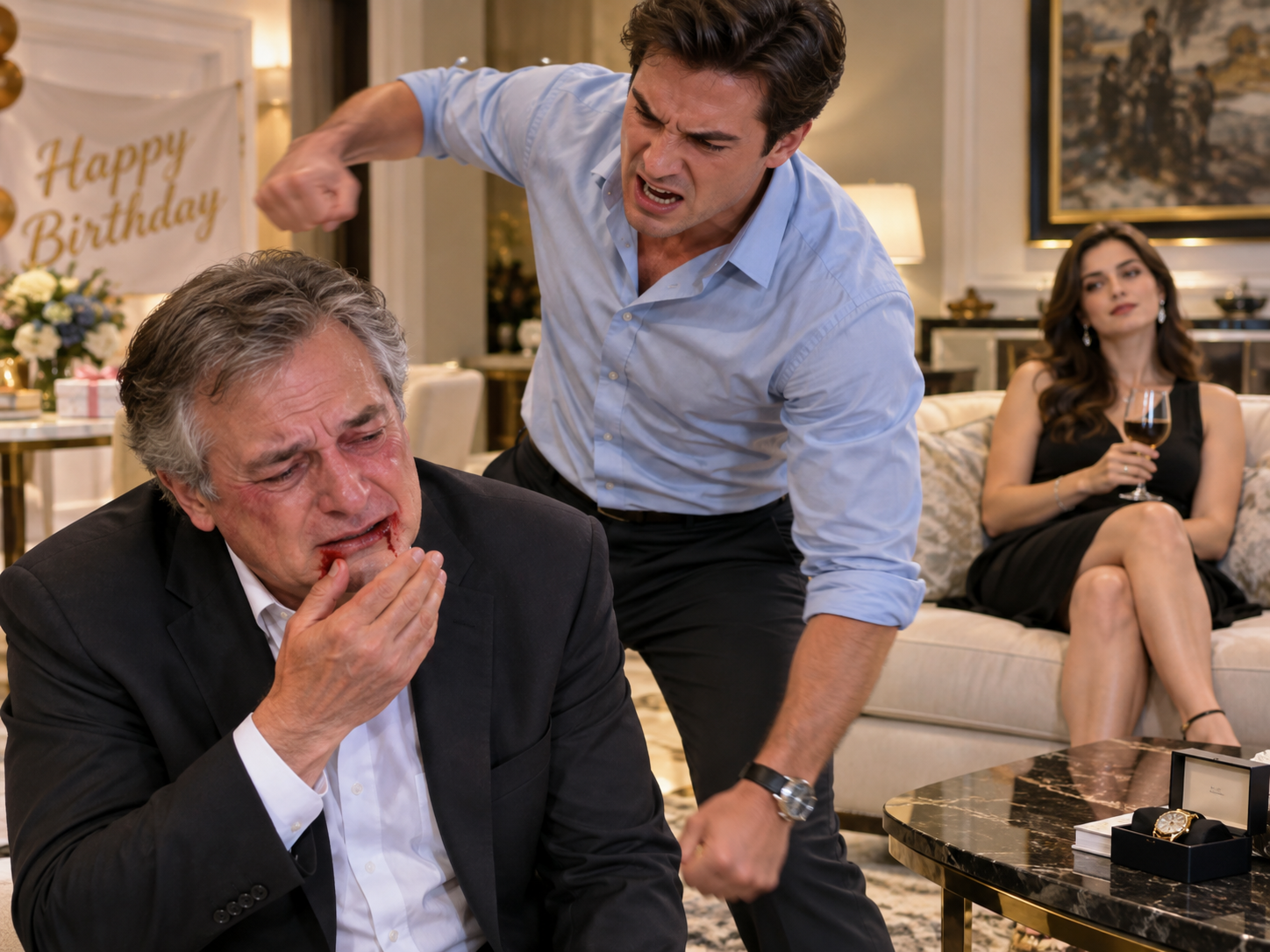
I thought about the night Daniel had struck me.
Thirty times.
I remembered the room.
The blood.
Sophia sitting on the sofa.
The silence.
The old watch.
The drive home.
The call to my attorney.
The signature.
For years, those memories had felt like the beginning of everything.
Now they felt like a chapter.
An important one.
A painful one.
But only a chapter.
The true ending had come much later.
It came when Daniel stopped asking for rescue.
When he began asking for responsibility.
When Sophia built her own life.
When his son learned that money did not replace preparation.
When the watch moved to another wrist.
When the family stopped treating inheritance as entitlement.
That was the ending I had never expected.
Not revenge.
Not punishment.
Not the house.
Not the money.
Change.
Quiet, difficult, imperfect change.
A few weeks later, Daniel's son brought the watch to me.
“I want to show you something.”
He opened the box.
The watch had a new strap.
“What happened to the old one?”
“It broke.”
I smiled.
“And you replaced it?”
“Yes.”
“Good.”
He looked at me.
“But I kept the old strap.”
“Why?”
“So we remember.”
I nodded.
“That's wise.”
He placed the old strap beside the watch.
Then he asked, “Grandpa, what should I do when I'm older?”
I looked at him.
“Work.”
He laughed.
“Anything else?”
“Tell the truth.”
He nodded.
“Anything else?”
“Don't assume someone owes you because they love you.”
His smile faded slightly.
“Okay.”
“And if you make a terrible mistake?”
“Say sorry?”
“Yes.”
“Then fix what I can?”
“Yes.”
“And accept the consequences?”
“Yes.”
He looked at the watch.
“I'll remember.”
I smiled.
“That's all I wanted.”
He put the watch back on.
Then he ran outside.
Daniel stood in the doorway.
“He listens to you.”
“He listens to you too.”
“Sometimes.”
“That is enough.”
Daniel looked at the watch through the window.
“I used to think my inheritance was the money.”
“What do you think now?”
He smiled.
“The lesson.”
I nodded.
That was the answer.
The one I had spent my entire life learning.
A house can be sold.
Money can disappear.
Companies can fail.
Documents can change.
People can leave.
But the things we teach the people who come after us can continue long after the buildings are gone.
That is what remains.
That is what survives.
The old watch had belonged to my father.
Then it belonged to me.
Then to Daniel.
Now it belonged to Daniel's son.
Each person had added something to its history.
A scratch.
A repair.
A lesson.
A promise.
The watch was not valuable because it was expensive.
It was valuable because it carried proof that a family could make mistakes and still choose to learn.
I looked toward the window.
Daniel was talking with his son.
Sophia was preparing lunch.
The foundation's work continued.
The community centers were full.
The shelters were open.
The mentorship program was growing.
The future was moving forward.
I thought about my father.
He had once told me that an object could carry a family history if the person holding it understood what had been sacrificed to keep it.
I finally understood.
The watch carried more than time.
It carried responsibility.
And perhaps that was the real inheritance.
Not a house.
Not a fortune.
Not a name.
A responsibility passed from one generation to another.
I closed my eyes for a moment.
Then I smiled.
The thirty blows were behind us.
The house was gone.
The money had found a better purpose.
The scars had faded.
The family had changed.
And the watch was still ticking.
That was enough.
The End
Read more original stories on Feel Every Story.
The Thirty Blows That Finally Made a Father Stop Protecting the Son He Had Spent a Lifetime Building Up
Part 16 of 16