
The first thing I remember about the night my father died is not the blood. It is the light. Blue and red reflections slid across my bedroom ceiling, disappearing and returning between the slats of my blinds. I was seventeen, old enough to understand that police cars outside our house meant something terrible had happened, but young enough to believe that whatever had happened could still somehow be fixed. Then I heard my little brother Matthew crying in the hallway.
He was barefoot and clutching the stuffed rabbit he had slept with since he was six. His hair stuck up on one side, and his eyes were wide with the kind of fear children have when adults stop pretending everything is normal. “Claire,” he whispered, “where’s Dad?” I opened my mouth, but no answer came. Before I could tell him to stay in my room, a uniformed officer walked past us toward our parents’ bedroom. Another officer followed, carrying a plastic evidence bag.
Then a detective said something quietly to a colleague.
“Her fingerprints are on the knife.”
I remember the sentence because everything after it seemed to move in slow motion. The knife had been found beneath my mother’s bed. My father, Daniel Carter, was dead on the kitchen floor. There was blood on the sleeve of my mother’s robe, and she was standing near the hallway with both hands pressed against her mouth. Her face was wet with tears. She kept shaking her head and repeating the same thing whenever someone looked at her.
“I didn't kill him.”
Nobody answered her.
My mother, Elena Carter, was arrested before sunrise. By then the house smelled of cold coffee, disinfectant, and something metallic that I could not identify at the time. Matthew was taken to our aunt Rachel’s house. I stayed behind because the police wanted to question me, and because some stubborn part of me believed that if I remained close enough to the house, someone would eventually explain what had happened.
Three months later, the explanation arrived in court.
The prosecution said my parents had been fighting. They said their marriage had deteriorated during the months before Dad’s death. They presented the kitchen knife, my mother’s fingerprints, and the blood on her robe as pieces of a simple story. According to them, an argument had turned violent, Mom had stabbed Dad, and afterward she had hidden the weapon beneath her own bed.
The newspapers loved the case because it fit neatly into a headline. Daniel Carter was a successful businessman. Elena Carter was the grieving wife accused of killing him. Reporters waited outside the courthouse every morning, their cameras pointed toward my mother as though her face itself might reveal guilt. One article called the murder “an open-and-shut domestic tragedy.”
I sat behind the prosecutor every day.
Matthew was not allowed to attend. Aunt Rachel kept him away from the courtroom, school, and reporters as much as she could. She told me I needed to be strong for him. I nodded every time, though I had no idea what strength was supposed to look like when the person who had always made our family feel safe was sitting behind glass in a prison uniform.
Mom never waved to me when she entered the courtroom. She simply looked at me.
Sometimes her eyes followed me until the judge took his seat. She looked thinner each week. Her hair became streaked with gray. Once, during a recess, she raised one hand toward me and stopped before touching the glass between us.
I placed my palm against it.
“I didn’t kill him,” she whispered.
I swallowed hard.
“I know.”
The words came easily.
Believing them did not.
She studied my face for several seconds. Then her shoulders lowered slightly, as though she had just heard an answer she had been expecting but still hoped would be different.
“You don’t believe me,” she said.
I looked down.
I was seventeen. I did not understand forensic reports or courtroom strategy. I knew only what adults kept repeating. The knife had her fingerprints. The blood was on her robe. Dad was dead. The weapon had been under her bed. Every fact seemed to point in one direction.
So I stayed silent.
The jury returned with a guilty verdict.
Mom closed her eyes.
For one moment, I thought she would fall. Instead, she opened them and looked directly at me. I expected anger. I expected accusation. What I saw instead was sadness so quiet that it hurt more than shouting would have.
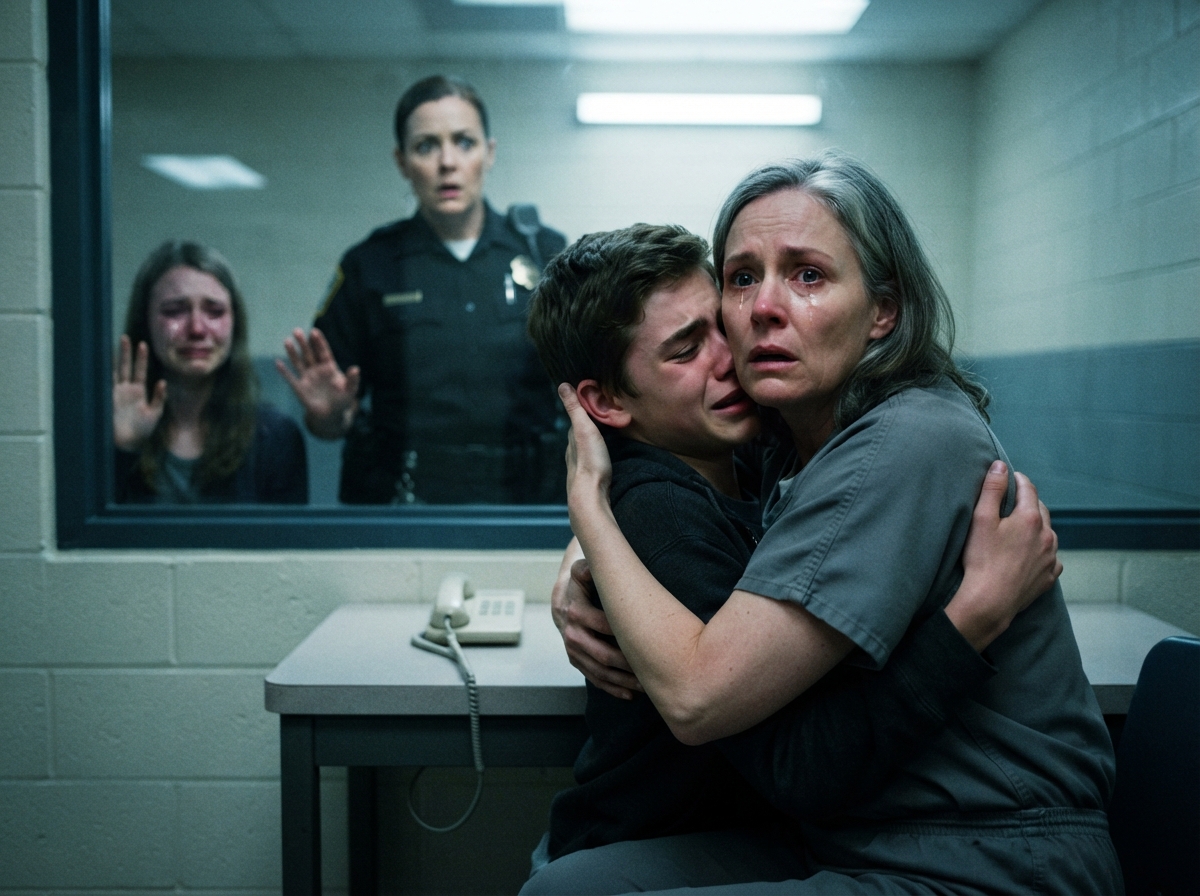
A guard led her away. I was allowed a few minutes with her afterward. We sat on opposite sides of a glass partition, each with a telephone receiver in our hands.
“I’m sorry,” I whispered.
“For what?”
I could not answer.
She pressed her fingertips to the glass.
“You’re my daughter,” she said. “Whatever you believe, that doesn’t change.”
That was the last time I saw my mother as a free woman for six years.
Time did not stop because our family had broken.
Matthew grew taller. I left for college. Aunt Rachel learned how to manage bills, school forms, birthdays, and the thousand ordinary responsibilities my mother had once handled without anyone noticing. Thanksgiving became a quiet meal. Christmas became a day we endured. Dad’s photograph remained on the mantel, but nobody looked at it for long.
Every year, the newspapers remembered his death.
And every year, they remembered my mother as the woman who had supposedly killed him.
Mom wrote letters.
At first, I did not open them.
They arrived in plain envelopes with her careful handwriting on the front. Some were one page. Others were several. She wrote about weather, books, the prison garden, and a bird that built a nest near her window. She asked how Matthew was doing. She remembered my birthday. She never described herself as a victim.
Almost every letter ended with the same sentence.
I didn’t kill him, sweetheart.
I kept those letters in a box.
I told myself I could not read them because doing so would make everything harder. The truth was less comfortable. I was afraid that if I listened to my mother again, I might have to admit that I had never really known whether she was guilty.
Six years passed before the state announced an execution date.
September 14.
I saw the headline online late at night. My hands became cold as I stared at the screen. Mom’s final appeal had been denied. The woman I had watched disappear behind prison glass at seventeen was going to be executed at twenty-three.
That was when guilt stopped being something I could postpone.
I called Matthew.
He answered immediately.
“Did you see it?” he asked.
“Yes.”
There was a long silence.
Then he said, “I’m going to see Mom.”
“You’ve been seeing her.”
“I mean before the execution.”
I sat on the edge of my bed.
“You believe she’s innocent?”
“I never stopped believing it.”
His certainty irritated me because I wanted it to be mine.
“You were eleven when Dad died.”
“So were you once.”
“I was seventeen.”
“And you think seventeen meant you understood everything?”
I had no answer.
Matthew had begun visiting Mom regularly after he turned sixteen. I had criticized him for it. He never argued for long. He simply kept going.
One night, he told me something I could not forget.
“You saw what everyone told you to see,” he said.
I hated him for saying it.
Mostly because I feared he was right.
The day before the execution, Matthew called again.
His voice sounded different.
“Claire.”
“What happened?”
“I know who killed Dad.”
I sat upright.
“What?”
“I know who hid the knife.”
The room seemed suddenly too quiet.
“Matthew, where are you?”
“At the old house.”
I had not been there in years.
“Why?”
“I found Dad’s toolbox.”
“And?”
“There’s a note inside.”
My heartbeat quickened.
“What does it say?”
“I don’t know yet. But it’s in Dad’s handwriting.”
He paused.
Then he said, “Claire, there’s something else.”
“What?”
“A photograph.”
“Of Dad?”
“Yes.”
“Then what’s wrong?”
“He isn’t alone.”
I stood.
“Who is with him?”
Matthew took a breath.
“Uncle Thomas.”
My father’s younger brother.
The man who had testified against Mom.
The man who had told police that my parents had been arguing for weeks.
The man who had later taken control of many of Dad’s business affairs.
The man I had trusted.
My phone buzzed.
Matthew had sent the photograph.
I opened it.
Dad stood beside Thomas in the garage. They were both smiling, but the picture had been taken only six days before Dad died. Behind them was a calendar.
September 8.
Beneath the photograph, someone had written four words in black marker.
THOMAS KNOWS ABOUT HER.
I called Matthew.
He did not answer.
I called again.
Still nothing.
Then I heard a car slow outside my apartment.
I turned toward the window.
Across the street, behind the windshield of a dark sedan, sat Uncle Thomas.
He was looking directly at me.
Click Here to continue read next: PART2: Six Years of Silence Began to Crack When My Mother Finally Told Me What She Had Seen Before My Father Died
The Night My Father Died Left One Detail Behind That Everyone Saw, Yet No One Thought Was Strange Enough to Question
Part 1 of 16

