The first morning Mom woke up without prison walls, she stood in the kitchen for nearly ten minutes without moving.
Sunlight came through the window and rested across the floor.
She touched the counter.
Opened a cabinet.
Ran her fingers over a wooden spoon.
Then she laughed quietly.
“I forgot how much space there is in a kitchen.”
Matthew was making coffee.
“You can have the whole thing.”
She looked at him.
“I might.”
He smiled.
It was the first ordinary joke I had heard between them in years.
I stood in the doorway and watched.
For six years, freedom had been something we imagined as a dramatic moment. We thought it would arrive with cameras, lawyers, shouting, and doors opening.
Instead, freedom arrived as Mom deciding what mug she wanted to use.
It was almost painfully ordinary.
She still woke before sunrise.
She still checked doors twice.
She still sometimes stopped speaking in the middle of a sentence because a sound reminded her of prison.
Healing did not follow the clean shape of a courtroom victory.
The first time she heard a metal door slam somewhere outside, she froze.
Matthew noticed.
He quietly closed the window.
Mom took a breath.
“I’m okay.”
Neither of us told her she was.
We simply stayed.
That became our way of helping.
Not insisting that she forget.
Not demanding that she be grateful.
Just staying.
The legal case continued long after the execution had been canceled.
Investigators reconstructed the night Daniel died minute by minute.
Thomas had arrived at the house before ten.
His phone records placed him nearby.
The photograph proved he had been outside the house at 9:47.
The financial records established his motive.
The fingerprint connected him to the knife.
The recording captured his threat.
Matthew’s testimony explained the missing piece.
And the blood pattern on Mom’s robe contradicted the original prosecution’s interpretation.
One by one, the pieces that had once pointed toward Mom now pointed away from her.
The prosecutor admitted publicly that the original investigation had been incomplete.
That statement made headlines.
I read it twice.
Incomplete.
That word seemed too small.
An incomplete investigation had almost killed my mother.
An incomplete investigation had taken six years from her.
An incomplete investigation had taught a frightened seventeen-year-old daughter to doubt the woman who raised her.
Words could be technically correct and still fail to describe the damage they carried.
Mom never spoke bitterly about the investigators.
When reporters asked whether she wanted apologies, she said, “An apology cannot give me back my life.”
Then she paused.
“But maybe it can keep someone else from losing theirs.”
That became the beginning of something new.
She began speaking about wrongful convictions.
Not because she wanted attention.
She disliked cameras.
She hated interviews.
She often became uncomfortable when strangers called her courageous.
“I was just trying to stay alive,” she once told me.
But she agreed to testify before lawmakers about evidence preservation, independent forensic review, and the dangers of treating a single theory as established fact.
Matthew came with her.
He never spoke for long.
When he did, people listened.
He explained what it felt like to be eleven years old and believe that adults knew everything.
“They sounded certain,” he said.
“That was what scared me. Everybody sounded certain.”
I understood that sentence better than anything else.
Certainty had been the strongest weapon used against us.
Thomas had been certain.
The prosecutor had been certain.
The newspapers had been certain.
Even I had eventually become certain.
And certainty had made questions feel unnecessary.
Years later, I still thought about the phrase the prosecutor had used during Mom’s trial.
There is no mystery here.
There had been a mystery.
We simply had not known how to look at it.
One winter evening, Mom and I sat at the kitchen table while Matthew studied in the next room.
She had a small box beside her.
“What’s that?” I asked.
She opened it.
Inside was the silver photograph from Dad’s old records, the brass key, and a copy of the note Matthew had found.
“You kept them?”
“Yes.”
“Why?”
She looked at the objects for a long moment.
“Because they brought the truth back.”
I understood.
They were not souvenirs.
They were reminders.
Not of Thomas.
Not of the courtroom.
Of the moment our family finally stopped accepting the story someone else had written for us.
Mom also kept one of the letters she had written on the morning of her scheduled execution.
I had not read it.
One night, almost a year after her release, she gave it to me.
“You should have this.”
I opened the envelope.
Her handwriting filled three pages.
She had written it because she believed she would die that evening.
She wrote about Matthew.
About me.
About Dad.
About ordinary memories.
Then I reached the final paragraph.
“If this letter reaches you after I am gone, please do not spend your life blaming yourself. Love your brother. Remember your father before the worst night of our lives. And if the truth ever finds you, have the courage to follow it.”
I had to put the letter down.
Mom watched me.
“You wrote that knowing you might die.”
“Yes.”
“How did you stay so calm?”
She gave a small smile.
“I wasn’t calm.”
“You sounded calm.”
“That’s different.”
I laughed through tears.
She reached across the table.
“You know what kept me alive?”
“What?”
“Your letters.”
I stared at her.
“I barely wrote.”
“You answered eventually.”
“I was terrible at it.”
“You were seventeen.”
There it was again.
That word.
Seventeen.
For years, I had treated it as an excuse.
Mom treated it as an explanation.
I finally understood the difference.
She did not need me to pretend I had handled everything perfectly.
She needed me to stop punishing myself for being a frightened girl in a situation no child should have understood.
“I’m sorry,” I whispered.
“I know.”
“I still wish I had believed you.”
“So do I.”
I looked at her.
She smiled gently.
“But wishing doesn’t change the past.”
“What does?”
“What we do with it.”
That became the sentence I carried forward.
Matthew graduated the following spring.
Mom sat in the front row.
When his name was called, she stood before anyone else.
She cried openly.
Matthew pretended not to notice.
Afterward, he hugged her in the parking lot.
“You made it,” he said.
She laughed.
“So did you.”
I watched them and thought about the boy he had been six years earlier.
Bare feet.
Stuffed rabbit.
Fear in his eyes.
A secret he was too young to carry.
He had grown into someone thoughtful and careful, but some part of that frightened child remained.
We did not try to erase him.
We let him heal.
Sometimes he still talked about Dad.
Not often.
But when he did, we listened.
We remembered Daniel before the murder.
That mattered.
He had been more than a dead man in a courtroom photograph.
He had been the father who taught Matthew to repair a bicycle.
The man who burned pancakes every Sunday because he refused to admit he could not cook.
The person who kept an old toolbox in the garage and believed written records might someday protect his family.
His final attempt to protect us had worked.
Just not in the way he had imagined.
The money Thomas stole was eventually recovered in part.
The company was dismantled.
Several people connected to his financial scheme were investigated.
None of that brought Dad back.
None of it restored Mom’s lost years.
Justice had limits.
We learned that too.
There was no perfect ending.
There was only a life after the damage.
Mom planted roses beside the porch.
She chose red ones.
“I had enough gray in prison,” she said when I asked why.
Every spring, the flowers returned.
Matthew took photographs of them.
I started keeping my own box of family letters.
Not because I expected another tragedy.
Because I had learned how easily ordinary things could become precious.
A birthday card.
A grocery list.
A photograph.
A handwritten note.
Evidence of a life before someone else tries to tell you what that life meant.
On the anniversary of Dad’s death, we cooked his favorite meal.
Roast chicken.
Mashed potatoes.
Apple pie.
Mom set four plates on the table.
Then she paused.
She looked at the fourth plate.
“We should put one away.”
I nodded.
Matthew asked why.
Mom smiled sadly.
“Because your father still belongs here.”
We ate together.
We told stories.
Some made us laugh.
Some hurt.
Nobody pretended the past had disappeared.
That was important.
We were no longer trying to create a perfect family story.
We were trying to tell the true one.
Thomas had wanted the truth buried.
He had believed fear would keep Matthew silent.
He had believed evidence could be arranged into a convincing lie.
He had been almost right.
That was what frightened me most.
The lie had not been absurd.
It had been believable.
It contained real fingerprints.
Real blood.
A real knife.
A real grieving family.
The deception succeeded because it used facts.
That was why the truth had needed more than one discovery.
It needed the photograph.
The fingerprint.
The blood pattern.
The financial records.
The recording.
The hidden letter.
Matthew’s memory.
Each piece corrected something the earlier investigation had misunderstood.
Together, they changed everything.
Years after Thomas’s conviction, I visited the prison where Mom had spent six years.
I did not go inside.
I sat in my car across the street.
The building looked smaller than I remembered.
For a moment, I could almost see myself at seventeen, standing beside Aunt Rachel, afraid to approach the entrance.
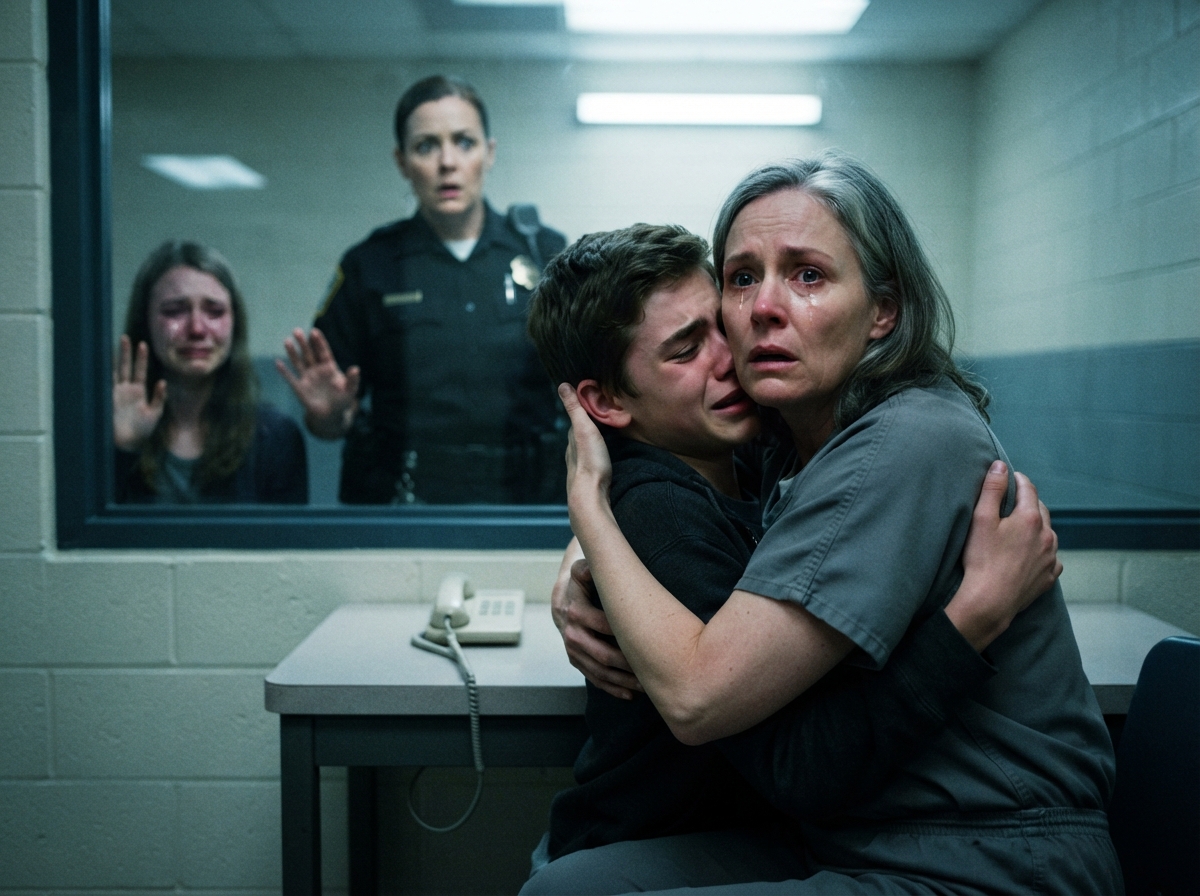
I remembered all the times Mom had looked through glass at me.
I remembered telling her I believed her when I didn't.
Then I remembered her final words before we left the prison.
“You came now.”
I finally understood what she meant.
Not that I had arrived physically.
That I had finally arrived emotionally.
I had stopped hiding from the truth.
I had stopped using my age as an excuse and my guilt as punishment.
I had accepted that I could have failed someone I loved without becoming permanently unforgivable.
When I returned home, Mom was watering the roses.
She looked over.
“Where were you?”
“Visiting the prison.”
She turned off the hose.
“Why?”
“I wanted to see it once.”
She nodded.
“Was it difficult?”
“Yes.”
She walked over and touched my shoulder.
“You don’t have to go back.”
“I know.”
We stood together beside the roses.
The evening light was soft.
For once, nothing urgent was waiting.
No lawyer.
No judge.
No reporter.
No prison guard.
No countdown.
Just the sound of water dripping from the hose.
Matthew came outside carrying three glasses of iced tea.
“Mom, you’re getting the flowers everywhere.”
“They need water.”
“They have enough.”
“They always need more.”
He handed me a glass.
I smiled.
Some things had changed.
Some things had not.
That was enough.
Later that night, I found the old silver photograph on the mantel.
Dad stood beside Thomas in the garage.
The calendar behind them showed September 8.
Six days before everything changed.
I turned the photograph over.
On the back was Dad’s handwriting.
I had read the words dozens of times.
This time, they felt different.
If something happens to me, protect your mother.
I sat there for a long while.
Then I put the photograph back.
Our family had spent six years living inside someone else’s lie.
But the lie had not become the whole story.
The truth had survived in a toolbox.
In a hidden box beneath a loose board.
In an old photograph.
In a fingerprint nobody thought mattered.
In a recording that had waited years to be heard.
And in the memory of a frightened little boy who finally decided that silence was more dangerous than speaking.
Matthew had not saved Mom because he suddenly became fearless.
He saved her because he became more afraid of losing her than he was of the threat that had kept him quiet.
I used to think the most important moment was when the judge canceled the execution.
It wasn't.
The most important moment happened earlier.
A child leaned close to his mother.
He whispered the truth.
And for the first time in six years, someone listened.
That whisper changed the course of our family.
It did not return Dad.
It did not erase Mom’s prison years.
It did not make my own failure disappear.
But it gave us something the lie had taken away.
A chance to begin again.
And sometimes beginning again does not look like forgetting what happened.
Sometimes it means remembering everything clearly—and finally refusing to let the worst thing that happened become the only thing your family will ever be.
Click Here to continue read next: PART5: The Truth Was Public, Yet One Unanswered Question Remained About the Night Daniel Died and the Secret He Never Told His Children
The Night My Father Died Left One Detail Behind That Everyone Saw, Yet No One Thought Was Strange Enough to Question
Part 4 of 16