I did not sleep that night.
Thomas remained across the street for nearly twenty minutes. He never stepped out of the car. He never called. He simply sat there with both hands resting on the steering wheel, watching the building as though he were waiting for me to make a decision.
Eventually, his headlights came on.
The car pulled away.
I stood behind the curtain until the street became empty again.
Then I called Matthew.
No answer.
I called Aunt Rachel.
She answered on the fourth ring.
“Claire?”
“Is Matthew with you?”
“No. Why?”
I told her only that I had been unable to reach him. I did not mention Thomas. I was afraid that if I said the name aloud, the situation would become real.
Rachel immediately became serious.
“Where was he last?”
“The old house.”
“You need to call the police.”
“I will.”
But before I could, my phone rang.
Matthew.
I answered so quickly I nearly dropped it.
“Where are you?”
“At home.”
“Are you safe?”
“Yes.”
“What happened?”
“I left the house when I saw Thomas.”
My stomach tightened.
“You saw him?”
“He was there.”
“What did he want?”
“I don’t know.”
Matthew sounded frightened, but underneath the fear was something else. Determination.
“I found Dad’s note,” he said.
“What does it say?”
“It says Thomas knows something about Mom.”
I closed my eyes.
The photograph, the note, Thomas watching me from across the street—each piece seemed to fit, but I still did not know what picture they formed.
“Bring the note to me,” I said.
“I can’t.”
“Why?”
“Because I think someone searched the toolbox after I left.”
I sat down.
“Are you sure?”
“The lid was open when I came back.”
The next morning, September 14, I drove to the prison.
My mother was scheduled to die that night.
The sky was gray, and rain tapped against the windshield all the way there. I kept thinking about the first night, about the police lights and Matthew’s stuffed rabbit, about Mom standing in the hallway saying she had not killed Dad.
For six years, I had treated that sentence like an excuse.
Now I could not stop hearing it.
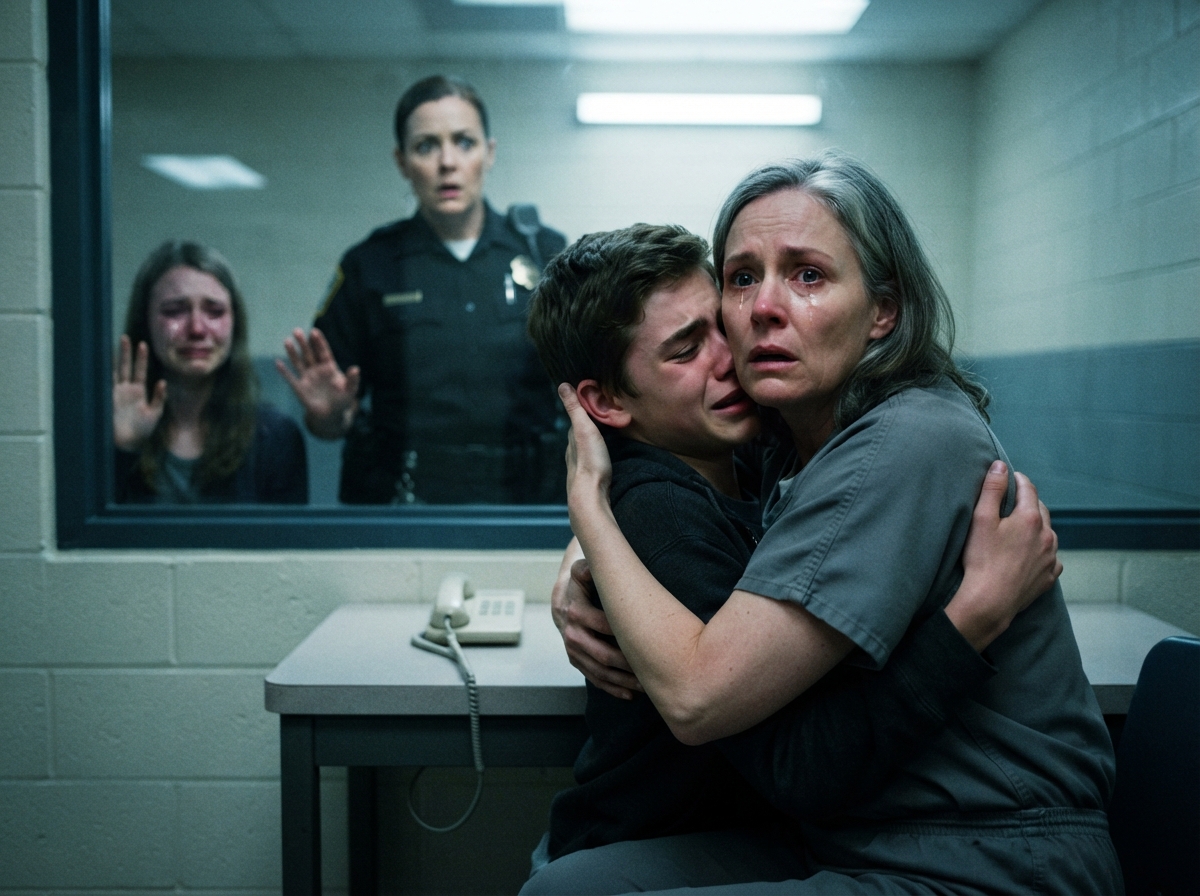
A guard led me into the visiting room.
Mom entered slowly.
Her hair was mostly gray. Her shoulders looked narrow beneath the prison-issued clothing. She seemed older than forty-eight, yet when she saw me, the smallest smile appeared.
“You came.”
I started crying.
“I should have come sooner.”
She shook her head.
“You came now.”
I sat across from her.
For several seconds, neither of us spoke.
Then I placed the photograph on the table.
Her expression changed instantly.
She leaned forward.
“Where did you get this?”
“Matthew found it.”
“Where?”
“The old house.”
She stared at Thomas’s face.
Then she looked at me.
“Your father kept copies.”
“Copies of what?”
“Records.”
“What records?”
Mom glanced toward the guard.
Then she lowered her voice.
“Daniel discovered Thomas was stealing from the company.”
The sentence landed harder than I expected.
“How much?”
“I don’t know. Enough that your father was afraid.”
“Why didn’t you tell the police?”
“I tried.”
“No, Mom. That was never part of the trial.”
“I know.”
“Then what happened?”
She looked down at her hands.
“The night your father died, Thomas came to the house.”
My breathing slowed.
“What did he want?”
“He said Daniel was planning to leave.”
“Leave you?”
“Leave town.”
She shook her head.
“He had discovered what Thomas was doing.”
I thought about the prosecution’s story. They had said Dad wanted to leave because his marriage was collapsing.
“What did Thomas say to you?”
Mom’s fingers tightened together.
“He told me that if Daniel spoke, our family would be destroyed.”
“Was that a threat?”
“Yes.”
The word was barely audible.
I leaned closer.
“Mom, tell me what happened after that.”
She closed her eyes.
“I heard something downstairs.”
“From where?”
“My bedroom.”
“Then?”
“I went to the kitchen.”
“And Dad?”
“He was already on the floor.”
Her voice broke.
“I knelt beside him. There was blood everywhere. I tried to stop it.”
“That’s why it got on your robe?”
“Yes.”
“Did you touch the knife?”
“No.”
“Then how did your fingerprints get on it?”
She looked at me with tired disbelief.
“Claire, that knife belonged to our kitchen. I used it all the time.”
Of course.
I suddenly remembered Mom chopping vegetables with that same knife while Matthew sat on the counter stealing pieces of carrot.
Her fingerprints had never proved that she used it to kill Dad.
They had only proved that she had touched a kitchen knife.
I felt ashamed that it had taken six years to see something so ordinary.
“What happened to the knife?”
“I don’t know.”
“Who moved it?”
“I didn’t see.”
“Thomas?”
Mom hesitated.
“I don’t know.”
I took a breath.
“I believe you.”
She stared at me.
“You don’t have to say that because I’m going to die.”
“No.”
I shook my head.
“I believe you because I finally understand how little I actually knew.”
She reached across the table.
I took her hand.
“I should have believed you.”
“You were seventeen.”
“I was your daughter.”
“And you were frightened.”
“I abandoned you.”
“You were a child.”
That word broke something open inside me.
For six years, I had treated seventeen as an age of responsibility. Mom saw it differently. To her, I had still been a frightened girl watching adults decide the fate of her family.
She squeezed my fingers.
“You came today,” she said.
“I should have come years ago.”
“Then stay now.”
I promised I would.
At 10:14 that morning, I called an attorney named Rebecca Shaw. I had found her through a wrongful-conviction organization. She had handled cases involving disputed forensic evidence and late discoveries.
I sent her everything I had.
Mom’s letters.
The photograph.
The note Matthew found.
The original trial documents.
Rebecca called twenty-three minutes later.
“Where did you get the note?”
“Matthew found it in Dad’s toolbox.”
“Has anyone authenticated the handwriting?”
“Not that I know.”
“That may matter.”
“Can it stop the execution?”
“If we move quickly.”
She asked me to send photographs of the note and the old evidence records.
Then she said something that made my stomach drop.
“Your father’s trial evidence may contain something nobody examined properly.”
“What?”
“The robe.”
I remembered it immediately.
Mom had worn it the night Dad died.
Rebecca explained that the robe had been stored under Daniel’s name instead of Elena’s. The error had caused it to be overlooked in later reviews.
“If the blood pattern can establish how she was positioned when the blood reached the fabric,” Rebecca said, “it could challenge the prosecution’s interpretation.”
I felt my hands shaking.
“How long?”
“Hours, not days.”
Rebecca contacted the courthouse.
The robe was located.
An independent forensic team examined it.
The blood belonged to Dad.
That was expected.
But the distribution was not.
The stains suggested Mom had been kneeling beside him rather than standing over him during an attack.
For six years, the state had treated the blood as evidence of murder.
Now it appeared to support her account.
Then Rebecca called again.
“There’s more.”
“What?”
“They found another partial fingerprint on the knife.”
I stopped breathing.
“It isn’t your mother’s.”
“Whose is it?”
“It was run through the database.”
I heard papers moving on her end.
“Thomas Carter.”
I sat down hard.
My father’s brother.
The man who had testified against Mom.
The man who had told police that he left our house early that evening.
The man who had been watching me from a car the previous night.
“Rebecca,” I whispered, “the execution is tonight.”
“I know.”
“Can this stop it?”
“We are about to find out.”
At 4:40 p.m., the prosecutor’s office filed an emergency motion.
At 5:03, a judge granted a temporary stay.
For the first time in six years, the state was officially reconsidering the conviction.
Mom would not die that night.
But Thomas had disappeared.
His house was empty.
His phone was switched off.
His car was gone.
Rebecca looked at me through the screen.
“He knows.”
“How?”
“He knows we found the fingerprint.”
I thought of the dark sedan.
Then I remembered something else.
“My father had another office.”
“Where?”
“Above the garage.”
“Was it searched?”
“I don’t think so.”
We drove to the old house.
The garage smelled of dust, oil, and damp wood. The developer who owned the property unlocked the door and waited outside while Rebecca and I searched.
The office contained almost nothing.
Then my phone rang.
Matthew.
“I found another box.”
“Where?”
“In Dad’s storage unit.”
“What’s inside?”
“I don’t know yet.”
“Send me the address.”
He did.
Rebecca and I drove there.
Inside were old contracts, bank statements, photographs, and a small cassette recorder.
Rebecca found batteries.
The machine clicked.
Then my father’s voice filled the storage unit.
“If anything happens to me, Thomas is responsible.”
I covered my mouth.
The recording continued.
“Thomas has been stealing from the company for three years. I confronted him today. He threatened me.”
Then another voice.
Thomas.
“You think you can destroy me?”
Dad answered.
“You destroyed yourself.”
A pause.
Then Thomas spoke again.
“If you tell anyone, Elena will take the blame.”
The recorder clicked.
Silence.
Rebecca looked at me.
“We have him.”
I wanted to believe her.
But the recording could be challenged.
Thomas could claim it was edited.
We needed something stronger.
Matthew found an envelope beneath the recorder.
On the front, in Dad’s handwriting, were the words:
FOR CLAIRE AND MATTHEW. ONLY IF I AM GONE.
My hands trembled as I opened it.
Inside was a letter.
And one instruction.
If something happens to me, look beneath the loose board in the garage.
Rebecca and I looked at each other.
Then we ran.
Click Here to continue read next: PART3: The Hidden Box Beneath the Garage Revealed Why My Father Had Been Afraid, and Why Someone Wanted My Mother Blamed
The Night My Father Died Left One Detail Behind That Everyone Saw, Yet No One Thought Was Strange Enough to Question
Part 2 of 16