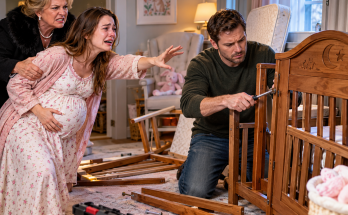
The loose board was near the back wall of the garage, half-covered by dust and a stack of warped wooden shelves. I had walked past it dozens of times as a child without noticing anything unusual. Now Rebecca crouched beside it and slid the tip of a screwdriver into the narrow gap.
The board lifted with a dry crack.
Beneath it was a metal box.
For several seconds, neither of us touched it.
My father had hidden it there before he died.
He had known he was in danger.
And somehow, he had expected that one day his children might find it.
Rebecca photographed the box before opening it.
Inside were bank statements, contracts, photographs, handwritten notes, and a small brass key taped beneath the lid.
The documents told a story Dad had apparently spent years building.
Thomas had been moving company money through accounts that did not belong to Hale Construction. Payments had been disguised as consulting fees. Contracts had been altered. Several clients had been charged for services they had never received.
At the bottom of the box was a handwritten list of dates.
Three years.
Three years of missing money.
Three years of Thomas taking what did not belong to him.
Then I found a note with my father’s handwriting.
Thomas knows I have copies.
That sentence made the room feel colder.
Rebecca examined the papers.
“This gives us motive.”
“We already have the fingerprint.”
“We need to connect him to the night of the murder.”
I pointed to the brass key.
“What about that?”
She turned it over.
“There’s a bank logo.”
We searched the documents until we found the corresponding safety-deposit information.
The bank was still open.
We drove there.
The manager initially refused to let us access the box, but Rebecca showed him the emergency court order and documentation proving my relationship to Daniel’s estate. After a tense phone call with the bank’s legal department, they allowed the box to be opened under supervision.
Inside was one photograph.
That was all.
One photograph.
But it was enough to make my knees weak.
Thomas stood outside our family home.
The timestamp showed 9:47 p.m.
The date was the night Dad died.
I stared at the image.
“His statement said he left at eight-thirty.”
Rebecca nodded.
“He lied.”
Dad had been found shortly after ten.
Thomas had been at the house less than an hour before the killing.
The photograph placed him there.
The fingerprint placed him on the weapon.
The recording gave him a motive and showed that he had threatened Dad.
The documents established the financial theft.
Still, Rebecca warned me not to assume the case was finished.
“Evidence can be challenged,” she said. “But this is no longer one unexplained clue. It’s a chain.”
I thought about Mom sitting in prison while we were finding the pieces that should have saved her years ago.
“Can she really be freed tonight?”
“If the district attorney withdraws the charge, yes.”
We called the prosecutor.
Then we waited.
At 7:18 p.m., police arrested Thomas at a motel two counties away.
He had cash in a suitcase.
Several changes of clothes.
A passport.
And the missing financial records.
He had been preparing to leave the country.
The prosecutor called us minutes later.
“The murder charge against your mother is being withdrawn.”
I closed my eyes.
“What does that mean?”
“She will not be executed.”
My knees almost gave way.
“And Thomas?”
“He is being questioned.”
I looked at Rebecca.
For six years, I had imagined the moment my mother might be proven innocent.
I had imagined screaming.
Celebrating.
Running down a prison corridor.
Instead, I felt strangely empty.
Because the truth had arrived too late to return everything it had taken.
At 8:02 p.m., the execution was officially canceled.
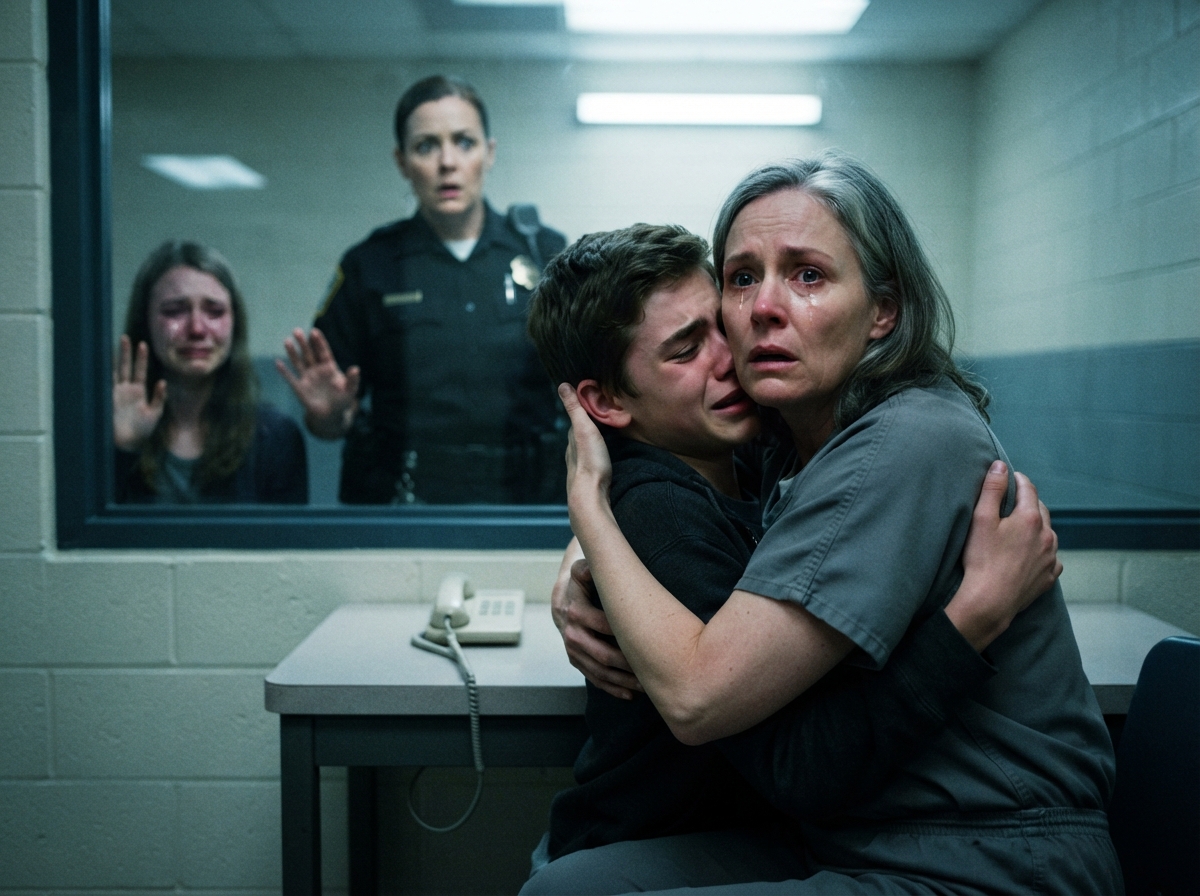
I was sitting in the prison visitation room when the door opened.
Mom walked in.
No restraints.
No guards gripping her arms.
No gray prison corridor behind her.
Just my mother.
Free.
She looked at me.
Neither of us moved.
Then Matthew came through the doorway.
“Mom!”
She opened her arms.
He ran into them.
They held each other so tightly that Mom stumbled backward.
I watched them for a moment before realizing I was crying.
Mom looked at me.
“You came.”
“So did you.”
She smiled.
“I told you.”
“What?”
“I didn’t kill him.”
I laughed through tears.
“No,” I said. “You didn’t.”
The district attorney later explained the evidence publicly.
Thomas had been stealing from Daniel’s company. Daniel discovered the theft and began collecting evidence. He confronted Thomas and threatened to expose him.
Thomas became desperate.
On the night of the murder, he confronted Daniel at the house.
The argument became violent.
Daniel was stabbed.
When Elena came downstairs, Thomas realized that her presence could be turned into an advantage.
He moved the knife beneath her bed.
He allowed her blood-stained robe to become part of the story.
Then he positioned himself as the grieving brother.
The prosecution accepted his account because it matched the evidence they had already chosen to emphasize.
Once investigators decided Mom was guilty, everything was interpreted through that assumption.
Her fingerprints became proof of murder.
The blood became proof of violence.
The knife beneath her bed became proof of intent.
Facts that could have had innocent explanations were treated as confirmation.
No one stopped to ask why the evidence was being interpreted in only one direction.
Thomas eventually confessed.
Not immediately.
At first, he insisted the evidence was circumstantial.
Then detectives confronted him with the photograph.
The fingerprint.
The financial records.
The recording.
His story changed.
He admitted that Daniel had discovered the theft.
He admitted the confrontation.
He admitted moving the knife.
And he admitted threatening Matthew.
That last confession nearly destroyed me.
Matthew had carried that threat for six years.
He had been eleven years old.
He had watched adults believe the wrong person.
He had been afraid that if he spoke, Thomas would hurt me.
When the investigators asked why he had waited, Matthew looked at the floor.
“I thought Claire was all I had left.”
I could not speak.
Mom reached for his hand.
“You protected your sister because you were scared,” she told him. “You were a child.”
Matthew wiped his eyes.
“I should have told someone.”
“You told someone when you could,” Mom said.
The official investigation uncovered more failures.
Several pieces of evidence had not been reviewed after the original trial. The robe had been mislabeled. The additional fingerprint had never been properly compared. Dad’s financial records had been overlooked. His warnings about Thomas had not been presented to the jury.
The case had not failed because there was no evidence.
It had failed because the evidence had been placed inside a story too early.
Once that story became accepted, everything else was forced to fit.
Mom’s conviction was formally overturned eight months later.
The state offered a settlement.
She accepted it.
Not because money could compensate her.
It could not.
She had missed six birthdays.
Six Christmas mornings.
Matthew’s graduation.
My first years of college.
The ordinary moments that families rarely appreciate until they are gone.
The settlement paid bills.
It did not return time.
Thomas was sentenced to life in prison.
When I saw him in court, I expected to feel hatred.
Instead, I felt tired.
He had destroyed our family for money.
Not because he hated Dad.
Not because he hated Mom.
Because he wanted something that was never his.
He had taken a successful family and turned it into a collection of grieving people.
And for six years, I had helped him by believing the wrong story.
That was the hardest part.
Mom never blamed me.
Even after everything, she told reporters that I had been a frightened seventeen-year-old girl surrounded by adults who sounded certain.
I wanted her to be angry.
Sometimes anger would have been easier to carry.
Instead, she forgave me before I knew how to forgive myself.
We moved away from the old house.
Rachel helped us find a small place with a porch and enough sunlight for Mom to plant roses.
Matthew started therapy.
At first, he slept with the bedroom door open.
Then he began leaving it closed.
One small change at a time.
I went through Mom’s letters.
All of them.
Two hundred and seventeen.
I answered every one.
Some replies were short.
Others filled several pages.
I told her things I had never been able to say while she was behind glass.
I told her I was sorry.
I told her I loved her.
I told her that I should have listened.
One evening, Mom found me at the kitchen table with another letter in front of me.
“You don’t have to finish them all tonight,” she said.
“I want to.”
She sat beside me.
“What does this one say?”
I read the first line.
Then I stopped.
“It says she saw a bird building a nest.”
Mom smiled.
“I remember that bird.”
“You wrote about it three times.”
“It kept rebuilding after the wind destroyed it.”
I looked at her.
“You remembered.”
“I remembered everything.”
That sentence stayed with me.
Because while I had been trying to survive by forgetting, Mom had been surviving by remembering.
Months later, Matthew and I returned to the old house with permission from the new owner.
The garage looked smaller.
The loose board was still there.
We stood in silence for a while.
“This is where Dad hid the truth,” Matthew said.
“No,” I answered.
He looked at me.
“He hid the truth here,” I said, “but he trusted us to find it.”
Matthew smiled faintly.
Then he reached into his pocket.
He had brought the photograph.
The one showing Thomas outside the house.
He stared at it.
“Do you think Dad knew he was going to die?”
I did not answer immediately.
“I think he knew he was in danger.”
Matthew nodded.
Neither of us knew what else to say.
That evening, Mom placed the photograph of Dad on the mantel.
For the first time, we did not have to look away.
His death would always be part of our family story.
So would the years Mom lost.
So would the mistake I made at seventeen.
But the story was no longer the one Thomas had created.
It belonged to us again.
Click Here to continue read next: PART4: Freedom Did Not Erase Six Lost Years, and the Final Truth Forced Us to Rebuild a Family We Had Once Thought Gone Forever
The Night My Father Died Left One Detail Behind That Everyone Saw, Yet No One Thought Was Strange Enough to Question
Part 3 of 16