The thirtieth blow landed harder than the others.
Or perhaps it only felt harder because by then I understood that the pain in my face was not the worst thing happening in that room.
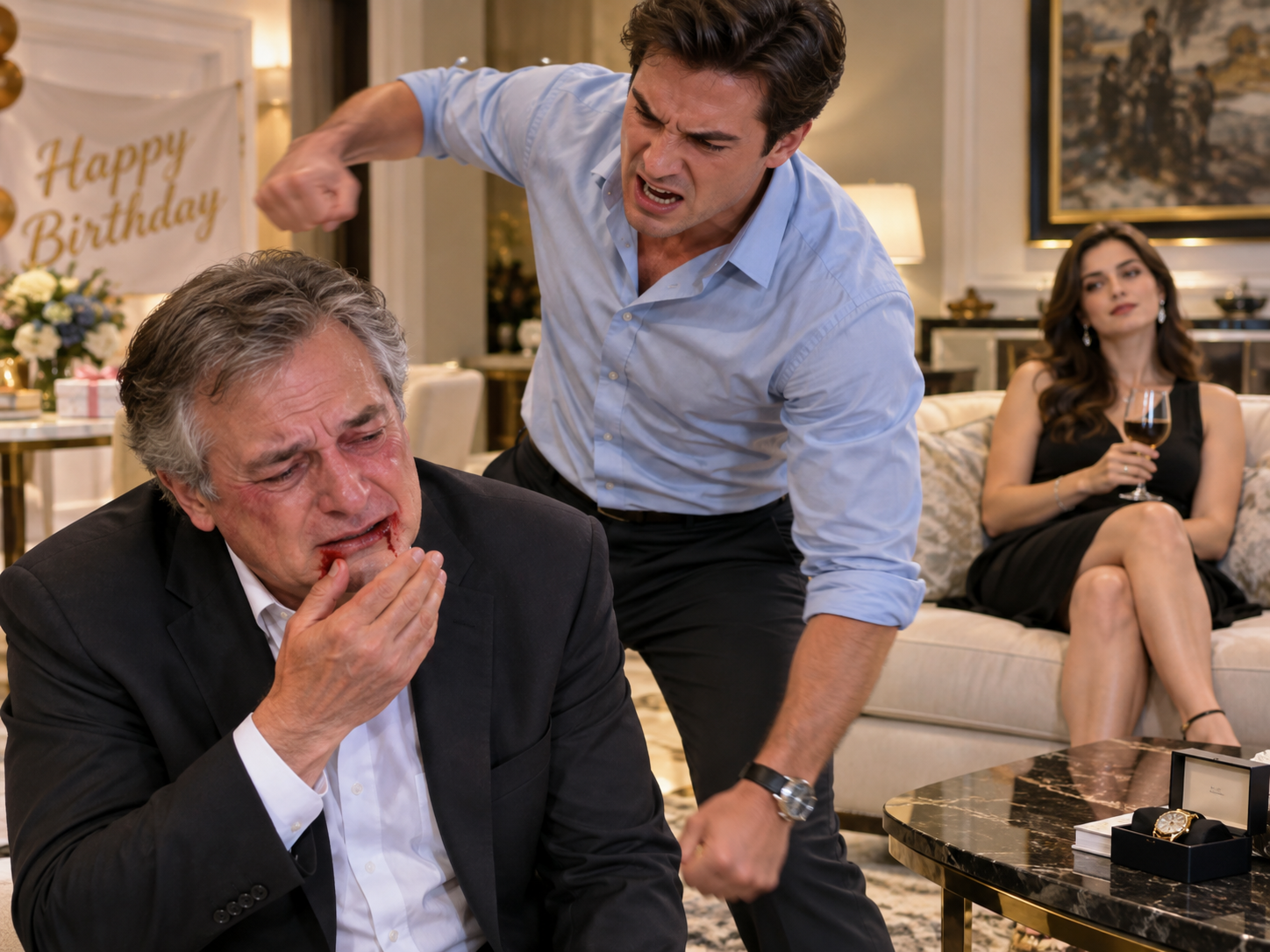
I tasted blood, heard the faint rattle of a glass somewhere behind me, and looked at my son standing less than three feet away. His chest rose and fell beneath his expensive shirt. His knuckles were red. His expression was not one of a frightened man who had just crossed a line.
It was the expression of someone who believed the line had never existed.
I counted every strike because numbers have a way of stripping emotion from a moment. One. Two. Three. By ten, my lip had split. By twenty, the room had begun to tilt at the edges. At thirty, I stopped wondering whether Daniel would ever become the son I remembered.
He would not.
Across the living room, Sophia sat frozen on the cream-colored sofa, one leg crossed over the other. She had watched the entire thing. She had not called for help. She had not stepped between us. She had not even stood.
When Daniel finally lowered his hand, Sophia gave a tiny breath of laughter.
It was barely a sound.
That made it worse.
I wiped my mouth with the back of my hand and looked at the blood on my fingers. The room was beautifully decorated, exactly as it had been for years: polished stone floors, tall windows, expensive paintings, furniture selected by an interior designer whose invoice I had paid without blinking.
The house looked magnificent.
It always had.
I had bought it.
Daniel had forgotten that.
So had Sophia.
Perhaps that was my fault.
For years, I had allowed them to believe the house belonged to them. I had watched my son grow comfortable behind its gates, watched Sophia host dinners there, watched them entertain people who assumed every luxury surrounding them had been earned by the couple themselves.
I told myself I was giving my son security.
I told myself a father should help his child get established.
I told myself that one day Daniel would understand.
That night, standing there with blood on my lower lip, I finally admitted the truth.
I had not been helping him grow.
I had been protecting him from the consequences that might have forced him to grow.
The evening had started innocently enough.
It was Daniel's birthday, and I had arrived carrying a small brown package. I had spent several weeks having the contents restored because I wanted to give him something that meant more than its price.
Inside was an old family watch.
It had belonged to my father.
My father had worn it while working long shifts and repairing things around our house. He had kept it for decades, even when the strap cracked and the glass became scratched. He had once told me that an object could carry a family history if the person holding it understood what had been sacrificed to keep it.
Daniel had never heard that story.
I thought perhaps the watch might make him curious.
Instead, he barely looked at it.
He opened the package, lifted the watch, and placed it on the table.
Then he looked at me.
“You still do this,” he said.
I thought he meant the gift.
“What?”
“Act like everything has to mean something.”
There were several people in the room. I remember that because nobody spoke after he said it.
I smiled faintly.
“It was your grandfather's.”
Daniel shrugged.
“I don't need an old watch.”
Sophia looked down at her glass.
I should have picked up the watch and left.
Instead, I made the mistake fathers make when they still believe there is something worth saving.
“I thought you might appreciate it.”
Daniel laughed.
“You always do that.”
“Do what?”
“Give me something and then wait for me to thank you.”
His voice had that familiar edge I had learned to recognize over the years. It was the voice he used when he wanted to turn a simple conversation into an accusation.
I looked around the room.
The birthday decorations had been arranged professionally. There were flowers on the dining table, candles along the mantel, and several bottles of wine that cost more than some families spent on groceries in a week.
I had paid for most of it.
I did not mention that.
“It's your birthday,” I said. “I'm not asking for anything.”
Daniel leaned back.
“You always ask.”
Sophia finally looked at me.
She did not defend him.
She did not correct him.
She simply watched.
I had seen that look before.
It was the look of someone waiting to see which direction the argument would go.
I should have left then.
Instead, I asked Daniel what he meant.
He stood.
“You want to know what I mean?”
“Yes.”
“You keep showing up here like this is your house.”
I stared at him.
For several seconds, I thought he was joking.
Then I realized he was serious.
“This house is your house now?” I asked.
He gave me a hard smile.
“You know what I mean.”
“No. I don't.”
He gestured around the room.
“You gave it to us.”
“I let you live here.”
“You gave it to us.”
“The property belongs to Mastiff Holdings.”
Daniel laughed.
“You're still doing that?”
“Doing what?”
“Pretending you're some businessman who controls everything.”
The words were strange coming from him.
I had spent decades building businesses. Roads, commercial projects, developments, contracts that had once seemed too large for a man like me. Mastiff Holdings existed because I had worked long enough to build something that could outlast me.
Daniel had benefited from that work almost his entire adult life.
He had begun mistaking access for ownership.
I looked at him.
“Remember who paid for the ground beneath your feet.”
His expression changed.
Not with shame.
With anger.
He crossed the room quickly.
The first shove sent me backward.
I caught myself against the edge of a chair.
Someone said Daniel's name.
Then his hand struck my face.
Once.
Twice.
Three times.
I remember the sound more than the pain.
A sharp slap.
A pause.
Another.
Then another.
I began counting.
Four.
Five.
Six.
The room seemed strangely quiet.
Nobody stopped him.
Seven.
Eight.
Nine.
I saw Sophia's face.
She was still sitting down.
Ten.
Eleven.
Twelve.
My cheek burned.
Thirteen.
Fourteen.
Fifteen.
Daniel's breathing became heavier.
Sixteen.
Seventeen.
Eighteen.
I wondered when the boy who used to crawl into my bed after thunderstorms had become this man.
Nineteen.
Twenty.
My mouth filled with blood.
Twenty-one.
Twenty-two.
Twenty-three.
I no longer tried to speak.
Twenty-four.
Twenty-five.
Twenty-six.
Daniel's eyes were wild.
Twenty-seven.
Twenty-eight.
Twenty-nine.
Then thirty.
His hand dropped.
The silence afterward seemed enormous.
I looked at him.
He looked at me.
And something inside me finally became still.
No anger.
No pleading.
No argument.
Just certainty.
I bent down and picked up the old watch from the table.
The glass had a small new scratch.
Daniel noticed it.
For the first time that night, his face showed something close to uncertainty.
I put the watch back into its box.
“Good night, Daniel.”
He frowned.
“What?”
I walked toward the door.
He did not stop me.
Sophia watched me leave.
Outside, the night air was cold against my swollen face.
I sat in my car and kept both hands on the steering wheel.
I did not start the engine immediately.
My reflection stared back at me in the dark windshield.
Sixty-eight years old.
Split lip.
Bruised cheek.
Tired eyes.
And a decision I had already made.
I drove home without calling the police.
I did not call Daniel.
I did not call Sophia.
I did not send an angry message.
I simply drove.
At home, I placed the brown package on my kitchen table.
The old watch remained inside.
My father had once worn it while building a life from almost nothing.
I had carried that lesson into my own life.
Daniel had inherited the result without understanding the lesson.
I went to bed before midnight.
I slept badly.
At 5:40 in the morning, I woke up and sat alone in the dark.
For a few minutes, I listened to the refrigerator hum.
Then I walked into my study.
Mastiff Holdings had several properties.
The house Daniel lived in was one of them.
The deed had never changed.
The ownership had never changed.
Only the illusion had changed.
I opened my computer.
The property file appeared on the screen.
I looked at the address.
Then I looked at the clock.
6:03.
I picked up the phone.
At 6:04, I called my attorney.
He answered on the fourth ring.
“Arthur?”
“I need you awake.”
There was a pause.
“I am now.”
“I want the Highland Park property sold.”
Another silence.
“Today?”
“Yes.”
He knew me well enough not to ask whether I was emotional.
Instead, he asked the practical question.
“Are you certain?”
I looked at the photograph on my desk.
It showed Daniel at twelve years old, standing beside me at a construction site, wearing an oversized helmet and grinning at the camera.
I had kept that photograph for more than twenty years.
“Yes,” I said.
“I am certain.”
“What about your son?”
I closed the photograph facedown.
“He had thirty chances last night to remember who I was.”
I looked again at the property file.
“He used every one of them to forget.”
My attorney exhaled slowly.
“Then I'll start the paperwork.”
I ended the call.
At 6:22, I contacted the manager of Mastiff Holdings.
At 6:47, the property's financial records were opened.
At 7:15, the private buyer who had previously expressed interest was contacted.
At 8:10, the buyer's representatives requested an inspection.
At 9:00, Daniel arrived at his office believing his life was exactly where he had left it.
He did not know the house was already moving toward another owner.
He did not know the legal machinery had begun.
He did not know that while he sat behind his expensive desk, the man he had struck thirty times was signing away the roof over his head.
And most importantly, he still believed I would eventually forgive him.
At 11:30, my attorney placed the final documents in front of me.
I read every page.
Then I signed.
The pen felt unusually heavy in my hand.
When I finished, I looked at the final line.
Ownership transferred.
I set the pen down.
My attorney closed the folder.
“It's done.”
I nodded.
Outside, traffic moved along the highway I had helped design decades earlier.
Everything looked ordinary.
That was the strange thing about irreversible decisions.
The world did not announce them.
There was no thunder.
No warning.
Just a signature.
A quiet transfer.
And a phone call waiting to happen.
At 11:49, my phone began ringing.
Daniel.
I stared at his name.
For the first time in my life, I did not feel compelled to answer immediately.
I let it ring.
Once.
Twice.
Three times.
Then I picked up.
“Dad?”
His voice was already different.
Not angry.
Confused.
“What is it?”
“Who are these people at the house?”
I leaned back in my chair.
“What people?”
“There are people here.”
“What are they doing?”
“They said they represent the new owner.”
I looked at the signed papers.
The room suddenly felt very quiet.
“Daniel,” I said, “I think you should open the door.”
He went silent.
Then his breathing changed.
“You sold the house?”
I looked through the window at the city beyond my office.
“Yes.”
He swallowed.
“You couldn't.”
“I could.”
“That is my home.”
“No,” I said. “It was never your home to own.”
His voice rose.
“Dad, what did you do?”
I looked down at my bruised knuckles.
“I did what you gave me a reason to do.”
He began shouting.
I let him.
Because for once, I was not going to rescue him from the consequences.
And before that conversation ended, he was going to learn that losing a house was only the beginning.
Click Here to continue read next: PART2: The House Was Gone, but the Documents on My Desk Revealed How Deeply My Son Had Built His Life on Property He Never Owned
The Thirty Blows That Finally Made a Father Stop Protecting the Son He Had Spent a Lifetime Building Up
Part 1 of 16