
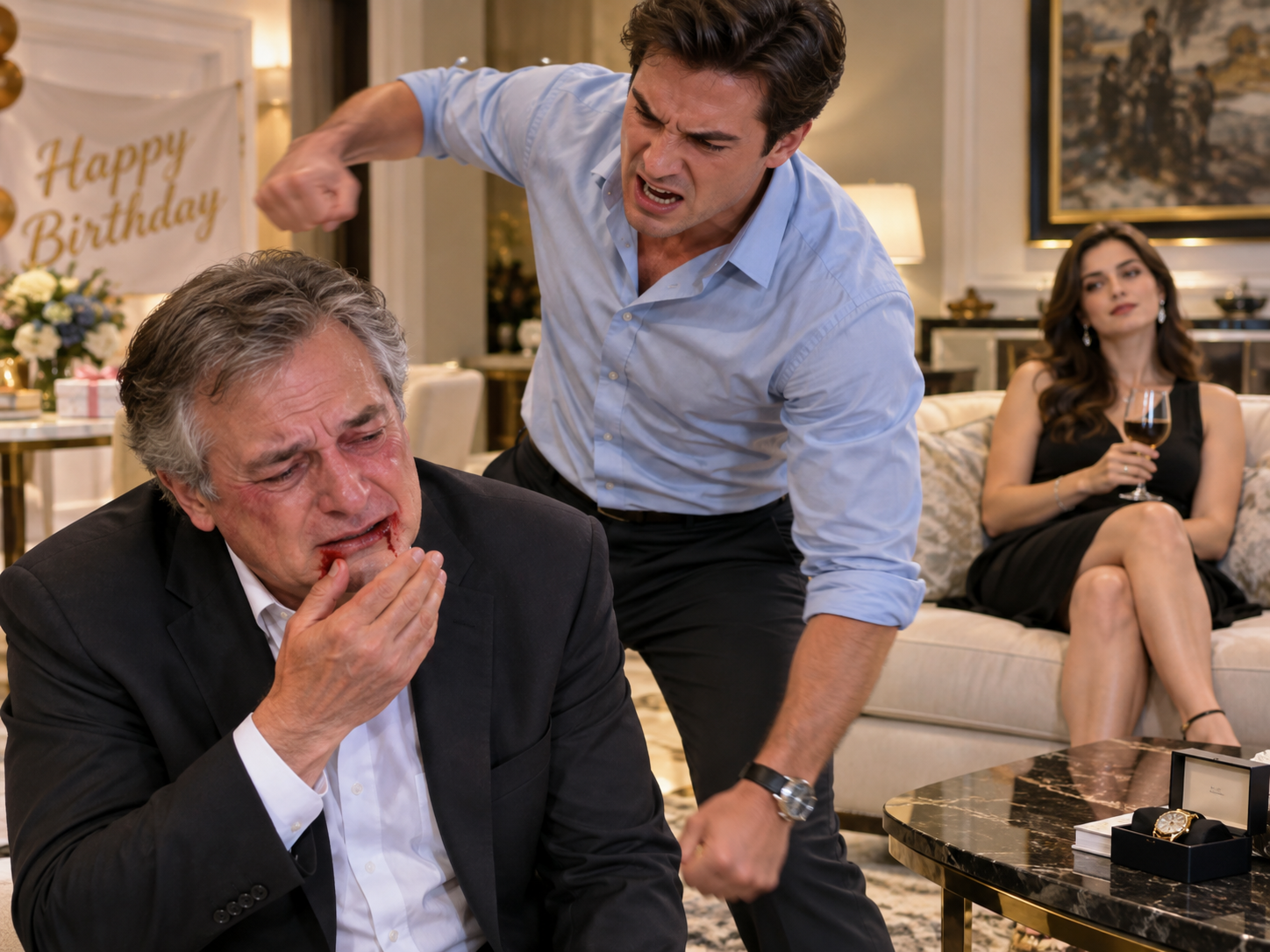
Daniel completed the three-year requirement on a Monday.
He did not call me immediately.
He finished his shift.
He signed the employment records.
He returned his company equipment.
Then he drove to the foundation office.
His supervisor sent me a message.
“He did it.”
I smiled.
I already knew.
At 6:30 that evening, Daniel arrived at my house.
He was carrying a small envelope.
He stood at the door.
“Three years.”
I smiled.
“Three years.”
He handed me the envelope.
Inside was his final employment statement.
Three years without a serious disciplinary issue.
Three years of completed training.
Three years of documented work.
I placed it on the table.
“You earned it.”
He looked at me.
“What happens now?”
I stood.
“Come into the study.”
He followed me.
On my desk was another envelope.
His name was written on it.
He stared at it.
“What is that?”
“Your future.”
He laughed nervously.
“That sounds ominous.”
“Open it.”
He did.
Inside were several documents.
The first was the final inheritance statement.
The second described the trust.
The third outlined the community construction fund.
Daniel read slowly.
His expression changed.
He looked up.
“What is this?”
“Your opportunity.”
“You said I was getting one dollar.”
“Personally.”
“And the watch.”
“Yes.”
He looked at the trust document.
“This is worth millions.”
“Yes.”
He sat down.
I watched him read.
The fund was not a personal account.
It was structured to finance construction projects for low-income communities.
Daniel would manage operations.
He would receive a salary.
He would have to meet performance requirements.
Independent trustees would oversee the money.
He could not use it to buy luxury property.
He could not transfer it for personal expenses.
He could not borrow against it.
The money had a purpose.
So did he.
Daniel read every page.
Then he looked at me.
“Why didn't you tell me?”
“Because I needed to know whether you would become responsible without knowing there was a reward.”
He closed his eyes.
“I don't know what to say.”
“Say nothing.”
He laughed softly.
“You always do that.”
“What?”
“Make the important things sound simple.”
“They are simple.”
“No.”
He looked at the papers.
“They're not.”
I sat across from him.
“The money isn't the point.”
“I know.”
“What is?”
He looked at the watch.
“Being trusted.”
I nodded.
“Yes.”
He was quiet.
Then he asked, “Do I deserve this?”
I answered carefully.
“You earned the opportunity to use it.”
“That isn't the same thing.”
“No.”
He looked at me.
“Do you trust me?”
I thought about the question.
“I trust the man who has spent three years proving himself.”
He smiled.
“What about the man who hit you?”
“He is part of your history.”
“Not who I am?”
“Not if you refuse to become him again.”
Daniel nodded.
He signed the acceptance papers.
Not because he wanted the money.
Because he understood what the responsibility meant.
The first project was approved two months later.
A community center in an area where families had been using temporary buildings for years.
Daniel supervised the project.
He visited the site every morning.
He spoke with residents.
He learned what they needed.
He listened.
I visited once.
He was standing beside a stack of lumber.
A worker approached him with a problem.
Daniel listened.
Then he asked two questions.
He did not shout.
He did not blame anyone.
He solved it.
I watched from a distance.
The transformation was not dramatic.
It was visible in small movements.
The way he listened.
The way he waited.
The way he accepted responsibility.
The way he treated people who had nothing to offer him.
That was the real inheritance.
Not the money.
The character.
One evening, after the workers left, Daniel and I stood inside the unfinished building.
“There was a time,” he said, “when I would have wanted my name on this.”
“Now?”
“Now I want people to use it.”
I smiled.
“You learned.”
He nodded.
“I had a good teacher.”
I shook my head.
“You had several.”
“Grandpa?”
“Your mother.”
He looked around.
“And you.”
I did not answer.
He continued.
“You made mistakes.”
“Yes.”
“I made worse ones.”
“Yes.”
“We both thought money could solve things.”
“Yes.”
“But it couldn't.”
“No.”
He smiled.
“Maybe that is what the watch was supposed to teach.”
I looked at him.
“Maybe.”
The community center opened six months later.
There was no grand celebration.
No giant photograph.
No plaque carrying my name.
Daniel refused one.
Instead, there was a small plaque honoring his mother.
He stood beside it during the opening.
Sophia was there.
They were not married again.
Not yet.
Perhaps they never would be.
But they stood together.
She looked at Daniel.
He looked back.
There was no resentment in either face.
Only caution.
That was enough.
After the ceremony, Sophia approached me.
“Thank you.”
“For what?”
“For giving him a chance.”
I shook my head.
“He gave himself the chance.”
She smiled.
“I think you're right.”
Daniel joined us.
“Dad.”
“Yes?”
“Can we go somewhere?”
“Where?”
“The old house.”
I looked at him.
“Why?”
“I want to see it.”
We drove there together.
The property had changed completely.
The new owner had renovated the exterior.
The garden was larger.
The windows were different.
The house looked beautiful.
But it no longer felt like ours.
Daniel stood at the gate.
“I don't miss it.”
I looked at him.
“Are you sure?”
“Yes.”
“Why?”
“Because I finally understand that it was never the thing I wanted.”
“What did you want?”
He thought about it.
“To feel successful.”
I nodded.
“And now?”
“I don't need the house to feel successful.”
We stood quietly.
Then he touched the watch.
“I think Mom would be proud.”
“I think she would.”
He smiled.
We turned toward the car.
Before getting in, Daniel stopped.
“Dad?”
“Yes?”
“Thank you for selling it.”
I looked at him.
He smiled.
“I hated you for it.”
“I know.”
“I thought you were destroying my life.”
“I know.”
“I was wrong.”
“Yes.”
He laughed.
“You could pretend to be humble.”
“I could.”
“But you won't.”
“No.”
We drove away.
The old house disappeared behind us.
Neither of us looked back.
Years later, the story became something we rarely discussed.
Not because we forgot.
Because we no longer needed to live inside it.
The foundation continued.
The community fund expanded.
Daniel eventually became one of its strongest leaders.
Sophia built her own business.
Their relationship changed slowly.
They never returned to the old arrangement.
That was probably for the best.
Daniel's inheritance was no longer something waiting at the end of a road.
It had become a responsibility he carried every day.
The old watch remained on his wrist.
He repaired the strap himself when it broke.
He refused to replace it.
“It has history,” he said.
I understood.
One afternoon, many years later, Daniel brought his own son to my house.
The boy was around the same age Daniel had been when I carried him on my shoulders.
He ran through the kitchen.
Daniel watched him.
Then he looked at me.
“I understand now.”
“What?”
“Why you gave so much.”
I smiled.
“And?”
“I also understand why you should have stopped sooner.”
I laughed.
“Yes.”
He sat beside me.
“I want to do better with my son.”
“You will.”
“How do I know when to help and when to step back?”
I thought for a moment.
“Ask yourself whether you're solving his problem or preventing him from learning.”
Daniel nodded.
“That sounds hard.”
“It is.”
He smiled.
“Then I'll probably make mistakes.”
“Of course.”
He laughed.
“So what should I do?”
“Admit them.”
He looked at his son.
Then at me.
“I think that's what you did.”
I shook my head.
“I was late.”
“But you did it.”
“Yes.”
He leaned back.
The boy came running into the room.
“Dad!”
Daniel stood.
“What?”
“Grandpa said you have a watch story!”
I looked at Daniel.
He smiled.
“Do I?”
“You do now.”
His son climbed onto the chair.
“Tell me.”
Daniel looked at me.
I nodded.
He began.
Not with the thirty blows.
Not with the house.
Not with the money.
He began with his grandfather.
A man who owned little but understood responsibility.
Then he told the boy about the watch.
How it had passed from one generation to another.
How it had been scratched.
How it had almost been lost.
How it had become a reminder that inheritance was not simply what someone left behind.
It was what the next person chose to do with it.
I listened.
The boy asked questions.
Daniel answered patiently.
At one point, he looked at me.
I knew what he was thinking.
The story had finally become useful.
Not a story about violence.
Not a story about a house.
Not even a story about money.
A story about what happens when love has no boundaries, and what can happen when boundaries finally become an act of love.
I had once believed selling the house was the hardest thing I would ever do.
It wasn't.
The hardest thing was letting my son face the consequences without rescuing him.
Harder still was waiting to see what he would become afterward.
He could have chosen bitterness.
He could have blamed me.
He could have blamed his mother.
He could have blamed the money.
Instead, he chose work.
Then responsibility.
Then honesty.
Then service.
Those choices could not erase the thirty blows.
They did not need to.
The past remained where it belonged.
Behind him.
The future was something else.
Something he had finally learned to build himself.
That evening, after Daniel and his son left, I opened the drawer one last time.
The original property deed was still there.
So was a photograph of Daniel as a child.
And beside them was a copy of my wife's letter.
I read the final line again.
Do not give him a life without difficulty. Give him enough love to survive difficulty and enough responsibility to become himself.
I folded the letter carefully.
For years, I had misunderstood that sentence.
I thought love meant giving.
I thought protection meant removing every obstacle.
I thought being a father meant making sure my son never fell.
Now I knew better.
Sometimes a father has to let his son fall.
Not because he wants him hurt.
Because he wants him strong enough to stand without him.
I closed the drawer.
The house was quiet.
Outside, the evening light faded across the street.
Somewhere in the city, my son was driving home with his child beside him.
The watch was still on his wrist.
The money was no longer the center of his life.
The house was gone.
The bruises had faded years ago.
But the lesson remained.
And perhaps that was the only inheritance that had ever truly mattered.
Click Here to continue read next: PART9: The Peace We Had Built Was Tested When Daniel Discovered That Success Could Bring Back the Very Temptations He Had Once Escaped
The Thirty Blows That Finally Made a Father Stop Protecting the Son He Had Spent a Lifetime Building Up
Part 8 of 16

