
By the middle of June, the cabin had settled into the rhythm I had imagined when I first bought it. Mornings began with the lake brightening beyond the porch windows, afternoons brought the occasional boat passing in the distance, and evenings ended with the trees turning dark against the water. I had stopped measuring the peace of the place by how completely I could avoid interruption. Instead, I measured it by how freely I could decide what belonged in my days.
Some mornings, I read for hours without checking my phone. Other days, I drove into town for supplies, spoke with the carpenter about a small repair, or called an old nursing colleague to catch up on the lives we had built after retirement. I kept my appointments, paid my bills, and made plans without consulting anyone about whether those plans were convenient for them.
The cabin was no longer merely an escape from the demands of my former life. It had become the place where I practiced living differently.
Brian and Tanya continued to work on their finances. They had not solved every problem, but they had begun building an emergency fund and making choices according to what they could afford. When the girls needed new bicycles, their parents compared prices and saved toward the purchase. When an unexpected school expense came up, they adjusted their plans rather than asking someone else to cover it.
Brian told me about these things occasionally, but he no longer spoke as though I were responsible for evaluating whether he was doing well. He shared the news because he wanted to share it, not because he needed me to approve his decisions. That distinction was one of the clearest signs that our relationship was changing.
Tanya had changed in quieter ways. She asked before making suggestions about the cabin, and when I declined something, she did not keep returning to it in different words. She still had opinions, as everyone did, but she had begun to understand that an opinion was not an instruction and a family relationship was not a transfer of ownership.
I did not assume those changes would last forever without effort. Habits could return under pressure, and old patterns were often easiest to recognize only after someone had begun repeating them. But I no longer felt the need to supervise every interaction. I could observe what happened, respond when necessary, and let the responsibility for their choices remain with them.
One Friday morning, Brian called to ask whether I would be interested in having the family visit the following weekend. The girls wanted to spend time near the lake before their summer activities became busy, and Tanya had suggested bringing lunch. He asked what day worked for me and whether I preferred a short visit or a longer afternoon.
I checked my calendar. I had planned to spend Saturday working in the garden, but Sunday was open.
“Come on Sunday,” I said. “We can have lunch, and the girls can spend some time outside if the weather cooperates.”
“Would you like us to bring anything?”
“Bring lunch if Tanya wants to prepare it. I'll make coffee.”
“Sounds good. We'll plan for Sunday and check the weather the day before.”
When we ended the call, I wrote the visit on my calendar. I noticed that I had not felt pressured by the invitation. I had considered it, checked my own plans, and accepted because I wanted to see them.
That was how it should have been from the beginning.
On Sunday morning, I woke early and walked down to the shore. The air was warm, and the water carried a faint green reflection from the trees. A pair of ducks moved through the reeds, and somewhere beyond the cabin, a bird called from high in the branches. I stayed by the water until the sunlight grew stronger, then returned to prepare the porch for lunch.
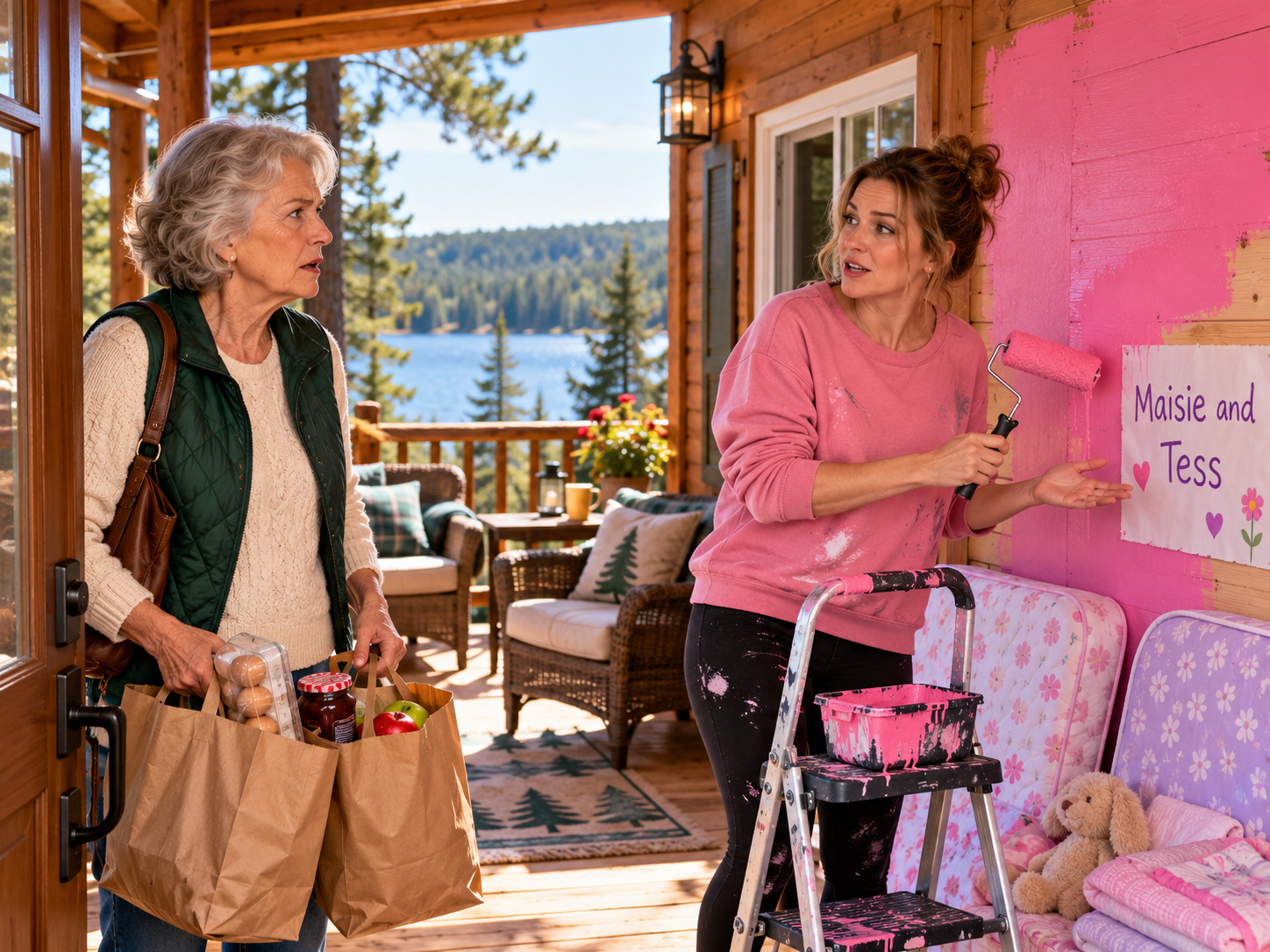
I wiped the table, straightened the chairs, and placed a small vase of flowers near the window. The cedar boards were weathered now, their color deepening in the summer light. If I looked closely, I could still find the places where the pink paint had left its faint marks. I had considered asking the carpenter to return and work on them again, but I had decided against it.
The boards were sound. The porch was beautiful. I did not need it to look untouched by history in order to enjoy it.
Brian's car arrived shortly before noon. The girls climbed out carrying a basket of food, and Tanya followed with a container of fruit. They waited at the door until I welcomed them inside, then hurried to show me a new drawing they had made together.
This time, the picture showed the cabin in summer. The lake was bright blue, the trees were green, and the porch was filled with tiny figures. Maisie had written our names beneath the drawing, while Tess had added a small sign beside the door. It read, Welcome. Please ask before changing things.
I laughed when I saw it.
“You remembered,” I said.
Tess nodded proudly. “It's important.”
“It is.”
I thanked them and set the drawing on the desk beside the others. Then we sat down to lunch. Tanya had brought sandwiches, salad, and a small cake. Brian poured the drinks while the girls talked about their summer plans, including a school activity they were looking forward to and a book they had both decided to read.
There was no hidden agenda to the visit. No one had come to discuss housing, ask about the loft, or suggest that the cabin could solve a problem elsewhere. We ate, talked, and enjoyed the afternoon.
After lunch, the girls asked if they could explore the shoreline. I told them they could go with their father, provided they stayed away from the deeper water and returned when he called. Brian took them down the path, and Tanya helped me clear the table.
As we worked, she paused beside the kitchen window.
“I'm glad you still invite us here,” she said.
“So am I.”
“I know we damaged something that mattered to you. I don't expect you to forget it just because things are better now.”
I placed a plate in the cupboard. “I won't forget it. But I don't want the worst thing that happened between us to become the only thing we can remember.”
She nodded slowly. “I understand.”
“I hope we keep learning from it.”
“Me too.”
That was all we said. It was enough.
When Brian and the girls returned, they were carrying a small collection of stones and a fallen branch that Tess thought looked like a bird's foot. I reminded them that the stones could stay outside rather than become permanent decorations on my shelves. Tess accepted the ruling, then asked whether she could place them in a little arrangement beside the porch steps.
I considered the idea and agreed, as long as they did not block the path. The girls carefully arranged the stones in a circle near the flower bed, leaving a small gap where the rainwater could drain. It was a modest project, and when they finished, they stepped back to admire it.
“Now it's part of the cabin,” Tess said.
“It's part of the garden,” I corrected gently. “And we chose to put it there together.”
She smiled. “Right.”
The distinction mattered to me. Sharing a place did not mean that every person could claim it as their own. It meant we could make small decisions together when I chose to invite them into that process. The stones could remain because I had agreed to the arrangement, not because anyone had assumed they had a right to alter the property.
By three o'clock, the girls were getting tired, and Brian began gathering their things. Tanya packed the remaining food and wiped the table. Before leaving, Brian asked whether I needed help carrying anything to the car.
“No, thank you. I've got it.”
He nodded and helped Tess put on her jacket. Then he came back to the doorway.
“Mom,” he said, “I want you to know that I understand why you changed the locks. I used to think that because we were family, the cabin should be available if we needed it. I wasn't thinking about what you had worked for or what you had told me. I was thinking about what I wanted to happen.”
I listened without interrupting.
“I can't undo that,” he continued. “But I don't want you to have to keep defending your home against me. If you invite us, we'll come. If you say no, we'll respect it. That's how it should have been from the beginning.”
I looked at my son, remembering the boy who used to fall asleep on the sofa while I prepared for another night shift, the teenager who had called me from school when he needed help, and the grown man who had once treated my retirement plans as an inconvenience to be rearranged.
“I appreciate you saying that,” I told him. “What matters now is how we treat each other from here.”
He nodded. “I know.”
I hugged him before he left. The embrace did not erase what had happened, but it did not need to. It was simply a moment between a mother and her son, one that I could accept without making it a promise about the future.
After their car disappeared down the lane, I closed the door and walked through the cabin. I collected the cups, put away the food, and swept the porch. The little stone arrangement remained beside the flower bed, exactly where the girls had placed it. I smiled when I saw it, then went inside to finish cleaning.
The afternoon was quiet, but I no longer experienced the silence as something I had to guard from the people I loved. I could invite my family into my life without handing them the authority to decide what my life should be. I could care about their difficulties without making myself responsible for every solution. I could say yes when I meant yes and no when I meant no.
For years, I had imagined retirement as a reward waiting at the end of a long stretch of work. I thought it would be enough to stop waking in the middle of the night for hospital shifts, to have mornings without an alarm, and to spend my days beside a lake with a book and a cup of coffee.
I had not understood that peace also required a kind of courage. It required me to disappoint people sometimes. It required me to let grown adults solve problems I could easily have solved for them. It required me to accept that someone might be upset with my decision without treating their disappointment as proof that I had done something wrong.
The cabin had taught me those lessons more forcefully than I would have chosen. Tanya's pink paint, Brian's duplicated key, and the plans they made without my consent had forced me to recognize how easily my own wishes could disappear beneath the weight of other people's needs.
But the cabin had also given me the opportunity to respond differently. I had changed the locks instead of surrendering the property. I had installed cameras without allowing fear to run my life. I had listened to apologies without rushing to restore the old arrangement. I had welcomed my family back when I wanted their company and declined requests that did not feel right.
Most importantly, I had learned that boundaries did not have to end in bitterness. They could make room for relationships that were more honest than the ones we had before.
That evening, I carried my tea to the porch and sat in the chair facing the water. The sky was beginning to turn gold, and the lake reflected the trees in long, broken lines. I thought about Walt's letter in the wooden box, about his reminder that helping someone was not the same as living their life for them.
I had spent so many years trying to protect Brian from difficulty that I had sometimes prevented him from learning how to face it himself. I had told myself that this was love. In some ways it had been, but love without limits had made it easier for both of us to confuse support with obligation.
I could still help my son. I could still make soup when he was sick, listen when work was difficult, and celebrate when the girls did well. I could offer advice when he asked for it and share what I had learned from a lifetime of mistakes. None of that required me to hand over the home I had saved for or surrender the quiet life I had earned.
The porch was not a symbol of my rejection of the family. It was the place where I had learned that love and independence could exist together.
I finished my tea and carried the cup inside. Before bed, I checked the front and back locks, glanced at the camera system, and turned off the kitchen light. These were ordinary actions now, not rituals of fear. The cabin was secure, and I was comfortable knowing that its doors would open when I chose to open them.
I climbed the stairs to the loft, where the girls' drawings hung above the desk. Their pictures showed a cabin surrounded by trees, a lake filled with birds, and a family sitting together on the porch. I looked at them for a moment, then switched off the light.
I could not promise that my family would never make another mistake. I could not promise that trust would never be tested again. But I no longer needed such promises to feel secure. I had learned what to do when someone crossed a boundary, and I had learned that I could respond without abandoning the people I loved or myself.
Tomorrow, I might spend the morning reading. I might drive into town or walk beside the water. I might call Brian, or I might let the day pass without speaking to anyone at all. Each possibility was mine to choose.
That was what I had worked for through thirty-five years of night shifts, through exhaustion and grief, through the long years after Walt died, and through the painful discovery that my own family could misunderstand what my home meant to me.
At sixty-seven, I finally understood that peace was not a gift someone else could grant me. It was a life I had the right to shape, protect, and share on my own terms.
The lake lay quiet beyond the windows. The cedar porch stood beneath the summer sky. My family had a place in my life, but the life itself still belonged to me.
And now, at sixty-seven, I was finally living it.
The End
Read more original stories on Feel Every Story.
I Bought the Cabin for Peace, but My Daughter-in-Law Had Already Decided Which Parts of My Life She Could Take
Part 20 of 20

