
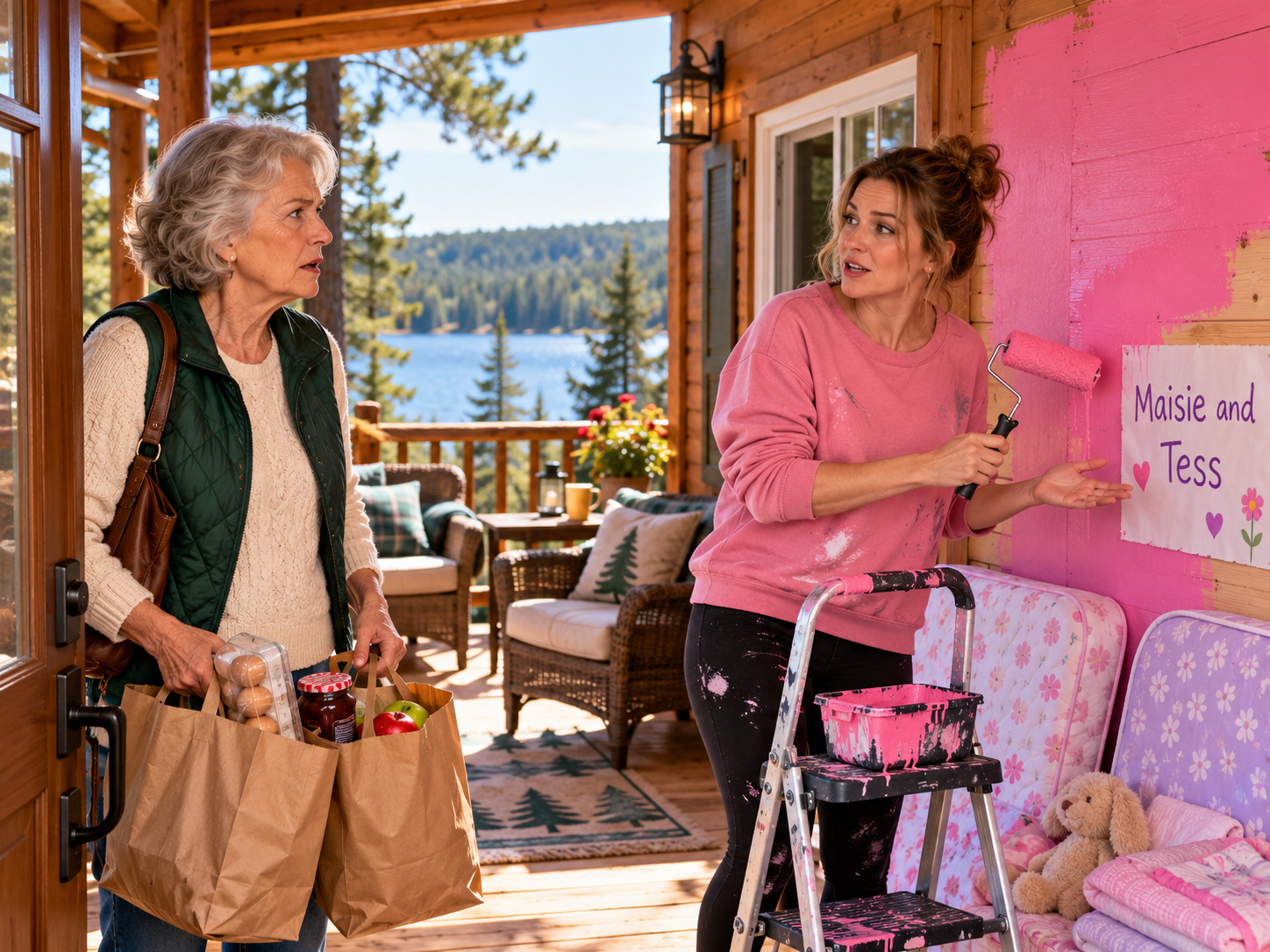
The call came from a number I did not recognize on a Thursday morning in January. I was at the cabin, sitting at the kitchen table with a stack of receipts and the warranty paperwork from the porch restoration. Outside, the lake had frozen near the shoreline, and a light wind pushed loose snow across the steps.
The caller introduced herself as Melissa Grant, a representative from a local property management company. She said she was calling to verify information connected to a housing inquiry Brian Harper had made several months earlier.
I set down my pen.
“What sort of information?”
She explained that Brian had asked about a temporary rental arrangement for his family and had mentioned a relative who owned a lake property. The conversation had never progressed to an application, but a note in their system indicated that the cabin might be available for occupancy.
I felt my fingers tighten around the phone.
“What did he tell you about the property?”
“He said his mother owned it and that the family expected to use it as a shared residence. We were checking whether the arrangement was still under consideration before closing the inquiry.”
I looked toward the front door. The new lock was visible beneath the camera, its metal surface catching the weak winter light.
“No,” I said. “It was never under consideration. I did not authorize my son to offer the property to anyone.”
There was a brief pause.
“I apologize,” Melissa said. “I didn't realize there was a disagreement. I'll update the record so no one contacts you about the property again.”
I thanked her and ended the call. Then I sat without moving, listening to the heating system hum beneath the floor.
The conversation had been polite, and Melissa had not accused me of anything. Still, it reopened a question I thought I had already answered: how much of Brian's original plan had been based on wishful thinking, and how much had he presented to other people as an arrangement that was practically settled?
I called Karen and explained what I had learned. She asked me to write down the date, the caller's name, and the details of the conversation. She also suggested that I request written confirmation that the inquiry had been closed.
I sent the property management company an email that afternoon. Melissa replied within an hour, confirming that the record had been updated and that no one had authority to represent the cabin as available housing.
I printed the message and placed it with the other documents related to the property.
I did not immediately call Brian. I wanted to understand what had happened before confronting him, and I did not want to turn a secondhand report into a larger accusation than the facts justified. Perhaps he had made the inquiry before I had firmly refused the move. Perhaps he had described a possibility rather than a certainty. The date would matter.
That evening, I searched my old messages with him. I found the text in which he had said Tanya had already spoken to someone about the cabin, and the family had plans. It had been sent after I discovered the pink paint and changed the locks, but before the locksmith arrived with him ten days later.
I read the message again.
The timing made my stomach tighten. By then, Brian knew I had refused to let them move in. He knew I had ordered the locks changed. He knew I was treating the cabin as my private home, not a family property waiting to be shared.
Yet he had continued making arrangements.
I put the phone down. I needed to speak to him, but I wanted to do it without letting anger choose my words.
The next morning, I called and asked whether he had time to talk that evening. He said yes, and we agreed to speak after the girls were in bed.
When he answered, I began with the facts.
“A woman from a property management company called me yesterday. She said you had asked about housing and told them your family expected to use my cabin as a shared residence.”
The silence lasted several seconds.
“Who was it?” he asked.
“Melissa Grant. She gave me the name of the company.”
He exhaled. “That was a long time ago.”
“It was after I told you I would not let you move in.”
“I was trying to find out what options we had.”
“You told them the cabin was expected to be available.”
“I didn't say you had signed anything.”
“That isn't what I asked.”
He went quiet again. I could hear the faint sound of a cupboard closing in the background.
“I probably made it sound more definite than it was,” he admitted. “I thought you might change your mind. I thought if I could show that we had a plan, you might see it as a reasonable arrangement.”
“You had already told Tanya where I would sleep. You had copied my key. You had started arranging the move. Then, after I refused, you kept making plans as though my answer was temporary.”
“I know how it looks.”
“Brian, I am not asking how it looks. I am asking whether you understood that I had said no.”
He did not answer right away.
“Yes,” he said finally. “I understood.”
I closed my eyes. His admission hurt more than a denial would have, because it removed the last excuse I had been holding on to. He had not misunderstood my answer. He had believed he could work around it.
“Why didn't you stop?” I asked.
“I was scared. We were running out of options, and I thought you would eventually agree if I could make the move seem practical enough. I kept telling myself that you loved the girls and wouldn't want us to struggle.”
“I do love them.”
“I know.”
“But you used that love as a reason to ignore me.”
He breathed out slowly. “Yes.”
I let the silence remain between us. There was no satisfaction in hearing him admit it. I wished the truth were different. I wished he had made one mistake, understood it, and stopped. Instead, I was learning that his first attempt to take over the cabin had been part of a larger pattern of acting on an outcome he wanted before receiving permission.
“Did you tell Tanya that the property management company thought the cabin was available?” I asked.
“Yes. I told her I was looking into options.”
“Did you tell her I had already refused?”
He hesitated.
“I told her you were still upset and that we might be able to work something out.”
I felt a tired sadness settle over me.
“So she believed there was still a chance because you told her there was.”
“Yes.”
“And then she started painting the porch.”
“I can't blame all of that on me,” he said quickly. “Tanya made her own decisions.”
“That is true. She was responsible for entering the cabin and painting it. You were responsible for giving her reason to believe the move was going to happen.”
He did not argue.
I thought of the girls' drawing, the one with the brown cabin and the blue lake. I remembered Tess telling me that her father had promised them a place to live. They had been children, trusting the adults to tell them the truth. Brian's plan had not only disregarded my wishes. It had created expectations in two little girls that I would eventually have to disappoint.
“Did you tell Maisie and Tess they could move in before or after I said no?” I asked.
“Before. But I kept telling them it was likely, even afterward.”
“Why?”
“I didn't want to tell them I'd been wrong. I thought there was still a way to make it happen.”
I sat back in my chair.
“That was unfair to them, too.”
“I know.”
The conversation lasted nearly an hour. Brian explained that he had felt ashamed of their financial circumstances and embarrassed by the idea that he might have to move to a smaller home. The cabin had seemed like a way to solve several problems at once. He had imagined that the girls would have more space, Tanya's mother could stay with them, and he could stop worrying about rent and repairs.
He had convinced himself that the benefits were so obvious that I would eventually see them.
“What I didn't consider,” he said, “was that I was asking you to give up the thing you'd spent your whole life working toward.”
“That is what I tried to tell you.”
“I know. I just didn't want to hear it.”
For a moment, I could not speak. His honesty did not erase the damage, but it was the first time he had described his actions without making my response the central problem.
“What happens the next time you want something I can't give you?” I asked.
“I don't know. I hope I handle it differently.”
“You need to do more than hope.”
“I know.”
I told him that I wanted our relationship to continue, but I would not make decisions about the cabin based on promises. Any future visit would be arranged with me directly. I would not hand over a key, and I would not agree to any arrangement involving the property without time to consider it. If he needed help, he could ask, but he could not make commitments on my behalf.
He agreed to each condition.
Before we ended the call, he asked whether I wanted him to apologize again.
“I don't need you to repeat the words,” I said. “I need you to understand what they mean when you make your next decision.”
“I will try.”
Afterward, I walked through the cabin. I checked the front door, then the back door, and looked out at the snow-covered porch. I felt foolish for a moment, wondering whether I had become too suspicious. Then I reminded myself that the property management call was not something I had imagined. Brian had continued to make plans after I refused.
Protecting myself did not mean assuming the worst about everyone. It meant paying attention to what people actually did.
That afternoon, I drove to the grocery store and bought ingredients for soup. On the way back, I stopped at the lakeside turnoff and watched the frozen water stretch between the trees. I thought about Walt's letter, especially the passage about letting people find their own way through difficult things.
I had wanted to rescue Brian from every hardship because I loved him. I had mistaken his discomfort for something I was supposed to remove. In doing so, I had made it easier for him to believe that my resources belonged to the family whenever he needed them.
I could not change the years that had brought us here. I could stop repeating the same mistake.
That evening, I received a message from Brian. He said he had spoken with Tanya and explained that the cabin had never been theirs to plan around. He had also corrected what he had told the girls, making it clear that they could visit when I invited them but would not be moving there.
I replied that I appreciated him setting the record straight.
Then I put the phone away and sat by the window. Snow drifted across the porch, covering the last faint marks left by the restoration work. The cedar still had its imperfections, but the wall was sound.
I thought about how much I had wanted the family to return to normal. Now I understood that normal had included too many assumptions I had never questioned. I did not want to return to that. I wanted something more honest, even if it took longer to build.
The cabin remained quiet around me. The locks were secure, the cameras were working, and the decision about who entered the property was mine.
For the first time, I could acknowledge the full truth of what Brian had done without feeling that I had to choose between loving him and protecting myself.
I could do both.
Click here to continue reading: PART 12: The Final Winter Gathering Showed Me Whether My Family Had Learned to Respect the Home I Refused to Surrender
I Bought the Cabin for Peace, but My Daughter-in-Law Had Already Decided Which Parts of My Life She Could Take
Part 11 of 20

