
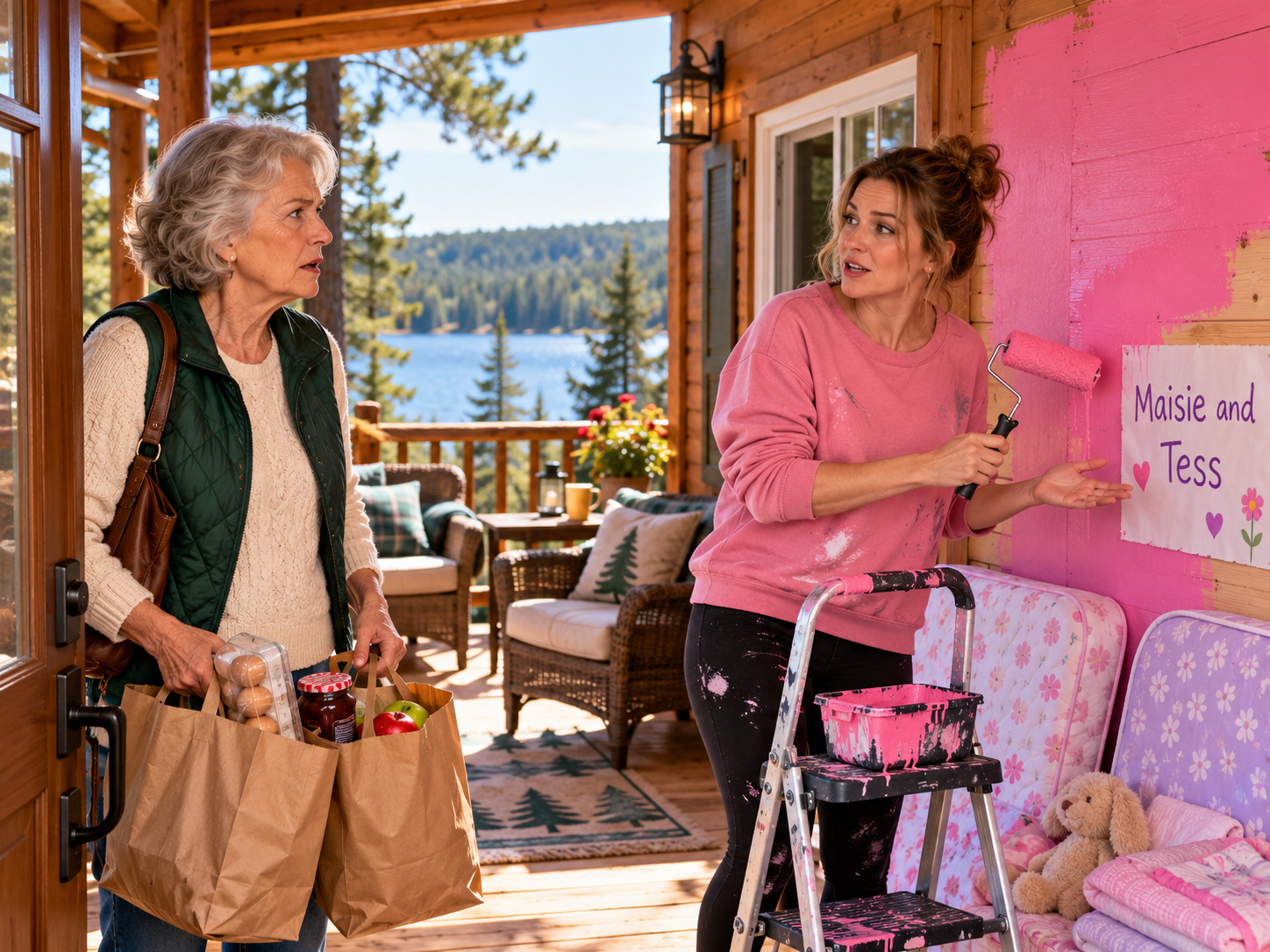
The first thing I noticed was the smell of paint. It hung thick in the air, sweet and chemical, overpowering the clean cedar scent that usually greeted me when I opened the cabin door. The second thing I noticed was the color spreading across the porch wall.
Pink. Not a soft blush or a quiet shade that might have belonged in a child’s bedroom, but a bright, startling pink that looked as though someone had squeezed the color straight out of a candy wrapper and rolled it across the wood.
Tanya stood on a step stool with a paint roller in her hand. A streak of color marked the cuff of her sweatshirt. Beneath the window, two small mattresses leaned against the wall, and a handwritten sign had been taped above them. Maisie and Tess, it said in purple marker.
My daughter-in-law turned when the floor creaked beneath my shoes.
“Dorothy! You’re back already.”
She said it brightly, with the same cheerful surprise someone might use when a neighbor dropped by with a plate of cookies. For a moment, I wondered whether I had misunderstood what I was seeing. Then I looked at the roller in her hand, at the paint tray on the floor, and at the cedar boards I had chosen one by one from photographs before I bought this place.
“What are you doing to my porch?”
Her smile held, although something behind it tightened.
“Getting the girls settled. Brian thought this would be the easiest arrangement. They can have this room, and you can use the loft. It’s actually quite comfortable up there.”
I was still holding a grocery bag against my hip. A carton of eggs pressed into my side, and the paper handles had begun to cut into my fingers. I had driven an hour and a half from Rockford with coffee, bread, fresh fruit, and a small jar of the strawberry jam I liked to eat while watching the sun come up over Birch Lake.
I had expected a quiet weekend.
Instead, I was standing in my own cabin while another woman explained where I would be sleeping.
For several seconds, I couldn't find an answer that would not come out sharper than I intended. At sixty-seven, after thirty-five years working as an emergency room nurse, I had learned that the first thing a person said in a crisis was not always the thing that helped most. I had seen frightened people become angry, exhausted people become cruel, and families say unforgivable things beside hospital beds. I had also learned that staying calm did not mean agreeing to whatever someone demanded.
I set the grocery bag on the counter.
“Who told you that you could change this house?”
Tanya lowered the roller slightly. A bead of pink paint traveled down its edge and fell onto the drop cloth.
“Brian and I talked about it. We’ve been trying to figure out what makes sense for everyone.”
“Everyone except me, apparently.”
“Oh, Dorothy.” She gave a little laugh, the sort meant to soften a disagreement before the other person could finish having it. “You’re retired. You don't need all this space. The girls need somewhere to sleep, and we need a fresh start. The loft is private. You'd barely notice us.”
I glanced toward the screened windows. When I had first toured the cabin, I had stood right there and watched sunlight scatter across the lake. The porch had been the deciding factor. Two comfortable chairs, a narrow table for my coffee, and enough room to hear the water moving against the shore without listening to traffic or a television from the next room.
That porch had been part of a promise I made to myself long before I ever found the property.
My husband, Walt, used to talk about a place beside the water. He imagined us sitting outside after breakfast, with no alarm clock waiting to pull me into another overnight shift and no hospital pager demanding that I return before sunrise. He wanted a small house, a wooden porch, and mornings that belonged to us.
He died four years before I could afford to make that dream real.
I had not bought the cabin to prove anything to anyone. I bought it because I had spent most of my adult life putting other people’s needs ahead of my own, and I wanted a place where that would no longer be the rule.
Now Tanya was covering the cedar with paint as if the decision had already been made.
“How did you get inside?” I asked.
She looked toward the front door.
“Brian had a key.”
I turned to face her.
“No, he didn't.”
For the first time, she seemed unsure of herself. She set the roller against the tray and wiped her fingers on a rag. The gesture left a pink smear across the cloth.
“He made a copy.”
“Of what?”
“The key.”
“I understood that part. How did he get it?”
Tanya hesitated. She glanced at the windows, then back at me, as though she expected Brian to walk in and take over the conversation.
Finally, she said, “He took a picture of it.”
I waited.
“At Easter,” she added. “Your purse was on the kitchen chair. He used his phone, then had a duplicate made. He said you wouldn't mind if we needed to get in.”
The memory came back in pieces. Easter dinner at Brian and Tanya’s house. The children chasing each other through the yard. Maisie asking me to help her find a plastic egg beneath the lilac bushes. I had left my purse in the kitchen and spent nearly half an hour outside with my granddaughters while Brian cleared plates.
I remembered laughing when Tess put a yellow egg in her pocket and insisted it was a treasure that could never be traded.
I had not known my son was photographing my house key.
“Did he tell you I agreed to this?” I asked.
Tanya picked up the rag again. “He said you'd come around once you saw how much the girls loved it.”
“That isn't an answer.”
“He said you were being stubborn because you hadn't thought through the practical side.”
I felt something cold settle beneath my ribs. It was not surprise, exactly. I had noticed Brian's questions over the previous several weeks, and I had tried to explain them away as concern. He wanted to know how many bedrooms the cabin had, whether the porch had heating, how far it was to the nearest school, and whether the road was plowed in winter. Each question had sounded reasonable on its own. Together, they formed a plan I had never agreed to join.
I had simply been too willing to believe he was curious about my new life.
“Put the key in my hand, Tanya.”
Her eyebrows rose. “What?”
“The key you used to get in.”
She stared at me for a moment, then reached into the pocket of her jeans. She produced a small silver key attached to a plastic cat charm, bright pink ears sticking out from either side of its round face.
She held it between two fingers.
“Dorothy, we're family. You don't have to make this into some big confrontation.”
“Then you shouldn't have entered my home without permission.”
“I was only trying to help.”
“Help whom?”
Her mouth tightened. She dropped the key into my palm, where it landed with a light metallic click. The little cat swung against my wedding ring.
I closed my fingers around it.
“Take your things and leave.”
Tanya looked at the mattresses. “I can't just leave everything here.”
“You can take what belongs to you. The paint stays until I decide how to remove it.”
“You're being unreasonable.”
“I'm asking you to leave a property you entered without my permission. That's not unreasonable.”
She climbed down from the stool, muttering under her breath. She gathered her purse and phone, then searched for her car keys beneath a pile of children's clothes she had brought in. Before leaving, she stopped near the doorway and looked back at the half-painted wall.
“Brian is going to be furious.”
I held the door open.
“That will be a conversation between Brian and me.”
She walked past me without another word. Her car tires crunched over the gravel, then faded down the narrow road between the trees. I watched until the red taillights disappeared around the bend.
Only then did my hands begin to shake.
I stood alone in the cabin, listening to the refrigerator hum and the faint rattle of the screen door in the breeze. The grocery bag remained on the counter. One of the eggs had cracked, leaving a wet streak on the carton.
I put the milk away first. Then the bread, the apples, and the jam. I moved slowly, not because the tasks required care, but because I needed something ordinary to do while the truth settled into place.
Brian had not simply brought his wife to see the cabin. He had arranged for a key to be copied without asking me. He had allowed Tanya to begin changing the property. And he had told her I would accept sleeping in the loft, even though I had already told him no.
My son had heard my answer. He had simply decided it did not count.
I sat at the kitchen table and looked through the window at the lake. The afternoon light had begun to soften, turning the water a dull silver. Walt would have hated the pink paint. He would have made a joke about needing sunglasses to sit on the porch, then asked whether I wanted him to sand the boards back to their original color.
For one brief moment, I could almost hear his voice.
Then I remembered that Walt was gone, and that the person who had violated my privacy was not a stranger. It was the boy I had raised.
Over the years, I had given Brian money when he needed it. Thirty-five thousand dollars had helped him buy his house. Another twelve thousand had covered expenses when his family was in trouble. I had never treated those amounts as loans. He was my son, and I could afford to help. I had wanted him and the girls to have a stable home.
But generosity had quietly become part of the arrangement between us. Brian called when something went wrong. I listened, asked what he needed, and often reached for my checkbook before he finished explaining. Sometimes he thanked me. Sometimes he sounded relieved and moved on to the next problem.
I had told myself that was what family did.
Now I wondered whether my willingness to help had taught him that my boundaries were temporary inconveniences.
I took my phone from the table and called a locksmith whose number I found through a local service listing. A woman answered, asked for the address, and said a technician could arrive within two hours.
“Have you lost your keys?” she asked.
“No,” I said. “Someone made a copy without my permission.”
Her tone changed immediately. She asked whether I felt safe staying at the property. I told her I did, but I wanted the locks changed before I left.
The technician arrived before sunset in a white work van. He examined the front and back doors, replaced both cylinders, and gave me a new set of keys. I watched him test each lock from the inside and outside.
When he finished, he asked whether I wanted any additional security.
“I'd like cameras at both entrances,” I said.
He recommended a doorbell camera at the front and a weatherproof unit near the back door. We discussed where they should be mounted, how the motion alerts worked, and how the recordings could be saved. I paid for the installation before he packed his tools away.
After he left, I walked through the cabin with my new keys in my hand. I checked the windows, the back door, and the small storage closet where I kept cleaning supplies. Nothing else appeared to have been disturbed.
The porch was another matter.
The pink paint had dried along the edge of the cedar boards, leaving a hard, glossy stripe that caught the fading light. I ran my fingertips close to it without touching the surface. Removing it would take work. Some of the wood might need sanding, and the finish would have to be restored carefully.
I was angry about the damage, but I was more troubled by the ease with which Tanya had assumed the right to make it.
That evening, I called Brian.
He answered on the fourth ring.
“Hey, Mom. Everything okay?”
“Did you give Tanya permission to paint my porch?”
Silence.
Then he sighed. “She told me you came home early.”
“Answer the question.”
“We were trying to get things ready for the girls.”
“You copied my key without asking me.”
“It was just a key, Mom.”
“No. It was access to my home.”
He exhaled sharply. I could hear television noise behind him and one of the girls calling his name.
“Look, Tanya got carried away. The color isn't permanent. We'll fix it later.”
“You don't get to decide what happens to my house.”
“We're family. You said you wanted the girls to spend more time with you.”
“I do want that. I never offered you my cabin.”
“You have two bedrooms and a loft. We're cramped where we are, and you have all this space sitting empty.”
“I bought it for my retirement.”
“And we're supposed to struggle while you sit by the lake?”
The question landed harder than I expected. Not because I believed it was fair, but because it revealed what he thought my comfort meant. To Brian, my having something peaceful and private was not simply a choice I had earned. It was a resource he believed should be redistributed if his family needed it.
“I worked night shifts for thirty-five years,” I said. “I missed birthdays, holidays, and more mornings than I can count. Your father and I saved for this place. I bought it with my own money. You knew that when I told you I was buying it.”
“I know how hard you worked.”
“Then why are you treating my retirement as if it's a problem you need to solve?”
He did not answer immediately. When he spoke again, his voice was quieter, but not kinder.
“Maybe you're not thinking clearly about how lonely you're going to be out there.”
“I will decide how I want to spend my time.”
“Mom—”
“I changed the locks. Do not make another copy of my key. Do not come onto the property unless I invite you.”
He let out a disbelieving laugh.
“You changed the locks on your own son?”
“I changed the locks on a house someone entered without permission.”
I ended the call before he could turn the conversation into an argument about how hurt he felt. For several minutes, I remained seated at the table with the phone beside me.
The lake had gone dark. A porch light reflected in the window, and behind my reflection I could see the bright pink patch Tanya had left on the wall.
I wanted to believe that changing the locks would end the matter. I wanted to think Brian would be embarrassed enough to reconsider what he had done. I wanted to believe my granddaughters would grow up understanding that loving someone did not mean claiming whatever belonged to them.
Instead, I found myself checking the new door lock twice before going to bed.
I had spent years trusting my son because he was my son. Now I had to learn what that trust should look like when it was no longer returned.
Click here to continue reading: PART 2: My Son Called My Boundaries Cruel, but the Questions He Asked About My Cabin Had Already Told Me What He Wanted
I Bought the Cabin for Peace, but My Daughter-in-Law Had Already Decided Which Parts of My Life She Could Take
Part 1 of 20

