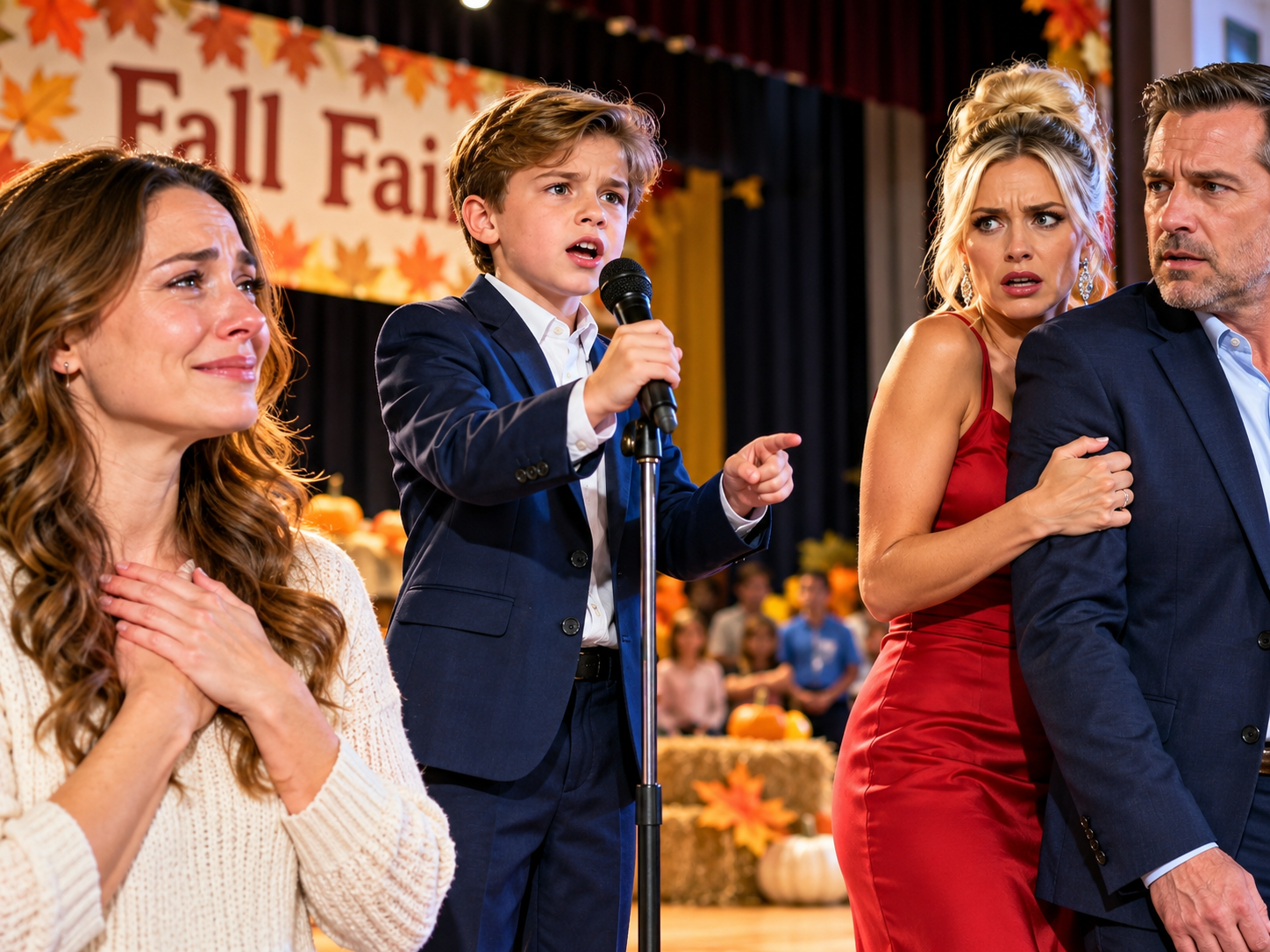
For several seconds, the crowd did not seem to understand that anything unusual was happening. The principal stood beside the microphone with one hand resting on the edge of the lectern. Mrs. Carter had stopped halfway up the steps. A few children whispered to one another, while their parents watched with the mild curiosity usually reserved for an unexpected school announcement.
Dustin held the flash drive in his palm. His fingers were small around it, but his grip was firm.
“There's something I want people to hear,” he said.
The principal approached him carefully. “Dustin, sweetheart, we have a program to follow. Is this something you discussed with your teacher?”
He looked at Mrs. Carter, then back at the principal. “I asked for help with it.”
Mrs. Carter's expression changed. She had not known exactly what he planned to do, but she had agreed to review a file he brought to her earlier that week. She stepped beside the computer table and spoke quietly with the teacher responsible for the presentation equipment. After a brief exchange, the teacher took the flash drive from Dustin and examined it.
“Do you want to go ahead?” she asked him.
Dustin nodded.
The principal looked uncertain. “We need to make sure this is appropriate for a school event.”
“I know,” Mrs. Carter replied. “I've checked what he submitted. We should review the file before displaying anything, but I believe we should listen to him.”
A low murmur passed through the adults near the stage. I could feel my heartbeat in my throat. Dustin had clearly been preparing something without telling me, and I could not tell whether I should be proud that he had found the courage to speak or frightened that he had decided to do it in front of the entire school.
I moved closer to the stage but did not climb the steps. I wanted him to know I was there without making the moment about my approval. He looked toward me briefly. His face was pale, and his mouth was set in a line I had rarely seen on him.
Then he turned toward the computer.
The teacher inserted the flash drive. A folder appeared on the screen, followed by several files. She opened the first one, read the title, and paused. She glanced at Mrs. Carter, who nodded once. After a moment, the large screen behind the stage flickered, displaying a simple heading against a plain background.
Dustin had chosen no dramatic music, no elaborate graphics, and no mocking photographs. The first slide contained a short sentence in large letters: “Please listen before you decide what is funny.”
The crowd grew quiet.
I glanced toward Nigel. He was staring at the screen, his shoulders rigid. Annabelle had grabbed his arm. Her fingers were wrapped tightly around his sleeve, and her face had lost its color. She leaned close to him and whispered urgently, but I could not hear the words.
Nigel looked at her in confusion. “What?”
She whispered again, more sharply this time.
“Make him stop.”
The words were barely audible, but the fear in her voice was unmistakable. Nigel pulled his arm away from her and looked back at the stage. For the first time since arriving at the fair, he seemed unable to decide what expression he should wear.
The teacher clicked to the next file.
A recording began.
At first, the sound was faint, filled with the muffled noise of a room and the movement of someone handling a phone. Then Annabelle's voice emerged clearly enough for the nearby audience to recognize it.
“Honestly, I don't understand how you stayed married to her for so long.”
A few people turned toward Annabelle. She stood motionless beside Nigel, staring at the screen.
The recording continued. Nigel's voice answered from somewhere beyond the microphone. He sounded relaxed, almost amused.
“Vivian can be difficult. You know that.”
Annabelle laughed. “Difficult? That's one word for it. She dresses like she stopped caring years ago.”
There was a pause, followed by another burst of laughter. It was not a recording of the fall fair. The voices sounded as though they had been captured in a private room, with the occasional clink of a glass and the soft scrape of a chair. The conversation was ordinary in its setting, which made the words more uncomfortable to hear in public.
Nigel stepped toward the stage. “Turn that off.”
The teacher looked at the principal, who raised a hand to stop him from approaching the equipment. She did not shout or threaten him. She simply asked him to remain where he was while they determined what the file contained.
“This is a school event,” Nigel said. “You can't play private recordings without knowing what they are.”
Mrs. Carter answered quietly, “We're reviewing the material now. Please give us a moment.”
Annabelle had begun shaking her head. “This is edited. Someone has taken things out of context.”
Dustin heard her. He turned from the screen and looked directly at her.
“I didn't change what you said,” he replied.
His voice trembled slightly, but he did not retreat. He faced the crowd again, and the teacher continued the recording only after the principal confirmed that the content was appropriate to review in the circumstances. The school staff had been careful about what they allowed to be shown. The recording contained no explicit material, no private images, and no information about other children. It was a conversation about Dustin's mother, and it was now being heard by the people who had gathered for the fair.
Annabelle's voice came through the speakers again.
“Seriously, how did you put up with her? I would have left years ago.”
Nigel gave a short laugh.
“I'm not going to pretend everything was perfect,” he said. “But we managed.”
“And now you're free,” Annabelle replied. “You can do better.”
The recording ended.
Nobody clapped. Nobody cheered. The silence was more powerful than either reaction could have been. Parents exchanged uncomfortable glances. Some looked at Nigel; others looked at me. A few turned toward Dustin with expressions of sympathy that made my chest tighten.
I wanted to go to the stage and take my son into my arms. I also knew that he had chosen to speak, and I did not want to interrupt him merely because I was struggling to watch. I stayed where I was, my hands clasped in front of me, and waited.
The principal spoke first. She thanked the teacher for checking the material and asked the audience to remain calm. She explained that the school would not allow the fair to become an argument between adults. If there were concerns about the recording, they could be addressed privately after the event. The immediate priority was to make sure Dustin was supported and that no one used the situation to intimidate him.
Nigel shook his head. “He shouldn't be doing this. He's a child.”
Dustin looked at him. “I know I'm a child.”
The answer was simple, but it silenced his father.
“I didn't want everyone to hear it,” Dustin continued. “I wanted you to stop saying things about Mom when you thought I wasn't listening.”
Nigel's expression shifted. “Dustin, this is between adults.”
“You said that before.”
The boy's voice was steadier now. He looked down at the microphone for a moment, then lifted his head.
“Every time I came home, Mom asked if I had a good weekend. I didn't want to tell her because I thought she would be sad. I didn't want you to be angry with me, either. So I just said everything was fine.”
I felt tears rise, but I held still. He had been carrying that fear for weeks, trying to protect both parents from the truth. I wished he had felt able to tell me everything sooner, but I understood why he had not. He had been trying to preserve the fragile peace of a child who loved two adults and believed that honesty might hurt one of them.
Annabelle stepped forward. “Dustin, you don't understand the conversation. We were joking privately.”
He looked at her. “You joked about my mom in front of me, too.”
She opened her mouth, then stopped.
Dustin continued. “At the fair, you said the pumpkin costume made sense because of her body. Dad laughed. I saw him laugh.”
The crowd shifted. Nigel's face reddened, and he looked at the ground before turning back toward the stage.
“That's not how it happened,” he said.
Dustin's eyebrows drew together. “I was standing right there.”
The statement was not dramatic. It was a child describing what he had witnessed. Yet it removed the comfortable distance Nigel had tried to create between an adult joke and its effect on his son. Dustin had not misunderstood a story told to him later. He had heard the comments himself, watched his father laugh, and carried the memory into the next room, the next weekend, and the next conversation with me.
The teacher paused the presentation. The principal asked Dustin whether he wanted to continue, and he nodded. There were other files on the drive, he explained, but he did not want to show every conversation. He had selected only the material he believed was necessary to explain why he had become upset. He had asked Mrs. Carter for help because he did not know how to handle it alone.
That detail changed the way I understood the flash drive. Dustin had not simply taken a recording and decided to embarrass his father's girlfriend. He had recognized that he needed an adult at school to help him handle something that had become too heavy for him to manage privately. The files were not a prank. They were his attempt to make the adults listen when his ordinary words had failed.
The principal asked the teacher to close the presentation and escorted Dustin to a quieter area beside the stage. I went to him as soon as she gave me permission. He climbed down the steps, still holding himself very straight, and stopped in front of me.
“Mom,” he whispered, “are you mad?”
I wrapped my arms around him. “No, sweetheart. I'm not mad at you.”
He pressed his face against my shoulder, and the tension he had been holding seemed to leave him all at once. I felt him begin to shake. I held him firmly, not asking him to explain anything else while people watched.
Behind us, Nigel was speaking in a low, urgent voice to the principal. Annabelle had moved several steps away from him. She kept glancing toward the crowd, as though she had suddenly become aware of how many people had heard the recording. Her earlier confidence was gone.
Dustin pulled back just enough to look at me. “I wanted them to know I wasn't making it up.”
I brushed his hair away from his forehead. “I believe you.”
He nodded, then looked over my shoulder toward his father.
“Does Dad believe me?”
I did not answer immediately. I could not promise what Nigel would feel or say next, and I would not comfort my son by inventing certainty. I told him that his father had heard the recording and the things he had said. What Nigel chose to do with that truth was his responsibility.
The principal asked me to join her in a nearby classroom while another staff member stayed with Dustin. She wanted to make sure he was safe, understand how the recordings had been obtained, and determine whether any further school support was needed. I agreed. Before I left, I kissed Dustin's forehead and told him that he had done the right thing by asking a trusted adult for help.
As I walked toward the building, I heard Annabelle's voice rise behind me.
“You promised me this wouldn't happen.”
Nigel replied, “Keep your voice down.”
“No. You told me he wouldn't say anything.”
I stopped briefly, then continued into the school. The words followed me through the doorway. Annabelle had not merely been surprised by the recording. She had expected Dustin to remain silent, and she had believed Nigel could guarantee it.
For the first time, I wondered how much more my son had heard than he had told me—and whether the adults who had dismissed his discomfort had been counting on his silence all along.
Click here to continue reading: PART 4: When the Recording Ended, My Son Finally Spoke Freely, and His Father Had to Face What His Laughter Had Cost
My Ten-Year-Old Son Had Been Keeping a Secret About His Father’s Girlfriend, and I Finally Understood His Silence
Part 3 of 20