Five years after the original confrontation, I woke before sunrise at the lake house.
The place was quieter than ever.
The trees had grown.
The dock had been repaired.
The porch had weathered several winters.
Inside, the walls carried photographs from years of ordinary family gatherings.
My parents.
Kyle.
Friends.
My grandmother.
Juniper, much younger, asleep on the same rug she had claimed from the beginning.
I walked into the kitchen and started coffee.
My parents were coming for lunch.
So was Kyle.
No twenty-person invasion.
No surprise guests.
Just family.
I smiled at the thought.
There had been a time when seeing their cars approaching would have made my stomach tighten.
Now I looked forward to it.
At eleven, Mom called.
“We're leaving.”
“Okay.”
“Do you need anything?”
“No.”
“Are you sure?”
“Yes.”
“Good.”
There was a pause.
“Claire?”
“Yes?”
“I love you.”
I smiled.
“I love you too.”
The call ended.
An hour later, their car came down the driveway.
Dad got out first.
He opened Mom's door.
They walked toward the house together.
Dad carried a basket.
Mom carried flowers.
I opened the door before they knocked.
“Hi.”
“Hi.”
Mom hugged me.
Dad hugged me too.
The simplicity of it still surprised me.
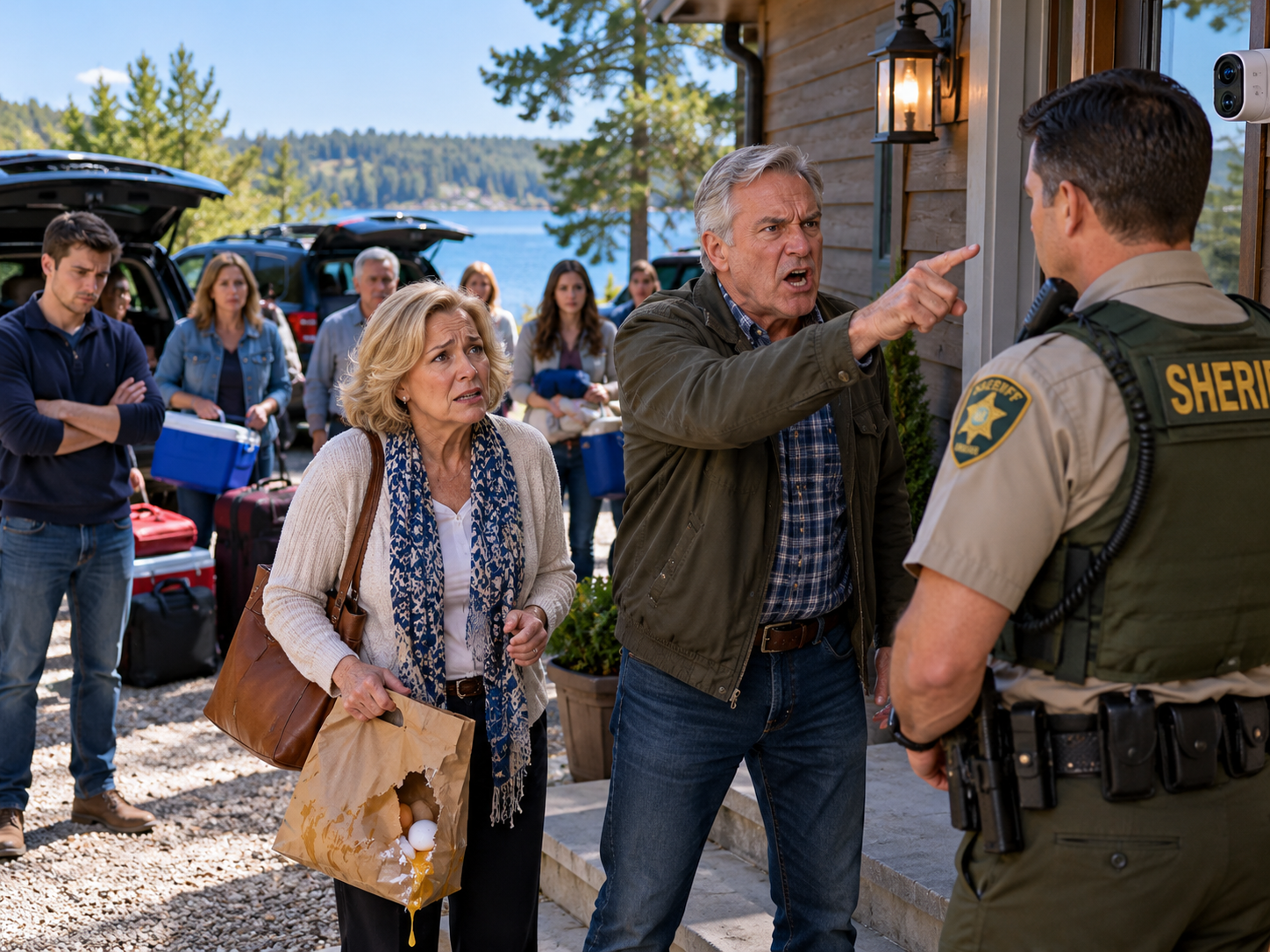
Five years earlier, twenty people had stood outside that same door while my father demanded entry.
Now he waited for me to invite him inside even though I was standing in the doorway.
“Come in.”
They did.
Kyle arrived later.
He had changed too.
He was married now.
His business had recovered.
The money he once owed me had been fully repaid years earlier.
He brought groceries without being asked.
“I wasn't sure what you had.”
“I have enough.”
“I know.”
He grinned.
“I'm practicing.”
We laughed.
Lunch was noisy.
Not chaotic.
There was a difference.
People asked before moving things.
Children were careful around the furniture.
Dad took his shoes off without being told.
Mom helped in the kitchen.
Kyle washed dishes.
I stood at the counter watching them.
For years, I had believed the opposite of being controlled was being alone.
I was wrong.
The opposite of being controlled was being able to choose who entered your life and under what conditions.
I had not needed to abandon my family.
I had needed to change the terms.
After lunch, everyone went outside.
Dad sat on the dock.
Mom walked along the shore.
Kyle took photographs.
I stayed on the porch.
The lake was almost perfectly still.
My father looked back at me.
“Claire.”
“Yes?”
“Come sit.”
I walked down to the dock.
I sat beside him.
He looked across the water.
“Do you ever think about that weekend?”
“Yes.”
“Me too.”
“What do you think about?”
He took a long breath.
“How certain I was that I was right.”
I smiled.
“That sounds like you.”
He laughed.
“I deserved that.”
“You did.”
He became serious.
“I thought if I admitted you were right, I'd lose authority.”
“You didn't lose it.”
“I lost something better.”
“What?”
“I lost the idea that authority was the point.”
I looked at him.
He continued.
“You were my daughter before you owned the house. You were my daughter after you locked the door. That never changed.”
I nodded.
“But I had to learn that being your father didn't mean being your owner.”
The lake moved gently against the dock.
“I wish you hadn't needed to learn it that hard,” I said.
“So do I.”
He looked at me.
“But I learned.”
“Yes.”
He smiled.
“That's something.”
“It is.”
We sat quietly.
Mom called from the shore.
“Lunch dessert!”
Dad stood.
“Come on.”
We walked back together.
That evening, after everyone left, I cleaned the kitchen.
The house settled into silence.
I turned off the lights one by one.
The refrigerator hummed.
The dishwasher ran.
Outside, the lake reflected the stars.
I stood at the front door for a moment.
Five years earlier, this was where I had watched my family gather without permission.
That day had changed everything.
Not because I had defeated them.
I hadn't.
There was no winner.
The family had simply reached a point where the old arrangement could no longer continue.
I had said no.
They had ignored it.
The sheriff had enforced what my family refused to understand.
Then came the harder work.
Apologies.
Distance.
Conversations.
Trust.
More boundaries.
Second chances.
Small mistakes.
Corrections.
Time.
The lake house had remained mine through all of it.
But eventually, I stopped thinking of ownership as the central victory.
The real victory was being able to sit at that same table with my parents without feeling that I owed them access.
My mother could ask.
My father could visit.
Kyle could call.
I could say yes.
I could say no.
And nobody needed to turn either answer into a referendum on whether I loved them.
That was freedom.
Not isolation.
Choice.
I walked onto the porch.
Juniper followed.
She was slower now.
I sat in the chair.
She rested beside me.
My phone buzzed.
A message from Mom.
Thank you for today.
I replied:
Thank you for asking.
She sent a heart.
I smiled.
Then another message appeared.
From Dad.
Home safe.
I wrote back:
Goodnight.
He replied:
Goodnight, Claire.
I put the phone down.
The lake was dark.
The trees moved slightly in the breeze.
I thought about the twenty people who had once stood outside the house with groceries melting in their hands.
I remembered Dad's anger.
Mom's laughter.
The sheriff's cruiser.
The locked door.
The first night I realized that my family did not believe my no was real.
Then I remembered something else.
My mother asking permission.
My father waiting at the door.
Kyle paying back what he owed.
Family dinners where everyone cleaned up afterward.
The ordinary things.
Those were the moments that proved the boundary had worked.
It had not destroyed the family.
It had forced the family to become more honest.
I had once thought saying no would cost me everyone.
Instead, it showed me who was willing to learn how to stay.
I looked toward the lake.
The house behind me was warm.
The lights from the kitchen reflected faintly in the glass.
Tomorrow I would go back to work.
There would be patients.
Long hours.
Coffee.
Traffic.
Bills.
Laundry.
Another ordinary week.
And the lake house would remain here.
Not a fortress.
Not a family resort.
Not a bargaining chip.
Home.
I stood and locked the front door.
This time, the click of the deadbolt did not sound like rejection.
It sounded like certainty.
I turned off the porch light.
Juniper followed me inside.
And as the house settled into silence, I realized the most important thing my parents had finally learned was also the simplest.
When I said yes, it meant yes.
When I said no, it meant no.
And because they finally respected the difference, I no longer had to choose between having boundaries and having a family.
I could have both.
Click here to continue reading: PART 9: The Quiet Years Made Me Wonder Whether My Family Had Truly Changed, Until One Unexpected Phone Call Tested Everything We Had Learned About Boundaries
Twenty People Arrived Expecting a Welcome, but My Locked Door and One Quiet Phone Call Forced My Parents to Face a Problem They Had Never Expected
Part 8 of 20