
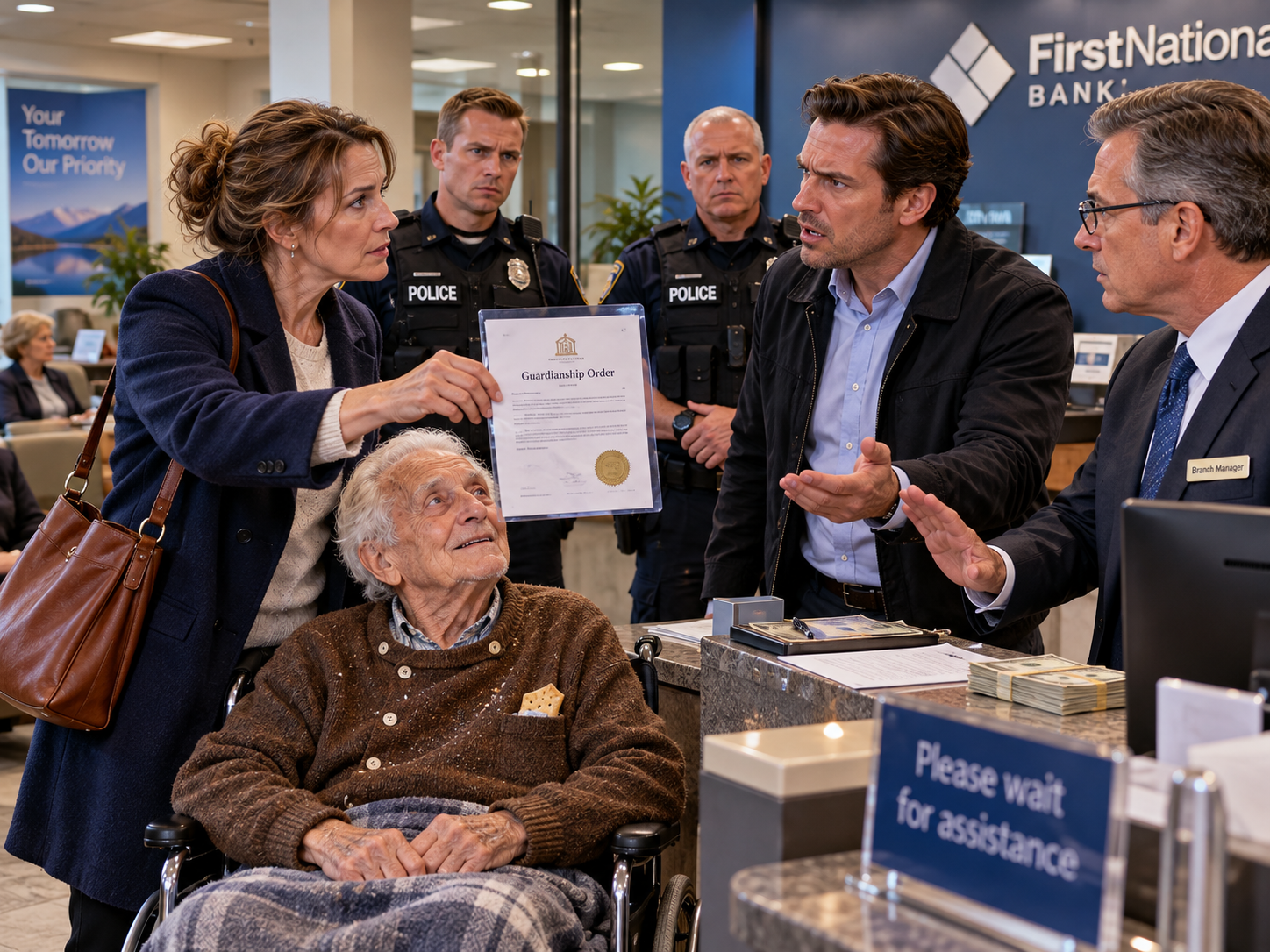
The first Sunday after the authorities concluded their investigation, I set an extra place at the kitchen table without thinking.
Dad sat near the window, wearing his brown sweater with the sleeves pulled over his wrists. His breakfast was cut into small pieces, and a cup of warm tea rested beside his plate. He was watching a patch of sunlight move across the floor when he noticed the empty chair opposite me.
“Someone coming?” he asked.
I looked at the chair.
For years, I had hoped Hugh would eventually show up on a Sunday morning, not because he needed money or wanted something signed, but because he wanted to see his father. I had imagined him bringing a bag of groceries, asking how Dad had slept, or offering to sit with him while I caught up on rest. Even after the bank incident, some foolish part of me had continued expecting a phone call that began with an apology.
“No, Dad,” I said, pulling the extra plate away. “It's just us today.”
He nodded and returned to his tea.
The ordinary ease with which he accepted my answer hurt more than I expected. Dad did not remember the bank visit clearly. He did not know that his pension had been repeatedly withdrawn or that the investigation had established serious problems with how the money was handled. He did not know that Hugh had stopped calling because I refused to let him turn the matter into a private bargain.
Dad only knew that the people around him came and went, and that sometimes he asked for someone who did not appear.
I carried the extra plate to the sink and began washing it. Water splashed against the stainless steel, and the smell of dish soap rose around me. I concentrated on the small task until the ache in my chest settled enough for me to return to breakfast.
By then, I had learned not to confuse the end of an investigation with the end of its consequences. The bank account was protected, the records were organized, and Dad's expenses were being paid. The legal process had established that Hugh could not simply take the pension and expect everyone to forget it. But the family I had known was changing in ways no document could repair.
Hugh did not contact me for almost a month.
I heard about him through relatives. He was angry, they said. He believed I had humiliated him in front of the bank staff and the police. He complained that the consequences had damaged his reputation and made it difficult for him to ask anyone for help. He did not mention the unpaid medical expenses or the days when Dad's account had been empty.
At first, I asked people whether Hugh had said anything else. I wanted to know whether he was thinking about what he had done. Eventually, I stopped asking. Every update arrived wrapped in someone else's opinion, and none of it changed the practical reality of caring for Dad.
I had enough to do without following my brother's feelings from one conversation to another.
The bakery was short-staffed that month, and I took extra shifts. I came home with flour caught in the creases of my sleeves and the smell of warm bread clinging to my hair. Lupita would tell me whether Dad had eaten well, whether he had been restless, and whether he had asked about the train. I would check his medications, make sure his clothes were ready for the next morning, and review the bills.
The work was repetitive, but the repetition gave our days a structure Dad could still recognize.
One afternoon, I found him standing beside the hallway table, looking at a framed photograph of my parents. He had apparently forgotten where he was going and had stopped there to study their faces.
“That's your mother,” I told him.
He nodded slowly. “Pretty girl.”
“She was.”
He turned toward me, his expression briefly clear. “I was lucky.”
I swallowed. “Yes, Dad. You were.”
I did not tell him that my mother had died before his dementia became severe, or that he sometimes seemed to remember her more vividly than the present. I did not need to correct every fragment of memory that brought him comfort. I only needed to remain close enough that he would not feel lost when the fragment passed.
A few days later, Aunt Margaret visited with a container of chicken soup and a bag of apples. She had become more involved since reading the bank records, although she never claimed to understand everything that had happened between Hugh and me.
“Have you heard from him?” she asked while we unpacked the food.
“No.”
“He says he wants to see your father.”
“Has he asked you to arrange it?”
“Not directly.”
I put the apples in a bowl. “If he wants to visit, he can ask. We'll work out a plan that keeps Dad comfortable.”
Margaret nodded. “He says you make everything difficult.”
“I make sure Dad's care is covered. If that seems difficult to Hugh, I can't change it.”
She looked down at the container in her hands. “I should have noticed sooner that something was wrong.”
I placed a lid on the soup. “We all wanted to believe he was helping.”
“Still, I should have asked more questions.”
I understood the regret in her voice. It was the same regret I had carried when I realized how long I had allowed myself to believe that the missing money must be a mistake. We had trusted the idea of family so completely that we had overlooked the possibility that someone inside it might take advantage of a person who could no longer protect himself.
“You asked now,” I said. “That matters.”
She stayed for lunch and helped Dad look through an old photo album. He was delighted by a picture of himself standing beside a locomotive, though he could not remember the year it had been taken. Margaret told him about the day he had brought Hugh and me to the rail yard for a family event. Dad laughed at one of the stories, then asked whether the train had arrived.
For an hour, the house felt almost ordinary.
When Margaret left, she hugged me at the door.
“You shouldn't have to do all of this alone,” she said.
“I know.”
It was a simple acknowledgment, but I felt its weight. For years, I had been the person who kept everything running. I had grown so accustomed to being responsible that I sometimes forgot I could ask others to share the burden. I could not make Hugh become the brother I needed, but I could accept help from people who were willing to offer it.
That evening, I called a local caregiver support service and asked about respite options. The person on the phone explained what assistance might be available and what paperwork I would need. I wrote down the information, then scheduled a consultation for the following week.
It was the first practical step I had taken for my own well-being in months.
Dad's needs were not going to become easier simply because I worked harder. His dementia would continue to progress, and I would eventually need more support than I could provide alone. Planning for that possibility was not abandoning him. It was part of making sure he remained safe.
The next morning, I told Lupita I was exploring additional respite care.
“Good,” she said immediately. “You need time to rest, too.”
I almost laughed. I had spent months trying to convince myself that I could keep going indefinitely, while the people who helped me could see how exhausted I had become.
“I don't know what I'd do without you,” I admitted.
“You don't have to figure out everything today,” she replied. “Just take the next step.”
I held on to that advice.
Later that week, Hugh finally called. His name appeared on my phone while I was waiting for a prescription at the pharmacy. I stepped outside before answering.
“What do you want?” I asked.
He sounded offended. “You could at least say hello.”
“Hello, Hugh. What do you need?”
There was a pause. Then he said he wanted to see Dad.
I looked through the window at the pharmacy counter, where a clerk was placing medication bottles into a paper bag. I thought of the day Lupita's card had been declined and how carefully she had explained the problem because she did not want me to panic while I was working.
“You can arrange a visit,” I said. “We'll agree on a time and make sure Dad is comfortable.”
“Why do I need your permission to see my own father?”
“Because I'm responsible for his care, and because the last time you took him out, you attempted to withdraw his pension in circumstances that required police intervention.”
“I've already paid for that.”
“The legal process addressed the matter. It doesn't mean we ignore what happened.”
He exhaled sharply. “I knew you'd never let it go.”
“I won't pretend it didn't happen. That is different from refusing to let you see him.”
Hugh said he would call back with a date. I told him to do that, and we ended the conversation.
I stood outside the pharmacy for another minute, breathing the cool air. I felt no satisfaction in having set the boundary. I felt tired, sad, and relieved that I had not been drawn into another argument about whether he had been wronged.
When I returned home, Dad was sitting by the window with Lupita. He looked up as I entered.
“Claudia,” he said, clearly enough that my heart lifted.
“I'm here, Dad.”
He reached for my hand. “Good. I was waiting.”
I sat beside him and let him hold my fingers. I did not know whether he remembered that I had gone to the pharmacy or whether the words belonged to another moment in his mind. It did not matter. For those few minutes, he knew he wanted me nearby, and I was there.
The silence from Hugh continued after that call. He did not send a date, and he did not ask about Dad's health. I decided not to chase him. The door to a carefully arranged visit remained open, but I would not keep calling my brother to persuade him to walk through it.
I had spent too many years hoping that enough patience would eventually produce responsibility.
Dad needed something more reliable than hope.
Click here to continue reading: PART 6: When Hugh Finally Asked to Visit Our Father, I Agreed to Let Him Come, but I Would Not Allow Him to Rewrite What Had Happened
My Brother Thought Our Father’s Memory Loss Had Made Him Easy to Rob, Until the Bank Manager Read the Papers I Had Brought
Part 5 of 20

