
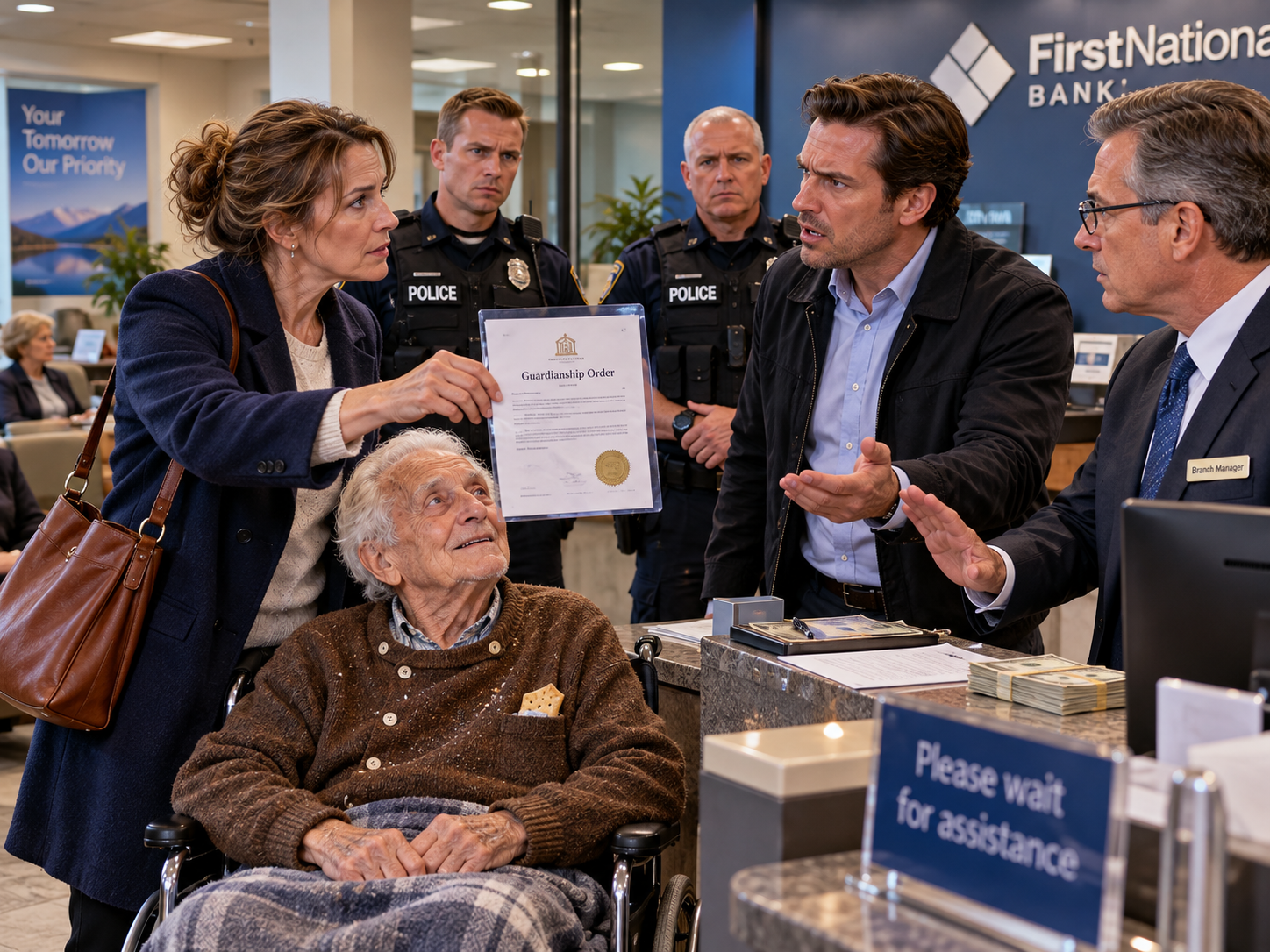
Hugh kept repeating that Dad had given him permission.
He said it first to the officer beside the counter, then to the branch manager, and finally to me, as if repeating the same sentence might turn it into proof. His voice grew louder each time. He insisted that our father had always trusted him with money and that I was using the guardianship order to take control of the family.
The officer listened without interrupting. When Hugh finished, he asked a simple question.
“What did you use the previous withdrawals for?”
Hugh rubbed his thumb across the edge of his watch.
“Household expenses.”
“Which expenses?”
“Food. Things Dad needs.”
“What food did you buy?”
Hugh stared at him. “I don't keep receipts for every little thing.”
The manager explained that the bank would retain the records relating to the attempted withdrawal and provide the appropriate documentation through the required process. The officers wanted to know whether Hugh had any documents showing that the money had been spent on Dad's care. He said he could find something later.
I knew that answer. Hugh had used it whenever I asked him to take responsibility for anything. Later meant after the argument had ended, after the person asking had grown tired, after everyone had moved on to something else.
“Did you buy Dad's diapers?” I asked.
He turned on me. “You don't get to interrogate me.”
“I'm asking because the money for his diapers wasn't there.”
“I gave you money before.”
“When?”
“Earlier this year.”
“How much?”
He opened his mouth, then stopped.
I did not need to raise my voice. The records were in the manager's office. Lupita had the declined purchase receipt. Dad's medical expenses were documented, and the pension deposits could be matched against the withdrawals. The facts were not going to change because Hugh found the situation humiliating.
One officer asked whether Hugh would accompany them to discuss the matter further. He objected, saying he had done nothing wrong and had come to the bank to help his father. The officer explained that they needed to establish what had occurred, and that refusing to answer a question did not make the records disappear.
Hugh looked at me again.
“You've been waiting for this, haven't you?”
I thought of the mornings I had left the bakery with aching feet, the afternoons I had spent at medical appointments, and the nights I had sat beside Dad's bed because he had woken confused and frightened. I thought of Lupita standing in the pharmacy aisle with a declined card, wondering how she would pay for supplies that should have been covered by the pension.
“I've been waiting for Dad to be safe,” I said. “This is what that looks like.”
He scoffed, but there was less certainty in it now.
The manager asked me to confirm the scope of the guardianship order. I handed him the copy and pointed to the relevant section. I was authorized to manage Dad's financial affairs within the court's terms. That did not mean I owned the pension, and it did not mean I could use his money for whatever I wanted. It meant I had a legal duty to act for his benefit and protect his interests.
Hugh understood the distinction well enough to be frightened by it.
“You can't just take over everything,” he said.
“I didn't take anything from you. I obtained legal authority to protect Dad.”
“He's my father, too.”
“Then you should want his money spent on him.”
He had no answer to that.
The officers eventually asked Hugh to step away from the wheelchair so they could speak with him separately. He resisted at first, claiming Dad would become distressed if they moved him. I looked at our father. He had become distracted by a reflection in the glass partition and was tracing its outline with one finger.
“He'll be all right if someone stays with him,” I said.
“I'll stay,” the teller offered.
I thanked her and crouched beside Dad.
“I'm going to talk to the officers for a little while,” I told him. “You'll be right here, and I'll come back.”
He nodded, then asked whether I had brought his lunch.
“Not yet. We'll get something after we're finished.”
He seemed content with that answer.
When I stood, Hugh was watching us. His expression was difficult to read, but for a moment I saw something close to shame. It disappeared when the officer spoke to him again.
They moved to a small meeting room near the branch manager's office. I was asked to wait outside while the officers established the details of the transaction and recorded Hugh's account. The manager stayed with me, explaining that the bank could not determine criminal guilt on its own, but it could preserve the records and prevent transactions that conflicted with the guardianship order.
“I appreciate you coming in before the withdrawal,” he said. “It gave us the chance to review the paperwork before any funds were released.”
“I was afraid he'd take the money before anyone realized what was happening.”
“That is why the account needs to be handled according to the order from this point forward.”
He spoke calmly, but I could tell he understood that the situation was not merely an administrative inconvenience. Dad was a vulnerable customer. The money supported his daily care. If it disappeared, I would have to find a way to replace it before the next payment was due.
I looked through the glass partition at Dad. The teller had brought him a cup of water. He held it with both hands, carefully, as if it were something precious.
I remembered him bringing home his wages when I was a child. He would place the envelope on the kitchen table and count the money with my mother while Hugh and I did our homework nearby. Dad never talked about how much he earned, but he made sure our school clothes were clean, our lunches were packed, and our shoes lasted as long as they could. When Hugh wanted to study beyond high school, Dad took extra shifts and bought him the books he needed.
He never asked Hugh to repay him.
That was not how Dad understood family. He believed that when you had enough to help someone, you helped. You did not keep a running tally of kindness.
I had learned that lesson from him. Hugh had apparently learned something else.
When the officers returned, one explained that they were documenting the attempted transaction and the information Hugh had provided. They had not made a final determination about the earlier withdrawals. They would need to review the records, establish where the funds had gone, and determine what further action was appropriate.
Hugh came out behind them, his face stiff.
“Are you satisfied now?” he asked me.
“No.”
His eyes flashed. “What more do you want?”
“An explanation for the money.”
“I told them.”
“You told them it was for Dad's expenses. You haven't shown what you bought.”
He moved closer, lowering his voice. “You have no idea how much pressure I've been under.”
I held his gaze. “Dad is the one who needs help. You have a job, a phone, a car, and a place to live. He has a pension that pays for his care. Why did you take it?”
Hugh looked away first.
The officers asked him not to contact the bank about the account until the documentation had been reviewed and the appropriate arrangements were in place. They also advised him not to interfere with Dad's care or attempt to access funds contrary to the guardianship order. Hugh objected that I was making it impossible for him to help his father, but neither officer accepted the argument that helping required unrestricted access to the money.
Before leaving, Hugh turned toward Dad's wheelchair.
“Come on, Dad. We're going home.”
I stepped between them, not aggressively, but firmly enough that he had to stop.
“Dad is going home with me.”
“He came with me.”
“And the withdrawal has been stopped. We need to follow the plan that keeps him safe.”
“You can't keep him from me.”
“I'm not keeping him from you. I'm making sure his care isn't used as an excuse to take his money.”
Dad looked between us, confused by the raised voices. His fingers began to move against the arms of the wheelchair.
I lowered my voice immediately. “It's all right, Dad. Nobody is angry with you.”
He looked at me and gave a faint smile.
“Good girl,” he murmured. “Your mother always said you were the sensible one.”
Hugh's face changed. The words had been spoken without accusation, but they seemed to hurt him more than anything I had said. He had spent years treating Dad's memory loss as a convenient weakness. Now our father's confusion had offered him a reminder of the person he had once been: a man who knew his children, who noticed their differences, who had trusted them both.
I took Dad home after the officers finished speaking with us. Lupita was waiting near the front door, worry visible in her eyes. When she saw Dad safe, she knelt beside his chair and asked whether he wanted a cup of tea.
“Did the train come?” he asked her.
“Not yet, Don Arthur,” she replied gently. “But your lunch is ready.”
She helped him settle into his usual chair while I checked the medication schedule. I gave her the update about the bank, including the fact that no cash had been released and that the records were being preserved.
“What happens now?” she asked.
“Now we find out where the money went.”
That afternoon, I gathered every statement and receipt I could find. I compared the withdrawal dates with the pension deposits, the bills I had paid, and the amounts needed for Dad's care. The pattern was more troubling when viewed as a whole. The account had been emptied repeatedly, while I had covered expenses out of my wages and borrowed from my own savings to keep everything running.
I had been telling myself that I was simply tired, that I needed to budget better, that perhaps Dad's care cost more than I realized. I had not understood that some of the pressure came from money that should have been there and was not.
I made a list of every expense that had gone unpaid or been delayed. The oxygen equipment had nearly become a problem. A pharmacy bill had been put on hold. Lupita had covered a small purchase herself because she did not want Dad to go without supplies while I was at work.
I called her into the kitchen and thanked her.
“You shouldn't have had to pay for anything yourself,” I said.
“I know,” she replied. “I just couldn't leave him without what he needed.”
I reimbursed her immediately and wrote down the amount. Then I checked Dad's remaining supplies and ordered what was necessary from the account I managed for his care, keeping the receipts.
That evening, Hugh called.
“You've made your point,” he said without greeting me. “Now stop this before you destroy the family.”
I sat beside Dad, who was watching an old train documentary with the sound turned low.
“I didn't take the money, Hugh.”
“You know what I mean.”
“Yes. I do. You want me to stop asking where it went.”
“I said I'd explain.”
“When?”
“Soon.”
“Give me a date.”
He went silent.
I looked at Dad. He had fallen asleep with one hand resting on the blanket. The documentary showed a locomotive moving slowly through a snowy landscape.
“I'll be talking to the bank and the appropriate authorities,” I said. “If you have receipts or records showing how the money was spent, provide them through the proper process.”
“You're treating me like a criminal.”
“I'm treating this seriously because Dad's care depends on it.”
I ended the call.
For the first time, I was not trying to persuade Hugh to become responsible. I was giving him a clear opportunity to account for his actions, while refusing to accept his anger as a substitute for evidence.
The next morning, a bank representative confirmed that the records relating to the attempted withdrawal had been preserved and that the account would be handled according to the guardianship order. I asked for the available statements covering the months in question and organized them into a file for the investigator.
Then I found something that made the pattern harder to dismiss.
The withdrawals were not random amounts. They were large enough to leave Dad's account nearly empty, but they were also timed so that the money disappeared before the recurring care expenses were paid. Whoever had made them knew when the pension arrived and understood how much could be taken before anyone noticed.
Hugh had not simply found a passbook and wandered into the bank.
He had planned around Dad's vulnerability.
I closed the file and looked at the clock. Dad's next medical appointment was in two days. The pension would not be enough to cover every cost if another withdrawal occurred, and I could not keep replacing missing funds indefinitely.
I had stopped Hugh once. Now I needed to make sure he could not repeat what he had done while the investigation continued.
Click here to continue reading: PART 3: When the Bank Traced the Missing Pension Money, My Brother’s Excuses Collapsed and the Family Learned What His Father’s Trust Had Cost
My Brother Thought Our Father’s Memory Loss Had Made Him Easy to Rob, Until the Bank Manager Read the Papers I Had Brought
Part 2 of 20

