
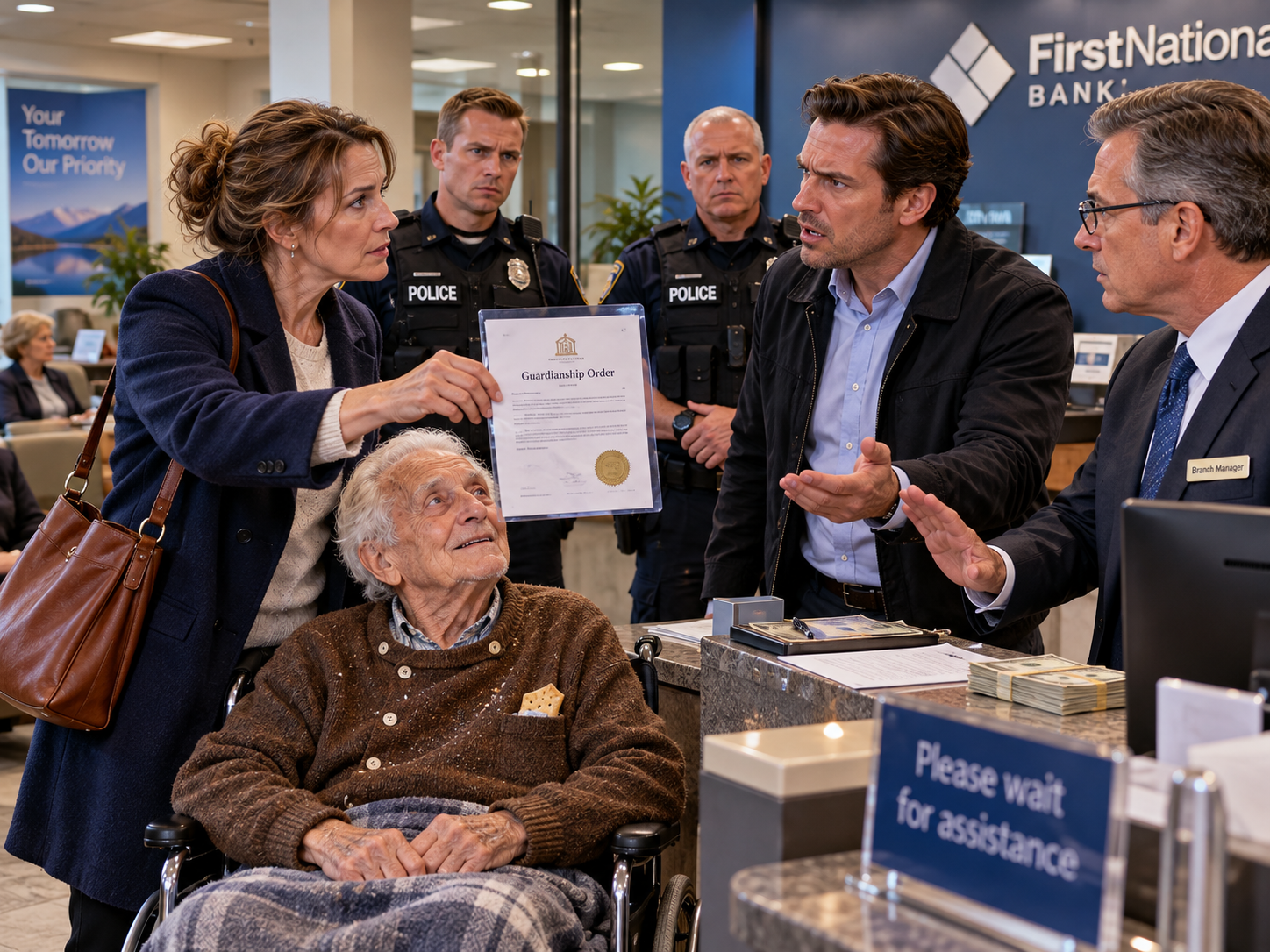
The bank's records arrived in a secure envelope several days later. I opened it at my kitchen table after Dad had gone to bed, placing each page in order beside the guardianship decree. The house was quiet except for the refrigerator motor and the occasional creak of the pipes. I had been expecting statements, transaction codes, and the same dates I had already recorded. What I found was a clearer picture of the pattern, along with enough information to show why the bank had needed to stop the latest withdrawal.
The account showed the pension deposits arriving on schedule. The large withdrawals followed soon afterward. Some entries had been processed at the counter, while others were linked to cash transactions requiring verification. The bank's records did not tell me what Hugh had done with every dollar, but they established the dates, amounts, and methods. They also showed that the funds had not been spent through the account on Dad's ordinary care.
I laid the pages side by side and wrote the figures into a spreadsheet. I compared them with the pharmacy receipts, the home health aide's invoices, and the payments I had made from my own account. By midnight, I had a total of the missing funds and a separate list of expenses I had covered because the pension balance had been depleted.
I sat back and rubbed my eyes.
The total was not just money. It represented weeks of supplies, medical appointments, and paid assistance that Dad had needed. It represented hours I had worked at the bakery when I was already exhausted. It represented the moments when I had worried that I was failing him because I could not make the numbers work.
I had been blaming myself for not managing the household budget well enough.
Hugh had allowed me to believe the problem was my failure.
The next morning, I spoke with the investigator handling the matter. I explained the sequence of events and supplied the bank statements, medical documentation, and records of the expenses I had paid. I did not speculate about Hugh's motives or claim to know where every dollar had gone. I described what I could prove and identified the questions that remained unanswered.
The investigator asked whether Hugh had acknowledged making the withdrawals.
“Yes,” I said. “He says Dad gave him permission and that he used the money for household expenses. He hasn't provided a detailed accounting.”
“Has your father been assessed for his ability to understand financial transactions?”
I provided the medical evaluation and explained the guardianship order. Dad could still express preferences and enjoy familiar activities, but his ability to understand complicated financial decisions had deteriorated. The doctor had documented the impairment. The court had considered the evidence when granting me authority to manage his affairs.
The investigator explained that those facts would need to be assessed alongside the bank records and Hugh's statements. I understood that an investigation was not the same as a conviction. I also understood that protecting Dad's account was necessary even while the investigation continued.
That afternoon, I received a message from Hugh.
We need to talk without lawyers and police getting involved.
I read it twice before answering.
You can provide your explanation and any supporting records through the investigator. I won't negotiate Dad's financial safety privately.
His response came almost immediately.
You have always thought you were better than me.
I put the phone down.
For most of our lives, Hugh had treated responsibility as a competition. If I did something well, he claimed I wanted praise. If I asked him to contribute, he accused me of acting superior. He could not see that I was not trying to win against him. I was trying to make sure our father had clean clothes, enough food, and the medical support he needed.
I returned to the kitchen and checked Dad's medication organizer. The small compartments were labeled by day and time. I had learned to double-check every dose because Dad sometimes forgot whether he had taken his medicine and occasionally tried to take it again. The routine was simple but important. If I made a mistake, he could suffer. If Hugh made a mistake with the pension, I had to find the money to correct it.
That imbalance had become the shape of our family.
On Saturday, Dad woke early and asked whether he could go outside. I helped him into a light jacket and took him to the small bench in the garden. The morning was cool, and the grass still held dew. He watched a bird hop along the fence, then pointed toward the road.
“Freight train,” he said.
I listened. A distant horn sounded beyond the neighborhood.
“Yes,” I told him. “A train.”
He smiled, pleased that the world had offered him something familiar. I sat beside him and let the silence settle. He did not need me to explain the bank, the missing money, or the fact that his son was under investigation. He needed a quiet morning, a warm drink, and someone who would not hurry him when his thoughts moved slowly.
Later that day, my aunt Margaret called. Hugh had spoken to her, telling her that I had taken control of Dad's finances and was trying to get him arrested. He had described the bank visit as a family disagreement that I had escalated into a public humiliation.
“Claudia, I don't want to take sides,” she said. “But Hugh says you won't let him help his own father.”
I closed the cupboard where I kept Dad's supplies. “Has Hugh told you why the pension account was empty?”
“He said there were expenses.”
“Which expenses?”
She paused. “He didn't say.”
“Has he shown you receipts?”
“No.”
“Then you don't have enough information to take a side.”
My aunt sighed. “I only want the family to be all right.”
“So do I. Dad needs his money for his care. If Hugh spent it on Dad, he can provide the records. If he didn't, he needs to account for it.”
She was silent for a moment. Then she asked whether Dad was safe.
“Yes,” I said. “He is safe. I'm making sure he stays that way.”
That seemed to settle her more than anything else. She told me she would visit the following week and bring some photographs from the family albums. I welcomed the offer. Dad enjoyed looking at old pictures, and I wanted him to have moments that connected him with his life before illness had taken so much from him.
When she arrived, she brought a photograph of Dad standing beside a locomotive, his work clothes stained and his smile broad. Hugh was a small boy in the picture, perched on Dad's shoulder. I was standing beside them, holding my father's hand.
Dad studied the photograph for a long time.
“That's me,” he said, tapping his chest.
“Yes,” I told him. “You were working on the railroad.”
He pointed at Hugh. “My boy.”
“Yes. Hugh.”
Then he looked at me and smiled. “And you.”
I took his hand. “I'm right here.”
My aunt watched us, her eyes bright. Later, when Dad was resting, she asked to see the bank documents. I showed her the transaction dates and the expenses that had gone unpaid. She read the pages carefully, without interrupting.
“I didn't know it was this much,” she said.
“Neither did I at first.”
“Why didn't he just ask you for help if he was in trouble?”
I shook my head. “I don't know. He knows I would have listened. But asking for help would have meant admitting he had a problem. Taking Dad's money let him avoid that conversation.”
My aunt returned the papers to me. She did not defend Hugh again.
The following week, the investigator contacted me with an update. The bank's records had helped establish the pattern of withdrawals, and Hugh would be asked to provide a fuller account of how the funds had been used. The investigator was also reviewing whether the circumstances supported further action. I was advised to keep records of all future care expenses and not to allow anyone to access Dad's account outside the terms of the guardianship order.
I followed that advice carefully. I arranged for the pension to be managed in accordance with the court order and made sure the bank had the necessary documentation. I set up a process for tracking every payment for Dad's care, including receipts for medicine, supplies, and the home health aide. It was more paperwork than I wanted, but it meant that no one could casually claim the money had gone somewhere without leaving a record.
Hugh's calls became more frequent.
At first, he accused me of trying to ruin his life. Then he insisted he could repay everything if I would simply stop cooperating with the investigation. Finally, he began asking what amount would make me feel that justice had been done.
I refused to negotiate a private settlement that would bypass the legal process.
“This isn't about what would make me feel better,” I told him during one call. “It's about Dad's money and what happened to it.”
“You'd rather see me suffer than help me.”
“I offered you help when you asked for it. You chose to take Dad's pension instead.”
“You don't know what I was going through.”
“Then tell the investigator the truth.”
He hung up.
I did not know whether he had spent the money on debts, personal purchases, or something else. I had suspicions, but I refused to treat suspicion as fact. The records would need to establish where the funds had gone. What I knew was already enough to require answers: the pension had been withdrawn repeatedly, Dad's care expenses had gone unpaid, and Hugh had failed to provide evidence that the money had been used for our father.
One evening, Lupita found me at the kitchen table surrounded by receipts.
“You need to sleep,” she said.
“I will after I finish this.”
“You said that last night.”
I smiled faintly. “I'm nearly done.”
She sat across from me and began sorting the receipts into piles. We worked quietly until the table was clear. Before leaving, she touched my shoulder.
“Your father knows you are there, even when he doesn't remember your name.”
I looked toward the living room. Dad was asleep beneath his blanket, his face relaxed.
“I hope so,” I said.
The next morning, Hugh sent a message saying he had documents he wanted me to see. He insisted they would prove he had not stolen anything. I replied that he should give them to the investigator so they could be reviewed properly.
He answered with a single sentence.
If you won't help me, don't expect me to help you when Dad gets worse.
I read it once, then set the phone aside.
Dad's illness was not a bargaining chip. His needs were not a debt Hugh could use to force my silence. I had been frightened for years that I would eventually be unable to provide everything Dad required. Hugh knew that fear and had tried to turn it against me.
I called the investigator and documented the message.
Then I went into Dad's room, straightened his blanket, and sat beside him until he woke. He blinked at me, confused for a moment, then reached for my hand.
“Are we going home?” he asked.
I squeezed his fingers gently.
“We're already home, Dad.”
Click here to continue reading: PART 4: The Truth About the Pension Finally Reached the People Who Could Act, but Protecting My Father Meant Accepting That My Brother Might Never Change
My Brother Thought Our Father’s Memory Loss Had Made Him Easy to Rob, Until the Bank Manager Read the Papers I Had Brought
Part 3 of 20

