
Arthur asked the question on a quiet Sunday morning while the kettle was warming and a pale strip of sunlight lay across the kitchen table. Hugh had come for breakfast before his scheduled visit, and the three of us were eating toast with soft eggs. Dad was unusually alert. He recognized Hugh immediately and teased him about taking too much sugar in his tea.
Hugh grinned. “You used to say the same thing when I was a boy.”
“Because you always did,” Arthur replied.
For several minutes, we were simply a family having breakfast. Hugh asked about the bakery, I complained about a supplier who had delivered the wrong flour, and Dad listened with a smile. Then he looked from Hugh to me and asked, “Are you two still fighting about my money?”
The spoon in my hand stopped halfway to the bowl. Hugh’s smile disappeared. Arthur watched us, waiting, and I could feel the room change around the question. We had not discussed the pension in front of him because the details would confuse him and might frighten him. But his mind had brought the subject into the room anyway, carrying a fragment of an argument he no longer fully understood.
Hugh glanced at me. I knew he was waiting for me to decide how much to say. There was no version of the truth that would restore the years of certainty Arthur had lost, but there were ways to speak that would either preserve his dignity or make him feel responsible for something he had not been able to understand.
“Your pension is being taken care of,” I said. “The bills are paid, and your money is protected.”
Arthur looked at Hugh. “Did I do something wrong?”
“No, Dad,” Hugh answered immediately. His voice shook slightly. “You didn’t do anything wrong.”
“Then why are you fighting?”
Hugh lowered his eyes to the table. For a moment, I thought he might explain everything, or defend himself, or ask me to rescue him from the question. Instead, he said, “I made some bad decisions about the money. Claudia stepped in to make sure you were safe. We’re working on taking care of you properly now.”
Arthur frowned, trying to arrange the words into a story he could hold. “Did I give you enough?”
The question struck harder than the others. Hugh’s face tightened, and he reached across the table but stopped before touching Arthur’s hand, as if he were unsure whether he had earned that closeness.
“You gave me more than enough,” Hugh said. “You worked hard for us. What happened wasn’t your fault.”
Arthur studied him for another moment, then nodded. He turned back to his breakfast and asked whether the train station still served coffee. The conversation moved on, but the silence it left behind stayed with us.
After Arthur finished eating, I helped him settle in the living room. Hugh followed me into the kitchen. He looked pale, and his hands were restless as he gathered the cups.
“I should have told him I was sorry,” he said.
“You can tell him you love him. You can show him that you’re helping. But don’t make him carry your guilt.”
“I wasn’t trying to.”
“I know. But he asked whether he had done something wrong. That’s what he’ll remember, if he remembers anything at all.”
Hugh set the cups down. “I hate that he thinks he might have caused this.”
“So do I.”
For a while, neither of us spoke. I had spent months imagining the confrontation I wanted to have with Hugh, the words I would use if he ever admitted the harm he had caused. Now that he was admitting it in pieces, I found no satisfaction in his distress. It did not give me back the money that had been missing when Dad needed supplies. It did not give me back the nights I had spent wondering how to pay the next bill. It only made clear how much damage had reached beyond a bank account.
Hugh asked whether I thought Arthur understood what had happened. I told him that I could not know exactly what Dad understood from one day to the next. He might remember a conversation for an hour, or remember only the emotion attached to it, or forget it entirely. We had to speak truthfully without burdening him with details he could not use. We also had to avoid pretending that the harm had never occurred.
“I can do that,” Hugh said.
“You can try,” I replied. “And if he asks again, we answer calmly. We don’t lie to make ourselves comfortable.”
He nodded, and this time he did not argue over the difference between those two things.
Later that afternoon, Hugh took Arthur into the garden while I prepared dinner. Dad was interested in a patch of soil beside the fence where he had once tried to grow tomatoes. He asked Hugh whether the plants would be ready for harvest soon. Hugh explained that it was the wrong season, then stopped when Arthur’s expression became disappointed.
“We can put a few in when the weather is right,” Hugh said. “You can help me choose them.”
Arthur brightened. “You’d better come on time. Plants don’t wait.”
“I’ll be here,” Hugh said.
I heard the promise from the kitchen. I did not remind him that plants were not the only things that could not wait. I had begun to understand that some lessons had to be lived rather than delivered as accusations.
In the weeks that followed, Arthur asked about the money twice more. Each time, we gave him the same simple answer: his care was being provided, his pension was protected, and he had done nothing wrong. Hugh did not attempt to shift blame onto me or turn the conversation toward the investigation. He accepted the discomfort and returned to the practical work of helping.
His monthly contribution arrived as agreed. The transfer went directly toward the documented care expense, and I recorded it in the ledger. When the care aide’s schedule changed, Hugh adjusted one of his visits rather than expecting me to solve the problem alone. He also began keeping a small list of activities Arthur enjoyed on clearer days: looking at railway photographs, watering plants, sorting old postcards, and listening to familiar songs.
Not every visit went smoothly. One evening, Arthur became convinced Hugh had come to take him away from home. He gripped the arm of his chair and refused to stand. Hugh tried to reassure him, but his voice became too insistent, and Dad’s fear increased. I stepped in and asked Hugh to give Arthur some space while I spoke gently about dinner.
When Arthur finally relaxed, Hugh went outside to the porch. I found him sitting on the step, his head bowed. He looked angry with himself.
“I thought if I explained it clearly, he would understand,” he said.
“Sometimes he can’t. It isn’t about how clearly you explain.”
“I know that now.”
“You will have to learn it again tomorrow.”
He gave a small, tired laugh. “You make it sound easy.”
“It isn’t easy. It’s just necessary.”
We reviewed the care notes together, and I showed him how the team recommended responding when Arthur became frightened: lower our voices, give him time, avoid crowding him, and redirect him toward something familiar. Hugh wrote it down. The next time Arthur became confused, he followed the guidance more patiently.
I noticed that my own reactions were changing too. I still felt anger when I remembered how Hugh had treated the pension as something he could take because our father could not challenge him. But I no longer watched every visit as if I were waiting for a performance to expose itself. I watched for whether Hugh followed the plan, respected the boundaries, and returned when he said he would. Those were smaller questions than forgiveness, and they were questions I could actually answer.
Aunt Margaret visited one Sunday with a tin of homemade biscuits. She sat with Arthur and listened while he described the railway yard, then joined Hugh and me at the table. She asked how the care arrangement was holding up. I told her that it was demanding but more stable than it had been. Hugh explained the schedule and the added support, without making himself the center of the story.
When Margaret left, she touched my shoulder and said, “I’m sorry I believed the easiest version of what I was told.”
I thanked her. I did not tell her that the apology had arrived late, although it had. I was beginning to recognize that people could take responsibility for their part without having the power to undo its consequences. I could accept a sincere apology without pretending the past had become harmless.
That evening, Hugh helped Arthur prepare for bed. Dad asked him to stay until the hallway light was on. Hugh waited, adjusted the blanket, and promised to return on his scheduled evening. Arthur looked up at him with a moment of recognition that was so clear it seemed to illuminate the whole room.
“You’re a good boy when you remember to be,” Arthur said.
Hugh laughed softly, but his eyes filled. “I’m trying, Dad.”
Arthur closed his eyes. Hugh stood beside the bed for another minute, then came downstairs. He did not ask me whether I had heard the comment or whether it meant Dad had forgiven him. He simply collected his coat and checked the next visit on the calendar.
After he left, I sat beside the ledger and the care folder. The paperwork remained what it had always been: a record of what had happened, what was owed, and what was being done now. No tender moment could replace it. No difficult conversation could make it unnecessary. I put the folder back in its place and went upstairs to check on Arthur.
He was sleeping peacefully, his hands resting outside the blanket. I watched him for a moment, thinking about the question he had asked at breakfast. The hardest part was not deciding what to tell him. It was accepting that I could not protect him from every loss, every confusion, or every truth that reached him in fragments. I could only make the answers gentle, keep his care steady, and refuse to let his vulnerability become an excuse for anyone to use him again.
Click here to continue reading: PART 12: The Day We Revisited Arthur’s Future, I Finally Understood That Protecting His Dignity Meant Preparing for Changes We Could Not Stop
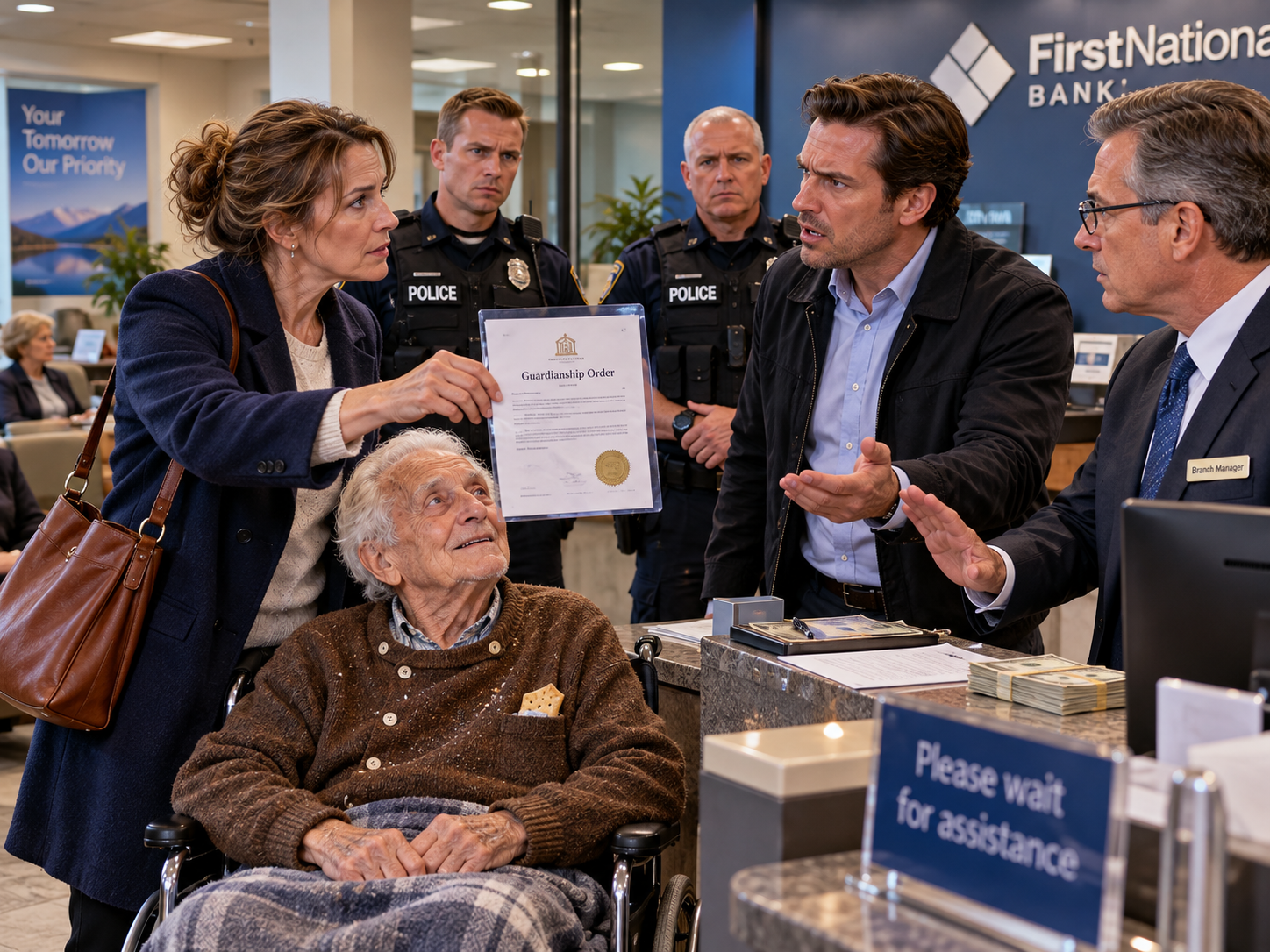
My Brother Thought Our Father’s Memory Loss Had Made Him Easy to Rob, Until the Bank Manager Read the Papers I Had Brought
Part 11 of 20

